
Urban living brings convenience, culture, and connectivity—but it also comes with an invisible cost: air pollution. Even in cities classified as having \"moderate\" pollution levels, airborne contaminants like vehicle exhaust, industrial emissions, and allergens can infiltrate homes and affect health over time. With rising awareness about indoor air quality, many city dwellers are asking: Are air purifiers really worth the investment when outdoor pollution isn’t at crisis levels?
The answer isn't a simple yes or no. It depends on your environment, health needs, building design, and lifestyle. While air purifiers won’t eliminate outdoor pollution, they can significantly reduce indoor concentrations of harmful particles—often where people spend 90% of their time. This article explores the science, practical considerations, and real-world value of using an air purifier in a moderately polluted urban setting.
Understanding Moderate Pollution and Indoor Air Risks
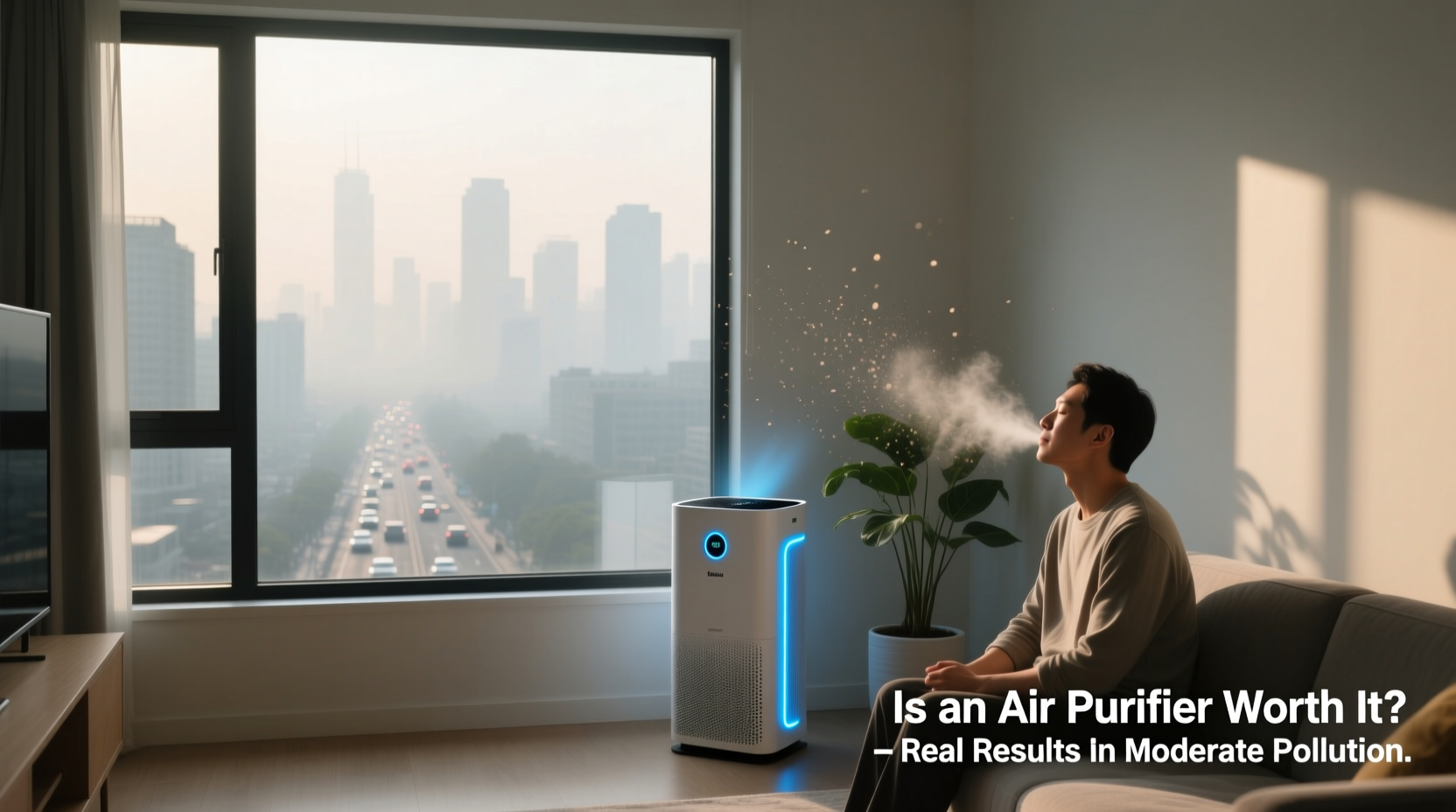
According to the World Health Organization (WHO), moderate pollution typically refers to an Air Quality Index (AQI) between 51 and 100. At this level, sensitive groups—such as children, older adults, and those with respiratory conditions—are advised to limit prolonged outdoor exertion. Common pollutants include:
- PM2.5: Fine particulate matter smaller than 2.5 micrometers, primarily from traffic and combustion.
- Nitrogen dioxide (NO₂): Emitted by vehicles and gas stoves.
- Volatile Organic Compounds (VOCs): Released from cleaning products, paints, and furniture.
- Allergens: Dust mites, pet dander, mold spores, and pollen that enter through windows and ventilation.
What many don’t realize is that indoor air can be two to five times more polluted than outdoor air—even in cities with moderate AQI. Sources like cooking fumes, candles, carpets, and poor ventilation contribute to this buildup. For example, frying food without proper exhaust can spike PM2.5 levels indoors far above outdoor readings.
“Indoor air quality is a silent determinant of long-term respiratory health. In urban environments, even moderate outdoor pollution translates into measurable indoor exposure over time.” — Dr. Lena Patel, Environmental Health Researcher, Harvard T.H. Chan School of Public Health
How Air Purifiers Work and What They Filter
Air purifiers use fans and filtration systems to draw in air and capture pollutants. Not all models are equal, and effectiveness varies widely based on technology and room size. The most effective units for urban environments combine multiple filtration stages:
- HEPA filters: Remove 99.97% of particles as small as 0.3 microns, including dust, pollen, mold, and PM2.5.
- Activated carbon filters: Absorb gases, odors, and VOCs—critical for neutralizing traffic fumes and household chemicals.
- Optional features: UV-C light (targets microbes), ionizers (can produce ozone—avoid these), and smart sensors.
It’s important to note that air purifiers only clean the air that passes through them. Their impact depends on airflow rate (measured in CADR—Clean Air Delivery Rate), room size, and placement. A unit too small for the space will struggle to make a difference.
Key Performance Metrics to Consider
| Metric | What It Means | Ideal Range for Urban Homes |
|---|---|---|
| CADR (Smoke) | Measures removal of fine particles like PM2.5 | At least 2/3 of room volume (in cubic feet) |
| Filter Type | Determines what pollutants are captured | True HEPA + activated carbon combo |
| Noise Level | Loudness at different fan speeds | Below 50 dB on high; under 30 dB on sleep mode |
| Energy Use | Power consumption per hour | Under 50 watts for continuous use |
| Room Coverage | Square footage the unit can effectively clean | Match or exceed your room size |
When an Air Purifier Makes a Real Difference
In a city with moderate pollution, an air purifier may not feel urgent—but its long-term benefits become clear under specific conditions. Here are scenarios where investing in one delivers tangible returns:
- You have allergies or asthma: Even low levels of indoor allergens can trigger symptoms. A HEPA purifier reduces airborne triggers and improves comfort.
- Your apartment is near a busy road or intersection: Studies show pollutant levels drop sharply with distance from traffic. If you’re within 150 meters of heavy traffic, indoor PM2.5 can remain elevated.
- You cook frequently with gas: Gas stoves emit NO₂ and ultrafine particles. Without strong ventilation, these accumulate indoors—carbon filters help absorb gases.
- Your building has poor ventilation or old HVAC systems: Stale air recirculates pollutants. An air purifier adds active filtration where mechanical systems fall short.
- You work from home or spend most of your time indoors: Prolonged exposure magnifies the impact of indoor pollutants, even at moderate levels.
Mini Case Study: Maria’s Apartment Near Midtown Traffic
Maria lives in a third-floor apartment overlooking a busy downtown avenue in Portland, Oregon—a city with generally moderate AQI. Her street sees constant bus and delivery traffic. Though she keeps windows closed during rush hour, she noticed frequent headaches and her son’s seasonal allergies worsened in winter.
After measuring indoor PM2.5 at 35 µg/m³ (above WHO’s recommended 24-hour average of 15 µg/m³), she purchased a mid-range air purifier with HEPA and carbon filters for her bedroom and living room. Within two weeks, symptom frequency dropped. Follow-up monitoring showed indoor PM2.5 stabilized around 12 µg/m³. “I didn’t think it would make such a difference,” Maria said. “But now I notice the air feels cleaner—especially after cooking or when the city smog gets thicker.”
Step-by-Step Guide to Choosing and Using an Air Purifier
Not all air purifiers deliver results. To maximize value in a moderately polluted city, follow this sequence:
- Assess your indoor air: Use a low-cost PM2.5/VOC sensor (like Temtop or AirVisual) to measure baseline levels in key rooms—bedroom, kitchen, living area.
- Identify primary pollutants: Is your main concern traffic soot, cooking smoke, pet dander, or chemical fumes? Match filter types accordingly.
- Select the right size: Choose a model rated for a room larger than yours. For example, if your bedroom is 300 sq ft, pick a purifier rated for 400 sq ft.
- Place strategically: Position the unit where you spend the most time (e.g., beside the bed or near the sofa). Avoid corners or behind furniture to ensure airflow.
- Run it consistently: Set to auto-mode if available. Run 24/7 on low unless noise is disruptive—continuous operation maintains lower particle counts.
- Maintain filters: Replace HEPA and carbon filters as recommended (typically every 6–12 months). Clogged filters lose efficiency and strain motors.
- Combine with other strategies: Open windows during low-traffic hours, use exhaust fans while cooking, vacuum with a HEPA-filter vacuum, and avoid aerosol sprays.
Common Misconceptions About Air Purifiers
Despite growing popularity, several myths persist that lead to disappointment or misuse:
- Myth: One purifier cleans the whole apartment
Reality: Air doesn’t move freely between rooms. Units are most effective in the room they’re placed in. - Myth: All “HEPA-type” filters are the same
Reality: Only “True HEPA” or “HEPA H13/H14” meets medical-grade standards. Avoid vague terms like “HEPA-like.” - Myth: Ionizers are better because they’re quieter
Reality: Some ionizers generate ozone, a lung irritant. The EPA warns against ozone-generating devices, especially for asthmatics. - Myth: Air purifiers replace ventilation
Reality: They filter but don’t bring in fresh air. In tightly sealed apartments, consider an energy recovery ventilator (ERV) alongside purification.
Frequently Asked Questions
Do air purifiers help with traffic-related pollution inside homes?
Yes. While they can’t stop pollutants from entering, HEPA filters effectively capture PM2.5 from vehicle exhaust, and activated carbon reduces nitrogen dioxide and odors. Keeping windows closed during peak traffic and using a purifier reduces indoor infiltration by up to 60%, according to a 2022 study in Environmental Science & Technology.
Can I rely on my HVAC system instead of buying an air purifier?
Most residential HVAC systems use basic filters (MERV 8–10) that don’t capture fine particles. Upgrading to MERV 13 helps, but central systems run intermittently. A standalone air purifier provides dedicated, continuous filtration—especially valuable in homes without ducted systems.
Are smart air purifiers worth the extra cost?
If you value automation and data, yes. Smart models adjust fan speed based on real-time air quality, send filter replacement alerts, and integrate with apps. However, non-smart units with manual controls perform just as well for less money.
Checklist: Is an Air Purifier Right for You?
Answer the following to determine if an air purifier is a worthwhile investment:
- ✅ Do you live within 200 meters of a major road or industrial zone?
- ✅ Have you or a family member experienced unexplained allergy symptoms or respiratory irritation?
- ✅ Is your home poorly ventilated or prone to stuffiness?
- ✅ Do you cook frequently with gas or use scented candles/aerosols?
- ✅ Can you commit to replacing filters every 6–12 months?
- ✅ Do you spend more than 12 hours per day indoors?
If you answered “yes” to three or more, an air purifier is likely a smart addition to your urban living setup.
Conclusion: Making Informed Decisions for Healthier Indoor Air
Living in a city with moderate pollution doesn’t mean ignoring air quality—it means being proactive. While outdoor conditions may not demand emergency measures, daily exposure to cumulative indoor pollutants can quietly affect well-being. Air purifiers aren’t magic boxes, but when chosen wisely and used correctly, they serve as effective tools to reduce airborne risks.
Their value lies not in transforming hazardous air into pristine mountain breezes, but in consistently lowering exposure over time—much like wearing sunscreen on cloudy days. For city residents with sensitivities, proximity to traffic, or concerns about long-term health, the return on investment goes beyond immediate comfort. It’s about creating a sanctuary where the air supports rest, recovery, and resilience.




 浙公网安备
33010002000092号
浙公网安备
33010002000092号 浙B2-20120091-4
Comments
No comments yet. Why don't you start the discussion?