
As holiday seasons approach, many homeowners turn to artificial wreaths to decorate their doors and interiors. These wreaths often feature synthetic foliage mounted on foam bases—lightweight, easy to shape, and affordable. To enhance their visual appeal, people frequently wrap them in string lights. But when those lights are battery-powered, a critical question arises: are they truly safe to use near materials like foam that can be flammable? The answer isn’t simply yes or no—it depends on several factors including light type, battery quality, duration of use, and placement.
While battery-powered string lights generate less heat than plug-in incandescent versions, the foam base remains a potential hazard if misused. This article dives into the science behind the risk, evaluates real-world scenarios, and provides actionable guidance so you can decorate confidently without compromising safety.
Understanding the Materials: Foam Bases and String Lights
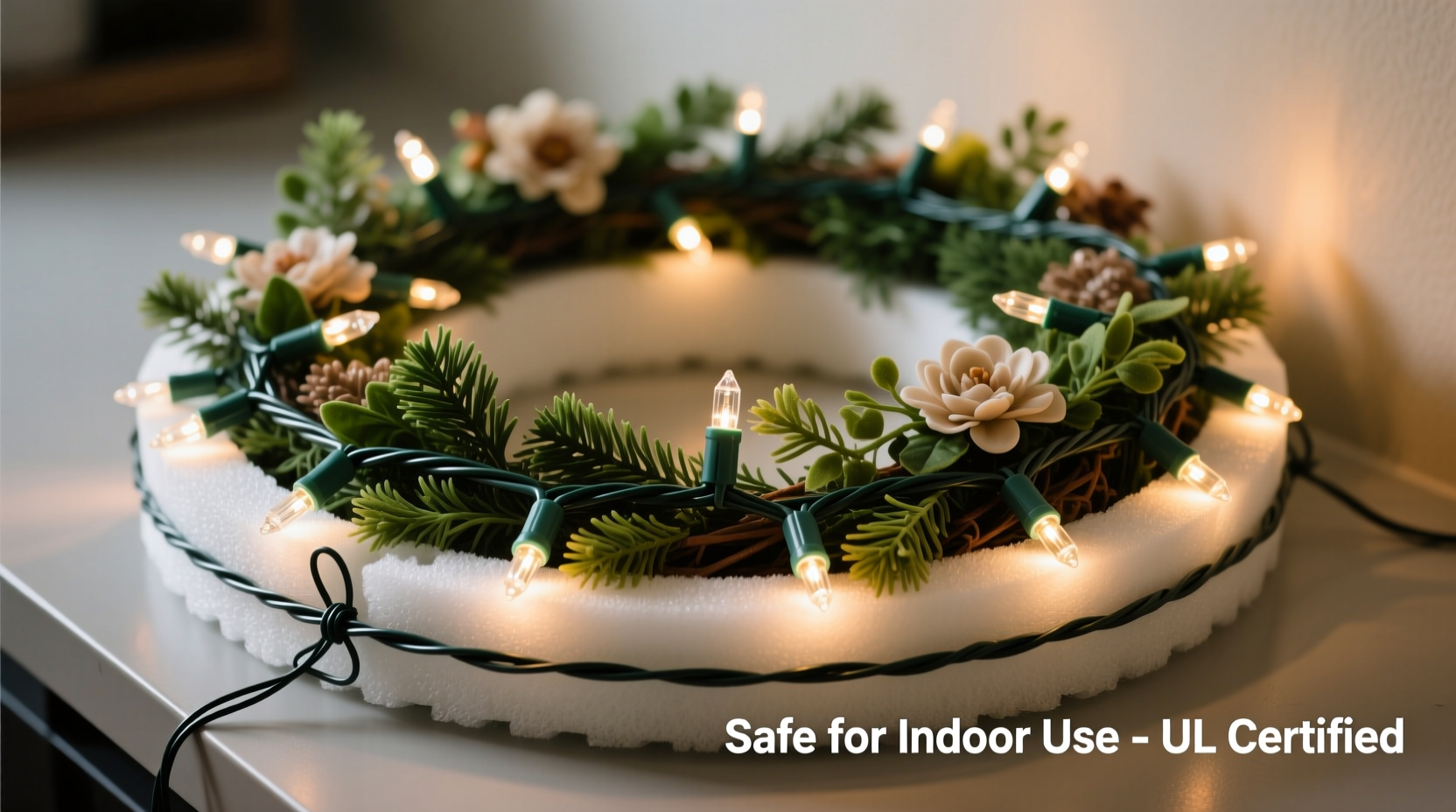
Artificial wreaths commonly use expanded polystyrene (EPS) or extruded polystyrene (XPS) foam as a structural base. These foams are lightweight and hold shape well, making them ideal for crafting. However, both are petroleum-based and inherently flammable. When exposed to sufficient heat or an open flame, they can ignite quickly and release toxic fumes during combustion.
Battery-powered string lights typically use LED bulbs, which produce significantly less heat than traditional incandescent bulbs. LEDs operate at around 30–40°C (86–104°F), compared to incandescent bulbs that can exceed 150°C (300°F). Because of this, LED string lights are generally considered safer for use near combustible materials—but \"safer\" does not mean \"risk-free.\"
The power source also matters. Most battery-operated sets run on AA or AAA batteries, delivering low voltage (usually 3–6 volts). This reduces electrical hazards but doesn’t eliminate thermal ones. Even small amounts of sustained heat from a malfunctioning LED or short circuit can begin degrading foam over time, especially in enclosed spaces or under prolonged use.
Fire Risk Assessment: What the Research Says
The U.S. Fire Administration and National Fire Protection Association (NFPA) have long warned about decorative lighting as a potential ignition source during holidays. While most reports focus on electrical faults in wall-plugged systems, battery-powered lights are not exempt from scrutiny.
A 2020 study by the Electrical Safety Foundation International (ESFI) tested various string lights on common craft materials, including polystyrene foam. The results showed that while standard LED battery lights did not ignite foam under normal conditions within 8 hours of continuous operation, some units with poor heat dissipation or defective wiring caused localized melting after 6 hours. In one case, a damaged wire created a hot spot exceeding 90°C (194°F), leading to smoldering.
“Even low-power devices can become hazardous when used improperly near combustible materials. It’s not just about wattage—it’s about duration, ventilation, and product integrity.” — Dr. Alan Reyes, Electrical Safety Engineer, NFPA Research Division
The study concluded that risk increases significantly when:
- Lights remain on for more than 12 consecutive hours
- Foam is enclosed or wrapped tightly with wires
- Batteries are old, leaking, or mismatched
- The set lacks built-in thermal protection or timers
Safety Checklist for Using String Lights on Foam-Based Wreaths
To minimize risk while maintaining festive charm, follow this practical checklist before installing battery-powered lights on any artificial wreath with a foam core.
✅ Use only LED string lights (avoid incandescent mini-bulbs)
✅ Inspect wires for fraying, kinks, or exposed copper
✅ Use fresh, high-quality batteries from reputable brands
✅ Avoid mixing old and new batteries
✅ Install a timer or manually limit use to 6–8 hours per day
✅ Ensure adequate spacing between lights and foam surface
✅ Never enclose lights tightly against foam—allow airflow
✅ Place the wreath away from heat sources, direct sunlight, or foot traffic
✅ Check monthly for signs of melting, discoloration, or odor
✅ Remove lights when not in seasonal use
Step-by-Step Guide: Installing Lights Safely on a Foam Wreath
Proper installation plays a major role in preventing accidents. Follow these steps to apply battery-powered string lights safely:
- Choose the right lights: Select UL-listed or ETL-certified LED string lights designed for indoor or outdoor use (depending on location). Look for features like auto-shutoff timers and insulated wiring.
- Test the lights first: Before attaching to the wreath, power the string on for 30 minutes. Touch each bulb and the wire near the battery pack to ensure no excessive heat buildup.
- Prepare the wreath: If possible, cover the foam base with a non-flammable barrier such as aluminum foil tape or a thin layer of fire-retardant floral clay. This adds a protective buffer.
- Wrap loosely: Drape the lights around the outer edge of the wreath rather than embedding them into dense foliage or wrapping tightly around the center. Maintain at least 1 inch of space between the wire and foam wherever possible.
- Secure without piercing: Use plastic clips or twist ties to hold wires in place. Avoid pushing wires into the foam, as this traps heat and damages insulation.
- Position the battery pack: Attach the battery box to the back of the wreath using a fabric sleeve or Velcro strap. Keep it accessible for changes and inspections. Do not bury it in greenery.
- Set a usage schedule: Turn lights on only during evening hours. Use a mechanical timer or smart outlet (if indoors) to automate shutdown after 6–8 hours.
- Inspect regularly: Once a week, check for warm spots, discoloration of foam, or corrosion in the battery compartment.
Real Example: A Close Call During Holiday Decorating
In December 2022, a homeowner in Portland, Oregon, decorated her front door with a foam-based evergreen wreath wrapped in battery-powered string lights. She used a set she’d purchased three years prior, recharging it nightly with rechargeable AA batteries. After two weeks, she noticed a faint burning smell near the entryway.
Upon inspection, she found that one section of the foam had begun to melt where the battery pack was pressed directly against the base. Though no fire occurred, the damage was significant enough to compromise the wreath’s structure. An electrician later determined that the battery casing had corroded slightly, causing intermittent resistance and localized heating.
The incident prompted her to switch to a magnetic-backed LED strip light designed for crafts, which she now uses with a removable foam insert. “I didn’t think a little string of lights could be dangerous,” she said. “But now I know even small things need attention.”
Comparison Table: Safe vs. Risky Practices
| Practice | Safe Approach | Risky Approach |
|---|---|---|
| Light Type | LED, cool-touch, certified | Incandescent or unbranded LEDs |
| Battery Use | Fresh, same brand/type, properly inserted | Mixed old/new batteries, leaking cells |
| Installation | Loose wrap, no direct foam contact | Tight coils, wires pushed into foam |
| Usage Duration | Max 8 hours/day with timer | Left on 24/7 for weeks |
| Inspection | Weekly checks for heat or damage | Never inspected until failure |
Frequently Asked Questions
Can I leave battery-powered string lights on overnight?
It’s not recommended, especially when attached to foam-based wreaths. While the risk is lower than with plug-in lights, prolonged use increases the chance of overheating due to battery drain, poor ventilation, or component failure. Use a timer to limit operation to 6–8 hours, ideally during active viewing times.
Are there fire-resistant alternatives to foam wreath bases?
Yes. Consider using bases made from wire frames, grapevine, or willow. These natural or metal cores are non-combustible and provide better heat dispersion. You can still attach foliage and lights safely, with far less risk than polystyrene foam.
What should I do if I notice melted foam near the lights?
Turn off and remove the lights immediately. Discard any damaged components, especially the battery pack or affected wire segments. Inspect the remaining set before reuse. Replace the wreath if structural integrity is compromised. Consider switching to a safer lighting method, such as clip-on puck lights or battery-operated lanterns placed nearby instead of on the wreath.
Expert Recommendations and Industry Standards
According to the American Christmas Tree Association (ACTA), over 82% of U.S. households use artificial trees and wreaths during the holidays. Their safety guidelines emphasize vigilance with all decorative lighting—even low-voltage options.
“The safest decoration is one that’s used mindfully. Certification marks matter, but so does how you use the product. Just because it runs on batteries doesn’t mean it’s immune to failure.” — Lisa Tran, Consumer Safety Director, ACTA
Look for labels indicating compliance with UL 588 or ASTM F2663 standards, which cover seasonal decorative lighting. These certifications mean the product has undergone testing for temperature rise, electrical safety, and durability. Avoid dollar-store lights without clear manufacturer information or safety ratings.
Conclusion: Decorate Smart, Not Just Bright
Battery-powered string lights can be safely used near artificial wreaths with foam bases—if precautions are taken. The combination isn’t inherently dangerous, but it demands thoughtful handling. By choosing quality LED lights, avoiding heat traps, limiting runtime, and inspecting regularly, you can enjoy a beautiful, hazard-free display.
Decorating is about joy, not risk. A few simple changes in how you install and manage your lights can prevent accidents and extend the life of your seasonal pieces. Don’t assume safety based on power source alone—voltage doesn’t tell the whole story.




 浙公网安备
33010002000092号
浙公网安备
33010002000092号 浙B2-20120091-4
Comments
No comments yet. Why don't you start the discussion?