
Bubble lights—the nostalgic, slow-churning ornaments that glowed warmly on mid-century Christmas trees—still captivate collectors, vintage decorators, and holiday traditionalists. Their hypnotic motion, soft amber glow, and retro charm make them enduring icons. Yet as homes adopt GFCI outlets, AFCI breakers, LED-dominant circuits, and stricter fire codes, a pressing question arises: Do these 1940s–1970s-era devices belong on today’s electrically sophisticated, safety-conscious trees? The answer isn’t a simple yes or no. It hinges on age, condition, certification, circuit compatibility, and usage discipline. This article cuts through nostalgia to deliver a grounded, code-informed assessment—drawing on UL standards, National Electrical Code (NEC) requirements, real-world incident data, and insights from licensed electricians who routinely inspect holiday lighting systems.
How Bubble Lights Work—and Why That Matters Electrically
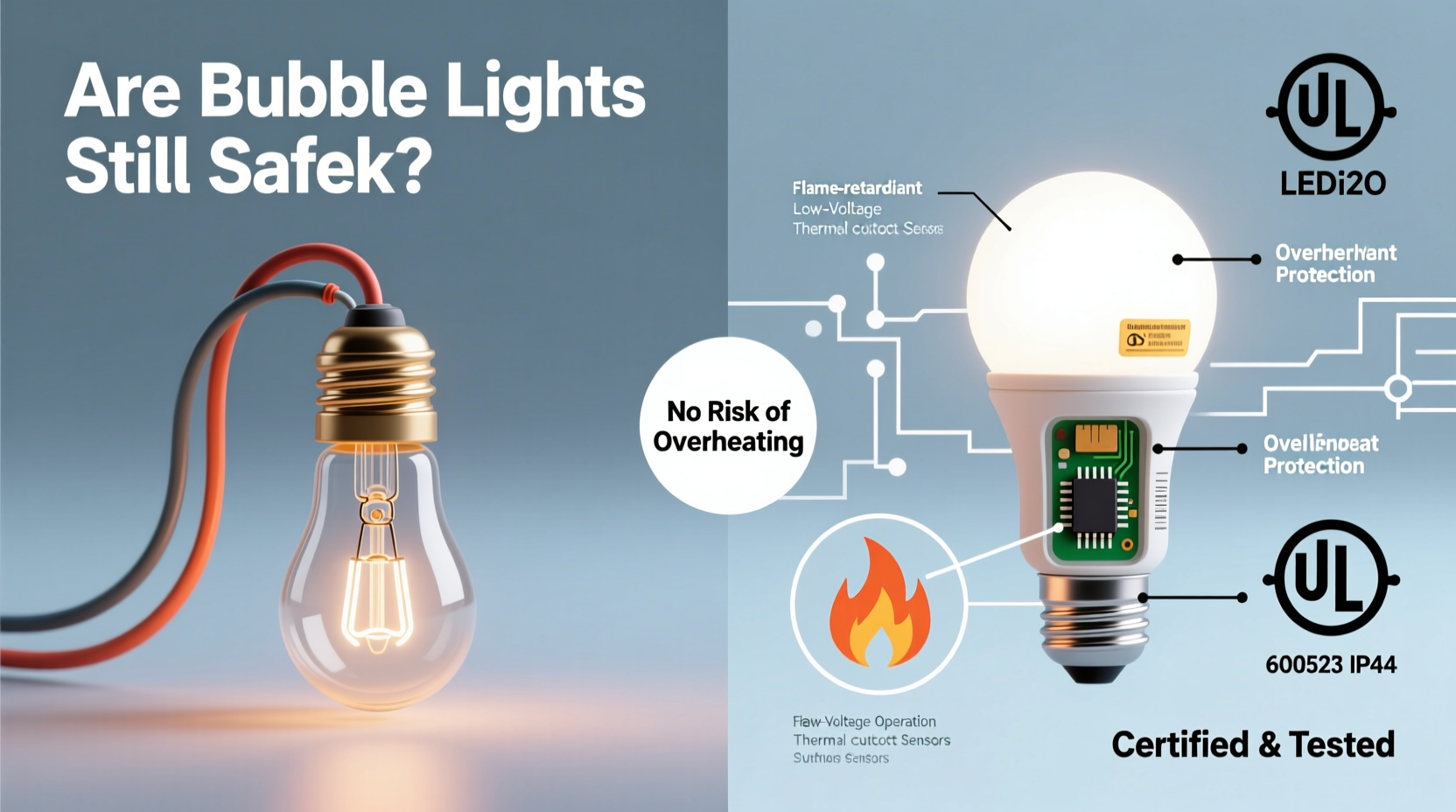
Bubble lights operate on a simple but thermally sensitive principle: a small incandescent bulb heats a sealed vial of methylene chloride (or, in later models, safer alternatives like ethanol or isopropanol). As the liquid warms, it vaporizes, rises, condenses at the top, and cascades back down—creating the signature “bubbling” effect. Crucially, the bulb inside the base is not just decorative; it’s the heating element. Most vintage units draw between 5 and 15 watts, but because they rely on continuous resistive heating, they generate more surface heat than modern LED equivalents—and their internal wiring, insulation, and socket construction reflect mid-20th-century materials and tolerances.
Unlike today’s UL 588-listed LED light strings—which undergo rigorous testing for overheating, short-circuit resilience, and flame propagation—most original bubble lights were manufactured before UL established comprehensive seasonal lighting standards. The first UL standard for Christmas lights (UL 588) wasn’t published until 1965, and even then, enforcement was inconsistent. Many bubble lights sold through the 1950s and early ’60s carried no third-party listing at all. That absence doesn’t automatically mean danger—but it does mean there’s no independent verification of dielectric strength, wire gauge adequacy, or thermal cutoff reliability.
Key Safety Risks Identified by Modern Electrical Standards
Three interrelated hazards emerge when bubble lights interface with contemporary home wiring and safety expectations:
- Thermal buildup in enclosed spaces: NEC Article 410.136 requires luminaires installed in combustible materials (e.g., tree branches, garlands, or wooden mantels) to maintain minimum clearance from heat sources. Vintage bubble lights often exceed surface temperatures of 120°F (49°C) during extended operation—well above the 90°C threshold that triggers mandatory thermal protection in modern listed devices.
- Aged insulation and brittle wiring: PVC and rubber insulation used in pre-1970s cords becomes brittle with age, UV exposure, and thermal cycling. Cracked insulation increases risk of ground faults—especially problematic on modern AFCI-protected circuits, which may nuisance-trip or, worse, fail to interrupt a high-resistance fault before ignition occurs.
- Non-compliant plug configurations: Many original bubble light sets feature two-prong, non-polarized plugs without strain relief. They lack the polarized blades required under NEC 406.4(A) for replacement receptacles installed after 1974—and none include the tamper-resistant (TR) features now mandated in all new residential outlets per NEC 406.12.
These aren’t theoretical concerns. According to the U.S. Consumer Product Safety Commission (CPSC), between 2015 and 2022, an average of 170 home fires annually were attributed to decorative lighting—12% of which involved vintage or non-UL-listed string lights. While bubble lights represent a small fraction of that total, fire investigators consistently cite “aged cordage and unlisted thermal design” as contributing factors in cases involving pre-1980 lighting.
What Modern Certification Actually Requires
Today, any decorative light intended for indoor seasonal use must comply with UL 588 (Standard for Safety of Seasonal and Holiday Decorations). For bubble lights specifically, UL 588 mandates:
| Requirement | Vintage Bubble Light Reality | Modern Compliant Equivalent |
|---|---|---|
| Third-party certification mark (e.g., UL, ETL) | Rarely present; many carry only manufacturer logos or “Made in USA” stamps | Mandatory—must appear on cord, base, and packaging |
| Maximum operating temperature (surface) | Often 130–150°F (54–66°C) at base housing | ≤ 90°C (194°F) measured at accessible surfaces |
| Wire insulation rating | Typically Type SPT-1 (60°C, 300V); prone to cracking | Type SPT-2 or higher (105°C, 300V), with flame-retardant jacket |
| Overcurrent protection | None—reliance on household breaker only | Internal thermal fuse or current-limiting resistor required |
| Cord strain relief | Minimal or absent; wires exit base with no anchoring | Mechanical grip within plug body to prevent pull-induced shorts |
Crucially, UL 588 also prohibits the use of methylene chloride—the original bubble fluid—in new designs due to its toxicity and flammability. Modern compliant bubble lights use ethanol, propylene glycol, or specialized low-vapor-pressure solvents approved under UL’s chemical safety annex. If you’re holding a bubble light manufactured before 1990, assume it contains methylene chloride unless explicitly labeled otherwise.
Real-World Assessment: A Case Study from a Home Inspection Report
In December 2023, licensed home inspector Marcus Lee (certified by InterNACHI and active in Chicago’s historic districts) evaluated a 1928 Tudor Revival home during a pre-holiday safety review. The homeowners proudly displayed a collection of 1950s bubble lights on their Fraser fir—wired in series with a 1960s aluminum-strand extension cord and plugged into a 1950s-era two-prong outlet without grounding.
Lee’s thermal imaging revealed localized hotspots: one bubble light base registered 142°F (61°C), while the adjacent aluminum cord junction hit 128°F (53°C)—well above the 104°F (40°C) ambient room temperature. Upon closer inspection, he found cracked insulation at three points along the cord, exposed copper strands near the plug, and a corroded socket contact in the light base. When tested with a multimeter, the set showed 0.8MΩ resistance to ground—far below the 1MΩ minimum recommended for aged appliances.
Lee advised immediate discontinuation of use—not because bubble lights are inherently unsafe, but because this specific configuration violated NEC 110.3(B) (equipment must be installed per manufacturer instructions), NEC 400.8(1) (cords not permitted as permanent wiring), and NFPA 101 Life Safety Code Section 18.5.5.2 (prohibiting decorative lighting on live trees without automatic shutoff). The homeowners replaced the set with UL-listed, low-heat LED bubble-effect lights—and reported no loss of ambiance.
Expert Insight: What Licensed Electricians and Fire Marshals Recommend
“Vintage bubble lights aren’t ‘unsafe’ in a vacuum—but they’re untested against today’s hazard models. We don’t ask whether something *could* catch fire; we ask whether it meets the engineered safety margins built into modern standards. These lights fall short on thermal management, insulation integrity, and fault response. If you love them, treat them like museum pieces: display only, unlit—or invest in a modern UL-listed replica.”
— Carlos Mendez, Master Electrician & NFPA 70E Instructor, Chicago Electrical Safety Alliance
“I’ve responded to two structure fires where vintage bubble lights contributed to ignition. In both, the failure point wasn’t the bulb—it was the degraded cord insulation contacting a metal ornament hanger, arcing, and igniting dry pine needles. Modern AFCIs would likely have tripped sooner—but only if the cord hadn’t already failed open-circuit first. Prevention starts with verification, not nostalgia.”
— Chief Lena Torres, Fire Prevention Division, Portland Bureau of Emergency Management
Step-by-Step: How to Evaluate Your Bubble Lights for Safe Use
If you own vintage bubble lights and wish to assess their viability—not as collectibles, but as functional decor—follow this field-tested protocol:
- Check for a UL/ETL/CSA mark on the cord, base, or packaging. No mark = no independent safety validation. Discard or display only.
- Inspect every inch of the cord under bright light. Look for cracks, stiffness, discoloration, or exposed wire. Any defect = immediate retirement.
- Test the plug: Insert gently into a grounded outlet. Does it wobble? Is the prong spacing uneven? Does the cord kink sharply at the plug? If yes, strain relief has failed.
- Smell and observe: Turn on for 5 minutes in a well-ventilated area. Does it emit a sharp chemical odor (possible methylene chloride leak)? Does the bubbling become erratic or stop entirely? Both indicate internal failure.
- Measure surface temperature with an infrared thermometer after 15 minutes of operation. Discard if base exceeds 115°F (46°C).
- Verify circuit compatibility: Plug into a GFCI- or AFCI-protected outlet. If it trips the breaker within 30 minutes, do not use—it’s generating leakage current or excessive heat.
Do’s and Don’ts Checklist for Responsible Use
- Use only on artificial trees or flame-retardant garlands
- Limit continuous operation to 4 hours, then allow full cool-down
- Plug directly into a wall outlet—not into power strips, daisy-chained cords, or surge protectors not rated for resistive loads
- Store vertically in climate-controlled space (avoid attics or garages)
- Replace every set after 10 years of intermittent use, regardless of appearance
- Use near curtains, paper decorations, or upholstered furniture
- Leave unattended overnight or while sleeping
- Modify bases, replace bulbs with higher-wattage types, or refill vials
- Use with dimmer switches (causes unstable heating and premature failure)
- Install outdoors—even under eaves—unless explicitly rated for wet locations
FAQ: Common Questions Answered
Can I get my vintage bubble lights recertified to meet modern standards?
No. UL and other NRTLs do not offer retroactive certification. Testing requires destructive evaluation (e.g., cutting open insulation, measuring dielectric strength), which invalidates the item for use. Certification applies only to production-line units manufactured to current specifications.
Are modern “bubble effect” LED lights truly safe?
Yes—if they bear a current UL 588 or ETL mark. These use low-voltage LEDs with micro-pumps or optical illusions to simulate bubbling, eliminating resistive heating and hazardous fluids. Surface temperatures typically stay below 100°F (38°C), and they draw less than 1 watt per unit.
My bubble light still works fine after 40 years. Isn’t that proof of safety?
No. Age-related degradation is cumulative and often invisible. Insulation embrittlement, solder joint fatigue, and capacitor aging increase failure probability exponentially after 25+ years—even without visible symptoms. Safety isn’t about longevity; it’s about predictable, verifiable performance under stress.
Conclusion: Honor the Past, Prioritize the Present
Bubble lights are more than ornaments—they’re artifacts of postwar optimism, craftsmanship, and analog charm. But honoring that legacy doesn’t require risking your home, your family, or your peace of mind. Modern electrical standards exist not to erase tradition, but to ensure it endures safely across generations. If your bubble lights are unlisted, untested, or show any sign of wear, their rightful place is behind glass—not on your tree. Fortunately, today’s market offers faithful, certified reproductions that deliver the same mesmerizing motion and warm glow, engineered to coexist with GFCIs, smart panels, and evolving fire codes. Choose authenticity rooted in verification—not assumption. Replace, verify, and celebrate consciously. Your holiday spirit deserves brilliance—without compromise.




 浙公网安备
33010002000092号
浙公网安备
33010002000092号 浙B2-20120091-4
Comments
No comments yet. Why don't you start the discussion?