
As we pass the age of 40, subtle but significant changes begin to unfold in our bodies. Skin loses elasticity, joints creak a little more, and recovery from physical activity slows. These shifts are partly due to the natural decline in collagen production—a protein that makes up about one-third of the body’s total protein content. By the time you’re 40, your body produces roughly 1% less collagen each year, accelerating visible and functional aging. This has led millions to consider collagen supplements as a way to slow or reverse some of these effects. But do they actually work? And more importantly, are they worth incorporating into your daily routine after 40?
This article examines the scientific evidence behind collagen supplementation, focusing on its real-world benefits for skin health, joint function, muscle maintenance, and bone strength. We’ll also explore which types of collagen are most effective, what dosages the research supports, and who is most likely to benefit.
The Role of Collagen in the Body After 40
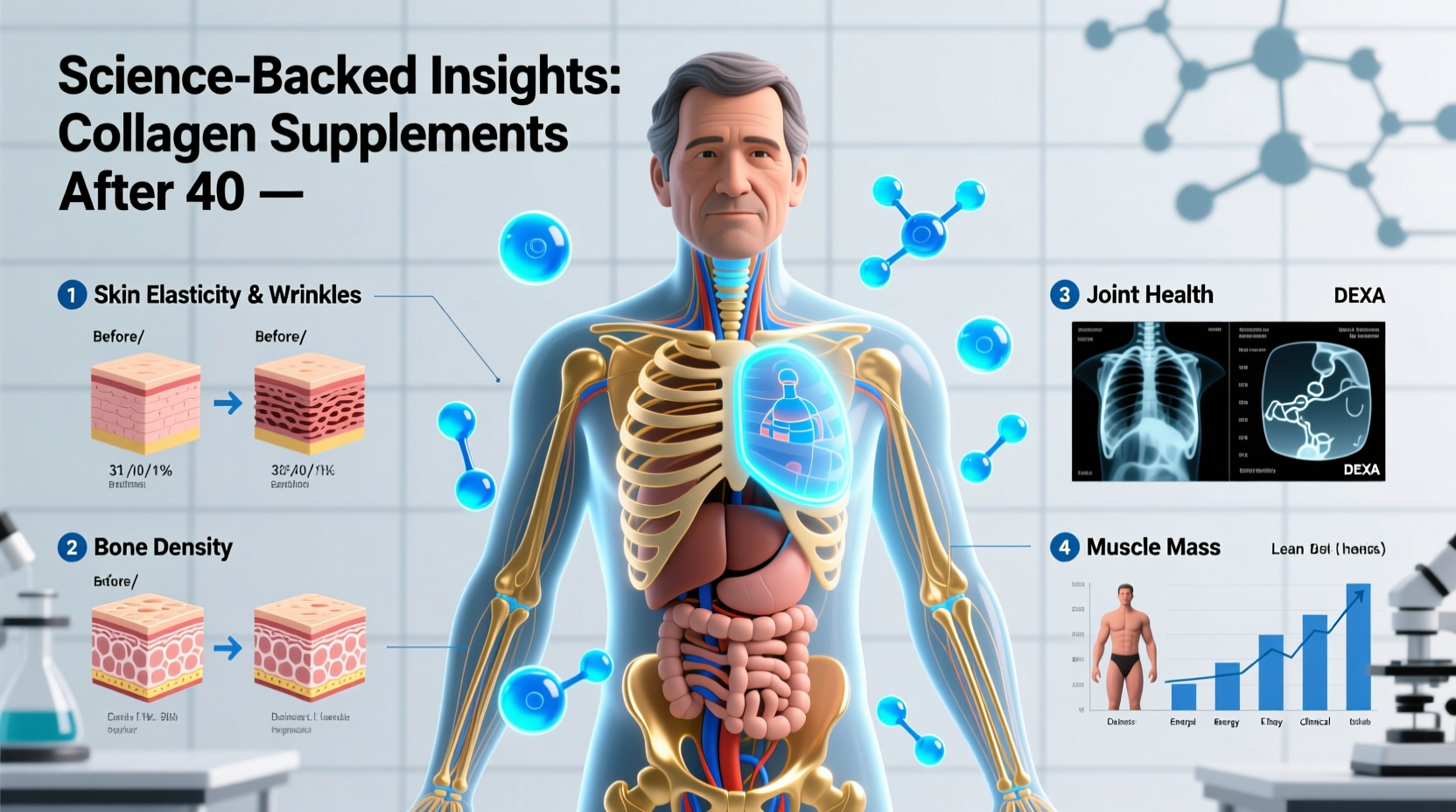
Collagen is the scaffolding of your body. It provides structure to skin, tendons, ligaments, bones, and even blood vessels. There are at least 28 types of collagen, but Types I, II, and III make up the vast majority. Type I dominates in skin, bones, and tendons; Type II is found in cartilage; and Type III supports muscles and organs.
After 40, several biological changes occur:
- Skin thinning: Collagen density in the dermis drops by about 1% per year, leading to wrinkles, dryness, and reduced wound healing.
- Joint degradation: Cartilage wears down, increasing stiffness and discomfort—early signs of osteoarthritis.
- Muscle loss (sarcopenia): Starting around age 30, muscle mass declines by 3–8% per decade, accelerating after 60.
- Bone mineral density reduction: Linked to lower collagen content in bone matrix, increasing fracture risk.
Given this backdrop, replacing lost collagen through diet or supplementation seems logical. But can ingested collagen peptides survive digestion, reach target tissues, and stimulate measurable improvements?
What Does the Science Say About Efficacy?
Over the past decade, numerous clinical studies have investigated whether oral collagen supplements deliver tangible benefits. The results are not universal, but they are increasingly compelling—especially for specific outcomes.
Skin Health: Visible Improvements Backed by Trials
A 2019 meta-analysis published in Clinics in Dermatology reviewed 19 studies involving over 1,100 participants. It concluded that hydrolyzed collagen supplementation significantly improved skin elasticity, hydration, and dermal collagen density after 8–12 weeks of daily intake (typically 2.5–10 grams).
In one double-blind, placebo-controlled trial, women aged 40–60 who took 5 grams of collagen peptides daily for 8 weeks experienced a 20% average increase in skin moisture and a noticeable reduction in wrinkle depth around the eyes.
“Oral collagen peptides act as signaling molecules that stimulate fibroblasts—the cells responsible for producing new collagen and elastin.” — Dr. Jessica Jorizzo, Dermatologist and Clinical Researcher
Joint Pain and Osteoarthritis: Modest Relief with Consistency
For joint health, the evidence is promising but more nuanced. A 2022 review in Nutrients analyzed 10 randomized controlled trials and found that collagen supplementation (particularly Type II) led to moderate reductions in joint pain during activity and at rest, especially in individuals with mild-to-moderate osteoarthritis.
One study followed athletes with activity-related knee pain. After 12 weeks of 5 grams of collagen daily, they reported a 40% improvement in pain scores compared to placebo. MRI scans also showed early signs of cartilage repair in some subjects.
However, collagen is not a replacement for medical treatment in advanced arthritis. It works best as part of a broader strategy including movement, weight management, and anti-inflammatory nutrition.
Muscle Mass and Sarcopenia: Emerging Support with Exercise
Here’s where timing matters. Collagen is low in tryptophan and deficient in certain essential amino acids, so it’s not a complete protein source. However, when paired with resistance training, collagen may enhance muscle growth and connective tissue strength.
A 2015 study in older men undergoing resistance training found that those who supplemented with 15 grams of collagen daily gained significantly more muscle mass and strength than the control group. Researchers believe collagen supports the extracellular matrix surrounding muscle fibers, improving structural integrity and recovery.
Bone Health: Potential for Slowing Decline
Collagen forms the organic framework of bone, onto which calcium and other minerals are deposited. As collagen degrades, bones become brittle. In a 12-month trial published in Journal of Medicinal Food, postmenopausal women taking 5 grams of collagen peptides daily showed a significant increase in bone mineral density (BMD) at the spine and femur compared to controls.
While not a substitute for calcium or vitamin D, collagen appears to support bone remodeling by stimulating osteoblasts (bone-building cells). Experts suggest combining collagen with weight-bearing exercise and adequate calcium intake for optimal skeletal health.
Choosing the Right Collagen: Types, Sources, and Dosage
Not all collagen supplements are created equal. Understanding the differences can help you make an informed choice.
Types of Collagen and Their Benefits
| Type | Primary Location | Supplement Benefit |
|---|---|---|
| I & III | Skin, bones, tendons | Improves skin elasticity, reduces wrinkles, supports bone density |
| II | Cartilage, joints | Reduces joint pain, supports cartilage repair |
| Hydrolyzed (Peptides) | N/A (broken-down form) | Better absorption; used in most clinical studies |
Source Matters: Bovine, Marine, or Chicken?
- Bovine collagen: Rich in Types I and III. Ideal for skin, hair, nails, and joint support. Sourced from grass-fed cows when possible.
- Marine collagen: Derived from fish scales or skin. High in Type I, smaller peptide size may improve bioavailability. Suitable for pescatarians.
- Chicken collagen: Primarily Type II. Best for joint and cartilage health, often used in arthritis formulations.
There is no definitive \"best\" source, but marine collagen shows slightly higher absorption rates in some studies. Personal preference, dietary restrictions, and targeted goals should guide your selection.
Dosage: How Much Is Enough?
Research consistently uses doses between 2.5 and 15 grams per day, depending on the goal:
- Skin health: 2.5–5 grams daily for 8–12 weeks
- Joints: 10 grams daily, preferably split morning and evening
- Muscle support: 15 grams taken before resistance training
Most benefits appear after 8–12 weeks of consistent use. Effects may plateau or reverse if supplementation stops, suggesting ongoing intake is necessary to maintain results.
Real-World Example: Maria’s Experience at Age 47
Maria, a 47-year-old teacher from Portland, began noticing deepening lines around her mouth and persistent knee pain after weekend hikes. She wasn’t ready for fillers or NSAIDs, so she started taking 5 grams of bovine collagen daily, mixed into her morning coffee with a squeeze of lemon.
After six weeks, her skin felt tighter and looked more radiant. By week 10, her daughter commented, “Mom, did you get a facial?” More importantly, her knee stiffness decreased significantly. She didn’t eliminate pain entirely, but she could hike longer without discomfort.
Maria attributes her results to consistency and pairing collagen with regular walking and strength training. “It’s not magic,” she says, “but it’s like giving my body the raw materials it’s missing.”
Who Should Consider Collagen Supplements?
Collagen isn’t essential for everyone. Here’s a checklist to help determine if it might be worth trying:
📋 **Collagen Supplement Readiness Checklist**- You’re over 40 and noticing visible skin aging (wrinkles, sagging, dryness)
- You experience joint stiffness or mild osteoarthritis symptoms
- You’re physically active and want to support tendon and ligament recovery
- You’re losing muscle mass despite staying active
- Your diet lacks animal connective tissues (e.g., bone broth, skin-on poultry, organ meats)
- You’re open to a 3-month trial with measurable goals (e.g., skin photos, pain tracking)
If three or more apply, a high-quality collagen supplement may offer meaningful benefits.
Frequently Asked Questions
Can vegetarians take collagen supplements?
No, because collagen is derived exclusively from animal sources. However, vegetarians can support their body’s natural collagen production by consuming ample vitamin C, zinc, copper, and amino acid-rich plant proteins like legumes and quinoa.
Are there side effects to taking collagen?
Collagen is generally well tolerated. Some people report mild digestive upset (bloating, heartburn), especially with higher doses. Choose hydrolyzed forms for better digestibility. Those with fish or egg allergies should avoid marine or chicken-derived collagen.
How long does it take to see results?
Most studies show measurable changes in skin and joint health within 8–12 weeks. Muscle and bone benefits may take 3–6 months. Individual results vary based on age, baseline collagen levels, lifestyle, and consistency.
Conclusion: A Strategic Addition, Not a Miracle Cure
Collagen supplements are not a fountain of youth, but they are a scientifically supported tool for managing age-related changes after 40. When chosen wisely and used consistently, they can improve skin appearance, ease joint discomfort, support muscle gains with training, and contribute to stronger bones.
The key is realism: collagen works best as part of a holistic approach that includes quality sleep, balanced nutrition, regular movement, and sun protection. It won’t erase deep wrinkles or cure arthritis, but it can tip the scale toward healthier aging.
If you’re considering collagen, start with a reputable hydrolyzed product at a clinically studied dose. Track your progress over 10–12 weeks. Take photos, note changes in how your clothes fit, or keep a simple pain journal. Let your own experience—not marketing claims—guide your decision.




 浙公网安备
33010002000092号
浙公网安备
33010002000092号 浙B2-20120091-4
Comments
No comments yet. Why don't you start the discussion?