
For frequent travelers and avid readers on the move, the e-reader has long been a trusted companion. Lightweight, battery-efficient, and capable of holding thousands of books, devices like the Kindle Paperwhite or Kobo Libra 2 have set the gold standard. But with recent advancements in flexible E Ink technology, a new category has emerged: the foldable e-reader. These innovative devices promise even greater portability by collapsing into compact forms. Yet, they come with trade-offs. Are foldable e-readers truly worth it for travel when stacked against their rigid, well-established counterparts?
The answer depends on your reading habits, tolerance for new tech, and what you prioritize in a travel device. While foldable models offer undeniable novelty and space-saving potential, they also introduce questions about durability, cost, and long-term usability. Let’s explore the key factors that determine whether folding is the future—or just a passing gimmick.
Portability and Space Efficiency
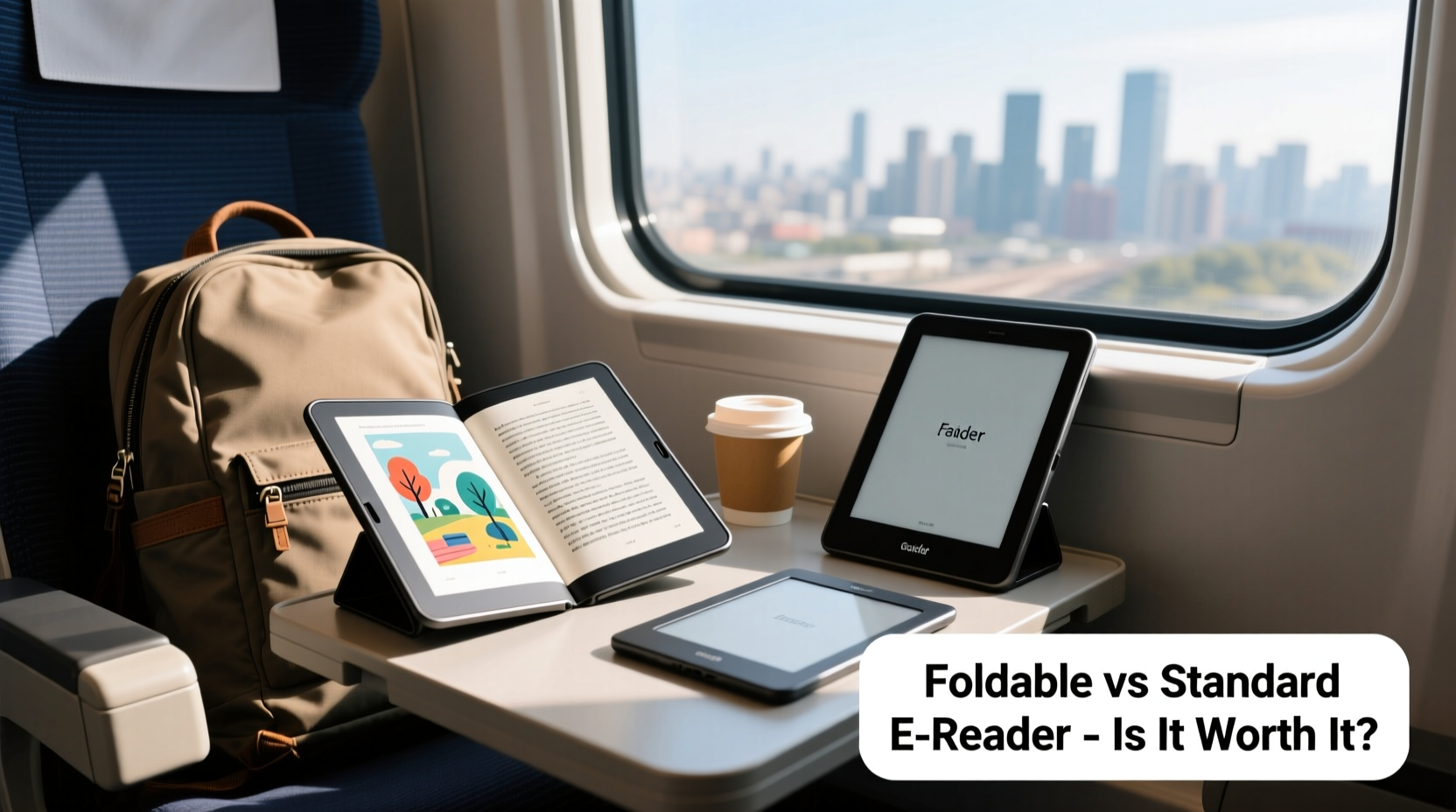
When traveling, every inch of luggage space counts. Traditional e-readers already excel here—most are smaller than a sheet of paper and weigh less than half a pound. But foldable e-readers take this further. Devices like the Onyx Boox Note Air 3 or prototype models from companies experimenting with rollable E Ink displays can fold down to pocket-sized dimensions, making them easier to slip into a jacket or small daypack without adding bulk.
In practice, this means you might carry a 7.8-inch screen that folds to the size of a credit card holder. For backpackers, business travelers, or those using handbags with limited room, this could be a game-changer. However, most current foldable e-readers aren’t fully self-folding—they require protective cases or sleeves to prevent creasing damage, which can negate some of the space savings.
Durability and Longevity Concerns
Foldable screens, even when built with flexible E Ink, remain a point of concern. Unlike traditional e-readers with reinforced plastic or glass fronts, foldable models hinge on a delicate crease line that undergoes repeated stress. While manufacturers claim these screens are rated for tens of thousands of folds, real-world conditions—like temperature changes, accidental drops, or improper storage—can shorten lifespan.
Standard e-readers are known for lasting five years or more with minimal wear. They’re often splash-resistant, shock-absorbent, and designed for daily use. Foldables, by contrast, are still in early adoption phases. Most lack IP ratings for water resistance, and their mechanical hinges are vulnerable to grit and impact.
Airlines, trains, and hostels aren’t gentle environments. A dropped foldable e-reader could suffer internal screen layer separation or permanent crease damage. Repair options are limited, and replacement costs are high—many foldable models exceed $500, nearly double the price of premium standard e-readers.
“While flexible E Ink is a breakthrough, it hasn’t yet matched the ruggedness of established designs. Travelers should weigh innovation against reliability.” — Dr. Lena Park, Display Technology Researcher at MIT Media Lab
Screen Quality and Reading Experience
E Ink remains the gold standard for glare-free, eye-friendly reading—especially under sunlight. Both foldable and standard models use E Ink Carta technology, but differences emerge in uniformity and refresh behavior.
Foldable screens sometimes exhibit slight color variation or ghosting along the fold line due to microscopic tension in the display layers. This doesn’t impair functionality but can be distracting during prolonged reading sessions. Additionally, because the screen must flex, manufacturers may reduce pixel density slightly to maintain flexibility, resulting in marginally softer text rendering.
On the other hand, standard e-readers benefit from years of refinement. Features like auto-adjusting front lights, anti-glare matte finishes, and page-turn buttons enhance comfort during long flights or beach lounging. Many also support physical page turns via side swipes or hardware buttons—something foldables often sacrifice for slimness.
For readers who prioritize immersive, distraction-free experiences, the consistency of a standard model still wins. But for those who value novelty and adaptability, a foldable’s dynamic form factor may justify minor compromises.
Comparative Overview: Foldable vs. Standard E-Readers
| Feature | Foldable E-Reader | Standard E-Reader |
|---|---|---|
| Screen Size (Unfolded) | 7.8\" – 10.3\" | 6\" – 8\" |
| Folded Size | Pocket-friendly (~credit card size) | No folding; fixed size |
| Weight | ~200–300g (with case) | ~150–200g |
| Battery Life | 2–3 weeks (mixed use) | 4–6 weeks (typical use) |
| Water Resistance | Rarely available | IPX8 common (e.g., Kindle Oasis) |
| Durability | Moderate (crease vulnerability) | High (tested over years) |
| Price Range | $400–$700 | $100–$300 |
| Best For | Tech enthusiasts, space-constrained travelers | Everyday readers, long-haul travelers, outdoor use |
Real-World Use Case: The Backpacker’s Dilemma
Consider Maya, a digital nomad who spends three months hiking through Southeast Asia. She carries a 35-liter pack and relies on her e-reader for downtime after long days of trekking. Her previous device—a Kindle Paperwhite—was durable, waterproof, and lasted weeks between charges. But she found herself wishing for a larger screen to read graphic novels and technical PDFs.
Last year, she upgraded to a foldable Onyx Boox device with an 8-inch flexible screen. Unfolded, it gave her the real estate she wanted. Folded, it fit neatly into her hip pocket. However, after two months, she noticed a faint shadow along the crease line. Sand had entered the hinge during a beach stay, and despite careful wiping, the mechanism felt stiffer. By month three, the screen flickered intermittently when unfolded.
She reverted to her old Kindle. “The foldable was brilliant in theory,” she said. “But in humid, dusty environments, it just wasn’t resilient enough. I’d rather have a slightly bulkier device that survives the journey.”
Her experience reflects a broader trend: while foldable e-readers shine in controlled environments, they struggle with the unpredictable conditions common in travel.
Cost vs. Value Analysis
Foldable e-readers are currently premium products with niche appeal. At $500+, they cost as much as a mid-range tablet—yet offer fewer features and higher fragility. Standard models, meanwhile, deliver exceptional value. For under $150, you can get a waterproof, glare-free reader with weeks of battery life and access to millions of books.
Moreover, the ecosystem around standard e-readers is mature. Apps, cloud syncing, audiobook integration, and lending libraries are seamless. Foldable devices, often running full Android systems, give more control but introduce complexity. You might need to manage updates, app permissions, and storage manually—less ideal when you’re offline in a remote location.
If budget matters—and for most travelers, it does—standard e-readers offer far better return on investment. Unless you specifically need a large, collapsible screen for documents or comics, the extra cost of a foldable is hard to justify.
Actionable Checklist: Choosing the Right Travel E-Reader
Before deciding, consider the following checklist to align your choice with your travel style:
- Assess your reading material: Do you mostly read novels, or do you need space for PDFs, textbooks, or manga?
- Check your luggage constraints: Is every ounce critical, or do you have room for a small dedicated device?
- Evaluate environmental exposure: Will you be near water, sand, or extreme temperatures?
- Test one-handed usability: Can you comfortably hold and operate the device while seated on a bus or train?
- Review battery expectations: How often will you have access to charging points?
- Consider repair and replacement: Is the device easily replaceable if damaged abroad?
- Compare total cost: Include accessories, cases, and potential insurance.
Future Outlook and Final Verdict
Foldable e-readers represent the next frontier in portable reading technology. As materials improve and manufacturing scales, we can expect thinner creases, better durability, and lower prices. In five to ten years, they may become the default choice for travelers.
But today, they remain experimental. For the average traveler—someone who values reliability, affordability, and ease of use—a standard e-reader is still the superior option. It’s not flashy, but it works flawlessly in rainforests, airplanes, and mountain huts alike.
Foldables make sense only if you fall into a specific niche: you frequently read complex layouts, have strict space limits, and are willing to accept higher risk for cutting-edge design. For everyone else, patience is the wiser strategy.
Frequently Asked Questions
Can foldable e-readers survive airport security scanners?
Yes, most foldable e-readers can pass through airport scanners without issue. However, repeated exposure to strong electromagnetic fields may affect sensitive hinge mechanisms over time. It’s safer to carry them in your hand luggage and request a manual check if concerned.
Do foldable e-readers support the same book formats as Kindles?
Most do, especially models running Android-based systems. They typically support EPUB, PDF, MOBI, and TXT files. However, Kindle-exclusive formats (like AZW) require conversion unless you use Amazon’s app, which isn’t always optimized on third-party devices.
Are there any truly waterproof foldable e-readers?
As of now, no major manufacturer offers a waterproof foldable e-reader. The flexible seals required for water resistance are incompatible with current folding mechanisms. This makes them unsuitable for beach reading or rainy climates.
Conclusion
The allure of a foldable e-reader is understandable—compact, futuristic, and seemingly perfect for travel. But practicality often trumps innovation. When weighed against proven durability, longer battery life, lower cost, and better environmental resilience, standard e-readers continue to dominate the travel landscape.
If you’re eager to adopt foldable tech, consider waiting for second- or third-generation models with improved build quality and user feedback. Or, test one in person before committing. For now, the humble, unbreakable e-reader remains the smartest companion for the open road.




 浙公网安备
33010002000092号
浙公网安备
33010002000092号 浙B2-20120091-4
Comments
No comments yet. Why don't you start the discussion?