
When holiday decorating in a compact apartment, studio, or cozy bedroom, every inch counts. The charm of twinkling lights is undeniable, but traditional string lights can quickly clutter tight surfaces or pose installation challenges on walls and windows. Enter the holographic Christmas projector—a modern alternative that casts festive patterns across rooms with minimal physical footprint. But is it truly better? For those balancing aesthetics, practicality, and space constraints, comparing these two lighting solutions reveals important trade-offs in ambiance, setup, energy use, and long-term value.
Understanding the Options: Projectors vs. String Lights
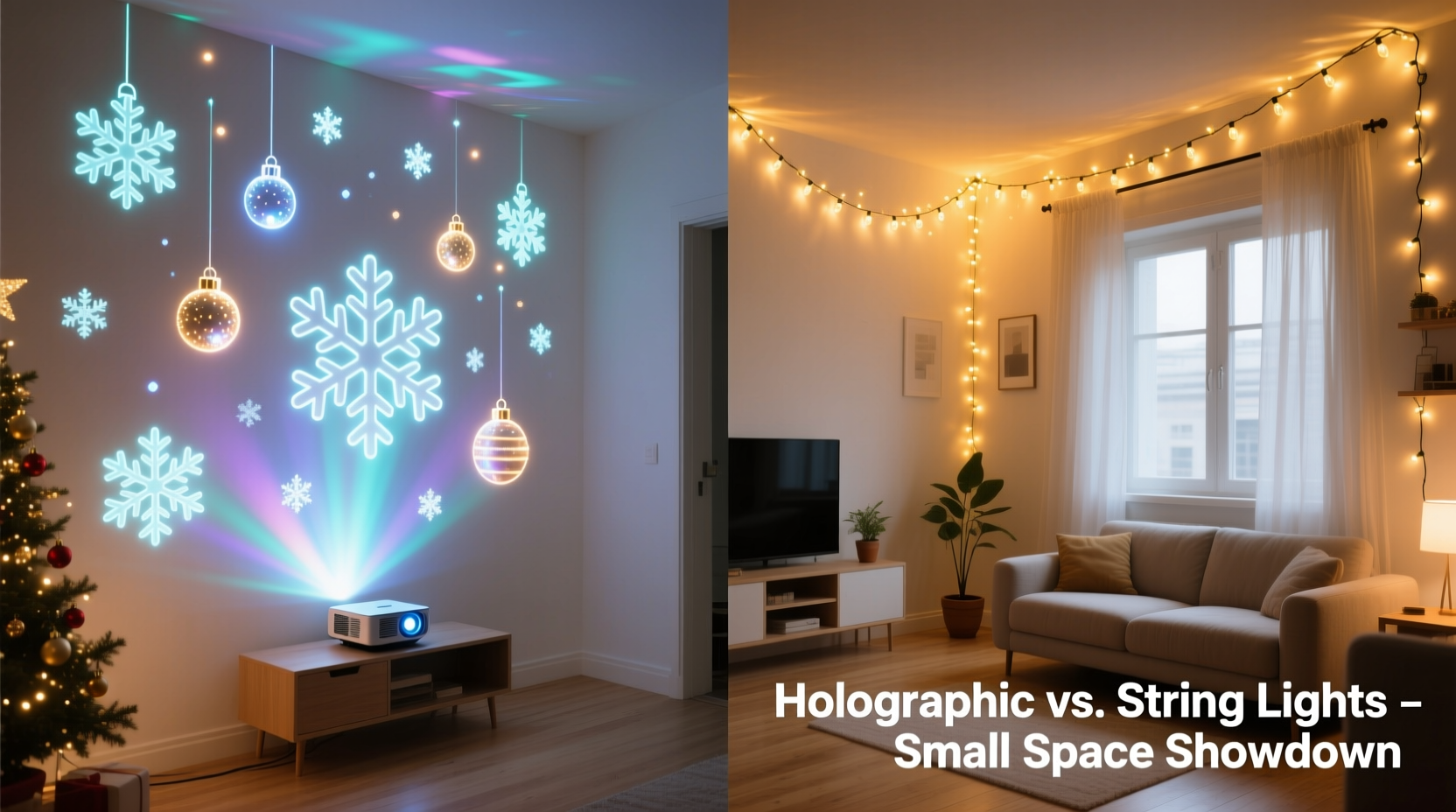
Holographic Christmas projectors use LED light sources and rotating lenses to beam animated holiday scenes—snowfall, dancing reindeer, glowing trees—onto walls, ceilings, and even outdoor surfaces. They typically plug into a standard outlet and require only a stable surface or mounting point. In contrast, string lights consist of multiple small bulbs wired together, often draped over mantels, wrapped around railings, or hung from ceilings. While they offer direct illumination and tactile presence, their physical spread can overwhelm limited areas.
In small spaces, visual weight matters as much as physical size. String lights add texture and warmth through proximity, but too many strands create visual noise. A single projector, meanwhile, transforms an entire wall into a dynamic canvas without occupying shelf space or requiring adhesive hooks. However, this convenience comes with limitations in customization and ambient feel.
Space Efficiency and Installation Practicality
One of the most compelling advantages of holographic projectors in small environments is their minimal spatial demand. A typical projector unit measures between 6 to 10 inches wide and stands less than a foot tall. It can sit on a windowsill, bookshelf, or coffee table without blocking furniture or walkways. Setup usually involves adjusting the tilt angle and selecting a display mode via a dial or remote.
String lights, while flexible, require anchoring points. In rentals or minimalist interiors where drilling isn’t allowed, users rely on adhesives or tension rods, which may damage paint or fail under weight. Even battery-operated strands need concealment for wires and power packs—challenging when outlets are scarce or furniture layout restricts access.
For micro-living scenarios—such as dorm rooms, tiny homes, or urban studios—projectors eliminate the need for intricate draping and reduce tripping hazards. They also allow seasonal changes without reconfiguring decor each year. Simply store one compact device instead of untangling dozens of wire sets.
“Compact living demands smarter decor. Projectors deliver high-impact visuals with zero clutter—ideal for renters and small-space dwellers.” — Lena Torres, Urban Interior Designer
Light Quality, Ambiance, and Customization
Ambiance plays a crucial role in holiday enjoyment. String lights excel in creating intimate, layered lighting. Warm white LEDs mimic candlelight; multicolored strands evoke playful nostalgia. Their proximity allows for dimming (if compatible), and some models offer fading, twinkling, or color-shifting effects. When arranged thoughtfully, they add depth and texture to shelves, headboards, or window frames.
Holographic projectors prioritize spectacle over subtlety. Most models project bright, animated sequences designed for visibility from afar. This works well outdoors or in larger rooms but can feel overwhelming indoors at close range. Some users report that the repeating motion—like looping snowflakes—becomes distracting after extended exposure, especially in bedrooms or quiet lounging areas.
Customization is another key differentiator. With string lights, you control length, density, color temperature, and placement. You can mix warm and cool whites, combine icicle strands with net lights, or spotlight specific objects. Projectors, by contrast, offer preset animations. While newer models include multiple scene options, switching between them is often manual and limited to three or four modes.
| Feature | String Lights | Holographic Projector |
|---|---|---|
| Installation Time | 15–45 minutes (depending on layout) | Under 5 minutes |
| Physical Footprint | High (wires span surfaces) | Very low (single unit) |
| Ambient Lighting Capability | Excellent (soft, diffused glow) | Poor (focused projection) |
| Outdoor Use | Limited by extension cords and weatherproofing | Strong (most are IP-rated) |
| Customization | High (mix colors, lengths, effects) | Low to moderate (preset scenes) |
| Storage Size | Bulky (tangles, reels needed) | Compact (fits in small box) |
Energy Use, Safety, and Long-Term Value
Both technologies have evolved toward energy efficiency. Modern LED string lights consume between 4 to 10 watts per 100-light strand and can last up to 50,000 hours. Projectors typically draw 15 to 30 watts depending on brightness and number of diodes. While projectors use more power per unit, they often replace multiple strands—making total consumption comparable.
Safety considerations favor projectors in confined areas. Since they emit no heat buildup (unlike older incandescent strings) and contain no exposed wiring, they’re safer near curtains, bedding, or children’s rooms. Many models also feature automatic timers (2–8 hours), reducing fire risk from overnight operation.
Longevity varies. Well-maintained string lights can last a decade if stored properly—away from moisture and extreme temperatures. However, tangled wires and broken bulbs shorten lifespan. Projectors have fewer moving parts but depend on lens clarity and motor durability. Dust accumulation inside the housing can degrade image quality over time, particularly in humid climates.
Real-World Example: Decorating a Studio Apartment
Maria, a graphic designer living in a 400-square-foot Brooklyn studio, struggled each holiday season with balancing festivity and functionality. Her previous setups involved wrapping fairy lights around her loft bed frame and hanging garlands across the ceiling—only to find them obstructing reading lamps and feeling oppressive during work hours.
Last year, she switched to a dual-mode holographic projector with snowfall and tree-lighting animations. She placed it on a side table angled toward the far wall, creating a “fireplace effect” during movie nights. The transformation was immediate: the room felt expansive, and the lack of dangling wires made cleaning effortless. She supplemented the projection with two short strands of warm-white lights behind her TV for task lighting, proving that hybrid approaches can maximize benefits.
“I finally got the cozy vibe without sacrificing space,” Maria said. “The projector does the heavy lifting visually, and the real lights add just enough warmth to keep it from feeling digital.”
Step-by-Step Guide: Choosing the Right Option for Your Space
- Assess your square footage and layout. Measure wall space, ceiling height, and available outlets. If floor or wall anchors are restricted, lean toward projectors.
- Determine primary use case. Is the goal ambient lighting or visual impact? Bedrooms and reading nooks benefit from soft string lights; entryways or living areas suit bold projections.
- Check power access. Projectors need nearby outlets. Battery-powered string lights offer flexibility but require frequent replacements.
- Test light intensity. In shared walls or apartments, ensure projector brightness won’t disturb neighbors through thin walls or windows.
- Consider storage capacity. If closet space is limited, prioritize compact, reusable devices like projectors over bulky light reels.
- Evaluate multi-season potential. Some projectors support non-holiday themes (e.g., starry skies, ocean waves), increasing year-round utility.
FAQ
Can I use a holographic projector indoors without it looking cheap?
Yes—if you choose a high-lumen model (minimum 500 lumens) and project onto a neutral, untextured surface. Avoid dark or patterned walls, which distort images. Pairing the projection with subtle physical decor (like a small tree or candles) enhances authenticity.
Do string lights work in very small rooms?
They can, but selectively. Use short runs (under 10 feet) in defined zones—above a mirror, along a shelf, or framing a window. Avoid wrapping furniture or overhead beams unless the ceiling is high enough to prevent visual crowding.
Are holographic projectors safe for kids’ rooms?
Generally yes. Most operate at safe temperatures and don’t emit UV radiation. However, avoid placing them where children can touch the lens or block ventilation. Also, consider turning off animated modes at bedtime to reduce sleep disruption.
Checklist: Choosing Between Projectors and String Lights
- 🔲 Measure available wall/floor space
- 🔲 Identify main decoration area (indoor/outdoor)
- 🔲 Confirm outlet locations and extension cord needs
- 🔲 Decide on desired mood (cozy vs. dramatic)
- 🔲 Review product specs: lumens, IP rating, timer functions
- 🔲 Check return policy in case of dissatisfaction
- 🔲 Plan storage method post-holiday
Conclusion: Matching Technology to Lifestyle
The choice between holographic Christmas projectors and string lights isn’t about superiority—it’s about alignment with your environment and expectations. For small spaces where clutter is a constant battle, projectors offer unmatched convenience, safety, and visual drama with minimal investment. They transform blank walls into immersive experiences and simplify annual setup.
Yet, they don’t fully replace the tactile warmth of real lights. The gentle flicker of LEDs strung across a windowsill, the way they catch reflections in glass ornaments—these details contribute to emotional resonance that projections can’t replicate. The smartest approach may be integration: use a projector as the centerpiece and complement it with a few tasteful strands to ground the illusion in reality.
As urban living trends continue toward smaller footprints and multifunctional design, lighting solutions must evolve accordingly. Whether you prioritize ease, elegance, or both, understanding the strengths and limits of each option empowers intentional, joyful decorating—without compromising comfort or style.




 浙公网安备
33010002000092号
浙公网安备
33010002000092号 浙B2-20120091-4
Comments
No comments yet. Why don't you start the discussion?