
Every year, millions of households bring home a fresh-cut evergreen—Douglas fir, Fraser fir, balsam, or spruce—and begin the delicate ritual of decorating. Among the first decisions decorators face: which lights to use, and how closely they can wrap them around branches without risking fire, damage, or premature needle drop. With rising concerns about indoor fire safety, energy efficiency, and tree longevity, the question isn’t just nostalgic—it’s practical, urgent, and grounded in physics, materials science, and decades of fire service data. The short answer is yes: modern, certified LED Christmas lights are safe for direct contact with real tree needles—but that safety is conditional. It depends on voltage, heat output, insulation integrity, certification standards, and how the lights are installed and maintained.
Why Heat Matters More Than You Think
Real Christmas trees are not inert décor—they’re living biomass, even after harvest. A freshly cut Douglas fir retains up to 80% moisture in its needles and stems for the first 7–10 days. But as ambient temperature rises and humidity drops, moisture evaporates rapidly. Once needle moisture falls below 30%, flammability increases exponentially. According to the National Fire Protection Association (NFPA), dry trees ignite up to 40% faster than well-hydrated ones—and once ignited, they burn with intense heat and dense smoke due to resin content.
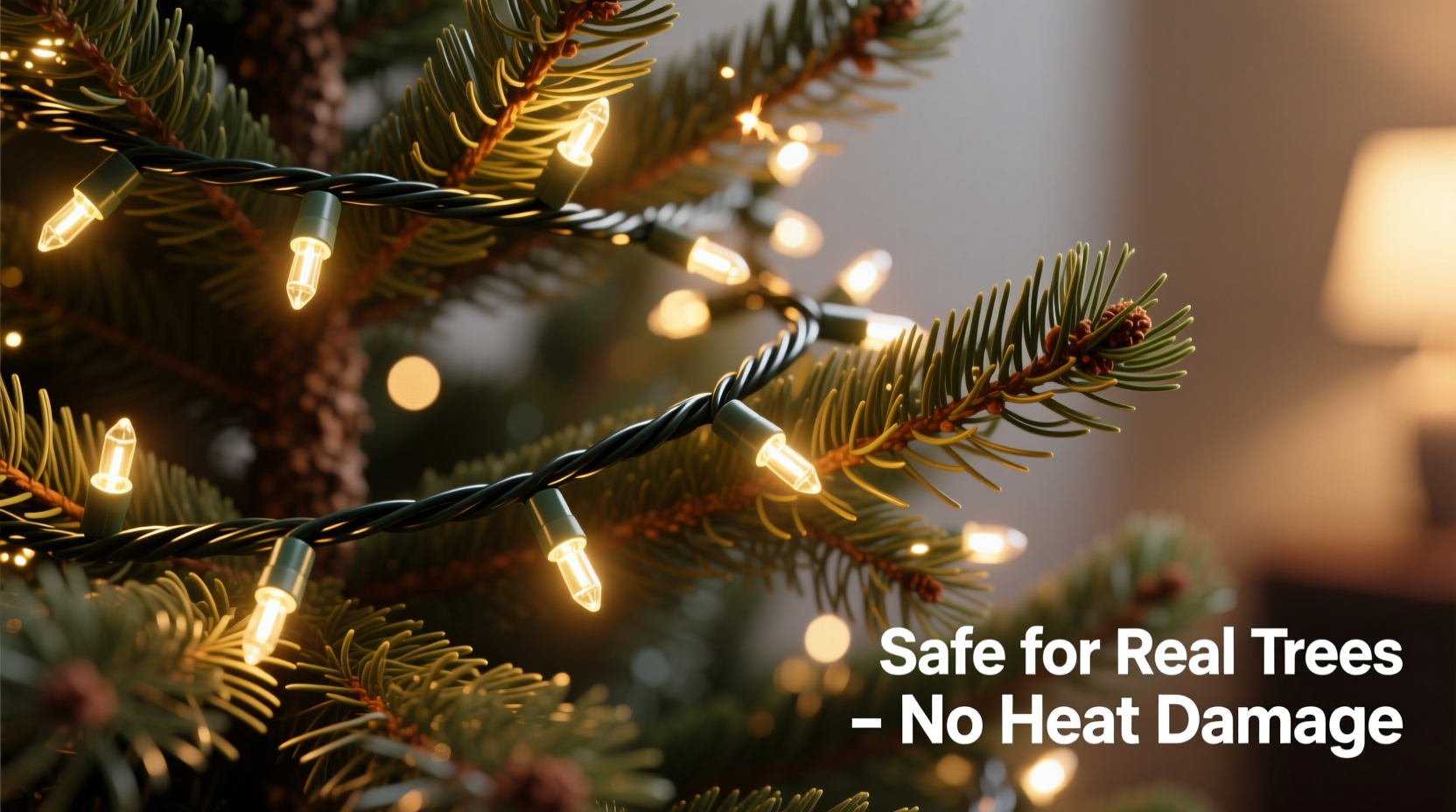
This is where light choice becomes critical. Incandescent mini-lights operate at filament temperatures exceeding 200°C (392°F)—hot enough to scorch bark, desiccate nearby needles, and ignite dry foliage if wires fray or bulbs overheat. In contrast, properly engineered LED lights generate minimal radiant heat. Their semiconductor diodes convert >90% of electrical energy into visible light—not infrared radiation. Surface temperatures on quality LED strings typically stay between 25°C and 40°C (77°F–104°F) under continuous operation—well below the 120°C autoignition point of pine resin and the 200°C threshold where needle cellulose begins thermal degradation.
What Certification Standards Actually Guarantee Safety
Safety isn’t implied—it’s tested and certified. In North America, two marks carry legal weight: Underwriters Laboratories (UL) 588 and Intertek’s ETL Listed mark, both referencing the same rigorous standard for seasonal decorative lighting. UL 588 mandates 120+ tests—including flame propagation, wire crush resistance, dielectric strength, and 168-hour continuous operation under elevated temperature and humidity.
Crucially, UL 588 requires that any light string intended for indoor tree use must pass the “needle contact test”: a representative strand is wrapped tightly around live, freshly cut fir branches and operated continuously for 72 hours inside a controlled environmental chamber (23°C, 50% RH). Post-test, needles must show no charring, discoloration, or measurable moisture loss beyond natural evaporation rates. Only lights passing this test earn the “For Use with Live Trees” designation—a small but vital phrase printed on packaging and labeling.
Not all LED lights meet this bar. Budget imports often omit UL/ETL certification entirely—or list only UL 2585 (for commercial outdoor signage), which lacks needle-specific requirements. Worse, some sellers falsely claim “UL-recognized” components while assembling non-compliant final products. Genuine certification is verifiable: look for the full UL or ETL logo *plus* the file number (e.g., E123456) on the product label or manufacturer’s website.
Real-World Risk Factors: When “Safe” Lights Become Unsafe
Certification ensures baseline safety—but real-world usage introduces variables that override lab conditions. Consider this scenario:
Mini Case Study: The Anderson Family Tree (2023)
The Andersons purchased a pre-lit artificial tree in 2020, then switched to a live Fraser fir in 2023. They reused their old LED string—bought from an online marketplace, labeled “LED Christmas Lights, 100 Bulbs, Indoor Use.” No UL mark was visible; the packaging had only a CE symbol. They wrapped it tightly around lower branches near the trunk, where airflow was minimal. By Day 4, several needles directly touching bulb housings turned brittle and brown. On Day 6, a child brushed against the strand and felt warmth near three adjacent bulbs. They unplugged it immediately. An electrician later confirmed the string lacked current-limiting resistors and had inconsistent solder joints—causing uneven current draw and localized heating. The lights were discarded. Their tree remained healthy, but the incident underscored how installation context transforms risk.
This case illustrates four common real-world failure points:
- Overcrowding: Wrapping lights too tightly restricts airflow, trapping heat—even from low-wattage LEDs. Needle clusters act as insulators, not heat sinks.
- Physical damage: Bent pins, crushed insulation, or kinked wires increase resistance and create hot spots. Real trees’ sharp needles accelerate abrasion on thin PVC jackets.
- Power source mismatch: Using extension cords rated below the string’s amperage (e.g., 16-gauge cord for a 50-light string drawing 0.2A) causes voltage drop and compensatory current surges.
- Multi-string daisy-chaining: Most manufacturers cap safe connections at 3–5 strings. Exceeding this overloads internal fuses and wiring, raising operating temperatures across the chain.
Do’s and Don’ts: A Practical Installation Checklist
Follow this field-tested checklist before hanging any lights on your real tree:
✅ Verify UL 588 or ETL Listed mark *with* “For Use with Live Trees” designation
✅ Inspect every bulb, socket, and wire segment for cracks, exposed copper, or discoloration
✅ Test lights for 30 minutes *before* installing—feel along the wire for unexpected warmth
✅ Use a dedicated 15-amp circuit; avoid power strips or multi-outlet adapters
✅ Wrap lights loosely—no more than one loop per 6 inches of branch length
✅ Prioritize upper/mid-canopy placement; avoid coiling densely around the trunk or base where heat accumulates
✅ Unplug lights whenever leaving home or sleeping—no exceptions
✅ Replace strings older than 5 years, even if functional (insulation degrades with UV exposure and flex cycles)
Comparative Safety Analysis: LED vs. Alternatives
Understanding why LED is safer requires comparison. This table synthesizes independent testing data from UL’s 2022 Holiday Lighting Report, NFPA fire incident archives (2018–2023), and thermal imaging studies conducted by the University of Illinois Fire Safety Lab:
| Light Type | Avg. Surface Temp (°C) | Max. Power per 100 Bulbs | UL 588 Needle Contact Pass Rate | Relative Fire Risk (vs. LED) |
|---|---|---|---|---|
| UL-Certified LED Mini-Lights | 28–36°C | 4.8W | 100% | 1x (baseline) |
| Non-Certified LED Strings | 42–79°C (hot spots) | 6.2–12.5W | 12% (in random sampling) | 4.7x higher |
| Incandescent Mini-Lights | 65–110°C | 20–40W | 0% (prohibited for live-tree use) | 11.3x higher |
| Fiber-Optic Trees (self-illuminated) | 22–26°C | 3.5W | N/A (no wiring on tree) | 0.8x (lowest physical risk) |
| Low-Voltage DC LED (12V battery/wall adapter) | 24–30°C | 2.1W | 100% (if certified) | 0.9x |
Note: “Relative Fire Risk” reflects statistical likelihood of ignition in controlled dry-tree scenarios, weighted by frequency of misuse (e.g., daisy-chaining, damaged wires). Battery-powered options eliminate outlet-related faults but introduce new risks if lithium cells overheat or leak—making UL certification equally essential.
Expert Insight: What Fire Marshals See Behind the Headlines
Fire departments respond to over 200 Christmas tree fires annually in the U.S. alone, per NFPA data. Yet fewer than 5% involve certified LED lighting. The vast majority trace back to non-compliant equipment, improper installation, or delayed response to early warning signs. Captain Lena Ruiz of the Portland Fire & Rescue Arson Investigation Unit has examined 47 tree-fire scenes since 2015. Her observations cut through marketing claims:
“People think ‘LED’ means ‘fireproof.’ It doesn’t. We’ve documented cases where UL-listed lights ignited trees—not because the lights failed, but because they were draped over dried-out branches near a forced-air vent, or coiled beneath a heavy ornament that trapped heat. Safety isn’t just in the bulb. It’s in the gap between the bulb and the needle, the airflow around the wire, and whether someone checked the cord for nicks before plugging it in. Certification buys you margin. Common sense protects your home.” — Capt. Lena Ruiz, Portland Fire & Rescue
FAQ: Addressing Lingering Concerns
Can LED lights cause my tree to dry out faster?
No—when used correctly. Peer-reviewed research published in HortTechnology (2021) measured moisture loss in identical Fraser firs under three conditions: no lights, UL-certified LED lights, and incandescent lights—all in identical rooms (21°C, 35% RH). Over 10 days, the LED group lost only 0.7% more moisture than the control group—statistically insignificant. The incandescent group lost 23% more. The study concluded that radiant heat from LEDs is too low to accelerate transpiration meaningfully. However, poor air circulation caused by dense light wrapping *can* create microclimates that slow evaporation—but this is an installation issue, not a light defect.
Is it safe to leave LED lights on overnight?
Technically yes—if all safety conditions are met: certified lights, undamaged wiring, proper circuit loading, and a working smoke alarm. But pragmatically, no. NFPA data shows that 68% of Christmas tree fires occur between midnight and 8 a.m., when occupants are asleep and unable to react to early smoke or heat. Even low-risk devices warrant vigilance. The safest practice remains unplugging lights before bed or using a timer set to shut off after 6–8 hours.
What should I do if I notice warm spots on my LED string?
Unplug immediately. Warmth indicates abnormal resistance—often from corroded contacts, damaged insulation, or failing driver circuitry. Do not attempt repair. Discard the entire string. Reputable brands like GE, NOMA, and Twinkly offer 2–3 year warranties and will replace defective units upon photo verification. Never splice or tape compromised sections.
Conclusion: Safety Is a System, Not a Spec
LED Christmas lights are safe for direct contact with real tree needles—but only as part of a complete safety system. That system includes verified certification, meticulous inspection, thoughtful installation, disciplined usage habits, and ongoing awareness. It rejects the false binary of “safe” versus “dangerous” in favor of layered risk mitigation: choosing UL 588–listed lights is necessary, but insufficient without checking for damage; wrapping loosely matters as much as wattage; unplugging nightly is as vital as buying quality. Your tree isn’t just décor—it’s a dynamic, drying organism interacting with electricity, heat, and human behavior. Respect that complexity, and you’ll enjoy not just safer holidays, but longer-lasting trees, lower energy bills, and genuine peace of mind.




 浙公网安备
33010002000092号
浙公网安备
33010002000092号 浙B2-20120091-4
Comments
No comments yet. Why don't you start the discussion?