
As holiday decorating trends evolve, creative DIY projects like illuminated gingerbread houses have surged in popularity. One of the most common questions from crafters and decorators is whether standard LED rope lights can be shaped into the angular, delicate form of a gingerbread house frame. The short answer is yes — but with important caveats. Understanding the flexibility, construction, and limitations of LED rope lights is essential for achieving a professional-looking result without damaging the lights or compromising safety.
LED rope lights are designed to offer a soft, continuous glow along their length, making them ideal for outlining shapes, adding ambient lighting, or enhancing festive displays. Their tubular silicone or PVC coating gives them a pliable feel, but not all models are created equal when it comes to tight bends and right angles. This article explores the technical aspects of LED rope light flexibility, provides practical guidance for shaping them into architectural forms, and shares tested strategies for integrating them into edible and non-edible holiday displays.
Understanding LED Rope Light Construction
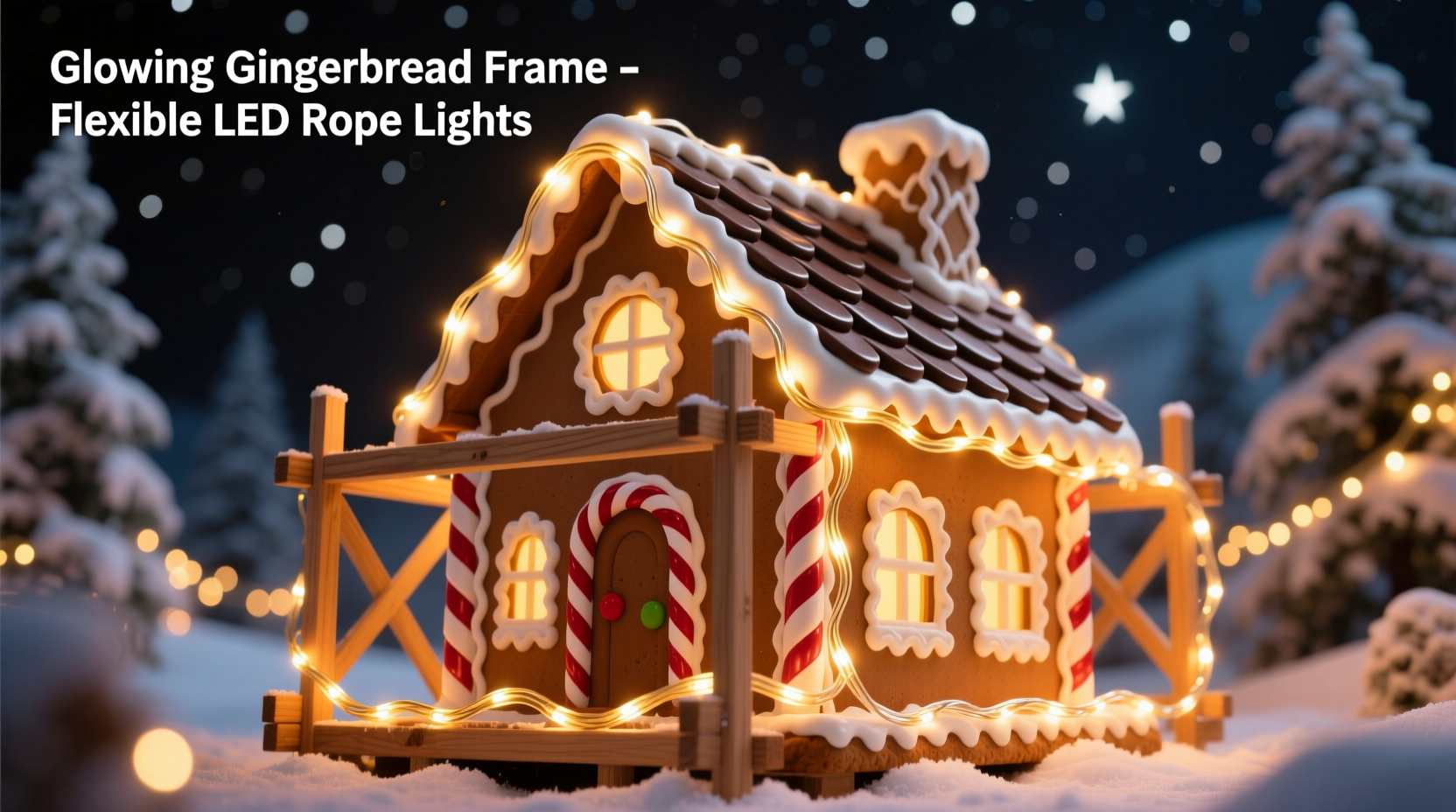
The flexibility of any LED rope light depends primarily on its internal structure and outer jacket material. Most commercially available rope lights consist of a series of small LEDs mounted on a flexible circuit board, encased in a translucent silicone or PVC sleeve. This design allows for some degree of bending, but the radius of curvature varies significantly between products.
Rope lights typically fall into two categories: solid-core and stranded-core. Solid-core models contain a rigid central wire that maintains structural integrity over long runs but limits how tightly they can bend. These are better suited for straight or gently curved applications such as under cabinet lighting or perimeter outlines. Stranded-core versions use multiple thin wires, offering greater flexibility and responsiveness to complex shapes.
The spacing between individual LEDs also affects performance in angular designs. If the gap between bulbs is too wide — say, more than an inch — the corners of a gingerbread house may appear dim or unevenly lit. For intricate frames, look for high-density models with LED spacing of 0.5 inches or less. These provide a smoother visual flow around corners and edges.
Can You Bend LED Rope Lights at Sharp Angles?
A traditional gingerbread house features sharp 90-degree angles at roof peaks, eaves, and base corners. Achieving these precise turns requires careful handling of the rope light. While most LED rope lights can handle gradual curves, forcing them into acute angles risks damaging the internal wiring or cracking the outer jacket.
Manufacturers often specify a minimum bend radius — usually between 1.5 and 3 inches — which indicates how tight a curve the product can safely endure. Exceeding this limit may lead to broken solder joints, flickering lights, or complete failure along the strand. For example, a rope light with a 2-inch minimum bend radius cannot cleanly wrap around a corner narrower than that without stress.
However, skilled installers have developed workarounds. One effective method is to create \"soft corners\" by rounding the angles slightly rather than attempting perfect right turns. Another approach involves cutting the rope light at designated cut points (if supported by the model), then using waterproof connectors to join segments at desired angles. Not all rope lights are cuttable; only those labeled as “cut-and-connect” or featuring marked intervals should be modified this way.
“Attempting to force a rope light beyond its bend tolerance is the most common cause of premature failure in decorative installations.” — Daniel Reyes, Lighting Systems Engineer, Holiday Illumination Labs
Step-by-Step Guide to Shaping LED Rope Lights for a Gingerbread House Frame
To successfully adapt LED rope lights to a gingerbread house structure, follow this tested sequence of steps:
- Choose the Right Product: Select a high-flexibility, cuttable LED rope light with close LED spacing (≤0.5\") and a bend radius of 1.5 inches or less.
- Measure the Frame: Determine the total length needed, including roof slopes, base perimeter, and any additional trim lines. Add 10% extra for error margin.
- Mark Cut Points (if applicable): If your design includes sharp corners, identify where you’ll need to cut and reconnect. Use only manufacturer-approved cutting zones.
- Create Corner Joints: At each vertex, cut the rope light and attach angled connectors or use soldered joints with heat-shrink tubing for durability.
- Test Before Finalizing: Plug in the assembled strand and verify all sections illuminate evenly, especially at connection points.
- Secure Gently: Use clear adhesive clips or food-safe mounting putty (for display-only setups) to affix the lights without compressing or pinching the cable.
- Power Safely: Ensure the transformer is rated appropriately and kept away from moisture or heat sources, particularly if used near real gingerbread.
This process ensures both aesthetic quality and operational reliability. Rushing through any step increases the risk of malfunction or physical damage.
Do’s and Don’ts When Using LED Rope Lights on Delicate Structures
| Action | Recommended? | Reason |
|---|---|---|
| Bend slowly and evenly | ✅ Yes | Prevents internal wire strain and jacket cracking |
| Cut at unmarked locations | ❌ No | Will break circuit continuity and void warranty |
| Use with edible displays | ⚠️ With caution | Ensure lights are food-safe coated and never powered during consumption |
| Apply tension while bending | ❌ No | Stretching weakens connections and causes hotspots |
| Use UV-resistant models outdoors | ✅ Yes | Prolongs lifespan if part of an exterior display |
Particularly when combining electronics with food-based art, hygiene and safety must remain top priorities. Never allow electrical components to come into direct contact with edible surfaces unless explicitly certified as food-safe. Even then, power should be disconnected during handling or serving.
Real Example: A Festive Display That Worked — And One That Didn’t
In 2022, a community center in Burlington, Vermont hosted a holiday contest featuring life-sized gingerbread house replicas. Two entries used LED rope lighting extensively, but with vastly different outcomes.
The winning entry, built by a team of engineering students, used a stranded-core, cuttable LED rope light with 0.4-inch LED spacing. They measured each panel precisely, cut the strands at labeled zones, and connected them with low-profile waterproof couplers. By pre-bending segments over wooden jigs, they achieved clean 90-degree transitions that followed the gabled rooflines perfectly. The result was a radiant, uniform glow that enhanced the architectural details without visible breaks or dark spots.
In contrast, another participant attempted to mold a standard indoor rope light around a similar frame without cutting. Over several days, the constant pressure caused microfractures in the silicone sheath, leading to intermittent flickering. On the final night, one corner went completely dark due to a severed conductor. Though visually appealing initially, the lack of technical preparation undermined the display’s longevity.
This case illustrates that success isn’t just about having the right idea — it’s about executing it with attention to material specifications and proper technique.
Alternative Solutions for Challenging Corners
If standard rope lights prove too limiting for your design, consider these alternatives:
- LED Strip Lights: Ultra-thin and highly flexible, these can be bent around tight corners and even layered for brighter edges. Best installed inside grooves or channels.
- Corner Connectors: Some manufacturers offer L-shaped plastic brackets that hold two rope light ends at precise angles, creating seamless joins.
- Segmented Rope Kits: Pre-cut kits with fixed lengths and included connectors simplify assembly for geometric shapes.
- Fiber Optic Edging: For purely decorative effects, fiber optic strands offer extreme flexibility and no electrical risk, though brightness is lower.
For temporary or edible installations, battery-powered micro LED strings with insulated wires can also trace outlines safely, eliminating the need for mains power altogether.
FAQ
Can I reuse LED rope lights after shaping them into a gingerbread house?
Yes, provided they were not permanently altered (e.g., cut without connectors) and show no signs of damage. Store them loosely coiled around a wide spool to prevent kinking.
Are there food-safe LED rope lights for edible displays?
While no LED rope light is officially certified as food-safe, some models use FDA-compliant silicone jackets. However, electricity and consumables should never mix during active use. Always disconnect power and isolate lights from eating areas.
What happens if I bend the rope light too tightly?
Over-bending can crack the outer jacket, expose internal circuits, or break solder joints. This leads to partial or total failure, potential short circuits, and safety hazards. Always respect the manufacturer’s minimum bend radius.
Checklist: Preparing LED Rope Lights for a Gingerbread House Project
- ☐ Confirm the rope light is labeled as flexible and/or cuttable
- ☐ Check the minimum bend radius specification
- ☐ Measure total linear footage needed, including corners
- ☐ Identify cut points if segmenting is required
- ☐ Acquire appropriate connectors or junction boxes
- ☐ Test illumination before final attachment
- ☐ Use non-damaging fasteners (clips, putty, ties)
- ☐ Keep power supply dry and accessible
Conclusion
LED rope lights are indeed flexible enough to bend into a gingerbread house frame — but only when chosen and handled correctly. Success hinges on selecting a product engineered for tight shaping, respecting mechanical limits, and planning the layout with precision. Whether crafting a whimsical centerpiece or a competition-grade display, the fusion of creativity and technical awareness transforms simple string lights into striking architectural highlights.
With the right materials and methods, you can illuminate every peak and sill of your gingerbread masterpiece safely and beautifully. Start small, test thoroughly, and let innovation guide your next holiday creation.




 浙公网安备
33010002000092号
浙公网安备
33010002000092号 浙B2-20120091-4
Comments
No comments yet. Why don't you start the discussion?