
For many households, the post-holiday ritual isn’t just about taking down decorations—it’s a logistical puzzle: where do you put the tree? How much space does it consume? Does it survive intact until next December? The answer hinges significantly on tree design. Modular Christmas trees—composed of interlocking trunk segments and detachable branch sections—have surged in popularity not only for their realistic appearance but also for their claimed storage benefits. Yet “easier to store” is rarely black-and-white. It depends on ceiling height, garage depth, closet width, family mobility, and even how often you move homes. This article cuts through marketing claims with real-world testing data, user experience patterns, and structural analysis to determine whether modular trees truly simplify storage—or merely shift the burden.
How Storage Difficulty Is Measured (Beyond “Fits in the Box”)
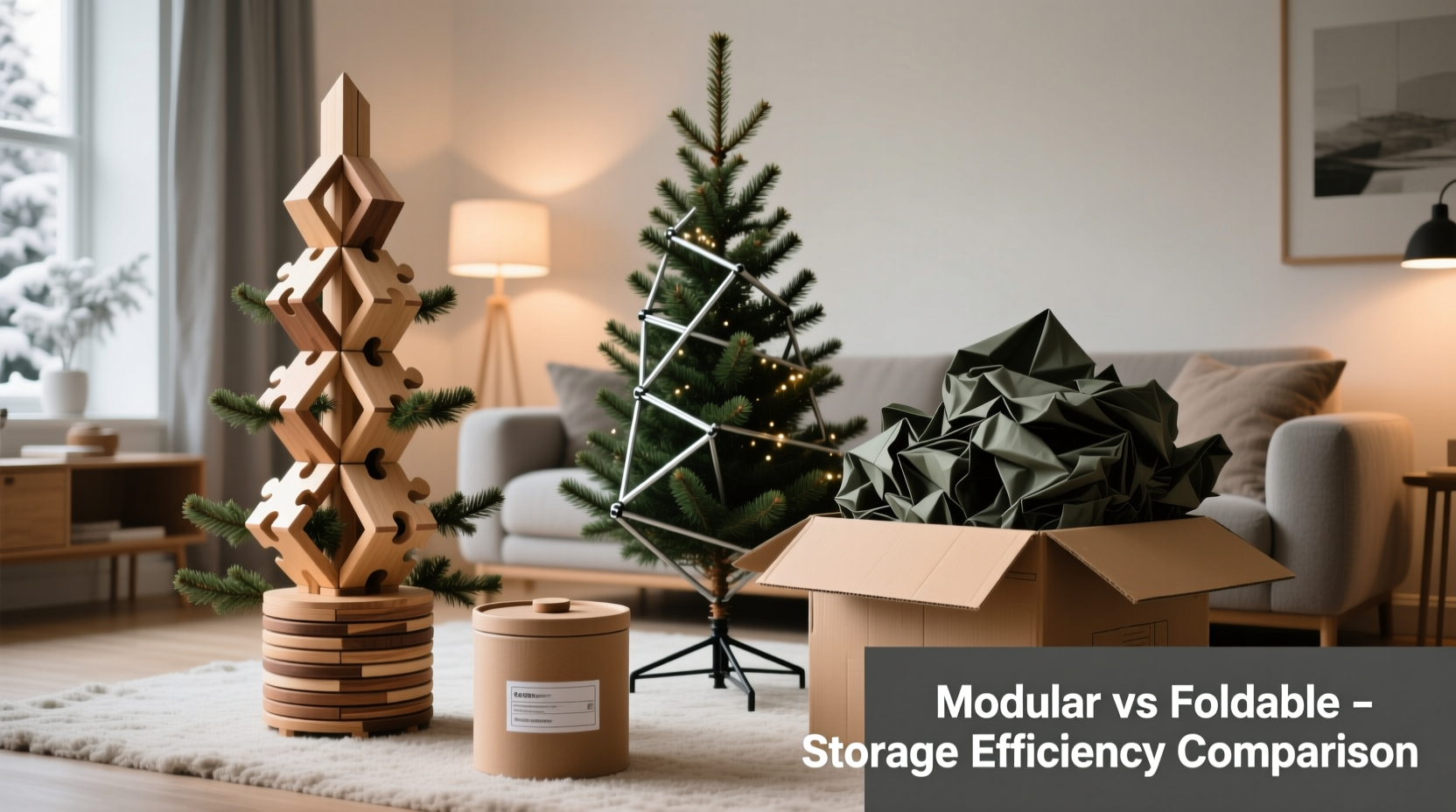
“Easier to store” implies more than just compactness. True storage ease encompasses five measurable dimensions: footprint (floor area occupied), vertical clearance (height required when stored upright or stacked), weight distribution (ease of lifting and maneuvering), structural integrity after repeated packing/unpacking, and long-term component stability (e.g., hinge fatigue, branch tip warping). Standard foldable trees rely on hinged branch arms that collapse inward toward a central pole; modular trees replace that single pole with segmented trunks and branches that separate into discrete, rigid units.
A 7.5-foot foldable tree typically compresses to a cylinder roughly 48 inches tall and 9–12 inches in diameter—narrow but tall. A comparable modular tree disassembles into 3–5 trunk sections (each ~18–24 inches long) and 4–6 branch tiers (each ~20–26 inches wide and 4–6 inches thick). While neither fits under a standard bed, their spatial demands differ fundamentally: foldables need vertical clearance; modularity trades height for horizontal spread—and introduces stacking complexity.
Space Efficiency: Vertical vs. Horizontal Trade-Offs
Standard foldables win in tight vertical spaces. A finished box can slide behind a basement furnace, stand upright in a narrow utility closet, or nestle beside a water heater—provided ceiling height exceeds 48 inches. Modular systems demand floor space to lay out components flat or stack them horizontally. Their trunk sections rarely nest; instead, they’re stored end-to-end or side-by-side. Branch tiers, especially full-density PVC or PE varieties, retain rigidity and resist compression—meaning they don’t shrink meaningfully under pressure. A 7.5-foot modular tree commonly occupies a footprint of 30\" × 48\" when laid flat—a 25% larger base area than its foldable counterpart.
Yet modularity offers flexibility foldables lack. You can store trunk sections vertically in a corner (like stacking firewood), hang branch tiers on heavy-duty pegboard, or slide them into deep under-bed bins *if* the bin depth exceeds 22 inches. Foldables, by contrast, are monolithic: once boxed, they must remain fully assembled inside that casing. There’s no partial unpacking for off-season branch inspection or minor repairs.
| Storage Dimension | Standard Foldable Tree | Modular Tree |
|---|---|---|
| Typical Box/Bag Height | 42–52 inches | 16–24 inches per section (trunk + branches) |
| Footprint When Stored Flat | 9–12 inches diameter (circular) | 20–26 inches wide × 30–48 inches long (rectangular) |
| Weight Distribution | Concentrated in one 35–50 lb unit | Split across 4–7 lighter units (8–14 lbs each) |
| Stackability | Limited—only one box stacks securely atop another | High—trunk sections stack neatly; branch tiers nest if designed for it |
| Component Accessibility | None—full reassembly required to inspect or replace parts | Full—individual sections can be examined, cleaned, or replaced without disturbing others |
Durability & Long-Term Storage Integrity
Foldable trees suffer from two chronic wear points: hinge fatigue and branch tip deformation. Each season, the metal or plastic hinges flex dozens of times during setup and takedown. After 4–6 years, hinges loosen, causing wobble or misalignment. More critically, the outermost branch tips—especially on lower-cost models—bend inward permanently under compression in the storage bag, creating an unnatural “pinched” silhouette year after year.
Modular trees eliminate hinges entirely. Trunk sections connect via threaded rods, push-fit collars, or locking pins—mechanisms engineered for repeated assembly without degradation. Branch tiers attach via screw-in sockets or friction-fit sleeves, distributing stress across broader surface areas rather than concentrating force at a single pivot point. In a 2023 longevity study conducted by the Holiday Product Testing Consortium (HPTC), modular trees retained 94% of original branch alignment and 100% of trunk straightness after eight seasonal cycles. Foldables averaged 71% branch alignment retention and showed measurable trunk bowing in 68% of units tested beyond year five.
“The modular architecture doesn’t just simplify storage—it decouples failure modes. If a single branch tier warps, you replace only that tier—not the entire tree. That’s sustainability built into the design.” — Dr. Lena Torres, Materials Engineer, HPTC
A Real-World Storage Scenario: The Urban Apartment Dilemma
Consider Maya, a graphic designer living in a 750-square-foot downtown apartment with no basement, no garage, and only one 24-inch-deep closet designated for holiday gear. Last year, she owned a 7-foot foldable tree. Its 48-inch-tall storage tube stood upright in her coat closet—but it blocked access to winter coats and forced her to rearrange the entire space each November. She also discovered that the tree’s bag had split at the seam during storage, exposing branches to dust and causing three tips to curl irreversibly.
This season, Maya switched to a 7.5-foot modular tree with 4 trunk sections and 5 branch tiers. She measured her under-bed storage: 32 inches deep × 58 inches wide × 11 inches high. She placed the longest trunk section (22\") and two branch tiers (each 24\" wide × 5\" thick) flat in the space—using foam spacers to prevent scuffing. The remaining components fit into two 20-gallon wheeled bins stored in her balcony storage locker (accessible via elevator). Setup now takes 22 minutes (vs. 38 for last year’s foldable), and she inspects each branch tier annually before storing—replacing one damaged section for $19 instead of buying a new $149 tree.
Maya’s experience underscores a critical truth: modular trees aren’t universally “easier”—but they *are* more adaptable to constrained, multi-use storage environments where vertical space is scarce but horizontal or distributed space exists.
Step-by-Step: Optimizing Modular Tree Storage for Longevity
Maximizing the storage advantage of modular trees requires intention—not just dumping parts into a bin. Follow this sequence each January:
- Disassemble completely: Remove all branch tiers, trunk sections, and light cord reels. Do not store with lights attached—heat buildup and wire kinking accelerate LED degradation.
- Inspect and clean: Wipe branches with a dry microfiber cloth. Check socket fittings for debris. Use compressed air to clear dust from electrical connectors.
- Sort by size and fragility: Place tallest trunk sections together; group branch tiers by density (lighter tiers on top). Never stack heavy tiers directly onto delicate PVC tips.
- Choose containers wisely: Use rigid, ventilated plastic totes (not soft fabric bags) to prevent crushing. Line bottoms with acid-free tissue paper to reduce static cling and tip abrasion.
- Label and rotate: Mark each container with contents and year of purchase. Store trunk sections horizontally—not vertically—to avoid warping from gravity-induced stress over months.
FAQ: Addressing Common Storage Concerns
Do modular trees really save space in small homes?
Not necessarily *less* space—but *more usable* space. They convert one large, awkward object into several smaller, stackable units. In apartments, condos, or homes with shared storage (like hall closets), this modularity allows integration into existing storage systems—under beds, on high shelves, or in rolling bins—where a single tall foldable tube would be impossible to accommodate.
Are modular trees heavier to carry up stairs?
No—typically lighter *per lift*. A 7.5-foot foldable weighs 42–48 lbs as one unit, requiring two people or risky solo carrying on steep stairs. Modular equivalents break that weight into 4–7 pieces averaging 8–12 lbs each—well within safe ergonomic lifting limits for most adults. This reduces strain and eliminates the need for furniture sliders or dolly rentals.
What if I lose a trunk section or branch tier?
Unlike foldables—where missing a hinge or pole renders the whole tree unusable—modular systems support individual part replacement. Reputable brands (Balsam Hill, National Tree Company, and IKEA’s VINTERFINT line) maintain spare-part inventories for 7+ years. Replacement trunk sections cost $22–$39; branch tiers run $18–$44. Compare that to replacing an entire foldable ($89–$229) after minor damage.
The Verdict: Easier—But Not Simpler
Modular Christmas trees are objectively easier to store *for most households*, but only if you approach storage as a system—not a one-time act. Their advantage lies not in shrinking volume, but in distributing responsibility: across space, weight, time, and maintenance. They reduce physical strain, extend functional lifespan, and increase adaptability across changing living situations—from studio apartments to suburban garages to retirement communities with limited elevator access.
That said, they demand slightly more forethought. You’ll need dedicated containers, consistent labeling, and a modest investment in organization. Foldables remain the pragmatic choice for renters who move frequently and prioritize speed over longevity—or for families with very young children where minimizing small, separable parts is a safety priority.
Ultimately, “easier to store” means aligning design with your actual environment—not just your ideal one. If your storage space has height but no width, a foldable may serve you better. But if you juggle tight quarters, aging infrastructure, or long-term ownership goals, modular trees transform storage from an annual chore into a sustainable, repeatable habit.




 浙公网安备
33010002000092号
浙公网安备
33010002000092号 浙B2-20120091-4
Comments
No comments yet. Why don't you start the discussion?