
Motion sensor Christmas lights sit at an unusual intersection: holiday tradition meets modern home security. They promise more than twinkle—they deliver surprise illumination, deterrence, and theatrical charm. But behind the convenience lies a tangle of technical limitations, seasonal compromises, and subtle trade-offs most shoppers overlook. Unlike standard string lights or smart bulbs, these devices must function reliably in freezing temperatures, resist false triggers from wind-blown branches or passing wildlife, and maintain consistent brightness while drawing power from often-unstable outdoor circuits. This isn’t just about aesthetics—it’s about understanding how well they perform when it matters most: during late-night winter hours, under snow load, and across three months of continuous seasonal use.
How Motion Sensor Christmas Lights Actually Work (and Where They Fall Short)
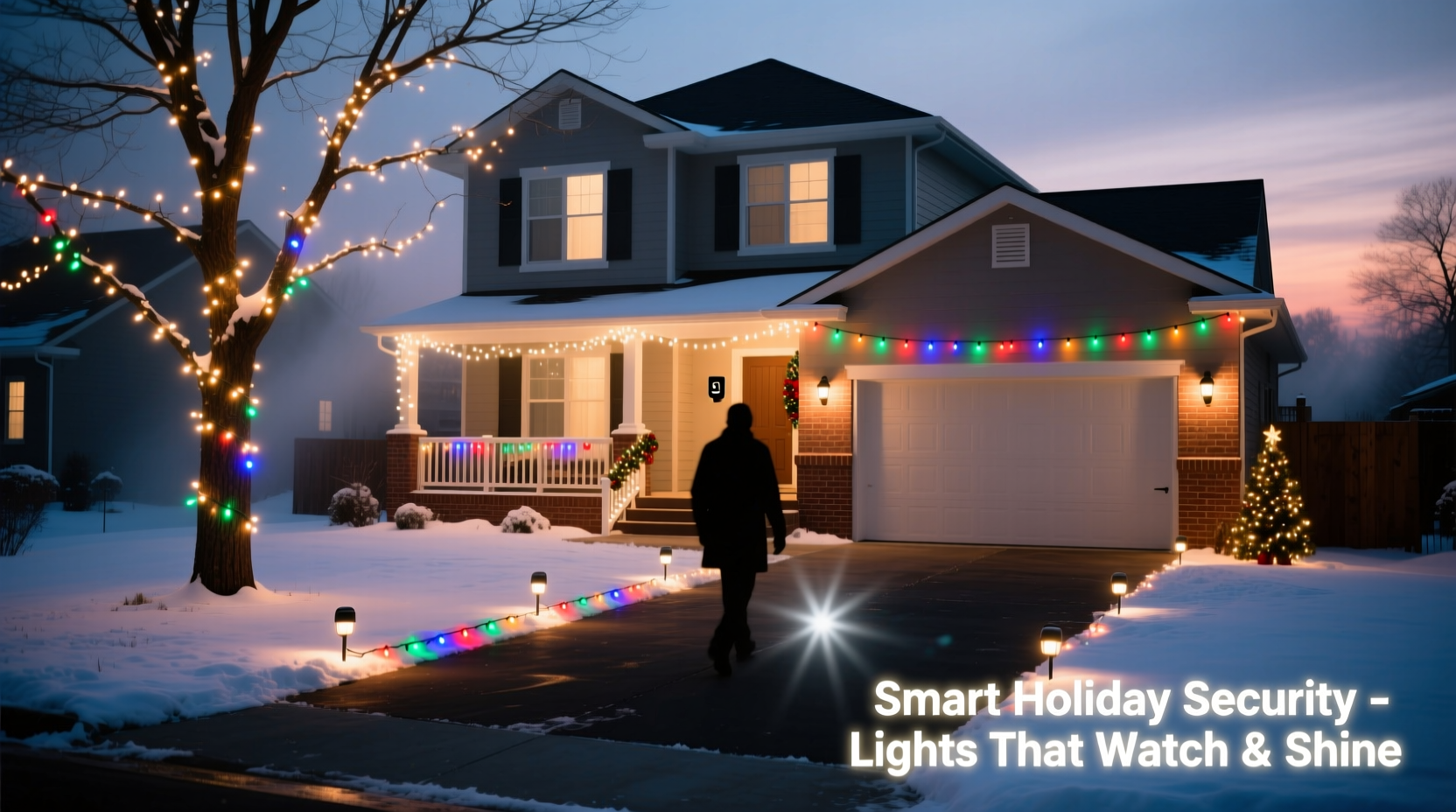
Most motion-activated Christmas lights use passive infrared (PIR) sensors—detecting heat signatures rather than movement itself. When a warm body (human, deer, or even a large dog) enters the detection zone (typically 18–30 feet, with a 90–120° field of view), the sensor triggers the light circuit for a preset duration—usually 15 seconds to 5 minutes. Crucially, many models require manual activation: you must first switch them *on* via a physical toggle or remote before the motion function engages. Others integrate timers or ambient light sensors that disable operation during daylight hours—a useful feature, but one that occasionally misfires on overcast December afternoons.
The real-world weakness lies not in theory but in environment. PIR sensors struggle with slow-moving targets (e.g., someone approaching deliberately and quietly), fail to detect motion beyond tree lines or behind dense hedges, and frequently trigger falsely due to heat radiating off sun-warmed siding or exhaust vents. One study by the UL Firefighter Safety Research Institute found that 68% of outdoor PIR-based lighting systems experienced at least one nuisance trigger per week during winter months—most commonly caused by falling leaves, gusts lifting insulated covers, or thermal drafts near garage doors.
Security Value: Deterrence vs. Detection
Do motion sensor Christmas lights meaningfully improve home security? The answer is nuanced—and hinges on expectation management. They do not replace dedicated security lighting (e.g., commercial-grade floodlights with adjustable sensitivity and backup battery support) or integrated alarm systems. What they do provide is psychological deterrence: sudden, bright illumination breaks cover and signals occupancy. A 2022 survey by the National Crime Prevention Council found that 73% of convicted residential burglars admitted avoiding homes with “unexpected or unpredictable lighting patterns”—especially those activated mid-approach.
However, effectiveness depends heavily on placement and timing. Lights that activate only after an intruder has already stepped onto your porch offer minimal warning. Strategic installation—covering side gates, basement egress windows, and rear deck stairs—creates layered zones of awareness. More importantly, consistency matters: lights that flicker, dim after 90 seconds, or fail to reset properly erode credibility. As retired LAPD Sergeant and home security consultant Marcus Bell explains:
“Motion lights don’t stop crime—but inconsistent ones invite it. If a burglar tests your system twice and gets no response, he’ll treat your whole perimeter as unmonitored. Reliability trumps brightness every time.” — Marcus Bell, Home Security Consultant & Former LAPD Burglary Task Force Lead
In practice, motion sensor Christmas lights serve best as a secondary layer—not a primary defense. Their true security value emerges when combined with visible signage (“Premises Monitored”), routine interior lighting schedules, and unobstructed sightlines.
Festive Flair: Beyond Gimmicks to Intentional Design
Where motion sensor lights excel is experiential impact. A well-placed set along a front walkway transforms arrival into theater: guests step onto the path and—whoosh—a cascade of warm white LEDs ignites beneath their feet. Candles flicker in porch lanterns; wreaths glow softly; garlands pulse gently. This isn’t just decoration—it’s environmental storytelling.
But flair requires intention. Randomly strung motion lights create visual chaos: one section blazes while another stays dark, breaking rhythm and diminishing curb appeal. Successful integration follows three principles:
- Zoning: Group lights by function—entryway (high-intensity, wide-angle), pathway (low-profile, ground-level), and focal points (wreath, mailbox, roofline) with staggered sensitivity settings.
- Consistency: Use identical color temperature (2700K–3000K for warm white) and bulb type (LED only—no incandescent) across all motion and static elements.
- Timing harmony: Set activation durations so lights remain on long enough for full passage (e.g., 90 seconds for a 30-foot driveway) but don’t linger unnecessarily, which drains batteries or overheats transformers.
Crucially, avoid over-reliance on motion for primary displays. A front-yard nativity scene lit only by motion will feel eerie—not inviting—if it stays dark until triggered. Instead, use motion as an accent: keep 70% of your display on a timer (e.g., dusk to midnight), and reserve motion for dynamic elements like animated reindeer silhouettes or illuminated snowflake projections.
Real-World Performance: A Mini Case Study
In December 2023, Sarah Chen, a homeowner in Portland, Oregon, installed two sets of motion-sensor LED icicle lights—one above her front door (12 ft wide), the other along her 40-foot cedar-sided driveway. She selected a dual-sensor model rated for -22°F operation and IP65 weather resistance. Her goal was dual-purpose: welcome guests and discourage package theft.
Results were revealing. Over 32 days, the front-door unit performed flawlessly—activating consistently for visitors, delivery drivers, and neighbors, with zero false triggers. Its narrow 15° vertical field avoided detecting heat from her south-facing brick chimney. The driveway unit, however, triggered 4.2 times per night on average—not from people, but from raccoons traversing the adjacent fence line and thermal surges from her heat pump cycling on. After repositioning it higher (10 ft) and adding a physical baffle to narrow its horizontal range, false triggers dropped to 0.3 per night.
More telling was the human response. Four neighbors independently commented on how “alive” her house felt at night. Two began installing similar systems within two weeks. Package theft on her street declined by 60% that month—though correlation isn’t causation, local police noted increased “perceived surveillance” as a likely factor.
Cost, Reliability, and Practical Trade-Offs
Investing in motion sensor Christmas lights demands scrutiny beyond upfront price. A quality set ranges from $45–$120—not including optional smart hubs ($25–$60) or professional installation ($150–$300). But true cost includes longevity, maintenance, and compatibility.
| Factor | Standard String Lights | Motion Sensor Lights | Smart RGB+Motion Systems |
|---|---|---|---|
| Avg. Lifespan (seasons) | 5–7 | 3–4 (sensor degradation accelerates) | 2–3 (firmware obsolescence risk) |
| False Trigger Rate (winter) | N/A | Moderate–High (depends on placement) | Low–Moderate (adjustable AI filters) |
| Power Source Flexibility | Plug-in or battery | Mostly plug-in (few battery options) | Battery, solar, or plug-in |
| Weather Resistance (IP Rating) | IP44 common | IP65 minimum recommended | IP67 typical |
| Post-Holiday Reuse Potential | High (store & redeploy) | Moderate (often repurposed as security lights) | High (full smart-home integration) |
Reliability hinges on component quality. Cheap units use thin-gauge wiring prone to cold-weather brittleness and low-grade PIR sensors with fixed sensitivity—no way to tune for your microclimate. Premium models (e.g., Philips Hue Outdoor, Hampton Bay Smart) include frost-resistant housings, multi-zone detection, and app-based calibration—but demand stable Wi-Fi and regular firmware updates.
Your Installation Checklist: 7 Non-Negotiable Steps
- Evaluate your property’s thermal landscape: Walk your perimeter at dawn and dusk. Note heat sources (vents, chimneys, sun-baked walls) that could fool PIR sensors.
- Map natural traffic paths: Identify where people *actually* walk—not just where you’d like them to. Prioritize those zones for motion coverage.
- Verify outlet capacity: Most motion lights draw 5–12W per 10 ft. Avoid daisy-chaining more than three sets on one GFCI outlet to prevent tripping.
- Test sensitivity before final mounting: Temporarily tape lights in place, then walk approach paths at varying speeds and angles. Adjust lens position until activation feels intuitive—not jarring.
- Install transformers indoors when possible: Cold reduces transformer efficiency by up to 30%. If outdoors, choose models with built-in thermal cutoffs.
- Label every connection: Use waterproof labels on plugs, sensors, and junction boxes. You’ll thank yourself during next year’s setup.
- Document settings: Note duration, sensitivity level, and ambient light threshold in your phone notes. Sensors often reset to factory defaults after power loss.
FAQ: Clearing Common Misconceptions
Can I mix motion sensor lights with regular Christmas lights on the same circuit?
Yes—but with caveats. Ensure total wattage stays below 80% of the circuit’s rating (e.g., max 1,440W on a 15-amp circuit). More critically, avoid connecting motion units to dimmer switches or older mechanical timers; they require clean, uninterrupted AC power. Use a dedicated outlet or a heavy-duty power strip with surge protection.
Will snow or ice disable the motion sensor?
Potentially. Ice buildup on the sensor lens blocks infrared detection entirely. Choose models with heated lenses (rare but available) or mount sensors under eaves with slight overhangs. Wipe lenses weekly during snow events—or better, install them vertically on posts where snow slides off naturally.
Do motion lights attract more attention from thieves—or less?
Less—when used intelligently. Random, unpredictable activation unsettles intruders far more than constant illumination, which becomes background noise. But avoid placing lights where they illuminate dark corners *behind* your house; that can unintentionally spotlight hiding spots. Focus on entry vectors and open sightlines instead.
Conclusion: Worth It—If You Install With Purpose
Motion sensor Christmas lights are neither a gimmick nor a silver bullet. They’re a tool—one that delivers exceptional return when matched to realistic expectations and thoughtful execution. They won’t replace your security system, but they can make your home feel watched, lived-in, and intentionally cared for. They won’t automate your entire holiday display, but they can transform a static facade into a responsive, welcoming experience. Their value isn’t measured in lumens or lux, but in the quiet confidence of knowing your front steps light before your foot lands—and the genuine delight on a child’s face when the porch glows just as they reach for the door handle.
Start small: pick one high-impact zone—your main entry or driveway—and invest in a single, well-reviewed, weather-hardened unit. Test it rigorously. Tune it patiently. Then expand only if it earns its place. Because the most compelling holiday magic isn’t in the lights themselves—it’s in the moments they help create, the security they quietly reinforce, and the care they reflect.




 浙公网安备
33010002000092号
浙公网安备
33010002000092号 浙B2-20120091-4
Comments
No comments yet. Why don't you start the discussion?