
When it comes to decorating shrubs and bushes for the holidays, choosing between net lights and individual light strands can significantly impact both your installation effort and final aesthetic. While both options deliver festive charm, their ease of use, coverage, and long-term maintenance differ in meaningful ways. For homeowners looking to minimize ladder time and maximize visual impact, understanding these differences is essential. This guide explores real-world performance, installation logistics, and practical considerations to help you decide which method best suits your landscape.
Understanding Net Lights vs. Individual Strands
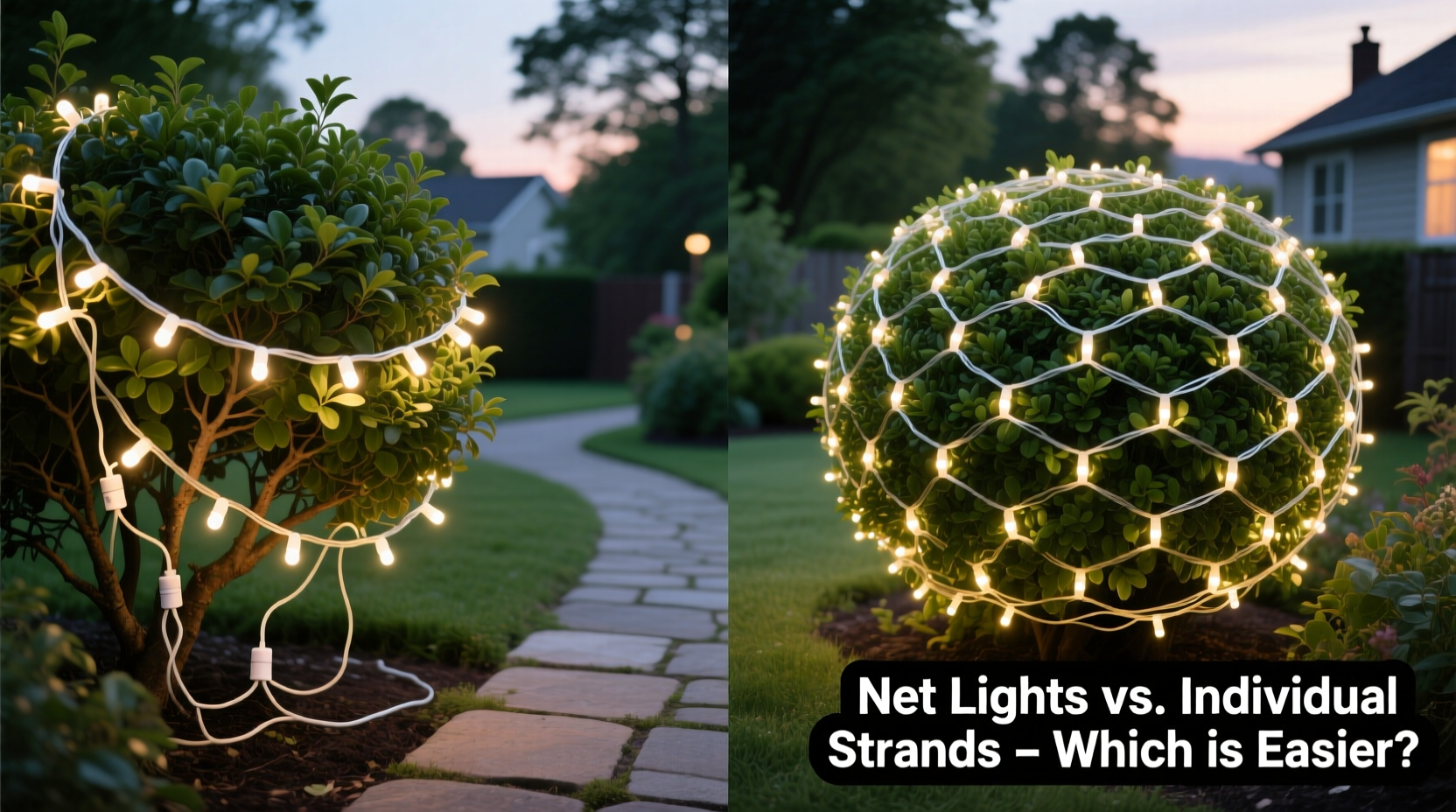
Net lights—also known as mesh or curtain lights—are pre-wired grids of LED bulbs spaced evenly across a flexible netting material. They come in various sizes and colors, typically designed to drape over bushes, hedges, or fences. Their structure allows for near-instant coverage with minimal adjustment.
Individual light strands, by contrast, are traditional strings of lights that must be manually wrapped around foliage. These offer greater flexibility in placement but require more time and precision to achieve even illumination. While they allow customization, they also increase labor intensity, especially on dense or irregularly shaped bushes.
The core difference lies in approach: net lights prioritize speed and uniformity; individual strands emphasize control and adaptability.
Coverage and Aesthetic Impact
Net lights excel at delivering consistent brightness across flat or gently rounded surfaces. Because each bulb is fixed in place, shadows and dark spots are minimized when applied correctly. They’re particularly effective on boxwood hedges, yew bushes, or foundation plantings with predictable shapes.
However, their rigidity becomes a drawback on thick, three-dimensional shrubs like arborvitae or juniper. The net may only cover one side effectively, leaving the interior and opposite face dimly lit. In such cases, multiple nets or supplemental strand lighting may be needed.
Individual strands, though slower to install, conform precisely to contours. By weaving lights through branches from multiple angles, you create a fuller, more immersive glow. This technique works well for spherical or voluminous bushes where depth matters more than speed.
Installation Time and Labor Comparison
Time is often the deciding factor during busy holiday seasons. Net lights dramatically reduce setup duration. A typical 6' x 6' net can cover an average shrub in under five minutes—simply drape, secure with clips or twist ties, and plug in.
Wrapping the same bush with individual strands may take 20–40 minutes, depending on density and desired coverage. Each loop must be spaced carefully to avoid clumping or gaps. Overlapping rows are necessary for fullness, increasing physical strain and time spent balancing on ladders or bending over.
A study conducted by the National Outdoor Lighting Association found that homeowners using net lights reported 65% less installation time compared to those using traditional strands on comparable landscaping. While not scientific, this aligns with widespread anecdotal feedback from DIY decorators.
“Net lights are a game-changer for clients who want professional-looking results without spending hours outside.” — Marcus Tran, Residential Lighting Designer, Pacific Holiday Illuminations
Step-by-Step Installation Timeline
Net Light Setup (Estimated: 5–8 minutes per bush)
- Measure the bush width and height to select appropriately sized net.
- Lay the net flat and check for burnt-out bulbs or damaged wires.
- Drape the net over the front and sides of the bush, ensuring even alignment.
- Secure corners using plastic-coated wire ties or plant-safe clips.
- Connect to power source and test operation.
- Adjust sagging areas or reposition if needed.
Individual Strand Setup (Estimated: 25–45 minutes per bush)
- Estimate total length needed (typically 100–200 lights per foot of shrub height).
- Begin at the base, wrapping upward in a spiral motion.
- Weave lights into inner branches every few inches for depth.
- Overlap rows slightly to eliminate dark zones.
- Anchor ends securely with clips or zip ties.
- Test connection and adjust spacing as necessary.
Durability and Reusability Considerations
Longevity plays a major role in cost-effectiveness. Net lights, while convenient, are more vulnerable to damage during storage and handling. The interconnected grid can snag, and a single broken bulb or severed wire may disable an entire section. Additionally, folding or cramming nets into boxes often leads to bent sockets or frayed wiring over time.
Individual strands, being modular, are inherently more resilient. If one section fails, only that segment needs replacement. High-quality strands with replaceable bulbs or shatterproof casings can last a decade or more with proper care.
Storage methods further influence lifespan. Net lights should be rolled or folded carefully along original seams and stored in breathable containers. Strands benefit from reel-based winding to prevent tangling. Both types should be kept in cool, dry locations away from rodents and moisture.
Checklist: Preparing for Bush Lighting Success
- ✔ Assess bush size and shape before selecting lighting type
- ✔ Choose LED lights for energy efficiency and cooler operation
- ✔ Inspect all bulbs and cords for damage before installation
- ✔ Use weather-resistant extension cords rated for outdoor use
- ✔ Secure lights with non-damaging fasteners (plastic clips, coated ties)
- ✔ Test lights before final placement
- ✔ Label storage containers with size and color for next season
Practical Trade-Offs: When to Choose Which Option
The choice isn’t always binary. Many experienced decorators combine both methods strategically. For example, net lights might cover the front face of a large shrub quickly, while individual strands wrap around the sides and top for added dimension.
Consider the following factors when making your decision:
| Factor | Net Lights Advantage | Individual Strands Advantage |
|---|---|---|
| Installation Speed | ✅ Very fast – minutes per bush | ❌ Slower – requires wrapping |
| Coverage Uniformity | ✅ Even spacing, no gaps | ⚠️ Depends on installer skill |
| Three-Dimensional Effect | ⚠️ Flat appearance unless layered | ✅ Deep, immersive glow |
| Storage & Longevity | ⚠️ Prone to tangles and breakage | ✅ Modular, easier to repair |
| Cost (per square foot) | ✅ Lower upfront for coverage | ⚠️ More lights needed for fullness |
| Reusability | ⚠️ Degrades faster if mishandled | ✅ Longer lifespan with care |
For seasonal rentals or temporary displays, net lights offer unbeatable convenience. Homeowners planning multi-year use may find greater value in investing time upfront with individual strands.
Mini Case Study: The Henderson Family’s Front Yard Upgrade
The Hendersons in Portland, Oregon, maintain four large holly bushes flanking their entryway. For years, they used individual strands, spending nearly two full weekends each December to achieve balanced lighting. Frustrated by inconsistent results and tangled cords, they switched to green-stringed white net lights in 2022.
They selected 7' x 7' nets to accommodate the height of their bushes. Installation dropped to under 30 minutes total. Neighbors complimented the clean look, though Mrs. Henderson noted the backside remained dark. To address this, she added a single strand wrapped loosely around the rear in 2023, taking just ten extra minutes.
“We got 80% of the effect in 20% of the time,” Mr. Henderson said. “The nets did the heavy lifting, and one strand finished the job.”
Expert Tips for Maximizing Results
No lighting solution performs well without proper technique. Whether using nets or strands, follow these proven strategies:
- Pre-lay your design: Unplug and drape lights loosely before securing to visualize coverage.
- Layer for depth: Combine net fronts with subtle inner strand lighting for a professional effect.
- Use timers: Set automatic on/off cycles to extend bulb life and save energy.
- Avoid overloading circuits: Connect no more than three standard sets to one outlet unless labeled otherwise.
Frequently Asked Questions
Can I cut net lights to fit smaller bushes?
No. Cutting any part of a net light grid will disrupt the circuit and likely render the entire section inoperable. Instead, choose a smaller-sized net or fold excess sections discreetly behind the bush.
Do net lights work on round, full bushes?
Partially. They cover the front well but struggle with curvature. For spherical shrubs, consider using two overlapping nets from different angles or supplement with a few wrapped strands for complete coverage.
Which option uses more electricity?
Energy consumption depends on bulb count and type, not format. Most modern net and strand lights use LEDs, drawing about 0.5–2 watts per set. A 7' net with 100 bulbs consumes roughly the same as a 100-light strand. Always check product labels for wattage details.
Final Recommendation: Match Method to Your Needs
If your priority is speed, simplicity, and consistent front-facing brilliance, net lights are objectively easier to install than individual strands—especially on flat or low-profile bushes. They reduce physical strain, shorten project timelines, and deliver instant holiday cheer with minimal effort.
However, for maximum visual impact on full, sculptural shrubs, individual strands remain superior. Their ability to penetrate deep into foliage creates a luminous, three-dimensional effect that nets cannot replicate alone.
The smartest approach often involves both. Use net lights as your base layer for rapid coverage, then enhance with targeted strands where depth and dimension matter most. This hybrid strategy balances efficiency with elegance, giving you the best of both worlds.
“The goal isn’t perfection—it’s joy. Choose the method that lets you enjoy the season, not just endure the setup.” — Lena Pruitt, Landscape Lighting Consultant, Evergreen Illumination Co.
Take Action This Season
This holiday season, evaluate your bushes with fresh eyes. Measure them, assess their shape, and decide whether speed or depth matters most. Try net lights on one shrub and strands on another—see which delivers the result you love with the least hassle. Document what works, label your gear accordingly, and build a repeatable system for years to come.




 浙公网安备
33010002000092号
浙公网安备
33010002000092号 浙B2-20120091-4
Comments
No comments yet. Why don't you start the discussion?