
Every holiday season, homes across the country light up with festive displays—strings of LEDs, animated figures, and glowing wreaths. While these decorations bring joy, they also raise questions about energy use and convenience. One popular solution: programmable timers for Christmas lights. Marketed as a way to automate your display and reduce electricity waste, these devices promise both efficiency and ease. But do they actually save meaningful energy, or are they simply another layer of tech that adds cost and confusion? The answer isn’t straightforward—and depends on how you use them, what kind of lights you have, and your household habits.
How Programmable Timers Work (And Why They’re Everywhere)
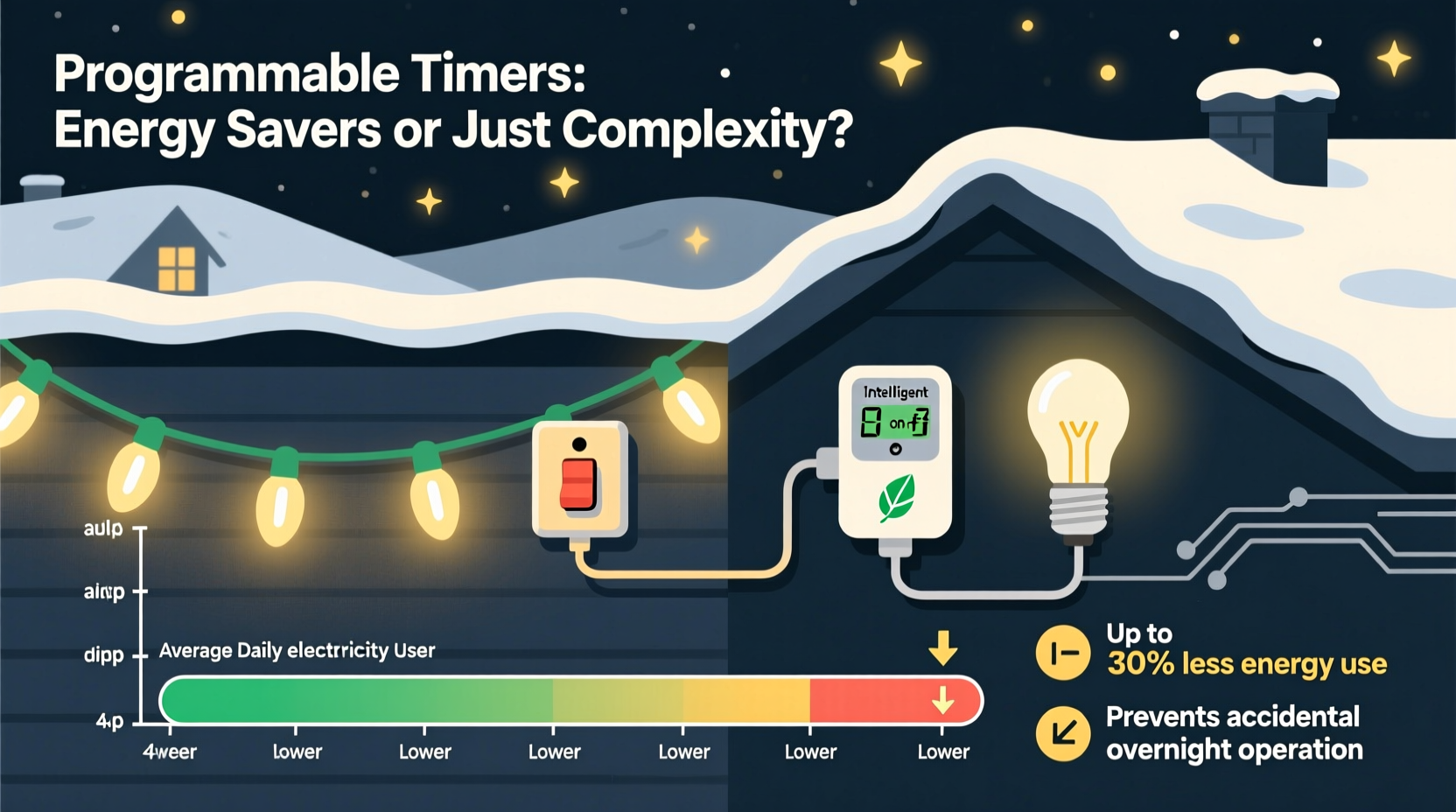
Programmable Christmas light timers are small plug-in devices that connect between your wall outlet and your light strings. They allow users to set specific times for lights to turn on and off automatically. Some models offer basic daily schedules; others include features like randomization, sunrise/sunset tracking via light sensors, or even Wi-Fi connectivity for remote control via smartphone apps.
The idea is simple: instead of leaving lights on all night—or worse, forgetting to turn them off altogether—the timer ensures they operate only during desired hours. This prevents unnecessary runtime, which in theory reduces energy consumption. For households with multiple displays or busy schedules, automation offers peace of mind and consistent curb appeal.
But while the concept sounds efficient, real-world savings depend on several factors—including baseline usage patterns, bulb type, and whether manual control would have been equally effective without any added device.
Energy Savings: Real or Overstated?
To assess whether timers save energy, it’s essential to understand typical Christmas light power draw. Modern LED string lights consume far less than older incandescent models. A standard 100-light LED strand uses about 4–7 watts. In contrast, an equivalent incandescent set can draw 40–50 watts or more.
Consider this scenario: a homeowner runs three strands of incandescent lights (totaling ~150 watts) from 5 PM to 11 PM daily—six hours. That’s 0.9 kWh per day, or roughly 27 kWh over a 30-day season. At an average U.S. electricity rate of $0.15/kWh, that’s about $4.05 in cost.
If those same lights were left on all night (say, 16 hours), consumption jumps to 2.4 kWh per day, totaling 72 kWh and costing $10.80—a difference of $6.75. A timer that limits operation to six evening hours would prevent that waste.
Now apply the same math to LED lights drawing 20 watts total. Six hours equals 1.8 kWh/month ($0.27), while 16 hours equals 4.8 kWh/month ($0.72). The savings from using a timer? Just $0.45 over the season.
This illustrates a key point: **timers save proportionally more when used with high-wattage, inefficient lights**. With modern LEDs, the absolute energy reduction is small—even if percentage-wise it seems substantial.
“Timers make the most sense when paired with older lighting technology. For today’s ultra-efficient LEDs, the energy payoff is minimal unless usage habits are extremely inconsistent.” — Dr. Lena Patel, Energy Efficiency Researcher at the National Grid Innovation Lab
When Timers Add Value Beyond Energy
While energy savings may be modest—especially with LED lights—programmable timers offer other tangible benefits:
- Safety: Prevents overheating risks from forgotten lights, particularly important with older wiring or indoor displays near flammable materials.
- Security: Scheduled lighting creates the appearance of occupancy, deterring potential intruders during long holiday absences.
- Convenience: Eliminates nightly trips to unplug lights, especially useful for hard-to-reach outdoor installations.
- Consistency: Ensures lights go on at the same time every evening, enhancing neighborhood aesthetics and family traditions.
In urban areas where noise ordinances or community guidelines limit late-night lighting, timers help residents comply effortlessly. Similarly, parents managing children’s excitement around the holidays often appreciate automated routines that preserve magic without encouraging late-night viewing.
Wi-Fi-enabled smart timers take this further by allowing adjustments based on weather, travel plans, or daylight changes—all without touching a switch.
Do Timers Introduce Unnecessary Complexity?
Despite their advantages, programmable timers aren’t universally beneficial. Many users report frustration with setup processes, unreliable performance, or unexpected behavior due to power surges, dead batteries (in some models), or incorrect time settings after daylight saving shifts.
Basic mechanical timers require manual programming each week and lack flexibility. Digital versions may need frequent reconfiguration, and app-based systems depend on stable home Wi-Fi and compatible smartphones—barriers for older adults or less tech-savvy users.
Moreover, some budget-friendly timers draw a small amount of standby power themselves—even when switches are off. Though negligible individually (often less than 0.5 watts), this “vampire drain” slightly offsets the energy saved by turning off lights earlier.
There’s also the environmental cost of manufacturing and disposing of additional electronic devices. If a timer extends the life of a lighting habit by only a few years, its carbon footprint must be weighed against the cumulative energy savings.
Comparison: Manual vs. Timer-Controlled Lighting
| Factor | Manual Control | Programmable Timer |
|---|---|---|
| Energy Savings Potential | High—if consistently managed | Moderate to high, depending on bulb type |
| User Effort Required | High (daily action needed) | Low after initial setup |
| Reliability | Depends on memory/habits | Generally reliable, but prone to glitches |
| Cost (Upfront) | $0 | $10–$50 per unit |
| Best For | Simple setups, disciplined users | Complex displays, frequent travelers, large homes |
Mini Case Study: The Johnson Family’s Holiday Lighting Upgrade
The Johnsons, a family of five in suburban Minnesota, had been using the same set of incandescent Christmas lights for over a decade. Their front yard display included roof outlines, tree wraps, and a lit nativity scene—totaling nearly 1,200 bulbs. They manually turned the system on around dusk and off before bed, but often forgot, leaving lights running until dawn.
In 2022, they invested in two programmable outdoor timers and upgraded half their display to LED equivalents. They programmed the timers to run from 5:30 PM to 10:30 PM daily.
Before: Estimated annual energy use was 180 kWh (mostly incandescent), costing $27 at local rates. Actual usage likely exceeded this due to frequent all-night operation.
After: With mixed LED/incandescent load and enforced schedule, measured usage dropped to 85 kWh. Cost: $12.75. Net savings: ~$14 annually.
The timers paid for themselves within two seasons. More importantly, the family reported reduced stress around remembering to shut off lights and greater confidence in home security during weekend trips.
However, one timer failed mid-season due to moisture exposure, requiring replacement. They now use weatherproof enclosures—a lesson learned the hard way.
Step-by-Step Guide: Maximizing Value from Your Christmas Light Timer
- Assess your current lighting: Identify whether you’re using incandescent or LED strings. Use a wattage meter or check packaging labels.
- Calculate baseline usage: Multiply total wattage by average daily runtime to estimate monthly kWh.
- Determine ideal on/off schedule: Most neighborhoods prefer lights between 5 PM and 10 PM. Align with local norms or HOA rules.
- Select the right timer: For simple needs, choose a mechanical dial timer. For flexibility, pick a digital or smart model with sunset tracking.
- Install safely: Use GFCI outlets outdoors, protect connections from rain, and avoid daisy-chaining multiple high-draw devices.
- Test and monitor: Run a trial week, then verify actual on/off times. Adjust for seasonal daylight changes.
- Evaluate annually: Compare electricity bills month-over-month. Replace failing units promptly.
Frequently Asked Questions
Can a timer save money if I already turn my lights off every night?
Possibly not. If your manual routine is consistent and aligns with optimal hours (e.g., 6–8 PM), the energy savings from a timer will be negligible. The value then shifts entirely to convenience or backup assurance.
Do smart timers use more energy than basic ones?
Slightly. Wi-Fi and Bluetooth connectivity require constant low-level power—typically 1–2 watts. Over a month, that’s 0.7–1.4 kWh. However, this is usually offset by better scheduling precision and remote management capabilities.
Should I replace my old timer every year?
No. Most quality timers last 3–5 years with proper care. Inspect annually for cracked casings, loose plugs, or erratic behavior. Replace only if malfunctioning or exposed to water damage.
Action Plan: Make Smarter Choices This Holiday Season
The truth is, programmable Christmas light timers aren’t a universal energy-saving miracle—but they’re not useless either. Their effectiveness hinges on context:
- If you use **incandescent or halogen lights**, timers deliver measurable energy reductions and faster payback.
- If you rely on **modern LEDs**, savings are minor, but convenience and safety benefits remain strong.
- If you travel frequently or manage complex displays, automation pays dividends in reliability and peace of mind.
- If you're eco-conscious, prioritize upgrading to efficient bulbs first—then consider timers as a secondary optimization.
“The biggest energy wins come from switching technologies, not controlling them. Once you’ve moved to LEDs, focus on behavioral consistency—whether manual or automated.” — Michael Tran, Senior Analyst at the American Council for an Energy-Efficient Economy (ACEEE)
Conclusion: Balance Simplicity with Smart Strategy
Programmable Christmas light timers sit at the intersection of practicality and perception. They symbolize control, responsibility, and modern convenience. But their real impact varies widely based on existing habits and equipment.
Rather than treating timers as a default upgrade, evaluate them critically. Start by auditing your current display’s energy footprint. Upgrade inefficient bulbs first. Then, decide whether automation meaningfully improves your routine—or just adds another gadget to manage.
For many, the best approach blends simplicity with strategy: use a basic timer on high-consumption circuits, leave efficient LED accents on manual control, and prioritize durability and safety in all choices.




 浙公网安备
33010002000092号
浙公网安备
33010002000092号 浙B2-20120091-4
Comments
No comments yet. Why don't you start the discussion?