
The holiday season is a time of tradition, warmth, and spectacle—especially when it comes to outdoor lighting. For decades, families have spent evenings untangling strands, testing bulbs, and manually flipping switches to illuminate their homes. But with the rise of smart home technology, programmable Christmas lights now offer an alternative: automated displays that sync to music, respond to schedules, and can be controlled from a smartphone miles away.
Yet, as appealing as this sounds, many homeowners hesitate. Are these high-tech upgrades truly worth the investment? Do they deliver enough convenience and impact to justify the cost over traditional lights? The answer depends on your priorities, technical comfort, and long-term plans. Let’s break down the realities of programmable holiday lighting—not just in theory, but in everyday use.
Understanding Programmable Christmas Lights
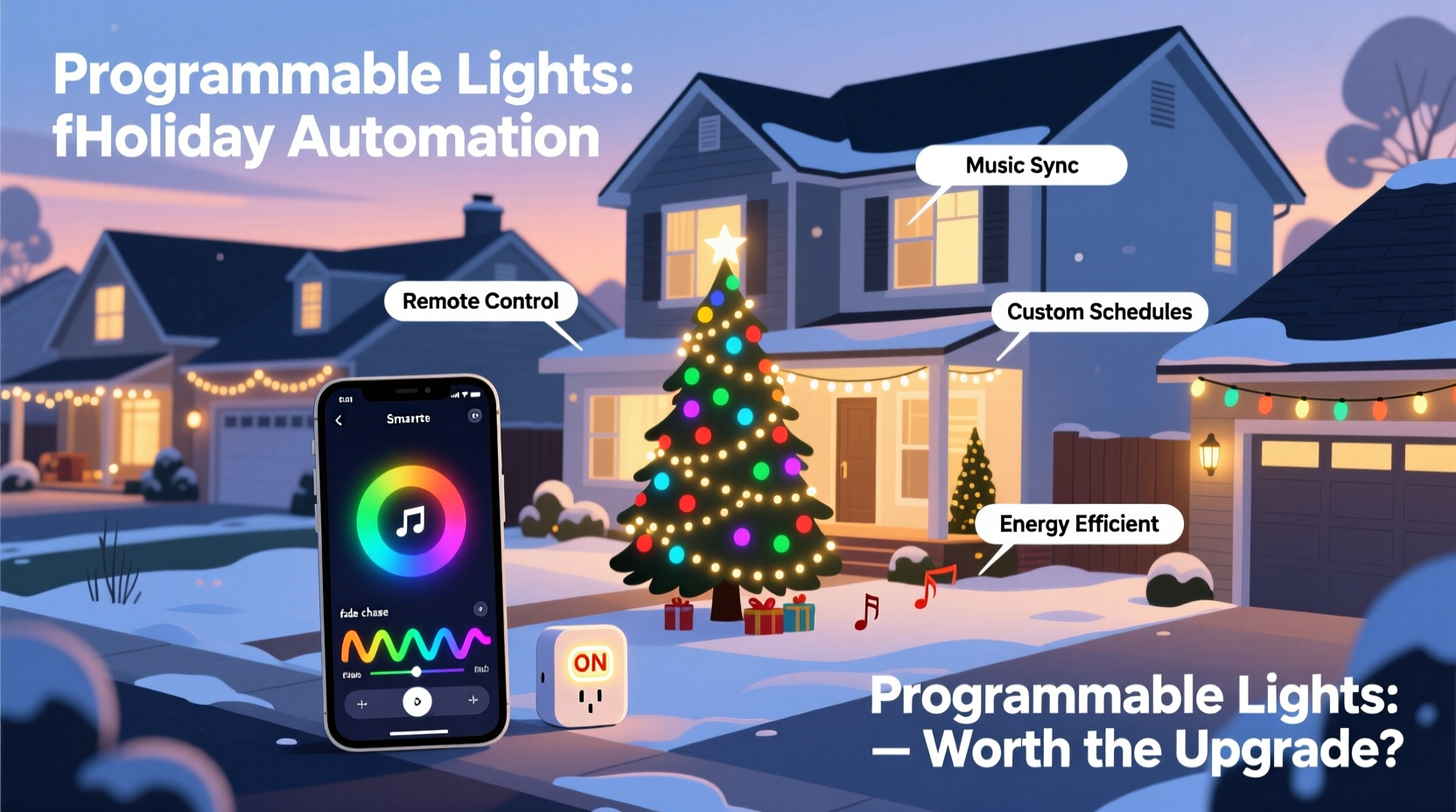
Programmable Christmas lights are LED strings equipped with microcontrollers that allow users to customize color, brightness, animation patterns, and timing. Unlike standard plug-in sets, these lights connect via Wi-Fi, Bluetooth, or proprietary hubs to smartphone apps or voice assistants like Alexa and Google Assistant. Some advanced systems support integration with home automation platforms such as Apple HomeKit, IFTTT, or SmartThings.
They come in various formats: mini lights, net lights, icicle strands, rope lights, and even pixel-based addressable strips that let you control individual bulbs. Brands like Philips Hue, Govee, Twinkly, and Lumenplay dominate the market, offering tiered product lines from basic timers to full-motion synchronized shows.
The core advantage lies in precision and automation. Instead of relying on manual operation or simple timers, users can schedule lights to turn on at sunset, fade out at bedtime, or flash in rhythm with holiday music—all without stepping outside.
Key Benefits of Upgrading to Smart Holiday Lighting
The shift from conventional to programmable lights isn’t just about convenience—it’s about transforming how we experience and manage holiday decor. Several tangible benefits make the upgrade compelling for certain users.
Effortless Scheduling and Remote Control
One of the most practical advantages is scheduling. With programmable lights, you can set them to activate daily at dusk and deactivate at 11 PM—no need to remember to flip a switch. If you're traveling during the holidays, you can still maintain the appearance of an occupied home by turning lights on remotely.
This feature also enhances safety. A house lit up on a regular schedule deters potential intruders more effectively than one that stays dark all night—or worse, has lights left on accidentally until dawn.
Dynamic Lighting Effects and Customization
Traditional lights offer limited variety: steady on, twinkling, or fading slowly. Programmable LEDs unlock dozens of built-in effects—chasing, pulsing, rainbow cycles, snowfall simulations—and allow custom programming. You can design a sequence where red and green sweep outward from your front door, or create a gentle glow that mimics candlelight in each window.
For creative users, some systems support uploading custom light patterns or syncing to audio. Imagine your roofline dancing to “Jingle Bell Rock” in perfect rhythm, all managed through an app with drag-and-drop simplicity.
Energy Efficiency and Longevity
Programmable lights are almost exclusively LED-based, which means they consume significantly less power than incandescent bulbs—often using up to 80% less electricity. When combined with precise scheduling, this translates into lower energy bills and reduced environmental impact.
Additionally, quality smart LEDs last longer—typically rated for 25,000 to 50,000 hours. That’s several decades of seasonal use if properly stored and maintained.
“Smart lighting doesn’t just save time; it reduces energy waste and gives homeowners unprecedented creative control over their holiday aesthetic.” — Marcus Lin, Smart Home Integration Specialist
Cost Analysis: Is the Upgrade Justified?
There’s no denying that programmable Christmas lights come at a premium. A single 50-light string can cost $30–$60, compared to $5–$15 for a standard set. Larger installations—such as wrapping trees, outlining roofs, or decorating porches—can easily run into hundreds of dollars.
But cost shouldn’t be viewed in isolation. Consider long-term savings and value:
- Reduced labor: No more climbing ladders late at night to turn lights on or off.
- Lower electricity usage: LEDs draw minimal power, especially when scheduled to run only part of the night.
- Durability: High-quality smart strands are often weather-sealed and built to last multiple seasons.
- Reusability: Once installed, they can be reprogrammed year after year with new themes and effects.
To illustrate, here’s a comparison between traditional and programmable setups for an average-sized home:
| Feature | Traditional Lights | Programmable Smart Lights |
|---|---|---|
| Average Cost (100 lights) | $10–$20 | $40–$70 |
| Energy Use (per season, 6 hrs/night) | ~60 kWh | ~12 kWh |
| Lifespan | 1,000–3,000 hours | 25,000–50,000 hours |
| Scheduling Capability | Basic timer required | App-based, sunrise/sunset sync |
| Custom Animations | No | Yes (full range) |
| Remote Access | No | Yes (via Wi-Fi/app) |
While upfront costs are higher, the long-term ownership model favors programmable lights—especially for those who plan to reuse them annually.
Real-World Example: The Johnson Family's Automation Journey
The Johnsons live in a suburban neighborhood known for its festive decorations. For years, they used standard incandescent lights, spending two weekends every December setting up, troubleshooting, and manually operating their display. Their teenage son often forgot to turn the lights off, leading to wasted energy and frustrated neighbors.
In 2022, they invested in a mid-tier programmable system from Govee: 200 feet of addressable LED strip lights, three smart net lights for bushes, and a Wi-Fi controller hub. Total cost: $280.
They programmed their lights to:
- Turn on automatically at local sunset.
- Display a rotating series of animations every evening.
- Sync to holiday music during weekend open-house events.
- Shut off at 10:30 PM nightly.
The first year, they saved approximately 70% on lighting-related electricity use. More importantly, maintenance dropped dramatically—no more blown fuses, fewer ladder trips, and zero arguments over forgotten switches. By the second holiday season, they had created themed scenes for Hanukkah, Christmas, and New Year’s, all activated with a few taps on their phones.
“It paid for itself in peace of mind,” says Sarah Johnson. “We used to dread taking the lights down. Now, we look forward to designing something new each year.”
Step-by-Step Guide to Transitioning to Programmable Lights
Making the switch doesn’t have to happen overnight. Follow this timeline to ensure a smooth transition without overspending:
- Assess Your Current Setup (April–September): Take inventory of existing lights. Note lengths, areas covered, and problem zones (e.g., hard-to-reach eaves).
- Choose a Starter System (September): Pick one visible area—like the front porch or tree—and buy a programmable strand compatible with your preferred ecosystem (e.g., Alexa or HomeKit).
- Test Connectivity and App (October): Install the app, pair the lights, and test scheduling and effects. Ensure strong Wi-Fi signal near the installation point.
- Install and Program (Early November): Mount the lights securely. Program daily on/off times and a few basic animations.
- Expand Gradually (Next Seasons): Replace old strands incrementally. Focus on high-impact zones first—rooflines, trees, entryways.
- Integrate Advanced Features (Year 2+): Add music synchronization, voice commands, or geofencing (lights turn on when you’re 5 miles from home).
Common Pitfalls and How to Avoid Them
Not every smart lighting experience is flawless. Common issues include poor Wi-Fi range, app instability, and compatibility problems. Here’s how to avoid them:
- Weak Signal: Outdoor installations may struggle to maintain Wi-Fi connection. Use an outdoor-rated Wi-Fi extender or choose lights that support mesh networking (e.g., Zigbee).
- App Crashes: Some brands have buggy mobile apps. Research user reviews before purchasing, and consider systems with web-based dashboards as backup.
- Overcomplication: Don’t start with 50 animated sequences. Begin with reliable schedules and add complexity once you’re comfortable.
- Power Surges: Always plug smart lights into surge protectors. A single lightning strike can fry controllers and render entire systems useless.
Frequently Asked Questions
Can I mix programmable lights with traditional ones?
Yes, but they won’t be controllable through the same app. You can group them on the same outlet and use a smart plug to turn both on/off together—but only the programmable set will support color changes or animations.
Do programmable lights work during power outages?
No—if the power goes out, all lights go dark. However, most systems resume their programmed schedule once power returns. For uninterrupted operation, pair them with a home battery backup like a UPS or solar generator.
Are they difficult to take down and store?
Physically, they’re similar to regular lights. However, because they’re more expensive, extra care should be taken during removal. Coil them gently, avoid kinking wires, and store in labeled bins with desiccant packs to prevent moisture damage.
Final Checklist Before Upgrading
Before making the leap, ask yourself the following:
- Do I leave my lights on for extended periods or forget to turn them off?
- Am I interested in creating dynamic, animated displays?
- Do I already use smart home devices (Alexa, Google Home, etc.)?
- Is my outdoor Wi-Fi coverage strong enough?
- Am I planning to keep and reuse these lights for multiple years?
If you answered “yes” to at least three, programmable lights are likely a worthwhile upgrade.
Conclusion: Embracing the Future of Holiday Lighting
Programmable Christmas lights aren’t just a novelty—they represent a meaningful evolution in how we celebrate the holidays. They reduce physical effort, enhance creativity, and bring a level of precision and consistency that traditional methods simply can’t match.
While the initial cost may give pause, the long-term benefits—lower energy bills, reusable designs, remote access, and sheer convenience—make a strong case for the upgrade. For tech-savvy households, families with busy schedules, or anyone tired of the annual lighting grind, smart holiday lights are more than worth it.




 浙公网安备
33010002000092号
浙公网安备
33010002000092号 浙B2-20120091-4
Comments
No comments yet. Why don't you start the discussion?