
When it comes to decorating your home’s exterior or enhancing window displays with seasonal charm, lighting plays a pivotal role. Two popular choices—rope lights and mini string lights—are frequently used to outline windows, but which one truly performs better? The answer depends on several factors: brightness, durability, ease of installation, aesthetic appeal, and long-term maintenance. This comprehensive guide dives into the functional and visual differences between these two lighting types, helping homeowners make an informed decision based on real-world performance.
Brightness and Light Distribution
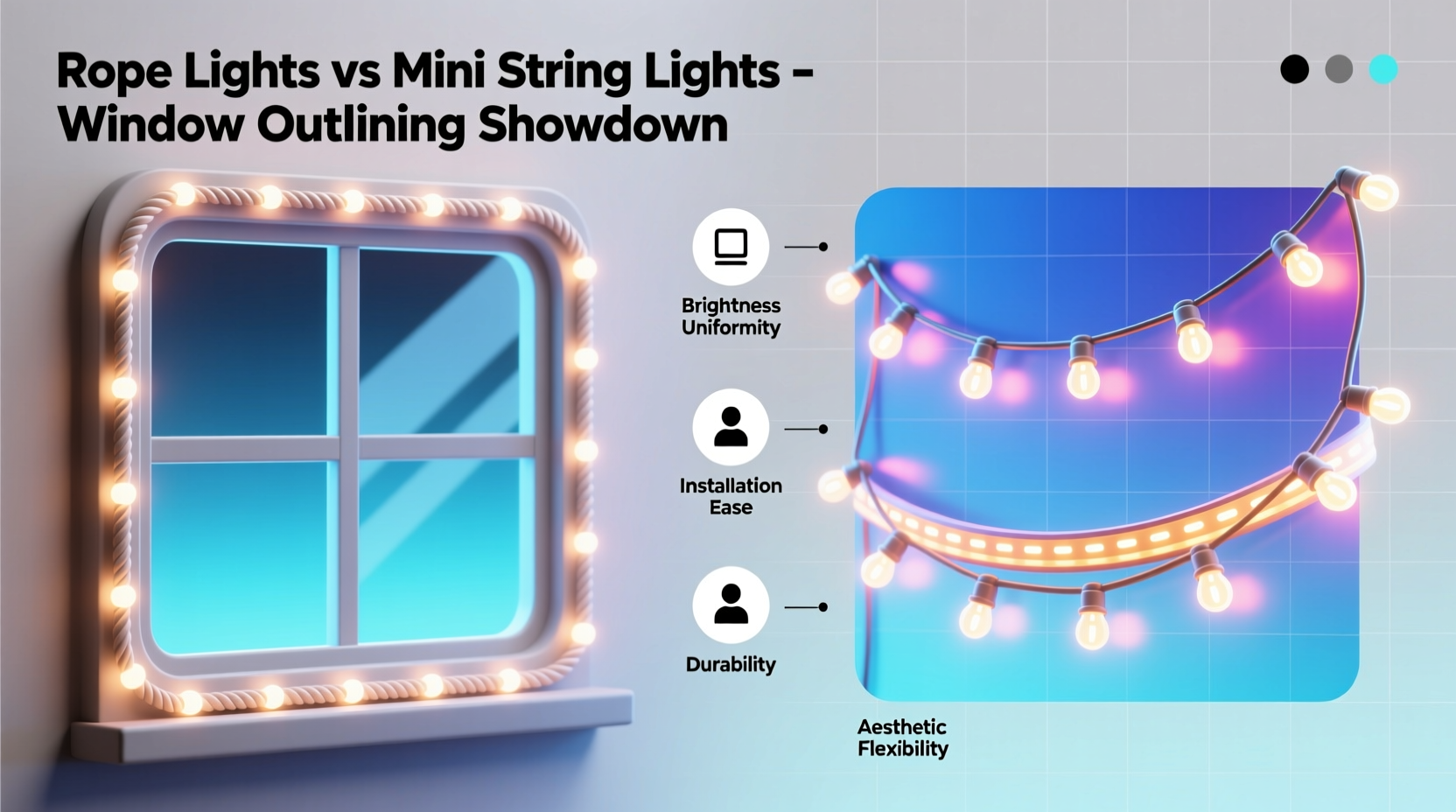
One of the most immediate differences between rope lights and mini string lights is how they emit light. Rope lights consist of small LED bulbs encased in a continuous plastic tube, creating a uniform glow along their entire length. This makes them ideal for outlining architectural features like windows, where consistent illumination is desired. Because the light source is diffused through the translucent tubing, glare is minimized, and shadows are reduced.
In contrast, mini string lights (also known as fairy or twinkle lights) feature individual bulbs spaced apart—typically 4 to 6 inches—on a thin wire. While charming and festive, this design creates a dotted lighting effect rather than a smooth line. For window outlines, this can result in gaps in visibility, especially from a distance or at night when contrast is high.
Rope lights also tend to have higher lumen output per foot. A standard 25-foot rope light might produce 600–800 lumens, whereas a comparable string of mini lights may only generate 300–500 lumens due to fewer active light points. This difference becomes noticeable when trying to define window edges clearly against dark siding or stucco.
Durability and Weather Resistance
Outdoor lighting must withstand temperature fluctuations, moisture, UV exposure, and physical stress. Rope lights generally outperform mini string lights in durability thanks to their protective outer casing. Most outdoor-rated rope lights are constructed with UV-resistant PVC jackets that shield internal wiring and LEDs from sun damage, rain, and snow. Many models are also rated IP65 or higher, meaning they are dust-tight and protected against water jets.
Mini string lights, while available in weatherproof versions, are more vulnerable at connection points. Each bulb socket is a potential entry point for moisture, especially if seals degrade over time. Additionally, the thin copper wires are more prone to breakage during installation or from wind-induced movement. After just one or two seasons, frayed wires or dead sections are common complaints among users.
“Rope lights are engineered for permanent or semi-permanent installations. Their robust construction makes them far more reliable for year-round exterior use.” — Daniel Reeves, Outdoor Lighting Technician with 12 years of experience
If you live in a region with harsh winters or humid summers, rope lights offer peace of mind. They’re less likely to fail mid-season and typically come with longer warranties—often 2 to 3 years versus 1 year for most mini light sets.
Installation and Flexibility
Installing lights around windows requires precision, especially on multi-story homes. Rope lights, while slightly stiffer than string lights, maintain shape well once bent. Their rigidity helps keep them aligned along straight window frames without sagging. Clips designed for rope lighting are widely available and secure the tube firmly without damaging siding or trim.
Mini string lights are more flexible and easier to drape creatively, making them excellent for wrapping trees or railings. However, this same flexibility works against them when outlining windows. Without proper support, they can droop or shift over time, leading to uneven spacing and a messy appearance. Securing each bulb individually requires more clips and labor, increasing installation time by up to 50% compared to rope lights.
Another consideration is power source placement. Rope lights often come in longer continuous runs—up to 100 feet—reducing the need for multiple extension cords or connectors. Mini string lights usually max out at 25–50 feet per strand, requiring daisy-chaining, which increases electrical load and potential failure points.
Step-by-Step Installation Comparison
- Measure the perimeter of the window frame using a measuring tape.
- Select appropriate length: Rope lights are sold in fixed lengths; mini lights in modular strands.
- Attach mounting clips: Use plastic clips rated for outdoor use every 6–8 inches.
- Run the light strand: Rope lights snap into clips easily; mini lights require threading each bulb.
- Connect to power: Plug into a GFCI-protected outlet. Avoid overloading circuits.
- Test and adjust: Check for dark spots or loose sections and reposition as needed.
Aesthetic Appeal and Design Options
The choice between rope and mini lights often comes down to desired ambiance. Rope lights deliver a clean, modern look—ideal for contemporary homes or minimalist holiday displays. Available in warm white, cool white, and RGB color-changing options, they can be programmed for subtle fades or static hues. Some advanced models integrate Wi-Fi or remote control for scheduling and effects.
Mini string lights, on the other hand, evoke nostalgia and whimsy. Their twinkling effect mimics starlight, making them popular for Christmas decor, patios, and romantic settings. While newer LED versions offer steady modes, the classic “twinkle” remains a favorite for seasonal charm.
For window outlining specifically, however, consistency matters. A glowing border defines the structure and enhances curb appeal. Rope lights excel here by providing architectural definition. Mini lights work better as accent lighting—say, above a window or along eaves—rather than precise framing.
Real-World Example: Homeowner Decision in Colorado Springs
Sarah M., a homeowner in Colorado Springs, experimented with both types over three holiday seasons. In 2021, she used mini string lights to outline her four front windows. By mid-December, wind had loosened several sections, and two strands failed due to moisture ingress. The repair cost and time frustrated her.
In 2022, she switched to commercial-grade rope lights. She invested slightly more upfront but completed installation in under an hour using included corner brackets. The lights remained intact throughout winter storms and were reused in 2023 with no issues. “They look sharper,” she said. “Like my house is wrapped in light. The mini lights felt temporary. These feel built-in.”
Comparison Table: Rope Lights vs. Mini String Lights
| Feature | Rope Lights | Mini String Lights |
|---|---|---|
| Light Output | High, continuous glow | Low to medium, intermittent |
| Durability | Excellent (UV/water resistant) | Fair to good (varies by model) |
| Installation Time | Fast (fewer clips, rigid form) | Slower (more clips, flexible wire) |
| Lifespan | 3–5 years (with care) | 1–3 years |
| Aesthetic Style | Clean, modern, defined | Festive, twinkling, soft |
| Best Use Case | Window outlines, permanent accents | Decorative draping, indoor/outdoor accents |
Checklist: Choosing the Right Window Lighting
- ✅ Determine whether you want a bold outline or subtle sparkle
- ✅ Measure total linear footage of all windows to be lit
- ✅ Choose outdoor-rated, LED-only products for efficiency and longevity
- ✅ Verify IP rating—minimum IP65 for wet locations
- ✅ Consider color temperature (2700K–3000K for warm, inviting glow)
- ✅ Plan power access—ensure nearby GFCI outlets or use outdoor-safe extensions
- ✅ Buy extra mounting clips and test lights before final installation
Frequently Asked Questions
Can I leave rope lights on all night?
Yes, modern LED rope lights are designed for extended operation. They consume minimal energy and generate little heat, making them safe for overnight use. However, it's wise to use a timer or smart plug to automate shut-off and reduce electricity usage.
Do mini string lights work well for large windows?
They can, but effectiveness diminishes with size. On windows wider than 5 feet, the spacing between bulbs becomes more apparent, creating a fragmented look. For larger spans, rope lights or commercial-grade curtain lights are better suited.
Are rope lights harder to hide when not in use?
Not necessarily. Both types require removal or storage if not intended for year-round display. However, some homeowners install low-profile rope light channels that allow quick insertion and concealment. Mini lights, being thinner, can be tucked away more discreetly but are more fragile during storage.
Final Recommendation
For the specific purpose of outlining windows, rope lights are objectively better than mini string lights in nearly every measurable category: brightness, durability, ease of installation, and long-term reliability. They create a polished, architectural finish that enhances a home’s structure rather than merely decorating it. While mini string lights have their place in festive and ambient lighting schemes, they fall short when precision and consistency are required.
That said, aesthetics are personal. If your goal is a cozy, twinkling effect rather than a crisp outline, mini lights may still suit your vision. But for homeowners seeking a professional-grade, reusable, and weather-resistant solution, rope lights are the superior investment.




 浙公网安备
33010002000092号
浙公网安备
33010002000092号 浙B2-20120091-4
Comments
No comments yet. Why don't you start the discussion?