
When it comes to accent lighting architectural features like columns and banisters, choosing the right type of string light can make a dramatic difference in both appearance and practicality. Rope lights and net lights are two popular options, each with distinct advantages and limitations. While rope lights offer continuous illumination and structural rigidity, net lights provide flexibility and a more organic sparkle. Understanding their differences is essential for achieving a professional-looking result that lasts through seasons and weather conditions.
This guide dives deep into the functional, aesthetic, and logistical aspects of both rope and net lights, helping you decide which option best suits your project—whether you're illuminating a porch column for holiday cheer or enhancing a staircase railing for year-round ambiance.
Understanding Rope Lights and Net Lights
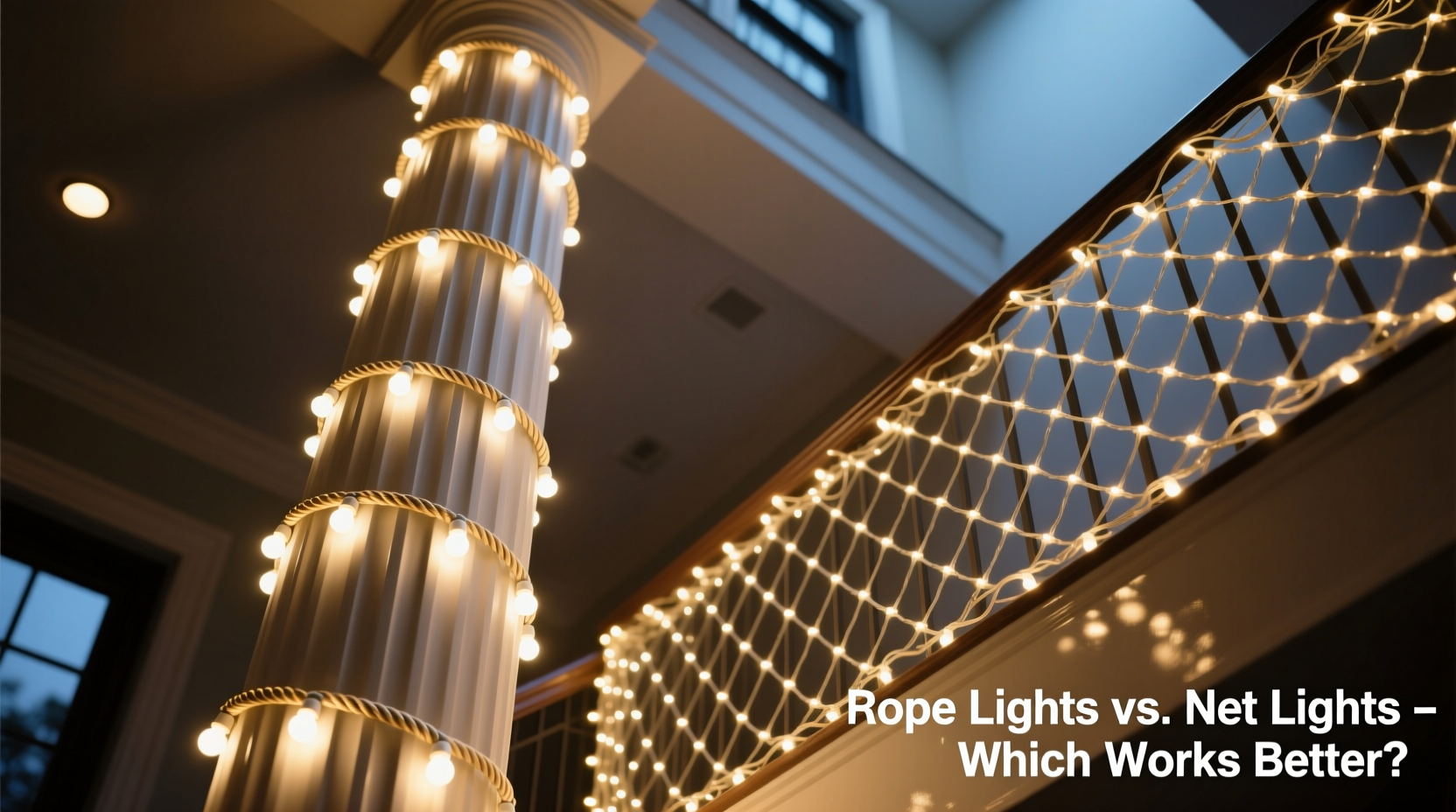
Rope lights and net lights serve decorative lighting purposes but differ fundamentally in design and application.
Rope lights consist of small bulbs (typically incandescent or LED) encased in a long, flexible plastic tube. The entire assembly resembles a literal \"rope\" of light, offering a continuous glow along its length. They are commonly used for outlining structures, under-cabinet lighting, and linear applications such as stair edges or railings.
Net lights, on the other hand, are grids of individual light strings arranged in a mesh pattern—like a fishing net embedded with bulbs. Originally designed for draping over shrubs and trees, they have found secondary use in wrapping cylindrical objects when cut or adapted. Their strength lies in even bulb distribution and a twinkling effect that mimics starlight.
The key distinction: rope lights emphasize linearity and uniform brightness; net lights prioritize dispersion and texture. This foundational difference shapes their suitability for vertical surfaces like columns and curved paths like banisters.
Installation Practicality: Wrapping Columns and Banisters
Wrapping architectural elements requires a balance between ease of installation, security, and visual continuity. Let’s examine how each light type performs in real-world scenarios.
Rope Lights: Precision and Control
Rope lights excel in applications requiring clean lines. Because they maintain consistent diameter and stiffness, they wrap around columns smoothly, allowing for tight, evenly spaced coils. Most models come with pre-drilled holes or clips every 6–12 inches, enabling secure fastening without sagging.
For banisters, especially those with straight or gently curving rails, rope lights can be affixed using mounting brackets or zip ties at regular intervals. Their tubular construction protects internal wiring from foot traffic or accidental snags—a major advantage in high-traffic indoor staircases.
Net Lights: Flexibility vs. Fit Challenges
Net lights were not originally designed for wrapping narrow vertical forms. Attempting to wrap a column often results in excess material flaring out at the top and bottom unless trimmed—an irreversible modification. Even then, maintaining alignment across multiple wraps is difficult because the fixed grid doesn’t conform naturally to tapering or irregular shapes.
On banisters, net lights may work only if the railing is wide enough to accommodate the net's width, and even then, securing loose sections becomes tedious. Bulbs tend to dangle unevenly, creating an unbalanced look. However, for short, low-traffic railings where temporary decoration is acceptable, net lights can deliver a whimsical, festive effect.
“Rope lights give you predictable coverage and durability—critical when lighting load-bearing structures like stairs. Net lights are great for foliage, but forcing them onto columns often leads to frustration.” — Daniel Meeks, Residential Lighting Designer
Performance Comparison: A Side-by-Side Analysis
| Feature | Rope Lights | Net Lights |
|---|---|---|
| Wrap Suitability | Excellent – designed for linear wrapping | Fair to Poor – requires trimming; poor conformity |
| Bulb Spacing | Even, continuous glow | Grid-based clusters with dark zones |
| Durability | High – protected wiring, weather-resistant jackets | Moderate – exposed wires prone to snagging |
| Installation Time | Moderate – needs securing every 6–12\" | Variable – depends on adaptation effort |
| Lifespan | 5–7 years (LED), less if UV-exposed | 2–4 years, shorter outdoors |
| Aesthetic Effect | Clean, modern, architectural | Playful, scattered sparkle |
| Reusability | High – easy storage, no cutting needed | Low to Moderate – often modified during use |
Step-by-Step Guide: Installing Rope Lights on a Column
For optimal results when wrapping a column, follow this proven method:
- Measure the column height and circumference. Multiply circumference by desired number of wraps (e.g., one wrap per foot of height).
- Select a rope light with appropriate length and rating. For outdoors, choose IP65-rated or higher waterproof models.
- Clean the surface thoroughly. Remove dust, grease, or old adhesive to ensure proper attachment.
- Start at the base and spiral upward. Maintain consistent spacing—use a pencil mark every full rotation as a guide.
- Secure every 6–12 inches using plastic clips or silicone caulk. Avoid metal staples that could damage the casing.
- Connect to power via a grounded outlet. Use a GFCI-protected circuit for outdoor installations.
- Test before finalizing. Turn on the lights to check for dark spots or flickering.
This process ensures a polished finish that enhances the column’s proportions while minimizing maintenance later.
Real Example: Holiday Makeover for a Historic Home
In Asheville, North Carolina, homeowner Sarah Lin renovated her 1920s Craftsman porch with new lighting for the winter season. The home featured four tapered wooden columns supporting the entryway roof. Initially, she tried using green net lights leftover from Christmas past, hoping to save money.
After several hours of struggling to stretch the net around each column, she noticed gaps near the base and excessive bunching at the top. Worse, wind caused parts of the net to flap loose within days. Discouraged, she consulted a local electrician who recommended switching to 12-foot warm-white LED rope lights with mounting clips.
She reinstalled them in under an hour per column, achieving smooth, even spirals. The new setup lasted all season without issue and was easily removed and stored for reuse. “It looked like a professional job,” she said. “The rope lights just made sense—they stayed put and glowed evenly.”
Common Mistakes to Avoid
- Using indoor-rated lights outdoors – Leads to premature failure from moisture ingress.
- Over-tightening wraps – Can deform rope light casing or create stress points.
- Ignoring voltage drop in long runs – Dimming at the end of extended circuits indicates undersized gauge or excessive length.
- Securing net lights with nails or sharp fasteners – Punctures insulation and creates shock hazards.
- Not planning for transformer access – Ensure nearby outlet or low-voltage power source availability.
When Net Lights Might Still Be the Right Choice
Despite their drawbacks for wrapping, net lights have niche uses even on vertical elements. If your goal is seasonal, temporary decoration rather than permanent enhancement, net lights can offer charm and speed.
For instance, covering a large square column or piling net lights loosely over a balustrade for a single event (like a wedding or holiday party) allows for rapid deployment. Some manufacturers now produce “half-net” or “strip net” variants—narrower versions specifically intended for railing applications. These reduce waste and improve fit compared to full garden nets.
Additionally, net lights often cost less upfront than commercial-grade rope lights, making them appealing for budget-conscious decorators. Just remember: lower initial cost may mean higher long-term expense due to shorter lifespan and reduced reusability.
Checklist: Choosing Between Rope and Net Lights
Use this checklist to determine the best option for your project:
- ✅ Will the lights stay up year-round? → Choose rope lights
- ✅ Is safety a concern (e.g., children, pets, foot traffic)? → Choose rope lights
- ✅ Do you need precise, even illumination? → Choose rope lights
- ✅ Are you decorating temporarily for a holiday? → Net lights may suffice
- ✅ Is the column tapered or irregularly shaped? → Rope lights adapt better
- ✅ Do you plan to reuse the lights next season? → Rope lights are more durable
- ✅ Is the railing narrow or winding? → Avoid standard net lights
Frequently Asked Questions
Can I cut net lights to fit a column?
Yes, but only along designated cut lines (usually marked every 8–12 inches). Cutting elsewhere will break the circuit. Keep in mind that once cut, the original shape is lost, reducing future versatility.
Do rope lights get hot?
Traditional incandescent rope lights can become warm to the touch, especially in enclosed spaces. Modern LED rope lights generate minimal heat, making them safer for wood, vinyl, or painted surfaces.
How do I hide the power cord on a banister?
Route the cord along the underside of the railing or down the support posts using discreet clips. For indoor setups, consider painting the cord to match the wall or using cord covers. Alternatively, use battery-operated rope lights for complete wire-free installation.
Final Recommendation: Why Rope Lights Win for Columns and Banisters
While both lighting types have their place in exterior and interior decor, rope lights are objectively superior for wrapping columns and banisters. Their durability, consistent output, ease of installation, and professional appearance make them the go-to solution for homeowners and contractors alike.
Net lights remain valuable for specific applications—draping over bushes, covering flat walls, or creating layered effects on wide railings—but they lack the precision required for tight, repeated wrapping. When aesthetics, longevity, and safety matter, rope lights deliver unmatched performance.
Investing in quality LED rope lighting not only enhances curb appeal but also reduces replacement costs and labor over time. With proper selection and installation, these fixtures can become a permanent, energy-efficient feature of your home’s design.




 浙公网安备
33010002000092号
浙公网安备
33010002000092号 浙B2-20120091-4
Comments
No comments yet. Why don't you start the discussion?