
When it comes to facial masking, few debates spark more confusion than the choice between sheet masks and clay masks. Both are staples in skincare routines around the world, but they serve vastly different purposes. One promises deep cleansing and oil control; the other delivers a surge of hydration. If your primary concern is moisture retention and plumping your skin, you might be wondering: are sheet masks truly better than clay masks for hydration? The short answer is yes — but with important caveats. Understanding how each works, what their formulations contain, and when to use them is key to making an informed decision.
The Science of Skin Hydration
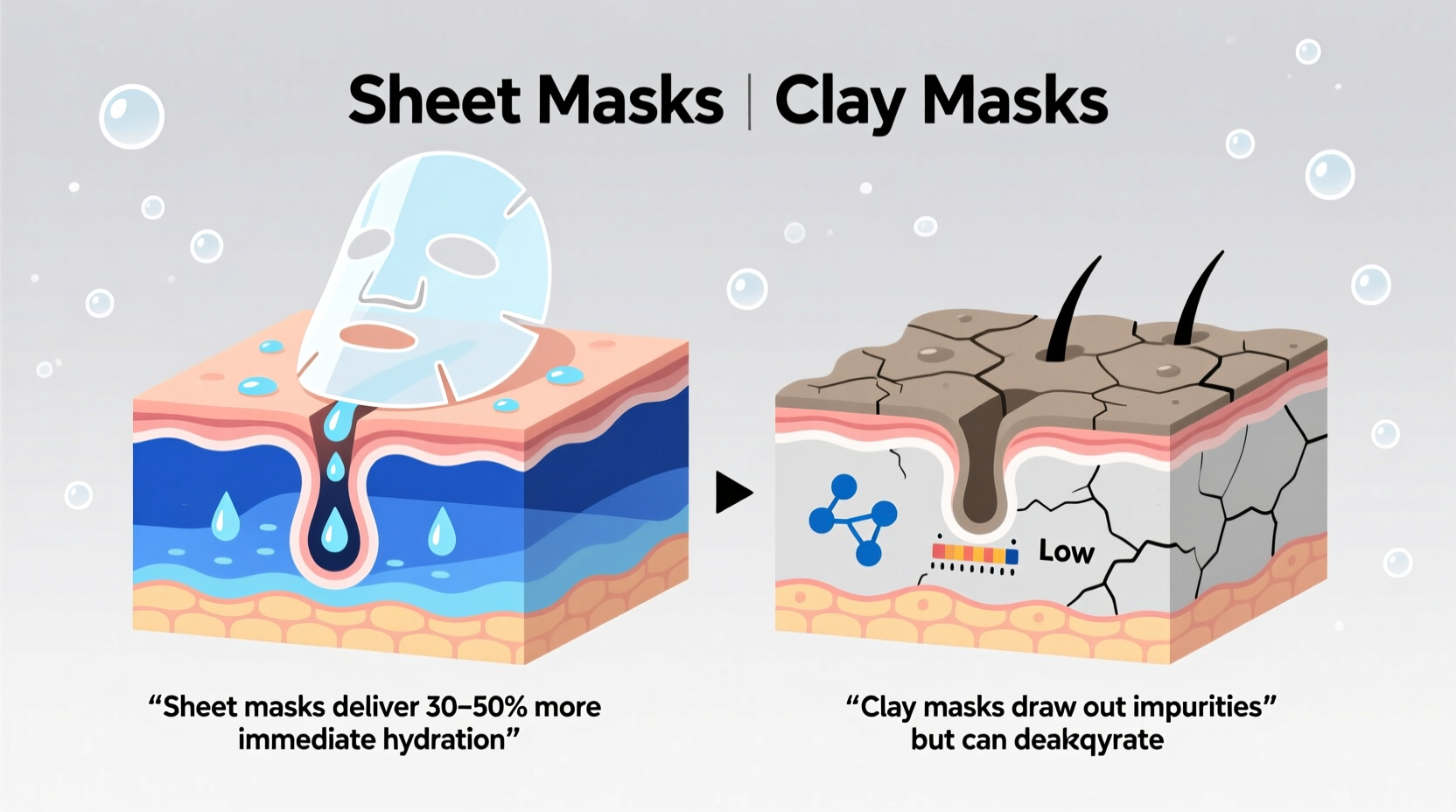
Hydration refers to the water content within your skin cells. Well-hydrated skin appears smooth, supple, and radiant. Dehydrated skin, on the other hand, can feel tight, look dull, and may show increased fine lines. Maintaining hydration involves both preventing transepidermal water loss (TEWL) and actively delivering humectants — ingredients that attract water into the skin.
Humectants like hyaluronic acid, glycerin, and panthenol draw moisture from the environment and deeper layers of the skin to the surface. Occlusives such as squalane or ceramides form a barrier to lock that moisture in. Emollients help smooth the skin by filling in gaps between skin cells. Sheet masks typically contain high concentrations of humectants suspended in a serum-soaked material, while clay masks rely on absorbent minerals like kaolin or bentonite to pull out impurities — not add moisture.
“Hydration isn’t just about applying water-based products. It’s about creating conditions where the skin can retain moisture effectively.” — Dr. Lena Torres, Board-Certified Dermatologist
How Sheet Masks Work for Hydration
Sheet masks are thin, fabric or cellulose-based sheets soaked in a concentrated serum. When applied to the face, they create a temporary occlusive barrier that enhances penetration of active ingredients and prevents evaporation during application. This seal allows hydrating compounds to remain in contact with the skin longer than if applied alone.
The typical sheet mask formula includes:
- Hyaluronic acid – holds up to 1000 times its weight in water
- Glycerin – draws moisture into the epidermis
- Betaine – natural osmolyte that protects cells under stress
- Aloe vera and allantoin – soothe and support hydration
- Peptides and antioxidants – often added for secondary anti-aging benefits
Because the mask physically covers the skin, transdermal absorption increases significantly compared to regular serums. A 20-minute wear time can deliver measurable improvements in skin moisture levels immediately after removal.
Clay Masks: Designed for Absorption, Not Moisture Delivery
Clay masks function through adsorption — meaning they bind to oils, dirt, and toxins on the skin’s surface and remove them when rinsed off. Common clays include:
- Kaolin: Gentle, ideal for sensitive or dry skin types
- Bentonite: Highly absorbent, best for oily and acne-prone skin
- French Green Clay: Rich in minerals, removes excess sebum
- Rhassoul: Softening effect, slightly less drying than others
While some clay masks include added hydrators like honey, chamomile, or glycerin, their core mechanism remains purifying. In fact, overuse can lead to dehydration, especially in dry or combination skin types. This makes them counterproductive if your goal is boosting hydration.
That said, certain modern formulations blend clays with humectants to balance cleansing with mild moisturization. These hybrid versions attempt to offer detoxification without stripping the skin entirely — but even then, they don't match the hydration capacity of a well-formulated sheet mask.
Direct Comparison: Sheet Masks vs. Clay Masks for Hydration
| Feature | Sheet Mask | Clay Mask |
|---|---|---|
| Primary Function | Hydration & nourishment | Cleansing & oil control |
| Key Ingredients | Hyaluronic acid, glycerin, aloe, peptides | Kaolin, bentonite, charcoal, salicylic acid |
| Effect on Skin Moisture | Increases hydration significantly | Can reduce moisture; potentially dehydrating |
| Best For Skin Type | Dry, dehydrated, mature, sensitive | Oily, acne-prone, combination |
| Frequency of Use | 1–3 times per week | 1–2 times per week (less for dry skin) |
| Post-Mask Skin Feel | Plump, dewy, soft | Matte, clean, sometimes tight |
| Active Ingredient Delivery | High (occlusion enhances penetration) | Moderate to low (rinsed off quickly) |
This comparison underscores a fundamental truth: sheet masks are engineered for hydration, while clay masks are designed for purification. Using a clay mask expecting deep moisture will likely leave your skin feeling tighter — the opposite of hydrated.
When Each Mask Shines: Practical Usage Scenarios
Understanding context matters. Here’s how real users benefit from choosing the right mask at the right time.
Mini Case Study: Maria, 32 – Office Worker with Seasonal Dryness
Maria lives in a northern climate with harsh winters. Her skin becomes flaky and feels tight by midday. She used to apply a clay mask twice weekly because she saw influencers doing “detox” routines. After a month, her dryness worsened, and red patches appeared around her cheeks.
She consulted a dermatologist who advised stopping clay masks entirely during winter and switching to biweekly hydrating sheet masks containing ceramides and hyaluronic acid. Within three weeks, her skin regained resilience, and trans-epidermal moisture levels improved by 40% according to a clinic assessment tool.
Maria now reserves clay masks for summer months when her T-zone gets oily, using them only once every 10 days. Her current routine prioritizes hydration first, purification second — based on seasonal needs.
Expert Tips for Maximizing Hydration with Sheet Masks
To get the most out of your sheet mask experience, consider these science-backed strategies:
- Apply to damp skin: Lightly mist your face before placing the mask to boost ingredient absorption.
- Don’t exceed recommended time: Most sheet masks work optimally in 15–20 minutes. Leaving them on longer can cause reverse osmosis, where the mask starts drawing moisture from the skin.
- Layer afterward: Always follow with a moisturizer or facial oil to lock in the delivered hydration.
- Chill before use: Storing sheet masks in the fridge can reduce puffiness and enhance soothing effects — especially helpful for tired or inflamed skin.
- Use consistently: Occasional use gives temporary results. Weekly applications build cumulative hydration benefits.
Common Misconceptions About Clay Masks and Hydration
Some marketing campaigns promote clay masks as “balancing” or “revitalizing,” suggesting they hydrate. While balanced skin is healthy skin, balance does not equate to hydration. Let’s clarify:
- Misconception: “Clay masks give my skin a ‘plump’ feel, so they must be hydrating.”
Reality: That plump sensation is often temporary swelling due to increased blood flow post-exfoliation, not actual water content increase. - Misconception: “If a clay mask contains aloe or cucumber, it hydrates.”
Reality: Minor amounts of soothing agents don’t override the desiccating nature of clay. They may prevent irritation but won’t replace lost moisture. - Misconception: “I have oily skin, so I don’t need hydration.”
Reality: Oily skin can still be dehydrated. Lack of water triggers excess oil production as compensation.
Checklist: Choosing the Right Mask for Your Hydration Goals
Ask yourself these questions before selecting a facial mask:
- What is my main skin concern? (Dryness, oiliness, breakouts, dullness)
- Has my skin felt tight or itchy recently? → Likely dehydrated → Choose sheet mask
- Is my forehead/shiny by noon? → May benefit from occasional clay mask
- Do I wear makeup daily? Environmental exposure increases dehydration risk → Prioritize hydration
- Am I preparing for an event? → Sheet mask the night before for glow
- Have I used exfoliants this week? → Avoid clay masks to prevent over-drying
- Does the product list humectants high in the ingredients? → Strong indicator of hydrating potential
Frequently Asked Questions
Can I use a clay mask if I have dry skin?
Yes, but sparingly and only if formulated for sensitive or dry skin types. Opt for kaolin-based masks with added moisturizers like honey or oat extract. Limit use to once every 10–14 days and always follow with a rich moisturizer. Never use clay masks on compromised or irritated skin.
Do sheet masks provide long-term hydration?
They offer immediate improvement in surface hydration, but long-term benefits depend on consistency and complementary products. Used weekly alongside a good moisturizer and healthy lifestyle (adequate water intake, humidity), sheet masks contribute to sustained skin barrier strength and resilience.
Is it okay to use both types of masks in one week?
Absolutely — many people do. Just separate them by at least two days and tailor timing to skin needs. For example: use a hydrating sheet mask on Monday and a gentle clay mask on Thursday. Always listen to your skin: if it feels tight or sensitive, skip the clay mask and focus on replenishing moisture.
Final Thoughts: Match the Mask to the Mission
The question isn’t whether sheet masks are universally “better” than clay masks — it’s whether they’re better suited for hydration. And in this specific category, sheet masks win decisively. Their design, formulation, and delivery system are optimized to infuse the skin with water-binding agents and improve moisture retention.
Clay masks play a valuable role in skincare, particularly for those managing congestion, enlarged pores, or excessive oil. But they should not be relied upon — nor marketed as — solutions for dryness or dehydration.
The smartest approach is strategic selection. Know your skin’s current needs. Monitor changes with seasons, stress, and lifestyle. Rotate mask types intentionally rather than habitually. And above all, never confuse cleansing with hydrating — they’re distinct goals requiring different tools.




 浙公网安备
33010002000092号
浙公网安备
33010002000092号 浙B2-20120091-4
Comments
No comments yet. Why don't you start the discussion?