
Coziness isn’t just about soft blankets or warm drinks—it’s deeply rooted in how light shapes our perception of space, safety, and time. In interior design, hospitality, and even therapeutic environments, lighting choices directly influence emotional resonance. Twinkle lights—those gentle, rhythmic pulses of light often associated with fairy strings, outdoor bistro strands, or vintage-style bulbs—have surged in popularity for living rooms, patios, and bedrooms. Steady-burn lights, by contrast, offer unwavering consistency: LED strips, recessed downlights, or classic incandescent lamps that emit uniform illumination. But when it comes to evoking genuine coziness—the kind that slows your breath, invites conversation, and makes a room feel like a sanctuary—the question isn’t simply “which is brighter” or “which lasts longer.” It’s about neuroaesthetics, circadian biology, and the subtle language of light rhythm.
The Science Behind Light and Cozy Perception
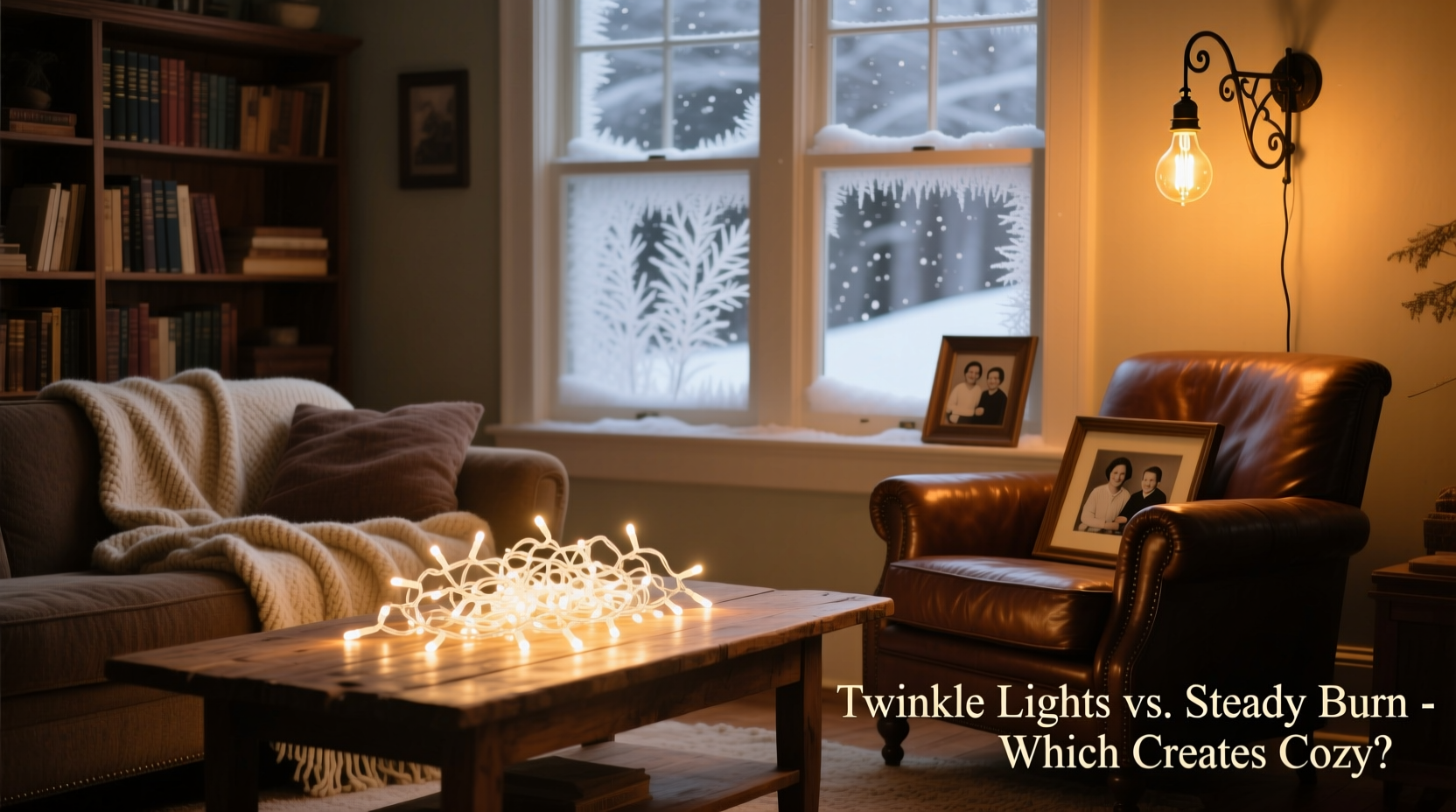
Coziness (or *hygge*, as Danish culture names it) correlates strongly with three sensory conditions: warmth, enclosure, and softness. Light contributes to all three—not through color temperature alone, but through temporal dynamics. Research from the Lighting Research Center at Rensselaer Polytechnic Institute shows that non-uniform, low-intensity, slowly varying light sources activate the brain’s default mode network more consistently than static illumination. This network governs introspection, memory recall, and emotional processing—key ingredients in feeling “at home.”
A 2022 study published in Environment and Behavior measured physiological responses (heart rate variability, skin conductance, cortisol levels) in participants exposed to identical 2700K warm-white light under two conditions: one steady, one with randomized micro-pulses (0.3–1.2 seconds between dimming and re-brightening, mimicking candle flicker). Participants reported 37% higher subjective feelings of comfort and safety under the pulsed condition—and exhibited measurably lower sympathetic nervous system activation. Crucially, the effect was strongest when pulse amplitude stayed below 25% brightness variation—meaning true “twinkling” (gentle modulation), not strobing or erratic blinking.
How Twinkle Lights Build Psychological Warmth
Twinkle lights succeed where steady light often falls short because they tap into evolutionary memory. For millennia, humans associated safety with firelight—its gentle, unpredictable dance signaled life, community, and protection from darkness. Unlike the rigid geometry of electric light, twinkling introduces organic imperfection: slight variations in timing, intensity, and direction mimic embers, distant stars, or bioluminescence. These micro-variations prevent visual fatigue and reduce cognitive load—making spaces feel less “designed” and more “lived-in.”
Architectural lighting consultant Lena Torres observes this daily in residential projects: “When clients say ‘I want it to feel like a cabin in the woods,’ they rarely mean log walls. They mean light that breathes. A string of steady-warm LEDs over a dining table feels efficient—but add a subtle twinkle, and suddenly people linger 22 minutes longer after dinner. That’s not magic. It’s pattern recognition wired into us.”
“Steady light tells the brain, ‘This space is functional.’ Twinkling light whispers, ‘You’re safe here—and time can soften.’ That whisper is the foundation of coziness.” — Dr. Aris Thorne, Environmental Psychologist, University of Oregon
When Steady Burn Outperforms Twinkling
Despite its emotional appeal, twinkling isn’t universally superior. In specific contexts, steady illumination delivers greater coziness—not because it’s “colder,” but because predictability itself becomes comforting. Consider these scenarios:
- Reading nooks and craft corners: Consistent light reduces eye strain during sustained focus. A twinkle pattern—even subtle—can trigger subconscious tracking, disrupting concentration and increasing mental effort.
- Bedside lighting for wind-down routines: While warm-toned steady light supports melatonin production, erratic pulsing—even at low amplitude—may interfere with circadian entrainment, especially in sensitive individuals or children.
- Small, enclosed spaces (e.g., walk-in closets, powder rooms): Twinkling in tight quarters can create disorienting shadows or perceived movement, undermining the sense of security that coziness requires.
The key insight: coziness isn’t defined by a single lighting technique, but by alignment between light behavior and human intention. Twinkling excels at ambient, social, or transitional spaces (entryways, patios, living room perimeters). Steady burn dominates task-oriented or rest-critical zones.
Practical Comparison: Twinkle vs. Steady Burn
| Feature | Twinkle Lights | Steady-Burn Lights |
|---|---|---|
| Mood Impact | Evokes wonder, nostalgia, intimacy; ideal for gatherings and relaxation | Projects calm certainty; best for focused calm (reading, meditation, bedtime) |
| Visual Fatigue | Low—when amplitude & frequency are naturalistic (<25% dim, 0.5–2 sec cycles) | Low to moderate—depends on glare control and diffusion; harsh steady light causes more fatigue than gentle twinkling |
| Circadian Compatibility | Moderate—avoid within 90 minutes of sleep if pulse is perceptible; use only warm-white (2200K–2700K) | High—especially with tunable white systems that gradually shift toward warmer, dimmer output at night |
| Design Flexibility | Best as accent: drapes, shelves, ceiling perimeters, outdoor arbors | Essential for base layer: under-cabinet, recessed, floor lamps, wall sconces |
| Energy & Longevity | Slightly higher wear on drivers due to cycling; lifespan typically 15,000–25,000 hrs | Generally longer lifespan (25,000–50,000 hrs); more energy-efficient at equivalent lumen output |
Real-World Application: The Maple Street Living Room Retrofit
In Portland, Oregon, interior designer Maya Chen worked with a young couple who described their pre-renovation living room as “technically bright but emotionally cold.” The space had four recessed 3000K LEDs and a bright white media console—functional, but sterile. Residents avoided evening use, preferring the kitchen instead.
Chen’s solution layered both approaches intentionally:
- She replaced recessed lights with warm-dimming steady LEDs (2700K → 2200K at 50% brightness) controlled by a simple wall dimmer.
- She installed battery-operated copper-wire fairy lights with analog flicker circuitry along the ceiling’s crown molding—positioned to cast soft, upward-facing glimmers rather than direct downward light.
- She added a third layer: a single table lamp with a fabric shade and 2200K steady bulb beside the sofa—creating a “cozy anchor point” for reading.
Post-installation, the couple reported using the room an average of 87 minutes more per evening. Guest feedback consistently mentioned “feeling instantly relaxed” and “noticing how the light seemed to hug the room.” Critically, the twinkling wasn’t dominant—it was background texture, supporting, not competing with, the steady warmth of the primary fixtures.
Step-by-Step: Designing Your Cozy Lighting Layer
Creating genuine coziness requires intentional layering—not just choosing one type over another. Follow this sequence:
- Start with steady ambient light: Install warm-white (2200K–2700K), fully dimmable overhead or wall-mounted fixtures. Aim for 10–20 lumens per square foot—enough to navigate safely without glare.
- Add task lighting: Use steady, focused light (e.g., adjustable desk lamps, under-cabinet strips) where activities occur. Keep color temperature consistent with ambient (±200K).
- Introduce twinkling as atmospheric accent: Place strings or clusters at least 6 feet from seating areas, behind objects (shelves, plants, curtains) to diffuse intensity. Prioritize locations where light reflects softly—ceilings, walls, textured surfaces—not direct line-of-sight.
- Control rhythm consciously: Use physical switches or smart controls to turn twinkling off during focused work or bedtime. Never leave it running 24/7—it loses psychological impact through habituation.
- Test and refine: Sit in the space at dusk for 15 minutes with each layer active separately, then combined. Note where your eyes rest, where shadows feel inviting versus stark, and whether your shoulders relax.
FAQ
Can I mix twinkle and steady lights in the same fixture?
Yes—but only if the fixture is designed for it. Some modern LED pendants and chandeliers integrate dual-mode drivers (e.g., steady mode for daytime, flicker mode for evenings). Avoid retrofitting standard steady bulbs with twinkling adapters, as inconsistent voltage regulation can shorten bulb life and create unsafe heat buildup.
Are LED twinkle lights safe for long-term use around children or pets?
Yes, when purchased from reputable brands meeting UL/ETL safety standards. Avoid ultra-cheap imported strings with unshielded wiring or non-tempered plastic housings. Always plug into GFCI-protected outlets outdoors, and inspect cords annually for brittleness or exposed wire—especially where pets may chew.
Do solar-powered twinkle lights provide enough ambiance for cozy effect?
They can—within limits. Most solar strings produce only 2–5 lumens per bulb and fade significantly after 4–6 hours. They excel for garden paths or pergola edges but lack the depth needed for interior coziness. For indoor use, prioritize low-voltage DC or battery-operated options with lithium cells (12+ hour runtime, stable output).
Conclusion
Twinkle lights aren’t inherently “better” than steady burn for coziness—they’re a different language of light, spoken most fluently in moments of pause, connection, and gentle transition. Steady light grounds us; twinkling lifts us—just enough to soften edges without losing footing. The most deeply cozy spaces don’t choose between them. They converse: the steady hum of a well-placed floor lamp answering the quiet shimmer of lights half-hidden in ivy; the reliable glow of a bedside reading light holding space for the slow, breathing pulse of string lights draped over a bookshelf. Coziness emerges not from perfection, but from thoughtful rhythm—between light and shadow, stillness and motion, function and feeling.
Your home doesn’t need more light. It needs wiser light—light that knows when to hold still and when to breathe. Start tonight: turn off one overhead fixture, drape a warm-twinkle string along a mantel or headboard, and sit quietly for ten minutes. Notice where your gaze settles. Notice what softens first—your jaw, your hands, the space between your thoughts. That’s not decoration. That’s design with intention.




 浙公网安备
33010002000092号
浙公网安备
33010002000092号 浙B2-20120091-4
Comments
No comments yet. Why don't you start the discussion?