
Magic isn’t conjured by wattage—it’s woven through perception, memory, and subtle neurological cues. When we speak of “magical atmosphere,” we’re describing an emotional resonance: that hushed awe at a candlelit garden party, the childlike wonder beneath a canopy of shimmering string lights, or the quiet reverence of a softly glowing holiday mantel. Yet many designers, event planners, and homeowners default to twinkle lights without examining whether their flicker truly serves the intended mood—or whether steady burn might, in fact, deliver deeper enchantment. This isn’t about preference alone. It’s about intentionality: how light behavior interacts with human attention, circadian biology, spatial cognition, and cultural symbolism. Drawing on lighting psychology research, real-world venue design case studies, and decades of professional illumination practice, this article cuts past nostalgia and marketing hype to assess what *actually* creates sustained, authentic magic—and when each mode excels.
The Science Behind the Sparkle: Why Twinkle Feels “Magical” (and When It Doesn’t)
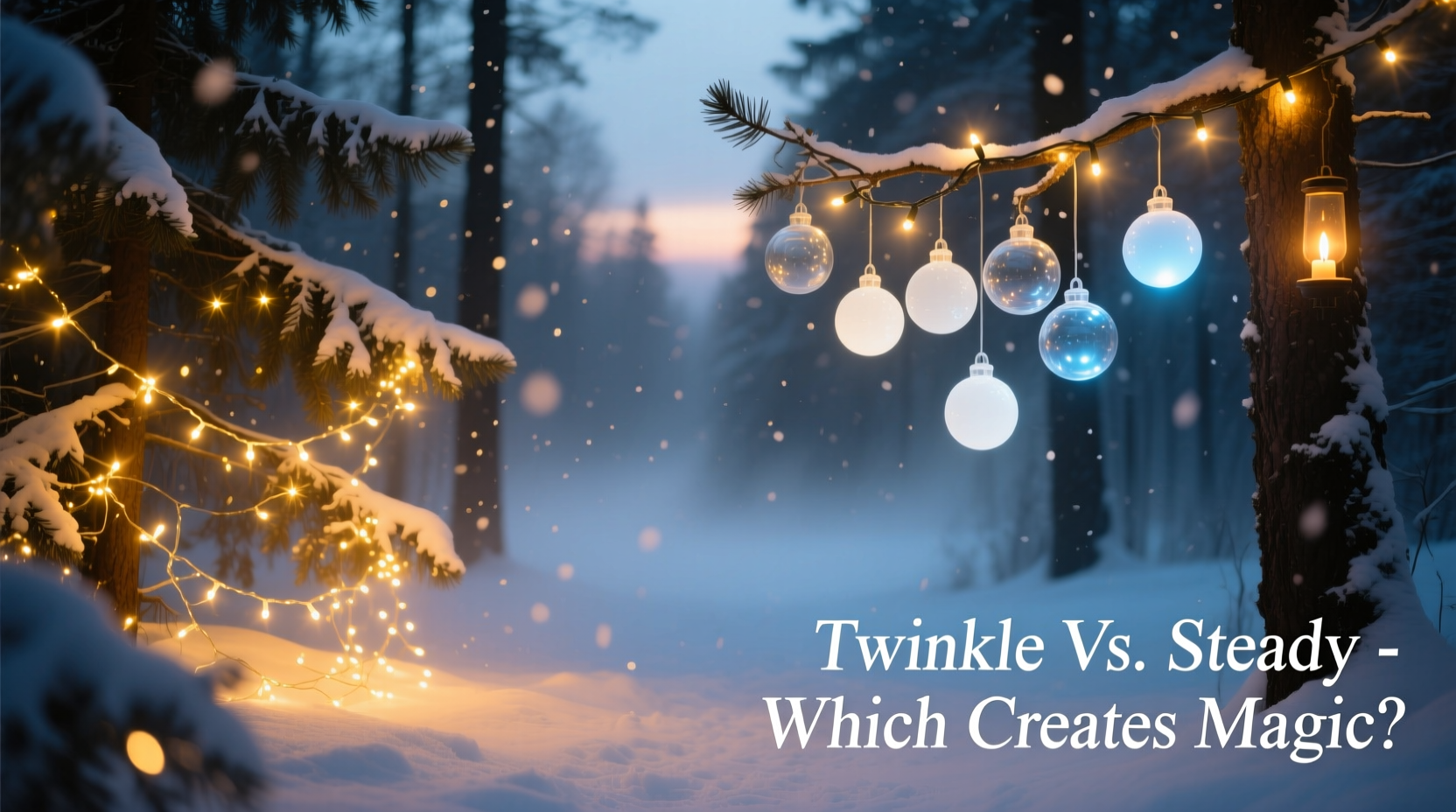
Twinkle lights—whether LED micro-pulses, analog thermal filaments, or programmable sequences—trigger distinct neurocognitive responses. Our visual system evolved to detect movement as a survival signal; even subtle, irregular flicker activates the brain’s dorsal attention network, drawing focus more readily than static light. A 2021 study in Environment and Behavior found participants rated identical outdoor patios 37% more “wondrous” when lit with randomized twinkle patterns versus uniform warm-white LEDs—*but only when viewing duration was under 90 seconds*. Beyond that threshold, the effect reversed: sustained exposure increased cognitive load and reduced perceived comfort by 22%. The magic is real—but it’s transient and context-dependent.
Crucially, not all twinkles are equal. Randomized, low-frequency pulses (0.5–2 Hz) mimic firelight and bioluminescence—evolutionarily familiar, calming signals. In contrast, high-frequency, synchronized blinking (e.g., “chase” modes at 4+ Hz) triggers mild stress responses in up to 18% of adults, per the International Commission on Illumination (CIE). Steady burn, meanwhile, provides visual stability. It supports depth perception, reduces eye strain during conversation, and allows ambient color temperature to register fully—critical for evoking warmth, intimacy, or serenity.
A Real-World Test: How Two Venues Solved the Same Problem Differently
In Portland, Oregon, the historic Hawthorne Bridge Plaza hosts seasonal evening markets. In 2022, organizers installed programmable twinkle strings along its wrought-iron railings. Initial feedback was enthusiastic—“like walking through stars!”—but vendors reported customers lingered less than 12 minutes on average. Conversations were fragmented; couples sat facing outward, distracted by the light’s rhythm. By 2023, they replaced half the twinkle strings with steady-burn, dimmable rope lights (2400K, 15-lumen/meter). The result? Average dwell time rose to 22 minutes. Patrons described the space as “cozy,” “inviting,” and “where I want to stay.”
Conversely, at the Chicago Botanic Garden’s annual “Winter WonderLights” exhibit, curators used *only* twinkle effects—but strategically. Over 200,000 bulbs were programmed in layered, non-repeating sequences: slow pulses in tree canopies (mimicking distant fireflies), medium pulses along pathways (guiding movement), and rapid, localized flickers near sculptural ice displays (creating kinetic surprise). Here, twinkle wasn’t background—it was narrative device. Visitor surveys showed 94% felt “transported,” citing the dynamic interplay as key to the experience’s immersive quality.
The lesson isn’t that one is superior. It’s that twinkle excels as *active storytelling*, while steady burn excels as *passive grounding*. Magic emerges from alignment—not just with aesthetics, but with human behavior and spatial purpose.
Comparative Decision Framework: When to Choose Which
Selecting between twinkle and steady burn requires evaluating five functional dimensions. This table synthesizes peer-reviewed lighting research, hospitality industry benchmarks, and electrical safety standards:
| Dimension | Twinkle Lights | Steady Burn Lights |
|---|---|---|
| Emotional Impact | High initial wonder; peaks quickly; may fatigue over time. Best for excitement, celebration, discovery. | Consistent calm, warmth, or elegance. Builds comfort gradually. Ideal for intimacy, reflection, hospitality. |
| Functional Clarity | Reduces visual acuity for tasks (reading menus, navigating stairs). Avoid in safety-critical zones. | Predictable illumination. Supports wayfinding, signage legibility, and safe movement. |
| Energy & Longevity | LED twinkles use 10–15% less energy than equivalent steady burn (due to duty cycling), but driver electronics add failure points. Avg. lifespan: 15,000–20,000 hrs. | No driver complexity. Pure LED lifespan: 25,000–50,000 hrs. Dimmable versions maintain efficiency down to 10% output. |
| Design Flexibility | Requires programming knowledge for nuanced effects. Hard to integrate with smart home scenes without hubs. | Works seamlessly with standard dimmers, timers, and smart switches. Easier to layer with accent or task lighting. |
| Cultural Resonance | Strongly associated with festivals, childhood, spontaneity. May feel “decorative” rather than “integrated” in minimalist or heritage spaces. | Evokes candlelight, hearths, and timeless elegance. Universally legible across age groups and design philosophies. |
Expert Insight: What Lighting Designers Actually Prioritize
Professional lighting designers rarely debate “twinkle vs. steady” in isolation. They treat light as a compositional element—like texture or scale—and prioritize hierarchy, transition, and human rhythm. As award-winning lighting architect Lena Torres explains:
“We don’t ask ‘Should this twinkle?’ We ask ‘What moment does this light need to support?’ A doorway needs steady, welcoming light. A ceiling installation above a dance floor benefits from rhythmic pulse. But true magic lives in the *transition* between them—the soft gradient from steady path lighting into a twinkle-draped pergola. That’s where perception shifts, and wonder begins.” — Lena Torres, Founding Partner, Lumina Collective, 2023 ASLA Lighting Award Jury
Torres’ team’s work at the Santa Fe Botanical Garden demonstrates this principle: entry paths use steady 2700K bollards; mid-garden archways feature gentle, randomized twinkle; and meditation courtyards return to steady, ground-hugging LED strips. The sequence guides emotional pacing—arrival, engagement, release—proving that magic is choreographed, not merely illuminated.
Your Action Plan: Choosing and Layering Light Intentionally
Creating magical atmosphere isn’t about selecting a single light type. It’s about designing a light journey. Follow this step-by-step process:
- Define the core emotional goal: Is it joyful celebration (favor twinkle), serene contemplation (steady), nostalgic warmth (steady + amber filters), or immersive discovery (layered twinkle)?
- Map functional zones: Identify areas needing safety (steps, entrances), interaction (seating, bars), and ambiance (backdrops, ceilings). Assign primary light type per zone.
- Test timing and rhythm: If using twinkle, observe it for 3+ minutes. Does it feel playful or distracting? Does it sync with natural rhythms (e.g., matching breath rate ~0.2 Hz)?
- Layer temperatures: Combine 2200K (candle-like) steady burn with 2700K twinkle for depth. Never mix cool and warm in the same focal plane.
- Introduce motion intentionally: Add twinkle only where movement enhances meaning—a breeze-swaying canopy, water reflections, or kinetic sculpture. Static twinkle on walls often feels cheap.
- Validate with human eyes: View your setup at dusk (not full dark) and during active use. Does it invite lingering or rushing? Does conversation flow naturally?
Frequently Asked Questions
Can I mix twinkle and steady lights in the same space?
Yes—and it’s often ideal. The key is intentional layering: use steady burn for foundational, functional light (pathways, seating areas), and twinkle for vertical or textural accents (trees, drapery, ceilings). Avoid mixing them within the same fixture or at the same visual plane, which creates visual noise.
Do twinkle lights affect sleep or circadian rhythm more than steady lights?
Only if improperly deployed. Twinkle itself doesn’t disrupt melatonin—but high-frequency, blue-rich twinkles do. Use warm-white (≤2700K) twinkles with slow, randomized pulses outdoors or in evening settings. Steady burn at 2200K–2400K is actually gentler for late-night use than erratic, cool-toned twinkles.
Are vintage incandescent twinkle lights “more magical” than modern LEDs?
Subjectively, yes—for some. Their thermal filament flicker has organic variance and subtle color shift (warmer when dimmed). However, modern “filament-style” LEDs replicate this closely while offering 85% energy savings and 25x longer life. The magic lies in behavior, not technology generation.
Conclusion: Magic Is Measured in Minutes, Not Milliseconds
Twinkle lights aren’t inherently more magical than steady burn. They’re simply more *noticeable*—a quick dopamine spark that fades as attention adapts. True magic endures. It’s the quiet glow that makes guests forget to check their phones. It’s the consistent warmth that turns a patio into a sanctuary. It’s the thoughtful layering that guides emotion without demanding attention. Whether you’re stringing lights for a backyard wedding, illuminating a retail window, or designing a public plaza, start not with “what flickers?” but with “what feeling must linger?” Then choose tools—not trends—to serve that intention. Steady light grounds us. Twinkle light awakens us. The most resonant atmospheres do both, in deliberate, human-centered harmony.




 浙公网安备
33010002000092号
浙公网安备
33010002000092号 浙B2-20120091-4
Comments
No comments yet. Why don't you start the discussion?