
In 2025, wireless charging is no longer a novelty—it’s embedded into cars, furniture, and public spaces. Yet a persistent question remains: are wireless chargers actually slower than their wired counterparts, and do they still make sense for everyday use? The answer isn’t binary. While wired charging still holds the edge in raw speed and efficiency, wireless charging has evolved significantly, offering compelling convenience that often outweighs its technical shortcomings for many users.
This article dives deep into the physics, performance metrics, and lifestyle trade-offs of both charging methods. Whether you're upgrading your phone, optimizing your workspace, or simply tired of tangled cables, understanding the real differences can help you decide what works best—now and in the near future.
How Charging Speed Really Works
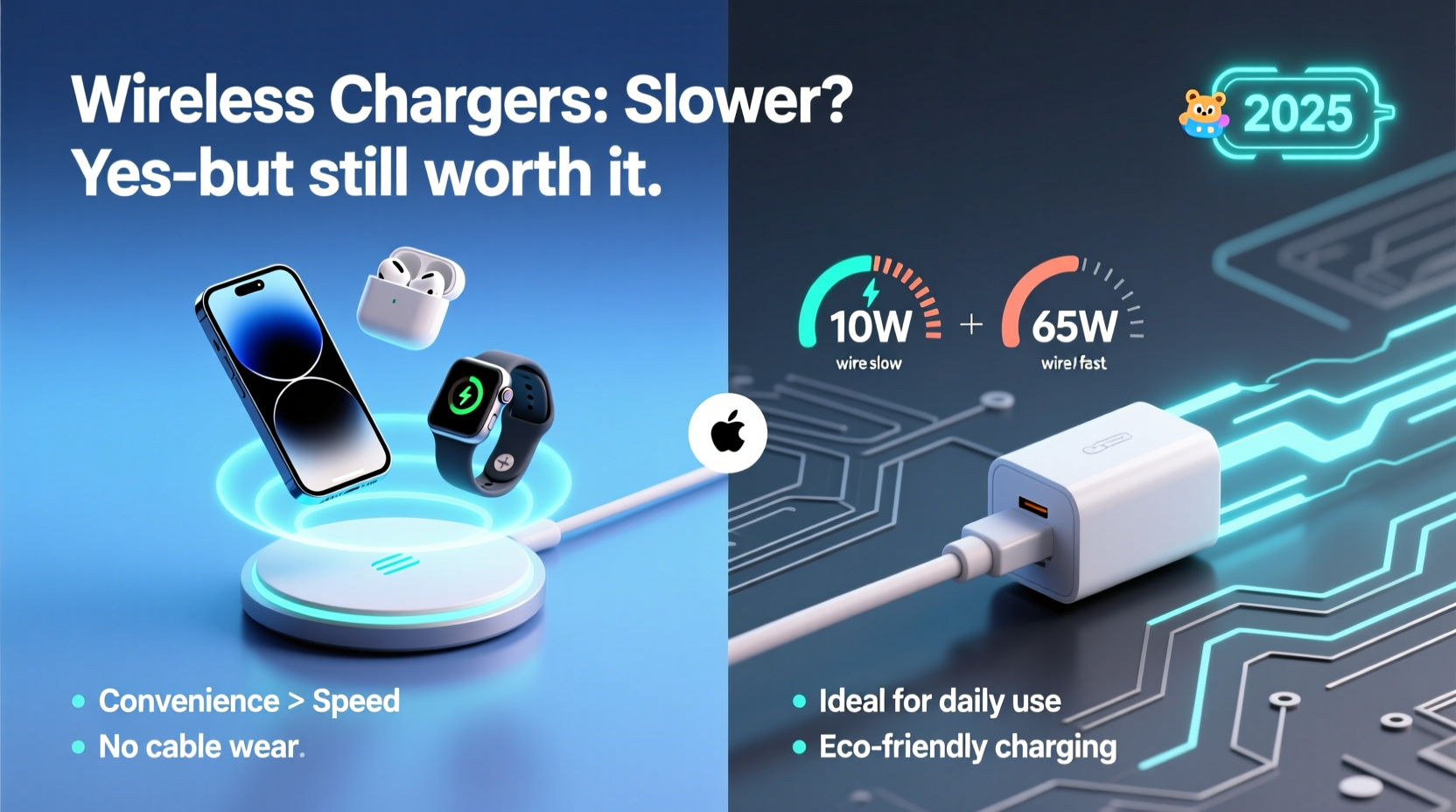
Charging speed is determined by power delivery, measured in watts (W). The higher the wattage, the faster a device can charge—assuming it supports that input. Modern smartphones typically support anywhere from 15W to over 100W via wired connections. Wireless chargers, on the other hand, usually max out at 15W to 50W, depending on the standard and device compatibility.
The fundamental difference lies in energy transfer. Wired charging uses direct electrical conduction through metal contacts, minimizing energy loss. Wireless charging relies on electromagnetic induction: a coil in the charger creates a magnetic field, which induces a current in a corresponding coil inside the phone. This process inherently generates heat and loses energy as radiation, reducing overall efficiency.
“Wireless charging will always be less efficient than wired due to physics—not engineering limitations.” — Dr. Lena Park, Electrical Engineer at MIT Energy Initiative
Studies show that wireless charging is roughly 60–80% efficient, meaning 20–40% of the energy is lost as heat during transfer. In contrast, wired charging operates at 85–95% efficiency. That inefficiency translates directly into slower charging times and increased electricity consumption over time.
Speed Comparison: Real-World Benchmarks
To illustrate the gap, consider two popular devices charged under controlled conditions:
| Device | Charger Type | Max Power | 0% to 50% Time | Full Charge Time | Heat Generated |
|---|---|---|---|---|---|
| iPhone 15 Pro | Wired (USB-C PD) | 27W | 23 minutes | 68 minutes | Moderate |
| iPhone 15 Pro | MagSafe Wireless | 15W | 48 minutes | 130 minutes | High |
| Samsung Galaxy S24 Ultra | Wired (Adaptive Fast Charging) | 45W | 18 minutes | 55 minutes | Low-Moderate |
| Samsung Galaxy S24 Ultra | Wireless (Qi2 Standard) | 15W | 45 minutes | 120 minutes | High |
As shown, even with identical battery capacities, wired charging completes the job in half the time. The gap widens further when fast-wired chargers exceed 45W, while most wireless systems remain capped at 15W for safety and thermal management reasons. However, newer standards like Qi2 (released in late 2023) now support up to 15W for iPhone-compatible devices and improved alignment, reducing misplacement issues that previously slowed charging.
When Wireless Still Makes Sense in 2025
Despite being slower, wireless charging offers unique advantages that align with modern usage patterns. It excels in scenarios where convenience trumps urgency.
Consider overnight charging: if you place your phone on a bedside pad before sleeping, the slower rate doesn’t matter. By morning, it’s fully charged, cable-free, and ready to go. Similarly, in-car wireless chargers eliminate the hassle of plugging in while driving—a small gain in safety and ease that adds up over time.
Another growing trend is integrated charging furniture. Desks, nightstands, and coffee tables with built-in Qi2 pads allow seamless drop-and-charge functionality. In office environments, this reduces cable clutter and improves ergonomics. For forgetful users, having a designated spot where “the phone always charges” encourages consistent top-ups throughout the day, preventing deep discharges that degrade battery health over time.
Moreover, Apple’s MagSafe ecosystem and Android’s adoption of Qi2 have standardized magnetically aligned wireless charging, improving efficiency and enabling accessories like wallets and battery packs to attach securely. These innovations enhance usability beyond pure speed.
The Battery Health Trade-Off
One overlooked aspect is long-term battery wear. While wireless charging generates more heat, sustained high temperatures accelerate lithium-ion battery degradation. However, frequent partial charges—enabled by convenient wireless pads—can actually extend battery lifespan compared to regular full discharge-recharge cycles.
The key is moderation. Using wireless charging casually during the day to maintain 40–80% charge levels is healthier than letting the battery drop below 20% and then fast-wiring it to 100%. Many manufacturers now include optimized charging modes that delay final charging stages until just before pickup, reducing stress on the cell.
Step-by-Step: Choosing the Right Charging Strategy
Instead of treating wired and wireless as competitors, think of them as complementary tools. Follow this decision framework to optimize your setup:
- Assess your daily routine: Do you need rapid top-ups between meetings? Or do you mostly charge at home and in transit?
- Prioritize speed when needed: Keep a high-wattage wired charger at your desk or in your bag for urgent situations.
- Leverage convenience otherwise: Use wireless chargers in fixed locations—bedside table, car console, office desk.
- Invest in Qi2 or MagSafe: Avoid generic Qi chargers. Newer standards offer better alignment, faster speeds, and accessory integration.
- Monitor temperature: Remove thick cases during wireless charging and avoid using the phone intensively while charging.
- Enable software features: Turn on “Optimized Battery Charging” (iOS) or “Adaptive Charging” (Android) to reduce long-term wear.
Expert Insights and Industry Trends
Industry momentum suggests wireless charging isn’t going away—it’s evolving. The AirFuel Alliance and WPC (Wireless Power Consortium) are developing resonance-based systems that could enable multi-device charging over distances of several centimeters, eliminating the need for precise placement.
“We’re moving toward ambient charging,” says Rajiv Mehta, CTO of a leading smartphone OEM. “By 2027, we expect to see rooms where devices charge passively just by being present—like Wi-Fi for power.”
Until then, hybrid approaches dominate. Flagship phones continue to support both high-speed wired and improved wireless options. Samsung’s recent foldables, for instance, support 45W wired but only 15W wireless, signaling that engineers still prioritize wire for performance.
Meanwhile, third-party brands like Anker, Belkin, and Spigen have refined multi-coil designs that tolerate minor misalignment and include cooling fans to manage heat. These refinements narrow the usability gap without violating physical limits.
Checklist: Optimizing Your Charging Setup in 2025
- ✅ Use wired charging when you need a quick boost (under 30 minutes)
- ✅ Reserve wireless charging for overnight, in-car, or stationary use
- ✅ Upgrade to Qi2 or MagSafe-certified chargers for better performance
- ✅ Avoid charging under pillows or thick blankets—especially wireless
- ✅ Enable battery optimization settings in your device OS
- ✅ Clean charging coils monthly with a dry microfiber cloth
- ✅ Replace damaged or overheating chargers immediately
Real Example: How a Remote Worker Balances Both Worlds
Taylor, a freelance designer based in Portland, uses both wired and wireless daily. Her morning starts with her phone already charged on a Qi2 pad beside her bed. During work hours, she keeps her laptop plugged in and uses a wired USB-C cable to rapidly recharge her phone after client calls. But when stepping away for lunch or walking around her home office, she drops the phone onto a wireless stand on her desk.
“I used to think wireless was pointless because it was so slow,” she says. “But once I stopped expecting it to replace wired entirely, it became part of a system. I get the speed when I need it and the convenience when I don’t.”
Her strategy reflects a broader shift: consumers are becoming more sophisticated about energy management, treating charging like nutrition—balanced, context-aware, and tailored to immediate needs.
Frequently Asked Questions
Is wireless charging bad for my phone’s battery?
Not inherently, but excessive heat from prolonged wireless charging can accelerate battery aging. To minimize risk, avoid using the phone for gaming or video calls while charging wirelessly, and remove insulating cases. Using optimized charging modes also helps preserve long-term health.
Can I use any wireless charger with my iPhone or Android phone?
Yes, as long as it supports the Qi or Qi2 standard. However, for fastest results and added features (like magnets or status indicators), use manufacturer-recommended or certified models. Generic chargers may throttle speed or fail to trigger proper alignment.
Will wireless charging ever catch up to wired?
In terms of raw speed, unlikely—due to inherent energy losses. However, future technologies like resonant charging or infrared-based systems could enable faster, mid-range wireless power delivery. For now, expect incremental improvements within existing frameworks rather than revolutionary leaps.
Final Verdict: Should You Still Use Wireless Chargers in 2025?
Yes—but selectively. Wireless chargers are slower than wired, and that won’t change fundamentally. If you measure value purely in minutes saved, wired wins every time. But technology adoption isn’t just about specs; it’s about fit within your life.
For those who value simplicity, reduced clutter, and effortless top-ups, wireless charging delivers tangible quality-of-life benefits. When paired with strategic wired charging for high-demand moments, it forms a balanced, sustainable approach.
The smartest users in 2025 aren’t choosing one over the other—they’re designing ecosystems where both coexist. A MagSafe pad in the car, a Qi2 station on the nightstand, and a 65W GaN charger in the travel bag create a seamless experience that adapts to context.




 浙公网安备
33010002000092号
浙公网安备
33010002000092号 浙B2-20120091-4
Comments
No comments yet. Why don't you start the discussion?