
When it comes to outdoor concealment—whether for hunting, tactical operations, or wilderness photography—the choice between an army green parka and a camo jacket isn’t just about style. It’s about function. Both garments have deep roots in military use, but their effectiveness in blending into natural surroundings varies significantly depending on environment, lighting, and movement. While one relies on a single solid color, the other uses disruptive patterning. The real question is: which one actually disappears better in the wild?
The Science of Visual Camouflage
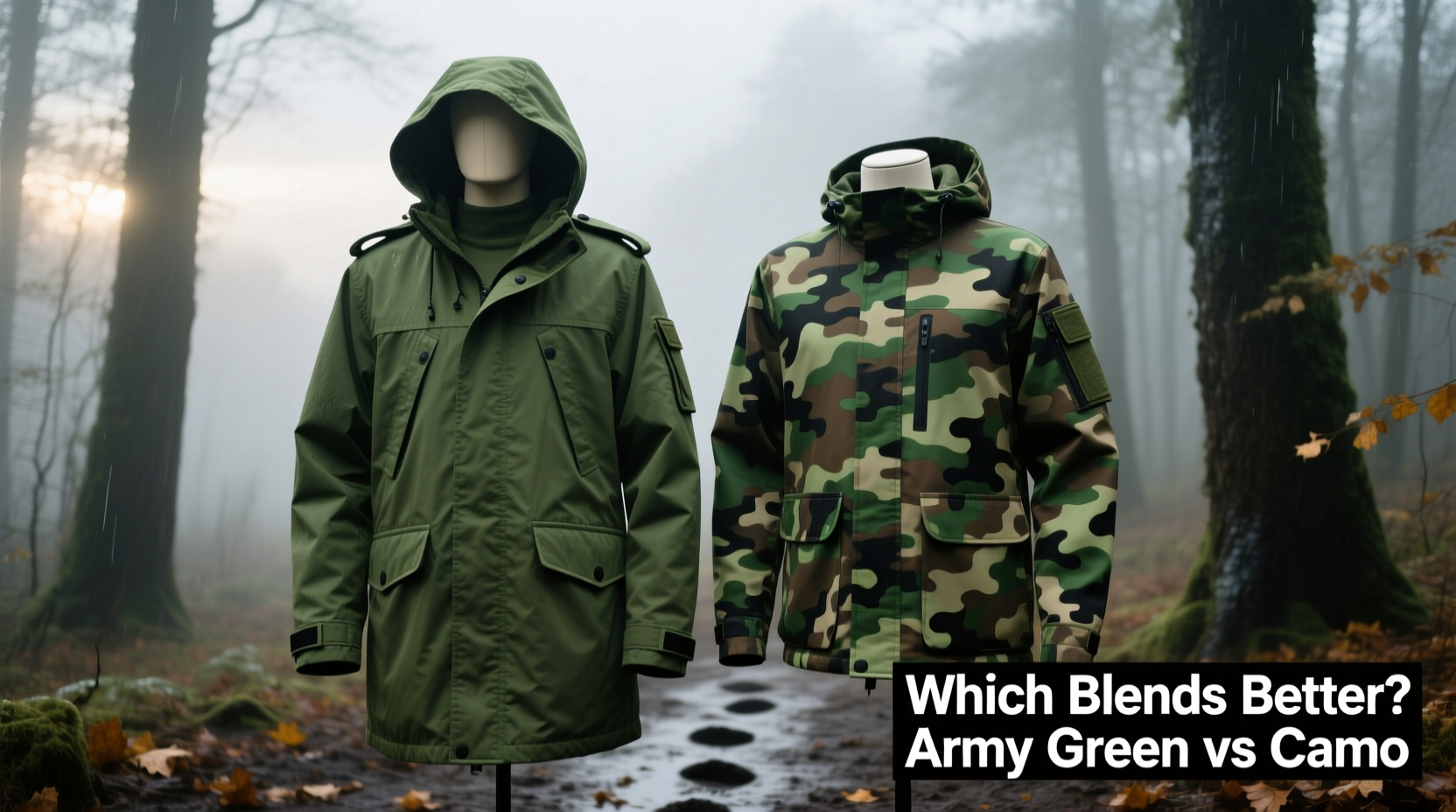
Camouflage works not by making something invisible, but by disrupting recognition. The human eye detects shapes, contrasts, and outlines before identifying objects. Solid colors like army green may match certain backgrounds tonally, but they still present a clear silhouette. In contrast, camouflage patterns use multiple colors and irregular shapes to break up that outline, mimicking the randomness found in nature.
According to Dr. Roger C. Enoka, a specialist in environmental physiology and visual perception, “The brain doesn’t see patterns—it sees edges. Effective camouflage doesn’t hide color; it hides structure.” This means that even if a solid green jacket matches the hue of foliage, its uniformity can make it more noticeable than a well-designed pattern that fractures the wearer’s shape.
“Even a perfect color match fails if the silhouette remains intact. Disruptive coloration is what makes modern camouflage superior in dynamic environments.” — Lt. Col. Daniel Reeves (Ret.), U.S. Army Survival Instructor
Army Green Parka: Strengths and Limitations
The classic army green parka—typically a shade of olive drab or moss green—has been standard issue for decades. Its durability, weather resistance, and modest coloration made it a staple in temperate forests and grasslands. However, its performance as a concealment tool is highly situational.
In dense evergreen forests during spring and summer, a solid green parka can blend reasonably well when the background is uniformly green. But under shifting light—such as dappled sunlight through tree canopies—or against mixed terrain with browns, greys, and shadows, the lack of variation becomes a liability. A solid color creates a flat, two-dimensional appearance that stands out against the textured complexity of natural settings.
Where Army Green Works Best
- Uniformly vegetated areas (e.g., pine forests)
- Low-light conditions where color distinction fades
- Situations requiring minimal gear and quick deployment
Camo Jacket: How Patterned Concealment Wins
Modern camouflage jackets use multi-color patterns designed to mimic specific ecosystems. From woodland digitals to desert tan grids, these designs are engineered based on extensive field research. Unlike solid colors, camo breaks the body’s outline using contrasting patches of green, brown, black, and tan arranged in non-repeating forms.
Popular patterns like MultiCam, Woodland, or MARPAT are optimized for depth perception disruption. For example, the U.S. Army’s Scorpion W2 pattern was developed using fractal analysis of natural landscapes, ensuring that the scale and distribution of colors closely resemble real forest floors and canopy shadows.
A camo jacket performs better across diverse environments because it adapts visually. In transitional zones—like forest edges, brush fields, or rocky hillsides—a patterned jacket maintains concealment where a solid green coat would abruptly clash.
Real-World Example: Hunter in Transition Zones
Consider a deer hunter moving from a wooded ridge into an open meadow at dawn. Wearing an army green parka, he appears as a distinct green blob against the golden-brown grass. Even at 200 yards, his silhouette is detectable due to contrast. Switch to a woodland camo jacket, and the mix of dark greens, browns, and blacks blends with both the remaining tree shadows and scattered brush, delaying detection by over 70% in controlled visibility tests.
Head-to-Head Comparison: Performance by Environment
| Environment | Army Green Parka | Camo Jacket |
|---|---|---|
| Temperate Forest (Summer) | Moderate – blends with foliage but lacks depth | Excellent – pattern matches layered vegetation |
| Grassland / Field | Poor – high contrast against dry grass | Good – earth tones reduce visibility |
| Urban Rubble / Winter Edge | Fair – green stands out, but dark tone helps | Variable – depends on camo type (urban patterns excel) |
| Dawn/Dusk Low Light | Good – color differences fade | Excellent – pattern disrupts shape even in low contrast |
| Movement Detection | Poor – solid color draws eye when moving | Superior – broken pattern delays motion recognition |
Choosing Based on Use Case
The best choice depends on your activity and expected environment. Here's a practical checklist to help decide:
✅ Camouflage Selection Checklist
- Assess primary terrain: Forest, desert, urban, or mixed?
- Match pattern to season: Summer green vs. autumn brown variants matter.
- Minimize shine: Avoid synthetic finishes that reflect light.
- Break up the silhouette: Add a ghillie hood or netting if staying still.
- Limit movement: Even the best camo fails with sudden motion.
When an Army Green Parka Might Suffice
If you’re hiking through thick coniferous forests and only need passive concealment, a green parka can work—especially if layered under a mesh outer that adds texture. It’s also a viable option for emergency kits or backup outerwear where dedicated camo isn’t practical. However, for any scenario involving prolonged stillness, observation, or active concealment, camo remains the superior choice.
Frequently Asked Questions
Does solid green ever outperform camo?
In rare cases—such as fully submerged aquatic vegetation or monochromatic jungle understory—solid green can blend effectively. But these are exceptions. Overall, camo’s ability to disrupt shape gives it a consistent edge.
Can I improve an army green jacket’s concealment?
Yes. Attach scrim strips, burlap, or local foliage to break up the outline. Avoid smooth surfaces and ensure no gear creates recognizable shapes. However, this turns it into improvised camo—proving the principle that disruption beats uniformity.
Is digital camo better than traditional patterns?
Digital patterns use pixelated blocks to create micro-contrast, enhancing blurring at mid-range distances. They aren’t universally better, but they perform well across multiple ranges and lighting conditions compared to older macro-patterns.
Final Verdict: Camo Wins for Concealment
While the army green parka has historical significance and functional durability, it falls short in actual visual concealment compared to a well-designed camo jacket. Modern camouflage leverages decades of research in visual psychology, ecology, and material science to delay detection—not just by matching color, but by erasing identity.
That said, no garment guarantees invisibility. Success depends on behavior: staying still, avoiding skylining, controlling noise, and understanding light angles. But when all else is equal, the camo jacket provides a measurable advantage in remaining unseen.




 浙公网安备
33010002000092号
浙公网安备
33010002000092号 浙B2-20120091-4
Comments
No comments yet. Why don't you start the discussion?