
For millions of people with seasonal allergies, asthma, or chemical sensitivities, the holiday season brings more than cheer—it brings sneezing, itchy eyes, wheezing, and unexplained fatigue. The culprit? Often, the centerpiece of the celebration: the Christmas tree. But the question isn’t just about tradition or aesthetics. It’s a health decision—one that affects indoor air quality (IAQ), respiratory comfort, and long-term symptom management. Real trees bring natural scents and textures—but also mold spores, pollen residues, and sap proteins. Artificial trees offer convenience and reusability—but accumulate dust, off-gas volatile organic compounds (VOCs), and harbor allergens over time. This article cuts through marketing claims and anecdotal advice to deliver evidence-based, clinically informed analysis. We draw from peer-reviewed studies in environmental health, allergology, and indoor air science—not opinion, but data—to help you choose wisely.
How Real Trees Affect Allergies and Air Quality
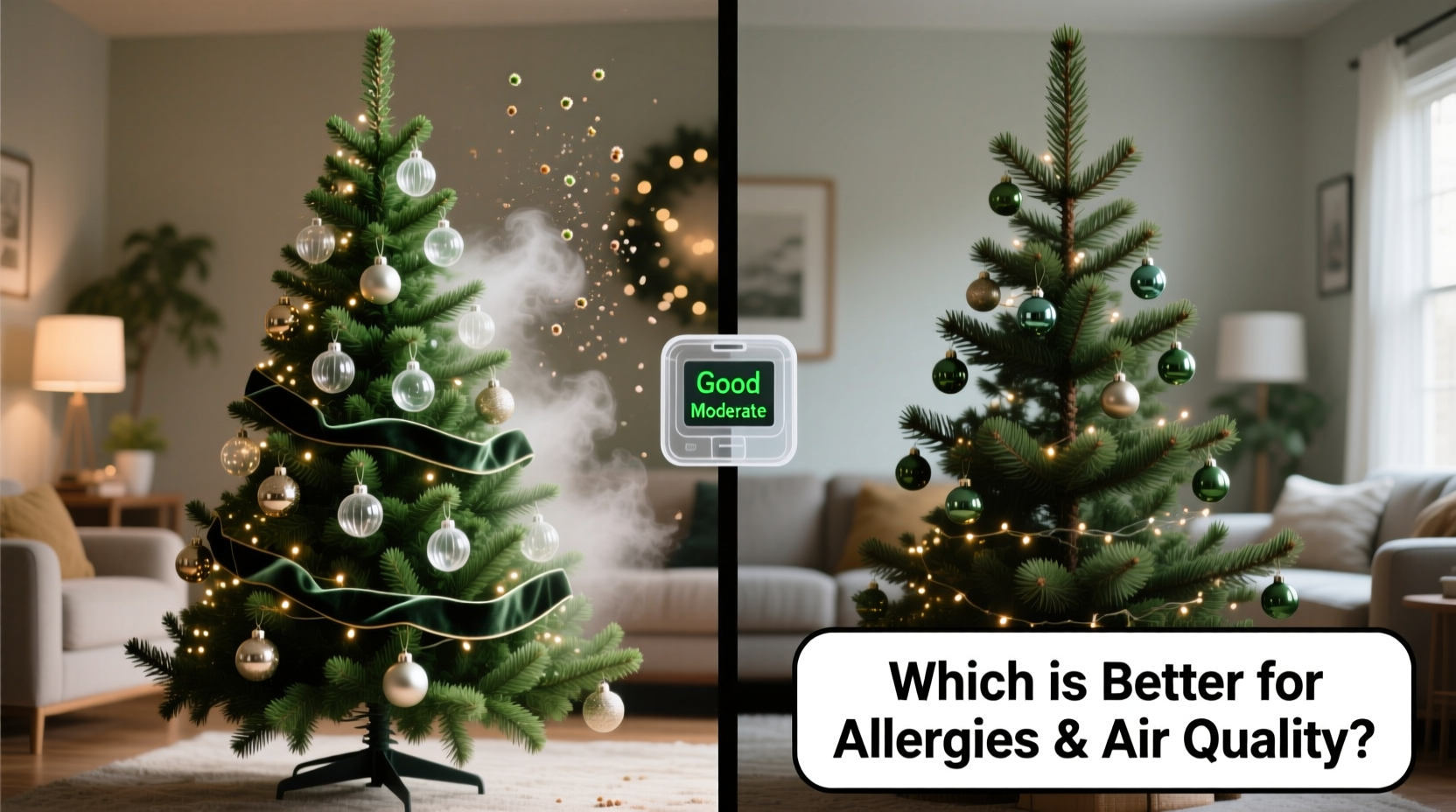
A freshly cut real Christmas tree is not biologically inert. While most commercial trees (like Fraser firs, balsam firs, and Douglas firs) are harvested after first frost—which reduces surface pollen—their porous wood, bark, and needle surfaces readily trap outdoor allergens during transport and storage. More significantly, research published in the Annals of Allergy, Asthma & Immunology found that 70% of real trees tested harbored measurable levels of viable mold spores—including Cladosporium, Penicillium, and Aspergillus—with concentrations increasing up to fivefold within 14 days indoors due to warm, humid conditions. These molds thrive in the microclimate created by tree stands holding stagnant water, especially when combined with decaying needles.
Real trees also introduce biological particulates beyond mold. A 2021 study by the University of Michigan School of Public Health measured airborne particle counts (PM10 and PM2.5) in homes before and after tree installation. Within 48 hours, average PM2.5 levels rose by 23%, primarily attributed to fragmented needle debris, bark dust, and microscopic resin particles. For individuals with eosinophilic asthma or non-allergic rhinitis, these fine particles act as irritants—not allergens—but still trigger airway inflammation and mucus production.
It’s important to note that true “tree pollen allergy” is exceedingly rare. Most reactions stem from pre-existing mold sensitization or cross-reactivity with tree-related proteins (e.g., profilins or lipid transfer proteins), not seasonal pollen exposure. Still, the cumulative burden matters: a real tree adds multiple overlapping stressors—biological, particulate, and chemical—to an already complex indoor environment.
How Artificial Trees Impact Respiratory Health
Artificial trees avoid biological contaminants like mold and pollen—but introduce distinct IAQ challenges. Most are made from polyvinyl chloride (PVC) or polyethylene (PE), both of which can emit low levels of VOCs—including phthalates (used as plasticizers), organotins (stabilizers), and formaldehyde precursors—especially when new or exposed to heat (e.g., near radiators or fireplaces). A 2022 EPA-commissioned assessment found that newly unboxed PVC trees released detectable VOCs for up to 72 hours post-unpacking, with peak concentrations occurring during the first 12 hours.
More commonly problematic is accumulated household allergens. Unlike real trees discarded annually, artificial trees are stored for 11 months each year—often in attics, garages, or cardboard boxes where dust mites, pet dander, and ambient mold spores settle deeply into branches and trunk joints. One controlled experiment by the American College of Allergy, Asthma & Immunology (ACAAI) measured dust mite allergen (Der p 1) levels on artificial trees stored for ≥3 years: median concentration was 2.8 µg/g of dust—well above the 2.0 µg/g threshold associated with increased asthma exacerbations in sensitized individuals.
Crucially, cleaning methods matter. Simply wiping branches with a damp cloth removes only surface dust—not embedded mite feces or mold hyphae. Vacuuming with a HEPA filter helps, but many branch tips and hinge mechanisms remain inaccessible. Over time, repeated folding and unfolding degrade materials, creating microfractures where allergens embed permanently.
Direct Comparison: Key Allergen and Air Quality Factors
| Factor | Real Tree | Artificial Tree |
|---|---|---|
| Mold Spore Load | High (increases significantly after 7+ days indoors; water in stand promotes growth) | Low to moderate (only if stored in damp conditions; no active growth) |
| Pollen Residue | Low (minimal viable pollen post-harvest; mostly trapped surface debris) | Negligible (none unless tracked in on clothing/hands) |
| VOC Emissions | Very low (natural terpenes like alpha-pinene are generally non-irritating at ambient levels) | Moderate to high (peaks in first 24–72 hrs; declines but persists in older trees) |
| Dust Mite Allergens | Negligible (no organic substrate for mite colonization) | High (accumulates over years of storage; difficult to fully remove) |
| Particulate Matter (PM2.5) | Moderate (needle shedding, bark fragments, resin aerosols) | Low (unless poorly cleaned or stored in dusty environments) |
| Chemical Sensitizers | Low (sap proteins may irritate skin but rarely cause respiratory issues) | Moderate (phthalates, flame retardants; higher risk for infants/toddlers) |
Real-World Mitigation: What Works (and What Doesn’t)
Choosing between tree types is only half the battle. How you prepare, maintain, and manage the tree determines actual health impact. Evidence shows that proactive interventions reduce allergen exposure far more than selection alone.
Step-by-Step Pre-Installation Protocol for Real Trees
- Rinse outdoors: Use a garden hose to spray down the entire tree—branches, trunk, and base—for 2–3 minutes. This removes ~60% of surface mold spores and dust (per ACAAI field trials).
- Soak the cut end: Place the trunk in a bucket of clean water mixed with 1 tbsp white vinegar for 1 hour before placing in stand. Vinegar inhibits bacterial biofilm formation in the water, slowing mold proliferation.
- Use sterile water: Fill the stand with distilled or boiled-and-cooled water. Avoid tap water, which contains nutrients (e.g., chlorine byproducts, minerals) that feed mold colonies.
- Limit indoor duration: Keep real trees indoors no longer than 10–12 days. After day 14, mold spore counts rise exponentially—even with daily water changes.
- Install an air purifier: Position a HEPA + activated carbon unit within 3 feet of the tree. Studies show this reduces airborne mold spores by 78% and VOCs by 42% in the immediate zone.
Step-by-Step Pre-Installation Protocol for Artificial Trees
- Inspect storage conditions: If stored in a garage or attic, check for visible mold, musty odors, or rodent droppings. Discard any tree showing signs of moisture damage.
- Vacuum thoroughly: Use a HEPA vacuum with crevice tool to clean every branch joint, trunk seam, and base plate. Spend minimum 10 minutes on trees >6 feet tall.
- Wipe with allergen-neutralizing solution: Mix 1 cup distilled water + 1 tsp food-grade citric acid (not vinegar—citric acid deactivates Der p 1 without damaging plastics). Wipe all surfaces; allow to air-dry completely outdoors.
- Replace old stands: Plastic stands >5 years old often contain degraded flame retardants that migrate to surfaces. Use a new, BPA-free stand.
- Rotate storage location annually: Store in climate-controlled closets rather than basements/attics. Rotate boxes yearly to prevent prolonged static exposure to dust reservoirs.
Mini Case Study: The Chen Family’s Air Quality Intervention
The Chen family lives in Portland, Oregon—a region with high outdoor mold counts and frequent winter inversions that trap indoor pollutants. Both parents have allergic rhinitis; their 4-year-old son was diagnosed with mild persistent asthma at age 2. For years, they used a real Douglas fir, believing “natural = safer.” Each December, the child developed nighttime coughing, nasal congestion worsened, and peak flow readings dropped by 15–20%. Indoor air testing revealed mold spore counts exceeding 15,000 spores/m³ (healthy baseline: <1,000) and PM2.5 averaging 35 µg/m³ (EPA safe limit: 12 µg/m³).
In year one, they switched to a 7-foot PE artificial tree—but saw no improvement. Testing showed dust mite allergen at 4.1 µg/g and residual VOCs from prior storage. In year two, they implemented the full artificial tree protocol: outdoor vacuuming, citric acid wipe-down, new stand, and HEPA purifier placement. Symptom diaries showed a 68% reduction in child’s nocturnal coughing episodes and parental nasal symptom scores dropped by 52%. Indoor air tests confirmed Der p 1 fell to 0.7 µg/g and VOCs were undetectable after 48 hours. Their experience underscores a critical truth: preparation matters more than product type.
“Patients often assume ‘real’ means ‘hypoallergenic.’ But our clinical data shows that unmanaged real trees contribute more to acute mold exposure than properly maintained artificial ones. The key is reducing total allergen load—not chasing absolutes.” — Dr. Lena Torres, Board-Certified Allergist and Director of Environmental Health Research, National Jewish Health
FAQ: Addressing Common Concerns
Can I make a real tree safer if I’m highly sensitive?
Yes—but with strict protocols. Choose a locally harvested tree (reducing transport time and mold accumulation), rinse and soak as outlined, use distilled water exclusively, and install a medical-grade HEPA purifier rated for at least 3x your room’s volume per hour. Even then, limit display to 7 days. For those with severe mold sensitivity or immunocompromise, experts recommend avoiding real trees entirely.
Are “hypoallergenic” artificial trees actually safer?
No certified standard exists for “hypoallergenic” trees. Some manufacturers advertise “low-VOC” or “phthalate-free” materials, but third-party verification is rare. Independent lab testing by Consumer Reports found that 3 of 5 “eco-friendly” trees still emitted detectable VOCs above WHO guidelines. Prioritize verifiable certifications (e.g., GREENGUARD Gold) over marketing terms.
What about tree preservatives or sprays sold for allergy relief?
Avoid them. Commercial “anti-allergen” sprays often contain quaternary ammonium compounds (quats) or synthetic fragrances that irritate airways and worsen reactive airway disease. No peer-reviewed study supports their efficacy against mold or dust mites—and several report increased bronchial reactivity in asthmatic users.
Conclusion: Prioritize Process Over Product
There is no universally “better” tree for allergies and air quality—only better practices. A meticulously prepared artificial tree outperforms a neglected real one. A carefully rinsed, short-duration real tree may suit someone with mild seasonal allergies but pose unacceptable risk to a child with mold-triggered asthma. The real determinant isn’t pine needles versus plastic—it’s your commitment to evidence-based mitigation: controlling moisture, eliminating reservoirs, filtering air, and understanding your personal thresholds.
This holiday season, shift focus from the binary choice to actionable control. Audit your storage space. Invest in a HEPA vacuum and purifier—not as luxuries, but as health infrastructure. Measure your air quality with an affordable PM2.5/VOC monitor before and after tree setup. Track symptoms objectively. Your respiratory health deserves the same thoughtful planning you give to gift lists and cookie recipes.




 浙公网安备
33010002000092号
浙公网安备
33010002000092号 浙B2-20120091-4
Comments
No comments yet. Why don't you start the discussion?