
In high-intensity training or competitive sports, every edge counts—especially when it comes to joint stability, muscle support, and injury resilience. Two taping methods dominate athletic care: traditional athletic tape and kinesiology tape. While both are staples in trainers’ kits, their purposes, mechanisms, and effects on performance differ significantly. Choosing the wrong one can mean the difference between enhanced function and restricted movement—or even delayed recovery.
Despite widespread use, confusion persists about which tape serves what purpose and how each influences physical output. This article breaks down the core distinctions that genuinely affect performance, not just marketing claims or aesthetic preferences. From material behavior to biomechanical outcomes, we’ll explore how these tapes interact with the body under stress, during motion, and throughout recovery.
Material Composition and Elastic Properties
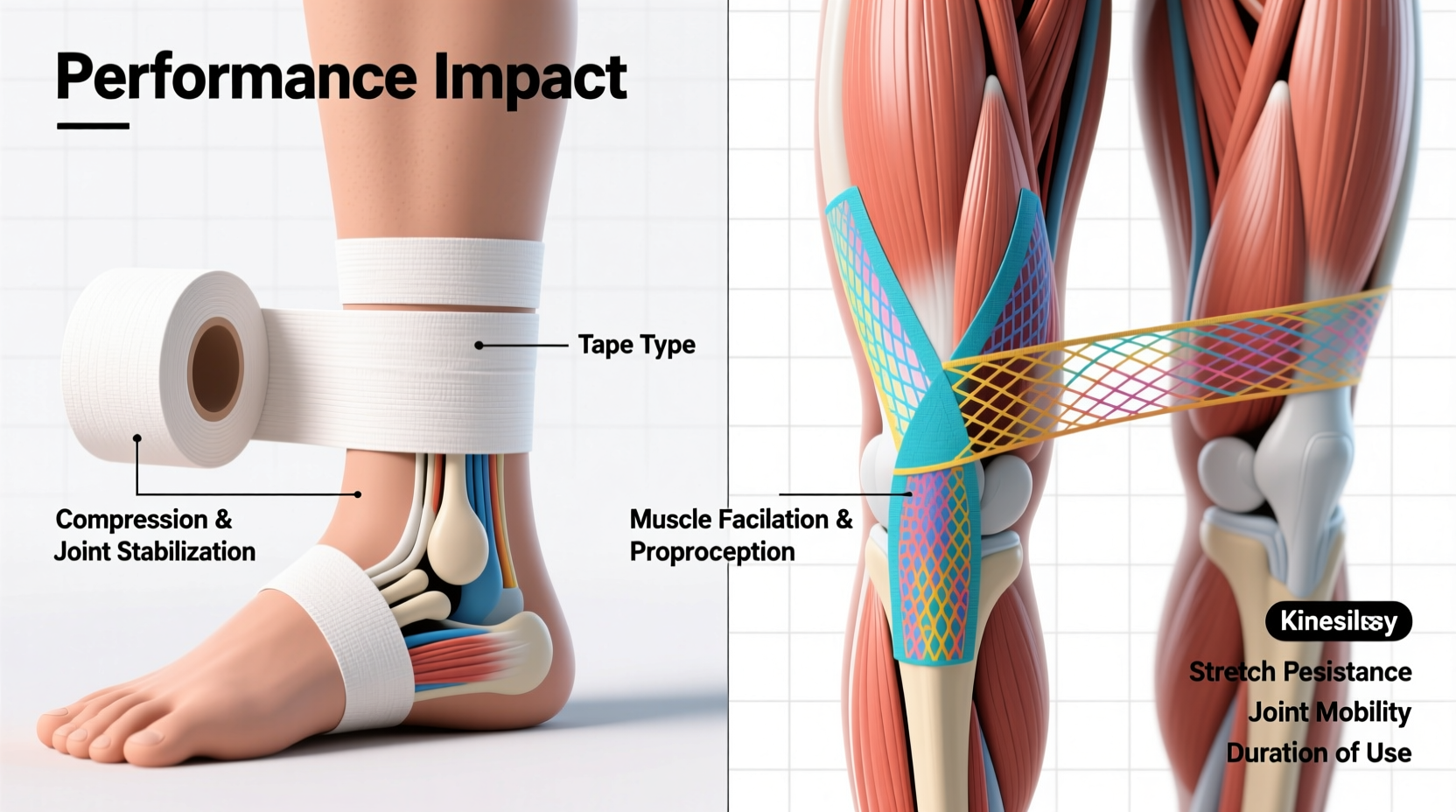
The foundation of any functional difference lies in what each tape is made of and how it behaves under tension.
Athletic tape, typically composed of rigid cotton or linen fibers with a strong adhesive, offers minimal stretch—usually less than 5%. Its primary role is mechanical restriction. When applied correctly, it limits joint motion, especially in high-risk areas like ankles or wrists, preventing excessive rolling or hyperextension during explosive movements.
Kinesiology tape, by contrast, is made from a thin, elastic polymer blend (often cotton-polyester with spandex) designed to mimic human skin’s thickness and elasticity. It can stretch up to 140% of its resting length and recoils naturally. This elasticity allows for full range of motion while still providing sensory feedback and light support.
| Feature | Athletic Tape | Kinesiology Tape |
|---|---|---|
| Stretch Capacity | < 5% | Up to 140% |
| Material Base | Cotton/linen with strong adhesive | Elastic fabric with heat-activated adhesive |
| Water Resistance | Poor (loses integrity when wet) | High (designed for sweat and showers) |
| Durability on Skin | 1–2 hours (during intense activity) | 3–5 days |
| Primary Function | Mechanical immobilization | Sensory modulation and circulation support |
These material differences aren’t trivial—they dictate how each tape interacts with dynamic movement. Rigid tape may prevent injury but at the cost of altering natural neuromuscular patterns. Kinesiology tape aims to support without interference, relying more on neurological input than structural constraint.
Mechanical Support vs. Neuromuscular Feedback
This is where performance implications become clear. Athletic tape works by physically restricting joint motion. In sports involving sudden direction changes—like basketball, soccer, or volleyball—it's commonly used prophylactically on ankles. Studies show that pre-taping reduces the incidence of acute lateral ankle sprains by limiting inversion beyond safe ranges.
However, this restriction comes with trade-offs. Research published in the *Journal of Athletic Training* indicates that rigid taping can reduce proprioceptive accuracy over time due to decreased joint afferent signaling. In other words, because the joint isn't moving as freely, the nervous system receives less feedback about position and velocity, potentially impairing coordination after prolonged use.
Kinesiology tape operates differently. Instead of blocking motion, it applies gentle, directional tension across muscles and fascia. When the tape recoils, it lifts the skin microscopically, creating space beneath the surface. This decompression is believed to improve lymphatic drainage and blood flow while stimulating mechanoreceptors in the skin.
“Kinesiology taping doesn’t replace strength or stability—it enhances the body’s ability to sense itself during motion.” — Dr. Lena Torres, Sports Physiotherapist & Biomechanics Researcher
The result? Improved kinesthetic awareness. Runners report feeling “lighter” strides; swimmers notice better shoulder tracking. These aren’t placebo effects alone—EMG studies show altered muscle activation timing in taped versus untaped conditions, particularly in fatigued states.
Impact on Recovery and Circulation
Performance isn’t only about peak output—it also includes how quickly you recover. Here, kinesiology tape shows distinct advantages.
By promoting interstitial fluid movement, kinesiology tape may help reduce localized edema and delay onset muscle soreness (DOMS). A 2020 meta-analysis in *Sports Medicine – Open* concluded that kinesiology taping applied post-exercise led to modest but statistically significant reductions in perceived muscle soreness at 24 and 48 hours, particularly in eccentric-dominant activities like downhill running or heavy resistance training.
Athletic tape has no such effect. Once removed, it leaves no residual physiological benefit. In fact, leaving it on too long can cause skin irritation, folliculitis, or impaired thermoregulation due to occlusion.
Yet, there’s a caveat: kinesiology tape’s circulatory benefits depend heavily on correct application technique. The “I,” “Y,” and “X” strip configurations must align with anatomical vectors of pull. Misapplication can create counterproductive tension or even restrict venous return.
Step-by-Step Guide: Applying Kinesiology Tape for Shoulder Recovery
- Clean and dry the shoulder area thoroughly; remove excess hair if necessary.
- Cut a “Y”-shaped strip: one anchor (5 cm unstretched), two tails (each ~25 cm).
- Anchor the base over the deltoid insertion (lateral upper arm) without stretch.
- Apply one tail along the trapezius toward the neck with 25% tension.
- Apply the second tail down the posterior deltoid with 25% tension.
- Rub the tape firmly to activate adhesive and ensure edge adhesion.
- Avoid stretching the ends—the last 5 cm should remain unstretched to prevent skin irritation.
This method supports scapular alignment and encourages lymphatic drainage from the rotator cuff region—useful after overhead lifting or swimming sets.
When Each Tape Actually Enhances Performance
Neither tape is universally superior. Their value depends on context, phase of training, and individual needs.
Athletic tape excels in acute protection scenarios:
- Returning to sport after an ankle sprain
- Playing on uneven terrain (e.g., trail running, beach volleyball)
- Preventing recurrent joint instability in contact sports
In these cases, mechanical restraint outweighs the slight loss in proprioception. A football linebacker charging through mud benefits more from locked-down ankles than subtle sensory cues.
Kinesiology tape shines in endurance, precision, and fatigue management:
- Long-distance runners managing IT band tightness
- Gymnasts refining joint positioning under load
- Post-match recovery in team sports
Triathletes often combine both: athletic tape on toes to prevent blistering during cycling, kinesiology tape on quads to manage swelling during the run leg.
Mini Case Study: Collegiate Volleyball Team Taping Protocol
A Division I women’s volleyball program implemented a split-season taping strategy. During preseason scrimmages, players used only athletic tape on ankles. Injury rates dropped 30% compared to the prior year, but coaches noted reduced agility in back-row transitions.
In midseason, they introduced kinesiology tape on hips and shoulders for neuromuscular priming. Players reported improved spatial awareness during aerial spikes. By finals, the team adopted a hybrid model: athletic tape for ankles during matches, kinesiology tape on kinetic chain areas (knees, low back) during practice and recovery.
The outcome? Fewest ankle injuries in five years, highest spike accuracy rate, and lowest DOMS complaints. The athletic trainer credited the success to matching tape type to functional demand—not tradition.
Common Misconceptions and Practical Checklist
Many athletes misuse these tapes based on myths. One common belief is that kinesiology tape “heals” injuries. It does not. It may support healing environments, but tissue repair requires rest, nutrition, and proper loading.
Another myth: “More tape = more support.” Over-taping with athletic tape can lead to compensatory strain elsewhere. A runner with excessively taped knees might develop iliotibial band friction syndrome due to altered gait mechanics.
📋 **Taping Decision Checklist**- Is the goal to prevent excessive joint motion? → Consider athletic tape.
- Do you need full range of motion with sensory feedback? → Choose kinesiology tape.
- Will you be sweating heavily or in water? → Kinesiology tape is more durable.
- Is this for competition or recovery? → Match tape to phase.
- Have you tested the tape during training before race day? → Always trial first.
- Are you addressing pain or dysfunction? → Consult a professional before self-taping.
Frequently Asked Questions
Can I wear kinesiology tape for multiple days?
Yes. Most medical-grade kinesiology tapes are designed to stay adhered for 3 to 5 days, even with showering and sweating. However, if you experience itching, redness, or peeling, remove it immediately—this may indicate an allergic reaction or poor breathability.
Does athletic tape weaken muscles over time?
No direct evidence shows muscle weakening from short-term use. However, prolonged reliance on rigid support instead of building intrinsic stability (via strength training) can delay neuromuscular adaptation. Think of athletic tape as a temporary brace, not a substitute for conditioning.
Can I apply kinesiology tape myself?
You can, but effectiveness drops without proper training. Incorrect tension or placement may increase discomfort or alter movement negatively. For chronic issues or complex areas (shoulders, spine), seek guidance from a certified physiotherapist or athletic trainer.
Conclusion: Choose Based on Purpose, Not Popularity
The choice between athletic tape and kinesiology tape shouldn’t hinge on trends or brand visibility. It should reflect your specific performance demands, injury history, and physiological goals. Athletic tape remains unmatched for immediate mechanical stabilization in high-risk settings. Kinesiology tape offers nuanced advantages in movement efficiency, recovery speed, and sensory enhancement—when applied correctly.
Elite performers don’t rely on one tool for every job. They assess the task, then select the right intervention. Whether you're sprinting toward a finish line or rehabbing after a strain, let function guide your taping decisions—not fashion or folklore.




 浙公网安备
33010002000092号
浙公网安备
33010002000092号 浙B2-20120091-4
Comments
No comments yet. Why don't you start the discussion?