
The final arc of *Attack on Titan* shocked fans worldwide with its devastating climax: the Rumbling. In a moment that redefined the series’ moral core, Eren Yeager unleashed 80% of the world’s Titans—over 1,400 Colossal Titans—to trample humanity beyond the walls. Millions died in an instant. The act was not just strategic; it was ideological, emotional, and deeply personal. To understand why Eren chose this path, one must trace his evolution from a vengeful boy to a godlike destroyer burdened by foresight and despair.
Eren didn’t wake up one day and decide to commit global genocide. His transformation was gradual, shaped by trauma, isolation, and an unrelenting desire for freedom. But freedom—for Eren—became indistinguishable from annihilation. This article dissects the philosophical, psychological, and narrative layers behind Eren’s decision, offering clarity on one of anime’s most controversial endings.
The Origins of Eren’s Ideology
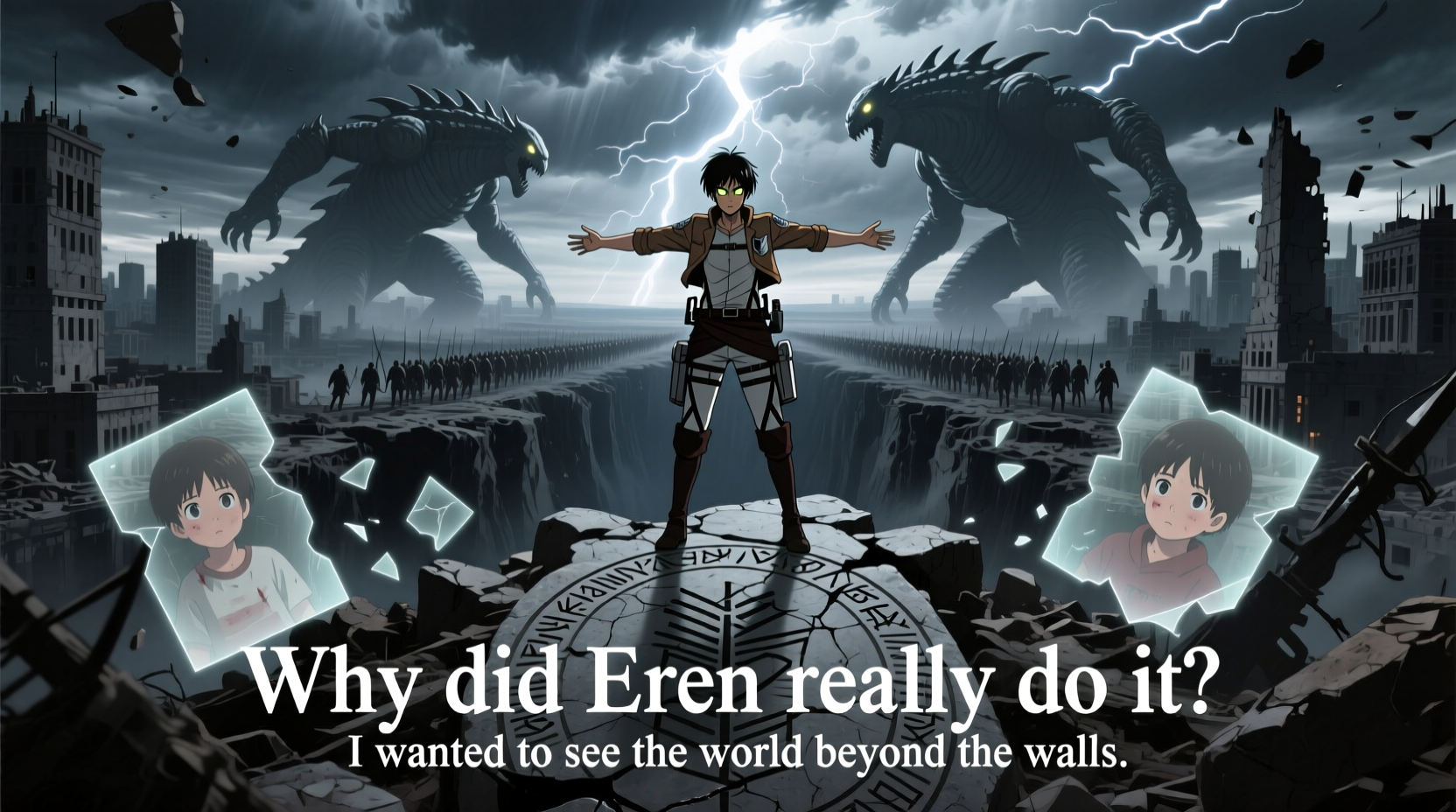
Eren’s worldview was forged in violence. From the fall of Shiganshina, where he witnessed his mother devoured by a Titan, his identity crystallized around two principles: destroy all Titans and reclaim human freedom. Early in the series, this meant liberation from the Titans within the Walls. But as the truth unfolded—that Titans were once humans, that Marley oppressed Eldians, and that Paradis was both victim and potential aggressor—Eren’s understanding of freedom expanded and twisted.
He came to believe that true freedom could only exist if Paradis was safe from external threats. And since the outside world saw Eldians as monsters, safety required eliminating the threat entirely. As Eren told Armin: “If we don’t kill them… they’ll kill us.” This zero-sum logic became the foundation of the Rumbling.
The Role of the Founding Titan and Future Memory
A critical factor often overlooked is Eren’s access to future memories through the Founding Titan. When Zeke attempted to activate the Beast Titan’s power during their fight in Liberio, Eren briefly touched him—and received visions of possible futures. Among them: endless cycles of war, failed negotiations, and the eventual bombing of Paradis. No matter what choices were made, peace never lasted.
This knowledge trapped Eren in a paradox. He saw every alternative path—and none led to lasting safety for his people. In his mind, doing nothing was equivalent to condemning Mikasa, Armin, and everyone he loved to death. So he chose the only future where Paradis survived: one where the rest of the world was erased.
“We can’t win without sacrificing something. That’s how the world works.” — Eren Yeager, Chapter 122
It wasn’t arrogance that drove him, but fatalism. He believed he had no choice. Freedom, for Eren, meant acting even when action felt monstrous—because inaction would be worse.
Eren’s Relationship with Freedom and Control
Throughout the series, Eren equates freedom with movement—running, breaking chains, tearing down walls. But his interpretation becomes increasingly possessive. By Season 4, his version of freedom excludes others’. He refuses to let Armin or Mikasa make their own choices about the Rumbling, insisting they follow his plan because “it has to be this way.”
This contradiction reveals a deeper flaw: Eren conflates control with freedom. He wants to free his people, but only by dominating the fate of billions. In seizing absolute power, he loses empathy. The boy who screamed “I want to see the ocean” becomes the man who says, “I want to destroy the world.”
His final confession to Armin underscores this tragedy: “I couldn’t stop. Even though I knew it was wrong… I kept going.” Eren recognized the horror of his actions—but felt powerless to change course. Not because of the Founding Titan, but because he had convinced himself there was no other way.
Timeline of Eren’s Descent Into Extremism
Eren’s radicalization wasn’t sudden. It followed a clear trajectory:
- Age 10: Witnesses mother’s death; vows to eradicate Titans.
- Age 15: Discovers truth about Titans; learns Eldians are feared globally.
- Age 16: Learns of Marley’s plans to invade Paradis; begins questioning diplomacy.
- Age 17: Gains Founding Titan; sees future visions during clash with Zeke.
- Two Years Before Final War: Secretly allies with Zeke to trigger the Rumbling under controlled conditions.
- Final Year: Manipulates events to ensure his friends oppose him, believing resistance makes their survival meaningful.
- Day of the Rumbling: Activates Founding Titan; initiates global annihilation.
This timeline shows Eren didn’t act impulsively. He spent years planning, isolating himself emotionally, and preparing the world for destruction—not out of hatred, but out of a warped sense of protection.
The Duality of Eren: Hero, Villain, or Tragedy?
Labeling Eren as purely evil misunderstands the narrative’s complexity. Is he a villain? Yes—he orchestrated mass murder. Is he a hero? In his own eyes, absolutely. But more accurately, Eren is a tragedy: a product of systemic oppression, inherited trauma, and a world that offers no clean solutions.
Creator Hajime Isayama never framed the conflict as good vs. evil. Instead, he presented a cycle of hatred where each side believes they are righteous. Marleyans view Eldians as demons. Eldians see themselves as victims. Neither side listens. And Eren, caught between identities, chooses the most extreme exit.
| Motivation | Eren’s Belief | Reality Check |
|---|---|---|
| Protect Paradis | Safety requires eliminating external threats | Destroys chance for diplomacy; provokes unified resistance |
| Secure Freedom | Freedom means acting without restraint | Denies freedom to billions; becomes tyrannical |
| Preserve Bonds | Killing his friends would make their survival meaningful | Causes irreversible trauma; betrays trust |
| Break the Cycle | Only total destruction can reset the world | Perpetuates violence; fails to offer peace |
Eren’s tragedy lies in his sincerity. He truly believed he was saving his friends. Yet in doing so, he became the very monster they once fought.
Expert Insight: What Philosophers Say About Eren’s Choice
Eren’s actions echo real-world ethical dilemmas. His reasoning mirrors utilitarian logic: sacrifice many to save a few. But unlike classic utilitarianism, Eren doesn’t weigh lives objectively—he prioritizes those he loves.
“Eren embodies the danger of love turned inward. When care for one’s own group justifies atrocity against others, morality collapses.” — Dr. Lena Torres, Professor of Ethics at Kyoto University
His mindset also reflects existentialist themes. Faced with an absurd, hostile world, Eren creates his own meaning—even if it’s destructive. As Jean-Paul Sartre wrote, “Man is nothing else but what he makes of himself.” Eren made himself into a destroyer because he saw no other role available.
Mini Case Study: The Fall of Liberio vs. The Rumbling
In Season 4, Marley launches an attack on Liberio using Warrior candidates, including Reiner and Pieck. Civilians die. Children scream. Homes burn. The audience feels horror—until we realize these are the same people who bombed Hizuru and enslaved Eldians.
This moment mirrors the Rumbling. Both acts involve surprise attacks on civilians justified by historical grievance. The difference? Perspective. Liberio’s attack is framed as tragic but necessary by Marley. The Rumbling is framed as unforgivable by the global community—and by Mikasa and Armin.
The parallel forces viewers to confront bias: we empathize with Paradis because we’ve followed their journey. But from the outside, Eren is no different than Reiner was in Season 3. Both believed they were protecting their people. Both committed atrocities. The case study proves that morality in *Attack on Titan* is not absolute—it’s relational.
FAQ: Common Questions About the Rumbling
Did Eren lose control of himself?
No. Despite claims that the Founding Titan influenced him, Eren retained full agency. He admitted to Armin that he chose the path willingly. The Titan gave him power and foresight, but not compulsion.
Why didn’t Eren just negotiate instead?
He believed diplomacy was doomed. Future visions showed failed talks, betrayals, and eventual annihilation of Paradis. To Eren, negotiation was delaying the inevitable. He wanted certainty—even if it came at a horrific cost.
Could the Rumbling have been stopped earlier?
Possibly. If the Survey Corps had discovered Eren’s plan sooner, or if Zeke had refused to cooperate, the outcome might have changed. But Isayama structured the story so that discovery comes too late—emphasizing the inevitability theme.
Actionable Checklist: Understanding Eren’s Psychology
To fully comprehend Eren’s decision, consider the following steps:
- Re-examine scenes where Eren expresses fear of losing Mikasa and Armin.
- Analyze his conversations with Zeke in the Paths dimension.
- Compare his early speeches about freedom with his final monologue.
- Reflect on how isolation (from friends, family, society) shaped his worldview.
- Consider whether any character in the series offers a viable alternative to endless conflict.
Conclusion: Why Eren Did It—And Why It Matters
Eren launched the Rumbling not out of hatred, but out of love. Love for Mikasa. Love for Armin. Love for the only home he ever knew. He saw extinction looming over Paradis and chose to strike first, believing silence and compromise would lead to the same end—just slower.
But in doing so, he repeated history. Just as Ymir Fritz served her king out of silent devotion, Eren sought to control fate through suffering. Both were trapped by roles they didn’t choose, yet perpetuated cycles they claimed to hate.
The brilliance of *Attack on Titan* lies in its refusal to offer easy answers. There is no hero who saves everyone. No speech that ends war. Only flawed humans making impossible choices. Eren’s story is a warning: when freedom becomes exclusionary, when love turns possessive, when fear dictates action—the result is always ruin.
So why did Eren really do it? Because he was afraid. Afraid of losing control. Afraid of losing his friends. Afraid that without absolute power, everything would be taken from him again. And in that fear, he became the very thing he swore to destroy.




 浙公网安备
33010002000092号
浙公网安备
33010002000092号 浙B2-20120091-4
Comments
No comments yet. Why don't you start the discussion?