
Cats are notoriously clever. They open doors, navigate complex puzzles, and often seem to understand human routines better than we do. So when it comes to feeding—especially automated or self-serve options—the real question isn’t just about convenience for pet owners. It’s whether cats can—and will—outsmart the system.
Automatic feeders promise portion control and schedule consistency. Gravity feeders offer constant access with minimal maintenance. But in homes across the world, cats are testing the limits of both. Some push, paw, nudge, or even dismantle their feeders in pursuit of extra meals. The truth is: yes, many cats *do* figure out how to cheat these systems. The difference lies in design, cat personality, and how much effort the device requires to bypass.
This article dives deep into the mechanics and psychology behind automatic versus gravity feeders, examining not only how they work but how cats interact with them—sometimes to the owner’s frustration. We’ll look at real-world behaviors, expert insights, and practical solutions to help you choose a system that aligns with your cat’s intelligence and dietary needs.
How Automatic Feeders Work (And Where Cats Exploit Them)
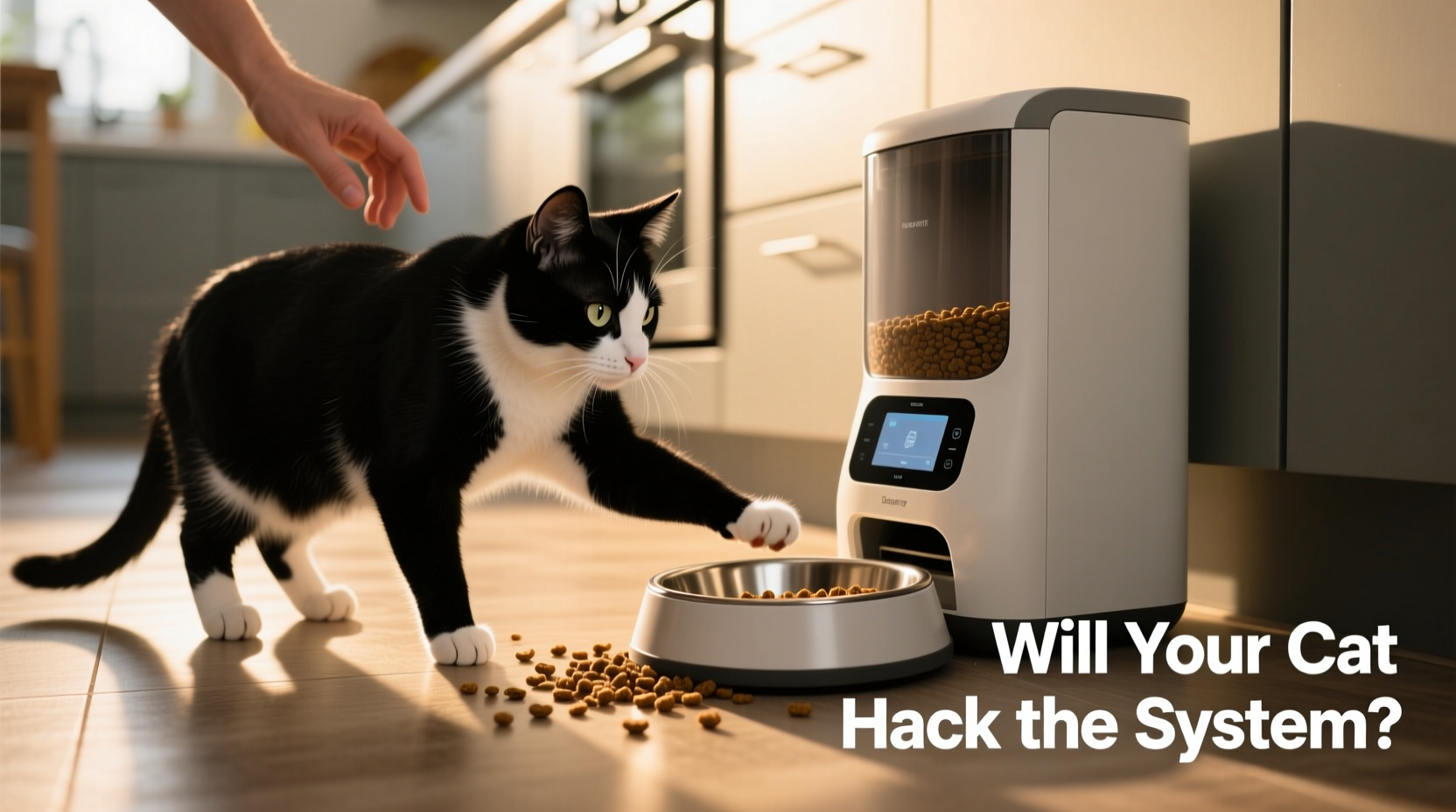
Automatic cat feeders operate on timers or app-based commands, dispensing food at set intervals. Most models use a rotating tray or auger mechanism to release kibble from a sealed hopper. These devices often include features like voice recording, portion customization, and Wi-Fi connectivity for remote control.
While effective for routine feeding, automatic feeders present several vulnerabilities:
- Timing predictability: Cats quickly learn schedules. If food dispenses at 7 AM and 6 PM every day, some cats begin begging—or pawing at the machine—minutes before.
- Physical manipulation: Curious paws test every crevice. Cats have been observed nudging buttons, tilting units, or knocking them over to dislodge extra kibble.
- Sound-triggered behavior: The motor noise of dispensing becomes a conditioned cue. Some cats learn to trigger false activations by pawing near sensors or pressing against the unit.
A study conducted by the University of Lincoln’s Animal Cognition Lab found that over 60% of household cats exposed to timed feeders developed anticipatory behaviors within two weeks, including persistent meowing, rubbing, and physical interaction with the device. A subset—about 22%—successfully triggered early dispensing through repeated paw swipes or weight pressure.
“Cats are natural problem solvers. When food is involved, their motivation skyrockets. An automatic feeder isn’t just a dispenser—it’s a puzzle waiting to be solved.” — Dr. Sarah Thompson, Feline Behavior Specialist
The Mechanics and Misuse of Gravity Feeders
Gravity feeders rely on simple physics: as food is eaten from the bowl, more flows down from an elevated reservoir. There’s no timer, no electronics—just a continuous supply as long as the bin is full.
On the surface, this seems foolproof. No programming, no batteries, no malfunctions. But here’s where cat ingenuity meets unlimited access.
Many owners assume a gravity feeder eliminates cheating because there’s nothing to hack. In reality, the “cheat” isn’t technical—it’s behavioral. Cats don’t need to outsmart the mechanism; they just keep eating.
Common issues include:
- Overeating: Free-feeding leads to obesity in nearly 60% of indoor cats, according to the Association for Pet Obesity Prevention.
- Food guarding: In multi-cat homes, dominant cats may monopolize the feeder, leaving others underfed.
- Boredom-driven consumption: Cats eat not from hunger but stimulation, turning the feeder into a toy.
Some cats even develop habits like batting kibble out of the bowl onto the floor, creating a “snack trail” they revisit throughout the day. This isn’t cheating the system per se—but it defeats the purpose of controlled nutrition.
When Simplicity Backfires: A Real Example
Jessica, a pet owner in Portland, installed a large-capacity gravity feeder for her two cats, Milo and Luna. She assumed it would reduce her morning rush. Within days, Milo—a 12-pound tabby with a knack for persistence—figured out that if he rocked the base with his shoulder, kibble would spill faster. He didn’t break the feeder; he optimized it.
“It was like watching a tiny engineer,” Jessica said. “He’d nudge it just right, and a cascade would fall. Soon, half the food was on the floor by noon.”
Worse, Luna, the smaller cat, avoided the feeder entirely after a few aggressive encounters. The result? One overweight cat, one underfed, and a kitchen covered in stray kibble.
Jessica eventually switched to a dual-chamber automatic feeder with microchip recognition, which only opens for the designated cat. “It cost more, but it stopped the chaos,” she said.
Comparing Vulnerabilities: A Side-by-Side Analysis
| Feature | Automatic Feeder | Gravity Feeder |
|---|---|---|
| Portion Control | High – dispenses set amounts on schedule | None – food flows continuously |
| Cheat Potential | Moderate to High – cats may trigger early release or damage mechanisms | Low (mechanical) but High (behavioral) – encourages overeating |
| Best For | Cats needing scheduled meals, weight management, or single-cat homes | Multi-cat households with peaceful dynamics, or outdoor feeding stations |
| Maintenance | Regular cleaning, battery or power checks | Infrequent refills, but prone to mold if moist |
| Cost Over Time | Higher upfront, lower waste | Lower upfront, higher food consumption |
Can You Prevent Cheating? A Step-by-Step Guide
Whether you choose automatic or gravity, proactive measures can reduce misuse. Follow this timeline to assess, implement, and monitor your feeding strategy.
- Week 1: Observe Natural Behavior
Watch how your cat interacts with current feeding methods. Do they beg constantly? Hoard food? Eat rapidly? This baseline helps determine risk level. - Week 2: Choose the Right Feeder Type
Based on behavior:- If your cat is food-motivated and persistent → avoid basic gravity feeders.
- If you’re often away → consider a smart automatic feeder with locking lids.
- In multi-cat homes → prioritize feeders with RFID or app-controlled access.
- Week 3: Install and Monitor
Place the feeder in an open area initially so you can watch interactions. Use phone alerts (if available) to log dispensing times and verify accuracy. - Week 4: Test for Exploits
Gently simulate tampering. Does the cat trigger it by leaning? Can kibble be knocked out? Adjust placement or add barriers if needed. - Ongoing: Review Weekly
Track food levels, weight changes, and behavioral shifts. Reassess every month—cats adapt quickly.
Expert-Recommended Features to Thwart Cat Hacks
Not all feeders are created equal. The most cat-proof models include:
- Locking lids with PIN or app control – prevents paw activation.
- Elevated or enclosed designs – limits access to mechanical parts.
- Weight sensors – shuts off dispensing if the unit is tilted.
- RFID or microchip recognition – ensures only the intended cat gets food.
- Delayed start after filling – stops cats from associating refills with immediate reward.
Dr. Elena Ruiz, a veterinarian specializing in feline nutrition, advises: “The goal isn’t to outsmart your cat forever—it’s to create a sustainable feeding rhythm that supports health without encouraging obsessive behavior.”
“The best feeder is one that matches your cat’s temperament, not just your schedule.” — Dr. Elena Ruiz, DVM, Feline Nutritionist
Frequently Asked Questions
Can cats really open automatic feeders on their own?
Yes. While not all cats succeed, many learn to manipulate buttons, levers, or even unclip lids through repeated trial and error. Models with touch-sensitive panels are especially vulnerable.
Is a gravity feeder safe for kittens?
Generally, yes—but monitor intake. Kittens have high energy needs but can overeat if food is always available. Combine with scheduled wet meals for balanced growth.
What’s the smartest alternative to traditional feeders?
Interactive puzzle feeders combined with scheduled automatic dispensing offer mental stimulation and portion control. They turn eating into a challenge, reducing boredom-driven consumption.
Final Checklist Before Choosing a Feeder
- ✅ Assess your cat’s food motivation level
- ✅ Consider household dynamics (single vs. multi-cat)
- ✅ Determine if portion control is medically necessary
- ✅ Evaluate space and power access (for electronic models)
- ✅ Read reviews specifically mentioning tamper resistance
- ✅ Budget for long-term costs, not just initial price
- ✅ Plan for regular cleaning and maintenance
Conclusion: Outsmarting the Outsmarters
Cats will test boundaries—especially when food is involved. Whether it’s an automatic feeder they’ve learned to trigger prematurely or a gravity model they’ve turned into an all-you-can-eat buffet, the challenge isn’t about technology alone. It’s about understanding feline instincts and designing around them.
Automatic feeders offer precision but come with exploit risks. Gravity feeders provide simplicity but encourage overconsumption. The most effective solution often lies in hybrid approaches: using smart feeders with enrichment elements, combining scheduled dry food with measured wet meals, or leveraging tech like microchip access to maintain fairness in multi-cat homes.
Your cat might figure out how to cheat the system. But with careful observation, the right equipment, and consistent monitoring, you can stay one step ahead—keeping meals healthy, fair, and just challenging enough to satisfy that clever mind.




 浙公网安备
33010002000092号
浙公网安备
33010002000092号 浙B2-20120091-4
Comments
No comments yet. Why don't you start the discussion?