
In an era where automatic transmissions dominate showrooms and driver’s education, the manual gearbox—once a rite of passage for new drivers—has become increasingly rare. Modern cars come equipped with seamless dual-clutch systems, adaptive cruise control, and even self-driving features that make gear changes a distant memory. Yet, despite this technological evolution, the question remains: is learning to drive a stick shift still useful?
The answer isn’t just about nostalgia or mechanical curiosity. It’s about control, adaptability, cost, and resilience. While most drivers will never need to operate a manual vehicle daily, understanding how one works—and being able to drive it—offers tangible benefits that extend beyond the clutch pedal.
Understanding the Core Differences
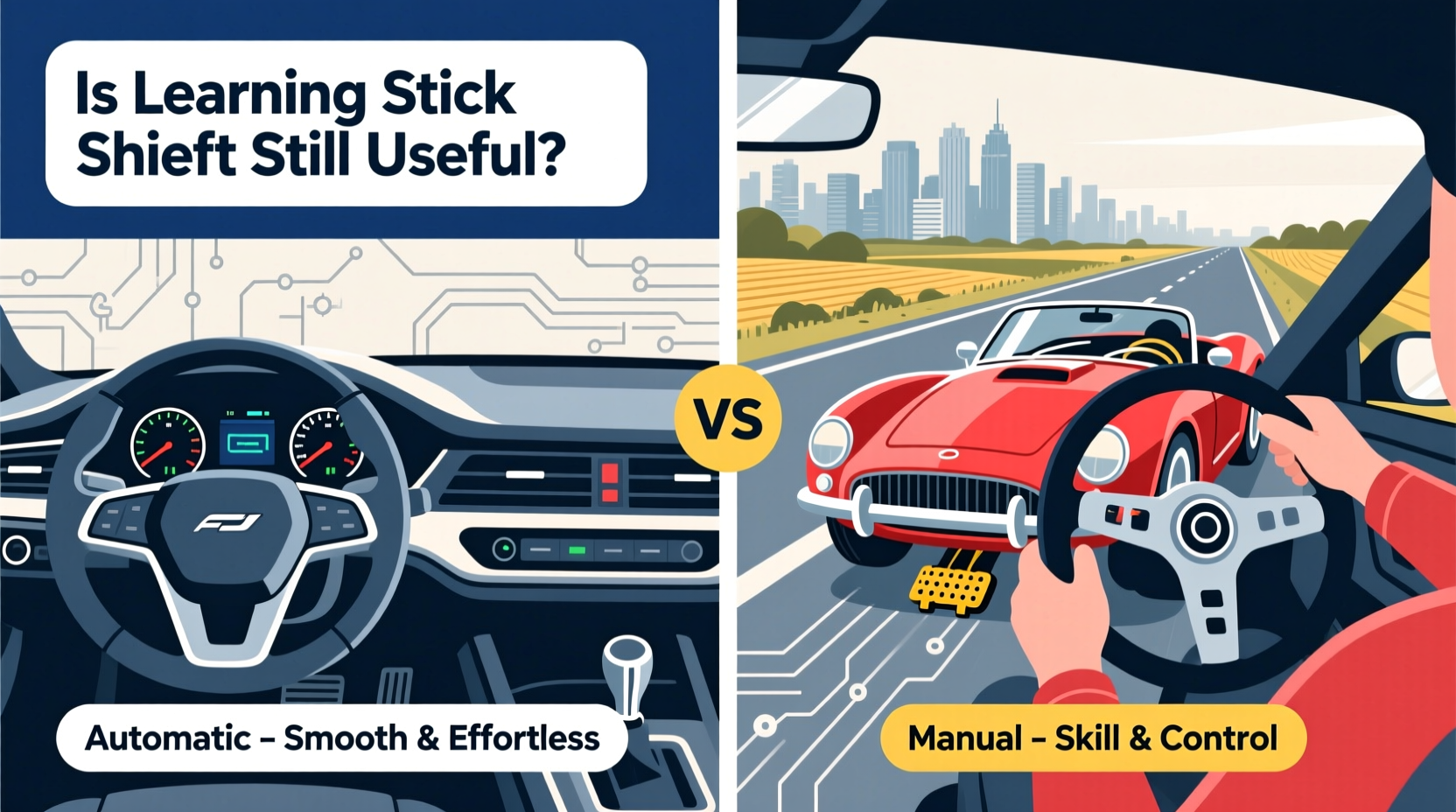
At the heart of the debate lies a fundamental mechanical distinction. Automatic transmissions use hydraulic systems and torque converters (or more recently, automated manual and CVT systems) to shift gears without driver input. Manual transmissions, on the other hand, require the driver to physically engage the clutch and select gears using a gear lever.
This difference affects everything from fuel efficiency and performance to maintenance costs and driving engagement. While automatics have closed the gap in many areas, key distinctions remain.
Performance and Control
Manual transmissions give drivers precise control over gear selection. This allows for better modulation of engine braking, optimized power delivery, and improved responsiveness in dynamic conditions such as mountain roads or track driving. Enthusiasts often cite the “connected” feeling of rowing through gears as a reason they prefer manuals.
“Driving a manual isn’t just about shifting—it’s about being part of the machine. You feel every transition, anticipate every curve.” — Mark Reynolds, Automotive Instructor and Former Rally Co-Driver
In contrast, even advanced automatics, while efficient, can sometimes hesitate or choose suboptimal gears in unpredictable terrain. Some drivers find this lack of direct involvement reduces their sense of mastery over the vehicle.
Fuel Efficiency and Mechanical Simplicity
Historically, manual transmissions were more fuel-efficient due to fewer mechanical losses. Today, the advantage has largely disappeared—many modern automatics outperform manuals in economy thanks to eight- or ten-speed gearboxes and intelligent programming. However, manuals still tend to be lighter and mechanically simpler, which can translate into lower long-term repair costs.
A failed torque converter or complex valve body in an automatic can result in repair bills exceeding $2,000. A manual clutch replacement, while not cheap, is generally more predictable and less expensive—especially when done by a skilled DIYer.
Is Learning Stick Shift Still Useful? Practical Reasons to Know
Despite declining availability, there are real-world scenarios where knowing how to drive a manual is not just helpful—it’s essential.
Travel and Vehicle Availability Abroad
In many countries—particularly across Europe, South America, Southeast Asia, and Africa—manual transmissions are still the norm. Rental agencies often charge a premium for automatic vehicles, and in rural areas, automatics may not be available at all. Travelers who can't drive stick may find themselves stranded or forced to pay significantly more.
A 2023 survey by a major European car rental company found that 78% of vehicles in Italy, Spain, and Greece were manuals. In Vietnam and Peru, the figure exceeded 90%. For budget-conscious adventurers or digital nomads relying on local transport, the ability to drive manual opens up mobility options.
Emergency and Backup Situations
Imagine borrowing a friend’s older truck to move furniture, only to realize it’s a five-speed. Or being handed the keys to a relative’s vintage car during a family emergency. Without manual skills, you’re dependent on others or limited to specific vehicles.
Moreover, in off-grid or disaster-response scenarios, older, durable vehicles (often with manual transmissions) are more likely to remain operational. Knowing how to drive them could mean the difference between getting help and being stuck.
Career and Technical Advantages
Certain professions benefit directly from manual transmission proficiency. Mechanics, auto detailers, test drivers, and fleet managers who understand clutch dynamics and gear synchronization are better equipped to diagnose issues and communicate with technicians.
Additionally, some military, agricultural, and industrial vehicles use manual or semi-manual systems. Training programs in these fields often assume basic knowledge of manual operation.
Comparison: Automatic vs Manual Transmission
| Factor | Automatic Transmission | Manual Transmission |
|---|---|---|
| Learning Curve | Easy for beginners; intuitive | Steeper; requires coordination |
| Fuel Efficiency (Modern Vehicles) | Generally better or equal | Slightly lower in most cases |
| Maintenance Cost | Higher when repairs needed | Lower; parts are simpler |
| Vehicle Availability | Widely available globally | Limited in North America; common elsewhere |
| Driver Engagement | Lower; more passive | High; active participation |
| Resale Value (for Manuals) | N/A | Often higher among enthusiasts |
| Usefulness in Emergencies | Depends on vehicle access | Greater flexibility with older models |
How to Learn Stick Shift: A Step-by-Step Guide
Learning to drive a manual doesn’t require formal classes, though structured practice helps. Here’s a proven sequence to build confidence safely.
- Understand the Components: Familiarize yourself with the clutch pedal (left), gear shifter (center console), and tachometer. Know neutral position and gear layout (e.g., 1st gear top-left).
- Practice in a Safe Area: Find a flat, empty parking lot. Turn the car on in neutral. Press the clutch fully and shift into first gear.
- Engage the Clutch Gradually: Slowly release the clutch while gently applying throttle. The car will begin to move as the clutch engages (the “biting point”).
- Shift Up Smoothly: At around 2,000–2,500 RPM, press the clutch, move to second gear, then release and accelerate. Repeat for higher gears.
- Downshift Properly: When slowing, press clutch, shift down one gear at a time, and match revs if possible. Avoid skipping gears unless necessary.
- Practice Hill Starts: Use the handbrake method: hold brake, start in first, release clutch until biting point, then release brake and accelerate smoothly.
- Drive in Real Conditions: Once comfortable, try city streets, hills, and highways to build experience.
Real-World Example: Driving Through the Andes
Consider Sarah, a traveler renting a car in Cusco, Peru, to explore remote villages near Machu Picchu. She booked an automatic online, but upon arrival, the agency had none left due to high demand. The only option was a 2018 Toyota Hilux with a manual transmission.
Having learned stick shift from her grandfather years ago, Sarah accepted the vehicle. Over the next week, she navigated narrow mountain passes, steep descents, and unpaved roads. Her ability to downshift for engine braking prevented brake fade on long declines—a critical safety feature in rugged terrain.
Had she not known how to drive manual, she would have either delayed her trip, paid a premium for a rare automatic, or hired a driver. Instead, she saved money, gained independence, and experienced the region more authentically.
Expert Insight: Why Manuals Still Matter
Automotive educators and mechanics emphasize that understanding manual transmission builds foundational knowledge about how cars work.
“Students who learn on manuals develop a deeper intuition for vehicle dynamics. They’re more aware of engine load, traction, and momentum—skills that improve safety even when driving automatics.” — Dr. Lena Torres, Automotive Technology Program Director, Vancouver Tech Institute
This mechanical literacy fosters better decision-making behind the wheel. Drivers who understand gear ratios are less likely to over-rev engines or misuse transmission modes like “L” or “S” in automatics.
Checklist: Should You Learn Stick Shift?
- ✅ Do you plan to travel internationally, especially to developing regions?
- ✅ Are you interested in classic or performance cars?
- ✅ Do you want greater independence in emergencies or rentals?
- ✅ Are you pursuing a career in automotive, logistics, or outdoor industries?
- ✅ Do you value mechanical understanding and driving engagement?
- ✅ Are you willing to invest 4–6 hours of focused practice?
If three or more apply, investing time to learn manual transmission is worthwhile—even if you never use it weekly.
Frequently Asked Questions
Can I damage a manual transmission by shifting incorrectly?
Yes, but modern vehicles are forgiving. Grinding gears occasionally won’t destroy the gearbox, but frequent improper shifting or riding the clutch can lead to costly repairs. Learning proper technique minimizes risk.
Are manual cars cheaper to insure?
Not typically. Insurance rates are based more on driver age, record, and vehicle type than transmission. However, manual cars often cost less to purchase, which indirectly lowers premiums.
Will manual transmissions disappear completely?
They’re fading in mainstream markets, especially in North America, but aren’t vanishing soon. Enthusiast models (e.g., Mazda MX-5, Subaru WRX, Porsche 911) still offer manuals, and commercial/industrial vehicles rely on them globally.
Conclusion: Mastering More Than Just Gears
Learning to drive a stick shift is no longer a necessity for daily commuting, but it remains a valuable life skill. It enhances adaptability, deepens mechanical understanding, and unlocks access to vehicles and experiences that others might miss. Whether you're navigating foreign backroads, handling an unexpected situation, or simply wanting to connect more deeply with your car, the ability to manage a manual transmission pays dividends.
Technology will continue to simplify driving, but true competence comes from understanding the fundamentals—not just pressing buttons. In a world of increasing automation, knowing how to drive a manual is a small act of independence.




 浙公网安备
33010002000092号
浙公网安备
33010002000092号 浙B2-20120091-4
Comments
No comments yet. Why don't you start the discussion?