
Mechanical timepieces have long been revered for their craftsmanship, heritage, and intricate engineering. Among them, automatic watches stand as a symbol of horological artistry—driven by motion, powered by precision, and appreciated by collectors and enthusiasts alike. On the other side of the spectrum, quartz watches offer accuracy, affordability, and minimal upkeep. But when it comes to ownership, a common question arises: is maintaining an automatic watch truly a hassle compared to its quartz counterpart?
The answer isn't binary. It depends on your lifestyle, expectations, and appreciation for what each type of movement offers. To understand whether mechanical maintenance is burdensome or simply part of owning a fine instrument, we need to examine both technologies in depth—from how they function to how they age, and what kind of care they genuinely require.
How Automatic and Quartz Movements Work
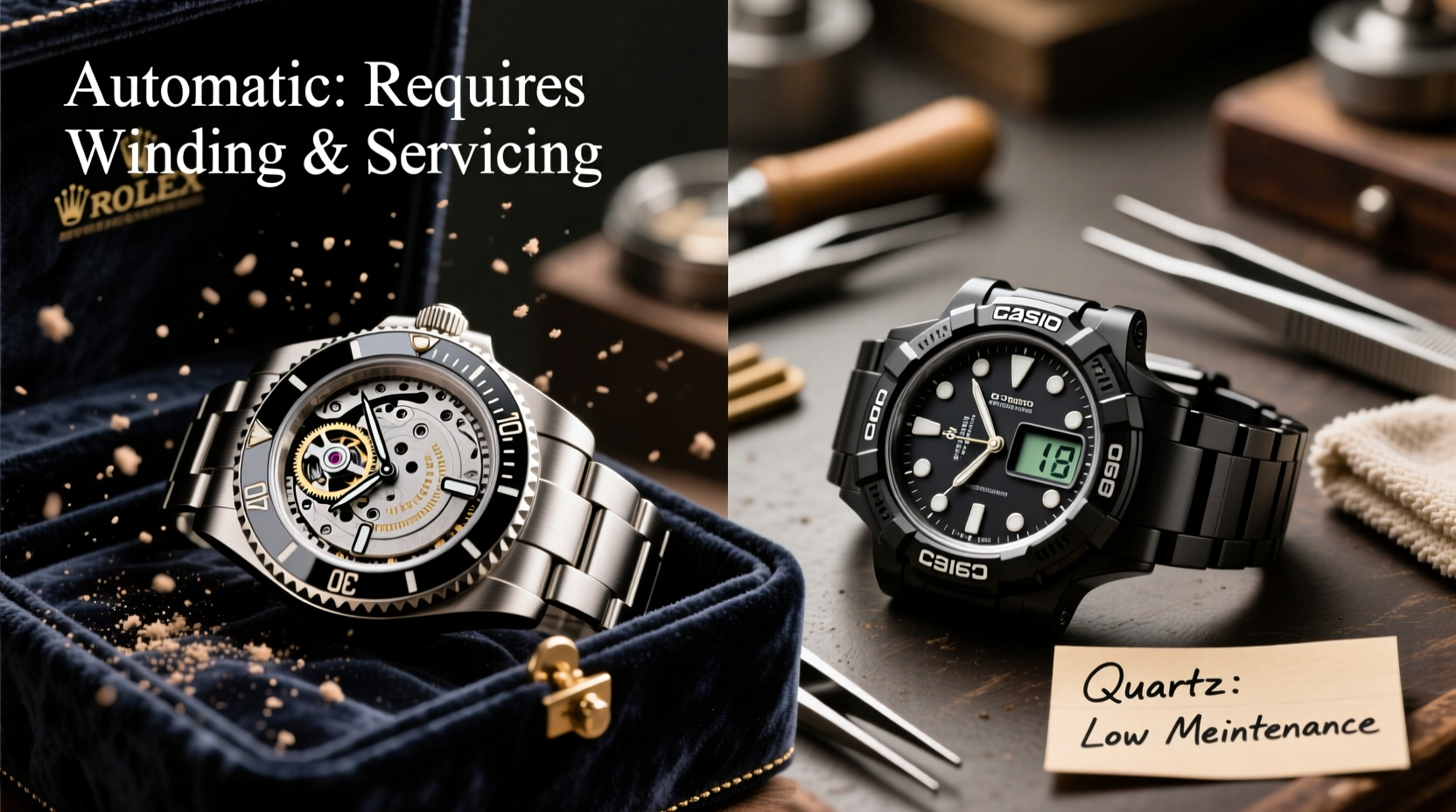
An automatic watch, also known as a self-winding mechanical watch, operates through a series of gears, springs, and oscillating weights. As you move your wrist, a rotor inside the watch spins, winding the mainspring. This stored energy powers the balance wheel, which oscillates at a consistent frequency (typically 4–8 times per second), regulating timekeeping. No battery is involved—just pure mechanics.
In contrast, a quartz watch relies on a battery to send an electrical current through a tiny quartz crystal. The crystal vibrates at a precise frequency (32,768 times per second), and these vibrations are measured by a microchip to drive the hands forward with exceptional accuracy. Quartz movements are mass-produced, highly reliable, and largely maintenance-free beyond occasional battery changes.
This fundamental difference in operation sets the stage for divergent maintenance needs. While quartz watches prioritize convenience, automatics emphasize tradition, craftsmanship, and engagement from the owner.
Maintenance Requirements Compared
Maintenance is where the rubber meets the road in this debate. Let’s break down what each type demands over time.
Quartz Watch Maintenance
- Battery replacement: Every 1–3 years, depending on the model and usage.
- Gasket checks: Recommended every 2 years during water resistance testing.
- Cleaning: Occasional case and bracelet cleaning; no internal servicing unless exposed to moisture or damage.
- Long-term risks: Circuit corrosion if battery leaks, or capacitor failure in older models.
Overall, quartz watches require very little attention. Most owners can go years without thinking about service, aside from swapping out a dead battery.
Automatic Watch Maintenance
Automatic movements are more complex and therefore require periodic servicing to ensure reliability and longevity. Here's what’s typically involved:
- Regular winding or wear: If not worn daily, the watch stops and must be manually wound or placed on a winder.
- Service interval: Recommended every 5–7 years, involving disassembly, cleaning, lubrication, reassembly, and regulation.
- Water resistance: Gaskets degrade over time and should be checked every 2 years, especially if used near water.
- Shock and magnetism: Mechanical watches are more sensitive and may require demagnetization or adjustment after exposure.
A well-maintained automatic watch can last generations. However, skipping service can lead to increased friction, oil drying, gear wear, and eventual failure.
Is Mechanical Maintenance Really a Hassle?
To some, the idea of sending a watch to a specialist every few years sounds inconvenient. To others, it’s part of the ritual of ownership—an investment in preserving something finely made. Whether it's a \"hassle\" depends on perspective.
Consider this: servicing a car every 10,000 miles is expected, even though modern vehicles are engineered for reliability. Similarly, a mechanical watch is a high-precision instrument with dozens of moving parts operating in tight tolerances. Lubricants break down, dust infiltrates, and metal wears. Preventative maintenance isn’t optional—it’s essential for sustained performance.
However, unlike cars, watches don’t need frequent visits. A 5–7 year service cycle means most owners only deal with it once or twice a decade. And while costs range from $200 to $800 depending on brand and complexity, that averages out to less than $100 per year—comparable to a monthly coffee habit.
“Owning a mechanical watch is like caring for a musical instrument. It requires tuning, but the experience of interacting with it is part of its value.” — Daniel Reeves, Master Watchmaker and Horology Instructor
Real-World Ownership: A Mini Case Study
Take James, a software engineer and casual watch enthusiast. He owns two timepieces: a Seiko 5 Sports (automatic) and a Casio G-Shock (quartz). The G-Shock has run flawlessly for six years with only one battery change. He barely thinks about it.
The Seiko, however, he wears three times a week. When he forgets to wind it after a weekend, it stops. He enjoys the ritual of picking it up Monday morning, giving it a few gentle shakes, and watching the seconds hand spring back to life. Two years ago, he sent it in for a full service. It cost $250 and took three weeks. Was it inconvenient? Slightly. But the watch emerged running more accurately than when new, with a fresh polish and restored water resistance.
For James, the maintenance wasn’t a burden—it was confirmation that he owned something worth preserving. The G-Shock serves a purpose; the Seiko tells a story.
Comparison Table: Automatic vs Quartz Ownership
| Factor | Automatic Watch | Quartz Watch |
|---|---|---|
| Accuracy | ±5 to ±20 seconds per day | ±15 seconds per month |
| Power Source | Mainspring (wound by motion or hand) | Battery |
| Service Interval | Every 5–7 years | Every 2–3 years (battery) |
| Average Service Cost | $200–$800 | $10–$50 (battery + check) |
| Lifespan with Care | Generational (50+ years) | 10–20 years (electronics degrade) |
| Daily Involvement | Moderate (winding, setting) | Minimal |
| Sensitivity to Environment | High (magnets, shocks, moisture) | Low to moderate |
This table illustrates a key insight: quartz wins on convenience and short-term cost, while automatics excel in longevity, emotional value, and potential heirloom status.
Actionable Checklist: Caring for Your Automatic Watch
If you’re considering an automatic watch—or already own one—here’s a practical checklist to keep it in top condition without turning maintenance into a chore:
- ✅ Wear your watch regularly (at least 8 hours/day) to keep it wound.
- ✅ Store it in a soft pouch or box when not in use to prevent scratches.
- ✅ Rotate between watches to avoid prolonged idle periods.
- ✅ Use a watch winder if you own multiple automatics.
- ✅ Have water resistance tested every 2 years, especially if used near water.
- ✅ Avoid strong magnetic fields (e.g., speakers, laptops, MRI machines).
- ✅ Schedule a full service every 5–7 years, even if it seems to be running fine.
- ✅ Clean the case and bracelet monthly with a soft cloth and mild soapy water (if water-resistant).
When Maintenance Becomes a Non-Issue
Some modern automatic watches are designed for durability and low upkeep. Brands like Rolex, Omega, and Grand Seiko use advanced materials (like Parachrom hairsprings and silicon components) that resist magnetism and shock, reducing the need for frequent adjustments. Their movements are also built to tighter tolerances and sealed better against dust and moisture.
Additionally, many high-end service centers offer multi-year warranties on overhauls, including complimentary inspections and timekeeping checks. For serious collectors, annual watch events or brand boutiques provide on-site diagnostics, making maintenance less daunting and more accessible.
In practice, the “hassle” often stems from misinformation or lack of planning. Those who budget for service and treat it as routine—like changing smoke detector batteries or servicing HVAC systems—rarely find it burdensome.
Frequently Asked Questions
Do I need to service my automatic watch even if it’s still running?
Yes. Internal wear and dried lubricants aren’t always visible. A watch can appear to run well while suffering gradual damage. Servicing prevents irreversible harm and ensures long-term reliability.
Can I service my quartz watch too infrequently?
While less critical, delaying battery changes can lead to leakage, which corrodes the movement. It’s wise to replace the battery promptly and inspect seals periodically if water resistance matters to you.
Are quartz watches cheaper to own long-term?
Initially, yes. But over 20+ years, cumulative battery replacements, potential circuit failures, and shorter lifespans can make them less economical than a well-serviced automatic, which may never need replacement.
Conclusion: Embracing the Ritual
The maintenance of mechanical movements isn’t inherently a hassle—it’s a commitment. Like tending to a vintage car, playing a piano, or cultivating a garden, it asks for involvement. But in return, it offers connection, satisfaction, and a sense of stewardship over something enduring.
Quartz watches serve admirably for those who prioritize accuracy and ease. But if you value craftsmanship, history, and the quiet rhythm of a beating heart inside your wrist, then the care an automatic watch requires isn’t a drawback. It’s part of the experience.




 浙公网安备
33010002000092号
浙公网安备
33010002000092号 浙B2-20120091-4
Comments
No comments yet. Why don't you start the discussion?