
In an era where smartphones tell time to the millisecond, the decision between an automatic and a quartz watch goes beyond mere functionality. It becomes a statement—about values, craftsmanship, precision, and personal taste. For many, the ticking of a mechanical movement echoes centuries of horological tradition. For others, the silent pulse of a quartz crystal represents unmatched accuracy and modern efficiency. So when you choose one over the other, are you investing in heritage—or in science?
This question isn’t just philosophical. It shapes how we perceive value in wristwatches today. As prices for automatic watches climb into the tens of thousands, while high-precision quartz models remain accessible, consumers are forced to ask: what am I really paying for?
The Mechanics Behind the Movement
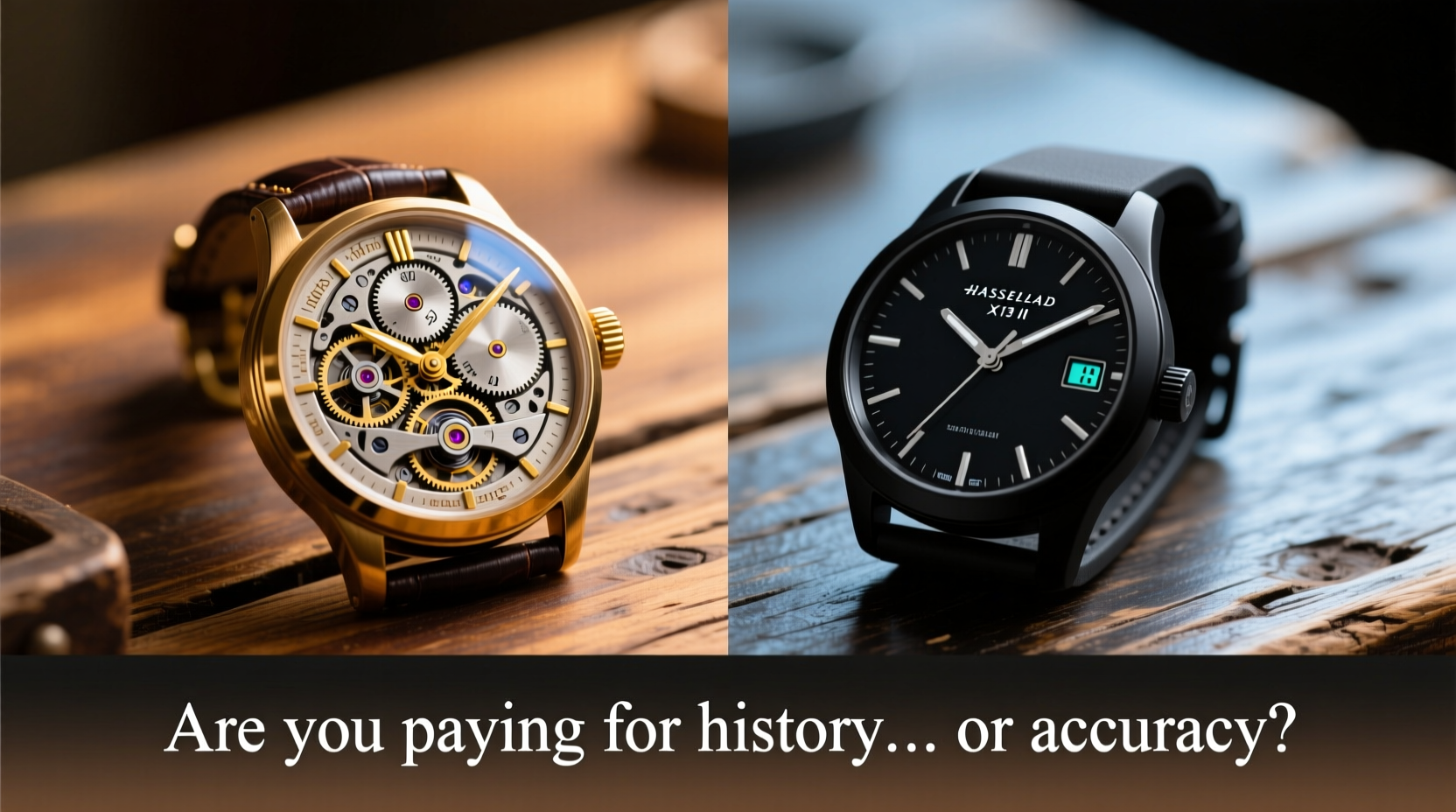
The fundamental difference between automatic and quartz watches lies in their internal mechanisms. Understanding how each works reveals why they diverge so dramatically in price, maintenance, and emotional appeal.
Automatic watches, also known as self-winding mechanical watches, rely on a complex system of gears, springs, and rotors powered by the natural motion of the wearer’s wrist. A mainspring stores energy as the rotor spins with movement. This stored energy is gradually released through a series of regulated gears, driving the hands forward. No battery is involved—just intricate engineering refined over 300 years.
Quartz watches, by contrast, operate on a simple but revolutionary principle: electricity. A small battery sends a current through a tiny quartz crystal, which vibrates at a precise frequency—32,768 times per second. These vibrations are counted by a microchip, which then converts them into a single electrical pulse per second, driving the motor that moves the hands.
“Quartz didn’t just improve accuracy—it redefined what a watch could be.” — Dr. Hiroshi Kikuchi, Horology Historian, Seiko Institute
The elegance of automatic movements lies in their mechanical complexity; the strength of quartz is its unwavering consistency. One appeals to the soul, the other to logic.
Accuracy: The Unbeatable Edge of Quartz
If precision were the sole criterion, quartz would dominate every conversation about timekeeping. Most quartz watches lose or gain no more than 15 seconds per month. Some high-end thermo-compensated quartz models (like those from Citizen’s Chronomaster line) are accurate to within ±5 seconds per year.
Compare that to even the finest automatic watches. A COSC-certified chronometer—a standard met by top-tier Swiss brands like Rolex, Omega, and Breitling—is allowed to deviate by -4 to +6 seconds per day. That means over a month, it could be off by nearly three minutes. In real-world conditions, variations in position, temperature, and wear patterns can widen this gap.
Yet despite this clear advantage, millions still opt for automatics. Why? Because human behavior isn’t always rational—and neither is luxury.
Value Beyond Timekeeping: Craftsmanship and Legacy
An automatic watch is not merely a tool; it's a miniature sculpture, a kinetic artwork worn on the wrist. Each component—bevelled gears, perlage finishing, hand-engraved rotors—is often assembled by skilled artisans. Brands like Patek Philippe, Jaeger LeCoultre, and A. Lange & Söhne spend hundreds of hours perfecting movements visible only through a sapphire case back.
This level of craftsmanship comes at a cost. But it also creates emotional resonance. Owning an automatic watch connects the wearer to generations of watchmakers who perfected the art long before digital technology existed.
Consider the story of James, a software engineer in San Francisco. He inherited his grandfather’s 1952 Omega Seamaster, a manual-wind piece that needed daily winding and gained about two minutes a week. When asked why he didn’t replace it with a smartwatch or a modern quartz model, he said: “Because when I wind it, I feel connected—to him, to history, to something bigger than time.”
This sentiment is echoed across collector communities. Watches aren’t judged solely by accuracy, but by legacy, design, rarity, and storytelling power.
Cost Comparison: What You’re Really Paying For
To understand the financial implications of choosing automatic over quartz, consider the following breakdown:
| Metric | Automatic Watch | Quartz Watch |
|---|---|---|
| Average Price Range | $800 – $50,000+ | $50 – $1,500 |
| Accuracy (per month) | ±2 to ±180 seconds | ±15 seconds |
| Battery Required? | No | Yes (every 2–10 years) |
| Maintenance Frequency | Every 5–7 years | Every 5–10 years |
| Service Cost | $200 – $800+ | $50 – $150 |
| Lifespan Potential | Generational (with care) | Decades (subject to part availability) |
| Resale Value Retention | High (especially limited editions) | Low to moderate |
As shown, automatic watches command higher prices not because they perform better technically, but because they offer intangible value: prestige, heritage, and mechanical fascination. Meanwhile, quartz excels in practicality, affordability, and reliability.
Environmental and Practical Considerations
While automatic watches are celebrated for longevity, their environmental footprint is worth examining. The mining of precious metals, use of lubricants, and energy-intensive manufacturing processes contribute to ecological impact. However, their potential to last over a century—with proper servicing—can offset initial resource costs over time.
Quartz watches, though cheaper and more accurate, face sustainability challenges. Many are discarded when batteries die or circuits fail, especially lower-end models. Replacement parts are often unavailable, leading to premature disposal. Even premium quartz watches, such as Grand Seiko’s 9F series, suffer from limited repair ecosystems compared to mechanical counterparts.
Still, advancements in solar-powered quartz (e.g., Citizen Eco-Drive, Seiko Solar) reduce battery waste significantly. These models convert light into energy, lasting decades without battery replacement—offering a sustainable middle ground.
When to Choose Automatic vs Quartz
The decision ultimately hinges on your priorities. Below is a checklist to help guide your choice:
✅ Choose an Automatic Watch If:
- You appreciate mechanical engineering and traditional craftsmanship.
- You plan to pass the watch down as a family heirloom.
- You enjoy the ritual of wearing and maintaining a mechanical device.
- You value brand heritage and collectibility.
- You’re willing to invest in regular servicing and accept minor timekeeping variance.
✅ Choose a Quartz Watch If:
- Your primary concern is precise, hassle-free timekeeping.
- You prefer low maintenance and minimal ongoing costs.
- You need reliability in extreme conditions (sports, travel, fieldwork).
- You want advanced features like perpetual calendars, alarms, or GPS syncing.
- You’re budget-conscious but don’t want to compromise on function.
Real-World Example: The Pilot’s Dilemma
Take Mark, a commercial airline pilot based in Munich. His job demands exact time coordination across global time zones. Initially drawn to the prestige of a Rolex Submariner (automatic), he found himself constantly adjusting it during layovers. After six months, he switched to a Breitling Aerospace Evo—an advanced quartz chronograph with dual time, countdown timer, and atomic clock synchronization via radio signal.
“I love the look of my old Rolex,” he admits, “but in the cockpit, five seconds off could mean miscommunication. With my quartz, I know it’s always right. And honestly, I don’t miss winding it every morning.”
His experience highlights a key truth: context matters. In professional environments demanding precision, quartz isn’t just preferable—it’s essential.
FAQ: Common Questions Answered
Can a quartz watch be considered luxurious?
Absolutely. While most luxury brands focus on mechanical movements, exceptions exist. Grand Seiko’s 9F quartz line features hand-assembled movements, dual-pulse motors for smooth second-hand motion, and finishes rivaling their mechanical siblings. Prices range from $2,500 to $6,000—proving that luxury isn’t exclusive to automatics.
Do automatic watches stop if not worn?
Yes. Most automatic watches have a power reserve of 38 to 72 hours. If left unworn beyond that period, they’ll stop and need to be manually wound and reset. Using a watch winder can keep them running during storage.
Are quartz movements less durable than automatic ones?
Not inherently. High-quality quartz watches are extremely durable and resistant to shocks and magnetism. However, their electronic components may become obsolete over decades, making repairs difficult. Mechanical movements, being purely physical, can be serviced indefinitely with the right expertise.
The Future of Watchmaking: Convergence Over Conflict
The debate between automatic and quartz is evolving. Rather than seeing them as rivals, the industry increasingly views them as complementary. Hybrid technologies like Seiko’s Spring Drive blend mechanical power with quartz regulation, achieving accuracy within ±1 second per day—best of both worlds.
Smartwatches, too, have entered the conversation. Devices like the Apple Watch deliver unparalleled functionality but lack the permanence and emotional weight of analog timepieces. Yet even here, traditional brands are adapting: Montblanc andTAG Heuer now offer hybrid smartwatches with mechanical aesthetics and digital brains.
The future belongs not to one technology, but to informed choice. Whether you wear a $20 Casio or a $30,000 Patek, what matters is alignment with your lifestyle, values, and expectations.
Conclusion: Honor Both History and Accuracy
So, are you paying for history or accuracy? The answer depends entirely on what you value. With an automatic watch, you’re investing in centuries of innovation, human skill, and timeless design. With a quartz watch, you’re embracing scientific precision, practicality, and modern convenience.
Neither is objectively superior. One celebrates the past; the other serves the present. The most thoughtful collectors don’t reject one for the other—they own both. A robust field watch for hiking, a solar-powered quartz for daily wear, and a finely finished automatic for evenings out.




 浙公网安备
33010002000092号
浙公网安备
33010002000092号 浙B2-20120091-4
Comments
No comments yet. Why don't you start the discussion?