
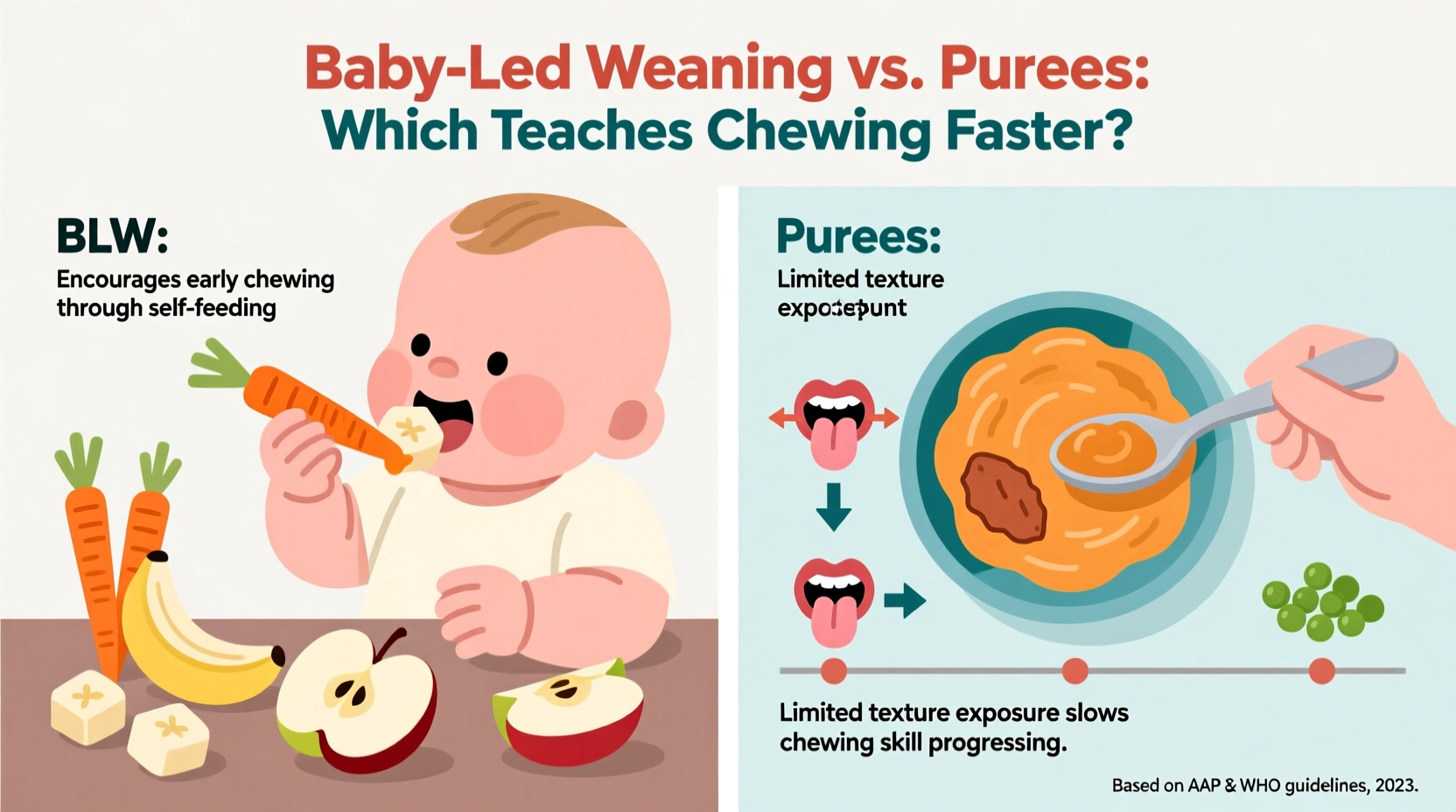
Introducing solid foods is a milestone many parents approach with excitement—and uncertainty. Among the most debated choices is whether to start with traditional purees or adopt baby-led weaning (BLW), where infants feed themselves whole, graspable foods from the beginning. While both methods can support healthy development, one key question persists: which approach fosters stronger, earlier chewing skills? The answer lies not just in technique but in how each method engages a baby’s natural oral motor development.
Chewing is more than a way to break down food; it’s a complex skill involving jaw strength, tongue coordination, lip closure, and sensory integration. How and when babies are introduced to solids significantly influences how quickly they master this ability. Understanding the differences between baby-led weaning and spoon-fed purees provides insight into their impact on chewing development and long-term eating behaviors.
The Science Behind Early Chewing Development
Chewing begins well before teeth appear. Infants develop the foundational skills through mouthing toys, babbling, and practicing gumming motions. By around six months of age—when most pediatricians recommend starting solids—babies have typically developed the postural control, hand-eye coordination, and oral reflexes needed to begin exploring textures beyond milk.
The transition from sucking to chewing involves a shift from vertical munching (up-and-down jaw movement) to rotary grinding (side-to-side motion). This progression doesn’t happen overnight, but early exposure to varied textures accelerates neuromuscular learning. Research shows that infants who experience diverse textures by nine months are less likely to become picky eaters and demonstrate better oral motor control.
“Babies learn to chew by chewing. The more opportunities they have to practice self-feeding with appropriate textures, the faster they develop coordinated jaw movements.” — Dr. Laura Sterling, Pediatric Feeding Specialist
How Baby-Led Weaning Encourages Early Chewing
Baby-led weaning skips purees entirely, offering infants soft, whole foods they can grasp and bring to their mouths. Proponents argue this method respects a child’s autonomy and aligns with developmental readiness. From a motor-skill perspective, BLW provides immediate tactile and oral feedback that supports chewing acquisition.
When a baby picks up a piece of steamed sweet potato or avocado strip, they must coordinate biting, gumming, and moving food within the mouth. Even without teeth, infants can mash soft foods using their gums and hard palate. Each attempt strengthens jaw muscles and refines tongue positioning. Because BLW babies control the pace and amount of food, they naturally progress at their own rate, often advancing more quickly due to frequent practice.
Key Benefits of BLW for Chewing Skills
- Natural progression: Babies move from gumming to chewing as they encounter increasingly textured foods.
- Muscle engagement: Self-feeding requires active jaw use, unlike passive swallowing of thin purees.
- Sensory integration: Touch, smell, and taste are all involved, reinforcing neural pathways linked to eating.
- Self-regulation: Infants learn fullness cues, reducing overeating and promoting mindful chewing.
Purees: A Gradual Path to Chewing
Spoon-feeding purees has long been the standard approach. It allows caregivers to monitor intake closely and ensures nutritional consistency. However, when purees remain overly smooth for extended periods, they may delay the development of chewing skills.
In traditional feeding, babies often spend weeks or even months consuming only liquefied or mashed foods. During this time, they continue using an infantile suckle pattern rather than transitioning to mature chewing. When lumpy or chunkier textures are finally introduced—usually around 7–9 months—some infants resist, gag excessively, or struggle to manage the new sensation.
A study published in *Pediatrics* found that infants introduced to lumpy solids after nine months were more likely to reject them and showed slower progression in chewing ability compared to those exposed earlier. This suggests that delaying texture advancement can hinder oral motor development, regardless of feeding method.
When Purees Work Well for Chewing Development
- Texture progression is prioritized: Moving from smooth to lumpy to minced foods by 8–9 months.
- Babies are encouraged to explore: Allowing self-feeding with fingers alongside spoon-feeding.
- Meals include family foods: Offering small portions of soft-cooked vegetables, pasta, or meatballs.
The issue isn’t purees themselves, but how they’re used. A rigid reliance on smooth blends past seven months limits chewing practice. In contrast, a hybrid approach—combining early purees with finger foods—can offer the best of both worlds.
Comparative Timeline: Chewing Milestones by Method
| Age | Baby-Led Weaning | Traditional Purees |
|---|---|---|
| 6 months | Begins self-feeding soft sticks; practices gumming and vertical jaw motion. | Receives smooth purees; uses suckle-swallow reflex. |
| 7 months | Handles lumpier textures; starts side-to-side jaw movement. | May still receive smooth purees unless texture progression begins. |
| 8 months | Eats chopped soft foods; demonstrates rotary chewing patterns. | Introduced to mashed/lumpy foods; may gag if delayed. |
| 9–12 months | Manages varied textures confidently; chews with increasing efficiency. | Catches up if exposed to solids early; may lag if textures remained too smooth. |
Data indicates that BLW infants typically begin demonstrating rotary chewing—the hallmark of true mastication—by eight to ten months, whereas puree-fed infants may not reach this stage until closer to twelve months, especially if texture progression was slow.
Real Example: Two Siblings, Two Approaches
Sarah, a mother of two, followed different feeding paths with her children. With her first child, Liam, she used store-bought purees exclusively until nine months, gradually introducing lumps. Liam resisted thicker textures, often gagging and spitting out food. It wasn’t until 11 months that he began chewing soft pieces of chicken or bread.
With her second child, Mia, Sarah tried baby-led weaning after reading about its benefits. At six months, Mia was offered soft-cooked carrot sticks and avocado wedges. Though she initially sucked or mashed food, by seven and a half months, she was clearly using side-to-side jaw movements. By ten months, Mia could handle diced fruit and small pieces of grilled fish with minimal mess and no choking incidents.
“I didn’t realize how much practice chewing actually takes,” Sarah shared. “Mia just had more chances to do it from day one. Liam got fewer opportunities because everything was pre-mashed.”
This anecdote reflects broader trends seen in clinical observations: early exposure to self-feeding correlates with earlier mastery of chewing, provided safety and developmental appropriateness are respected.
Expert Recommendations: Balancing Safety and Skill Development
Pediatric dietitians and feeding therapists emphasize that the goal isn’t to choose one method exclusively, but to ensure babies get ample opportunity to practice oral motor skills. The American Academy of Pediatrics supports both BLW and puree feeding, as long as iron-rich, nutrient-dense foods are introduced around six months.
However, experts caution against misinterpreting BLW as simply handing babies random foods. True BLW involves careful food preparation—ensuring items are soft enough to compress between fingers, large enough to grip, and free of choking hazards like nuts or whole grapes.
“The fastest way to teach chewing is consistent, safe practice. Whether you start with purees or whole foods, what matters most is exposing babies to textures that challenge their jaws and tongues in a supportive environment.” — Dr. Nadia Kaur, Child Nutrition Consultant
Action Plan: Building Strong Chewing Skills Regardless of Method
Parents don’t need to commit fully to one camp. A flexible, responsive approach often yields the best outcomes. Here’s a step-by-step guide to accelerate chewing development:
- Start at six months with iron-fortified foods, whether pureed or in soft stick form.
- Offer finger foods daily, even if also spoon-feeding. Examples: steamed broccoli florets, toast strips, or ripe pear slices.
- Progress texture weekly: Move from smooth to lumpy purees by seven months, then to minced and chopped foods by eight.
- Model chewing during meals. Exaggerate jaw movements so baby sees how food is processed.
- Allow exploration: Let baby play with food, rub it, squish it—mess is part of learning.
- Monitor gagging vs. choking: Gagging (coughing, retching) is normal and protective; choking (silent, distressed) requires intervention.
- Introduce variety: Include soft meats, grains, and vegetables to expose baby to different resistances.
Chewing Development Checklist
- ✅ Introduced solids by 6 months
- ✅ Offered soft, graspable foods regularly
- ✅ Progressed from smooth to lumpy textures by 7–8 months
- ✅ Observed baby using side-to-side jaw motion
- ✅ Minimized prolonged bottle or sippy cup use during meals
- ✅ Eats with family at least once daily to model chewing behavior
Frequently Asked Questions
Does baby-led weaning increase choking risk?
No, studies show that when properly implemented—with appropriately sized, soft foods and supervised mealtimes—BLW does not increase choking risk compared to puree feeding. In fact, because BLW babies learn to manage food in their mouths earlier, they may develop better airway protection reflexes. Always avoid common choking hazards like whole nuts, popcorn, and raw hard vegetables.
Can I combine purees and baby-led weaning?
Yes, and many parents do successfully. This “baby-led introduction to solids” (BLISS) approach includes offering finger foods while also providing nutrient-dense purees, especially for iron-rich foods like meat or legumes. Combining methods ensures nutritional adequacy while supporting motor development.
My baby gags a lot—should I stop?
Gagging is a normal, protective reflex that helps babies learn to manage food. It decreases over time as oral skills improve. Unless your baby is choking (unable to breathe, cry, or make sounds), continue offering safe textures. Reducing gagging comes with practice, not avoidance.
Conclusion: Prioritize Practice Over Method
The debate between baby-led weaning and purees often oversimplifies a nuanced process. What truly determines how fast a baby learns to chew isn’t the label of the method, but the frequency and quality of chewing practice. Baby-led weaning tends to promote earlier chewing because it immerses infants in textural exploration from the start. However, puree-fed babies can catch up—if caregivers intentionally advance textures and include finger foods early.
Ultimately, every baby develops at their own pace. The most effective strategy is responsiveness: watching your child’s cues, offering appropriate challenges, and creating a positive, low-pressure eating environment. Whether you scoop, slice, or blend, the goal remains the same—raising a confident eater who enjoys food and masters the mechanics of chewing with ease.




 浙公网安备
33010002000092号
浙公网安备
33010002000092号 浙B2-20120091-4
Comments
No comments yet. Why don't you start the discussion?