
For commuters, students, and urban professionals, carrying daily essentials over extended distances is a routine reality. Whether walking to work, navigating campus, or exploring a city on foot, the choice of bag can significantly impact spinal health and overall comfort. Backpacks and messenger bags are two of the most common options, each offering distinct advantages and drawbacks. But when it comes to protecting your spine during long walks, one clearly outperforms the other—though the answer isn’t always straightforward.
The spine is a complex structure designed for balance and load distribution. When improperly loaded, even moderate weight can lead to postural strain, muscle fatigue, and long-term spinal misalignment. Choosing the right carry method isn't just about convenience—it's a matter of biomechanics and long-term wellness.
Ergonomic Principles Behind Load Carrying
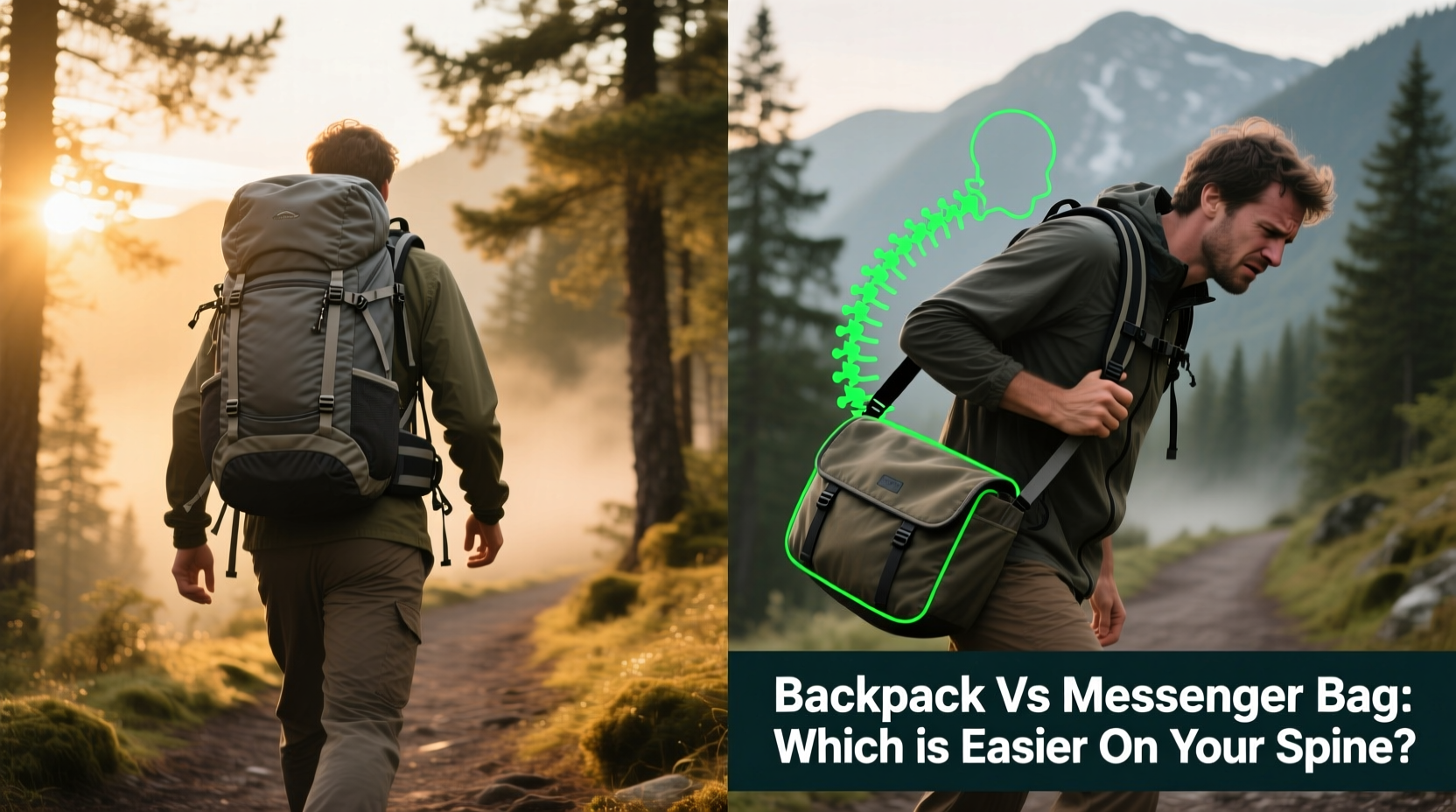
To understand how backpacks and messenger bags affect the spine, it’s essential to consider basic ergonomic principles. The human spine functions optimally when weight is distributed symmetrically across both shoulders and close to the body’s center of gravity. Asymmetrical loads, uneven weight distribution, or carrying weight far from the torso increase mechanical stress on the spine, particularly in the cervical (neck), thoracic (mid-back), and lumbar (lower back) regions.
When you walk, your body naturally shifts side to side to maintain balance. Adding an off-center load amplifies this motion, forcing muscles on one side of the body to work harder than the other. Over time, this imbalance can lead to:
- Muscle imbalances and chronic tension
- Spinal misalignment and posture degradation
- Inflammation in joints and ligaments
- Increased risk of disc compression or nerve impingement
These issues are especially pronounced during long walks, where cumulative strain becomes more significant. The duration and frequency of carrying further compound the risks associated with poor load distribution.
How Backpacks Support Spinal Health
Backpacks, when worn correctly, are widely recognized by orthopedic specialists as the most spine-friendly option for carrying weight over distance. Their design promotes bilateral shoulder support, keeping the load centered and close to the back. This alignment helps preserve the natural curvature of the spine and reduces lateral stress.
Key features that make backpacks advantageous include:
- Sternum and waist straps: These help transfer some of the load to the torso and hips, reducing shoulder strain.
- Padded back panels: Provide cushioning and maintain proper spacing between the bag and spine.
- Compartments for balanced loading: Allow heavier items (like laptops or books) to be placed closest to the back, minimizing forward pull.
“Properly fitted backpacks distribute weight evenly and encourage upright posture, making them the gold standard for spinal safety during prolonged ambulation.” — Dr. Alan Reeves, Physical Therapist & Ergonomics Consultant
Studies from the American Academy of Orthopaedic Surgeons suggest that backpacks should weigh no more than 10–15% of a person’s body weight to avoid strain. For example, someone weighing 150 pounds should carry no more than 15–22 pounds in their backpack. Staying within this range, combined with correct wearing technique (both straps used, snug fit), drastically reduces spinal pressure.
The Spinal Impact of Messenger Bags
Messenger bags, while stylish and convenient for quick access, pose notable risks to spinal health during extended use. Worn across one shoulder, they create an asymmetric load that pulls the torso to one side. This forces the spine to compensate by curving laterally—a posture known as “lateral flexion”—which increases disc pressure and muscular fatigue.
Over time, habitual use of a messenger bag can lead to:
- One-sided muscle hypertonicity (chronic tightness)
- Shoulder elevation on the loaded side
- Reduced range of motion in the neck and upper back
- Early onset of degenerative joint changes due to uneven wear
A 2020 study published in the Journal of Applied Biomechanics found that individuals using single-strap bags exhibited up to 37% greater spinal deviation compared to those using dual-strap backpacks during 30-minute walks. Additionally, participants reported higher levels of discomfort in the trapezius and paraspinal muscles after just one hour of use.
While some modern messenger bags include padded crossbody straps or ergonomic designs to mitigate these effects, they still fail to achieve true load symmetry. Even when adjusted tightly, the weight remains offset from the body’s midline, creating persistent biomechanical inefficiency.
Comparative Analysis: Backpack vs Messenger Bag
| Feature | Backpack | Messenger Bag |
|---|---|---|
| Weight Distribution | Even across both shoulders and back | Uneven, concentrated on one shoulder |
| Spinal Alignment | Maintains natural curvature | Promotes lateral bending and rotation |
| Muscle Engagement | Balanced bilateral activation | Asymmetric strain, leading to imbalance |
| Comfort During Long Walks | High, with proper fit and load | Moderate to low; degrades over time |
| Risk of Chronic Pain | Low, if used correctly | Moderate to high with regular use |
| Access to Contents | Less convenient; requires removal | Easy front access without removing |
| Best Use Case | Daily commuting, hiking, school | Short trips, urban errands, casual use |
This comparison underscores a critical trade-off: convenience versus spinal health. While messenger bags win in accessibility and aesthetic appeal, backpacks are objectively superior for protecting the spine during sustained physical activity.
Real-World Example: The Commuter’s Dilemma
Consider the case of Marcus, a 32-year-old software developer who commutes 45 minutes each way to his downtown office. For two years, he used a sleek leather messenger bag to carry his laptop, charger, notebook, and lunch. Over time, he began experiencing persistent pain in his right shoulder and upper back. His posture visibly slumped to the left, and he frequently woke with neck stiffness.
After consulting a physical therapist, Marcus learned that his bag, though stylish, was contributing to muscular asymmetry and spinal strain. He switched to an ergonomically designed backpack with lumbar padding and hip stabilization. Within six weeks of consistent use—and adherence to weight limits—he reported a 70% reduction in pain and improved energy levels throughout the day.
This scenario reflects a common pattern among urban professionals who prioritize aesthetics over ergonomics. The short-term convenience of a messenger bag often leads to long-term discomfort that could have been avoided with a spine-conscious choice.
Choosing the Right Bag: A Practical Checklist
If you're deciding between a backpack and a messenger bag for regular long walks, use this checklist to make an informed decision:
- ✅ Will you walk more than 30 minutes continuously? → Choose a backpack.
- ✅ Do you carry more than 10 lbs (4.5 kg)? → Avoid messenger bags.
- ✅ Is your load uneven (e.g., laptop + water bottle)? → Opt for compartmentalized backpacks.
- ✅ Do you value easy access over spinal health? → Messenger may suit short trips only.
- ✅ Can you adjust the fit regularly? → Ensure straps are customizable and secure.
- ✅ Are you prone to back or shoulder pain? → Eliminate asymmetrical carrying methods.
Expert Recommendations for Safer Carrying Habits
Regardless of the bag type, how you use it matters as much as the design. Experts agree on several best practices to minimize spinal strain:
- Pack smart: Place heavier items (laptops, books) closest to your back and centered vertically.
- Use both straps: Never sling a backpack over one shoulder—it defeats the purpose.
- Adjust fit daily: Straps should be snug but not restrictive; the bag should move with your body, not bounce.
- Take breaks: During long walks, stop every 20–30 minutes to shift position or remove the bag briefly.
- Strengthen supporting muscles: Core and back exercises improve posture and resilience to load.
Frequently Asked Questions
Can a well-padded messenger bag eliminate spinal strain?
No. Padding improves comfort but does not correct the fundamental issue of asymmetric load distribution. Even with cushioning, the spine remains under uneven mechanical stress, increasing the risk of long-term postural problems.
Are all backpacks safe for the spine?
Not necessarily. Poorly designed backpacks without proper support, excessive weight, or incorrect usage (e.g., single-strap carrying) can still cause harm. Look for models with chest and hip stabilizers, breathable backing, and adjustable compartments.
What’s the maximum safe weight for a messenger bag?
To minimize risk, keep messenger bag weight under 5–7% of your body weight—significantly lower than the 10–15% guideline for backpacks. For a 150-pound person, that means no more than 7.5–10 pounds.
Final Thoughts and Action Steps
When it comes to spinal health during long walks, the evidence is clear: backpacks are the safer, more sustainable choice. They align with the body’s natural mechanics, promote balanced muscle engagement, and reduce the risk of chronic pain. Messenger bags, while appealing for their style and functionality, introduce unavoidable biomechanical compromises that accumulate over time.
This doesn’t mean you must abandon your messenger bag entirely. It can serve well for brief outings, meetings, or situations where quick access is essential. But for daily commuting, hiking, or any extended walking, switching to a properly fitted backpack is one of the simplest yet most impactful decisions you can make for your long-term spinal health.
Start today: evaluate your current bag, assess your walking habits, and make adjustments before discomfort turns into injury. Your spine carries you through life—make sure you’re carrying your load in a way that supports it.




 浙公网安备
33010002000092号
浙公网安备
33010002000092号 浙B2-20120091-4
Comments
No comments yet. Why don't you start the discussion?