
When diving into the rich, story-driven world of Baldur’s Gate 3, one of the most immediate decisions players face isn’t about character class or origin—it’s about how they’ll interact with it. The choice between keyboard and mouse versus a gamepad isn’t just about comfort; it shapes the rhythm of combat, the fluidity of dialogue navigation, and ultimately, the level of immersion in this deeply layered RPG. While both inputs are fully supported and well-optimized, each offers a distinct experience that can enhance—or interrupt—your connection to the narrative and mechanics.
Larian Studios designed Baldur’s Gate 3 with flexibility in mind, ensuring console and PC players could enjoy parity in features and performance. But immersion—the feeling of being truly present in Faerûn—isn’t guaranteed by graphics or voice acting alone. It’s cultivated through seamless interaction. How easily can you issue commands during a heated battle? Can you navigate complex dialogue trees without breaking emotional momentum? These moments hinge on your control scheme.
The Precision Advantage: Keyboard and Mouse for Tactical Depth
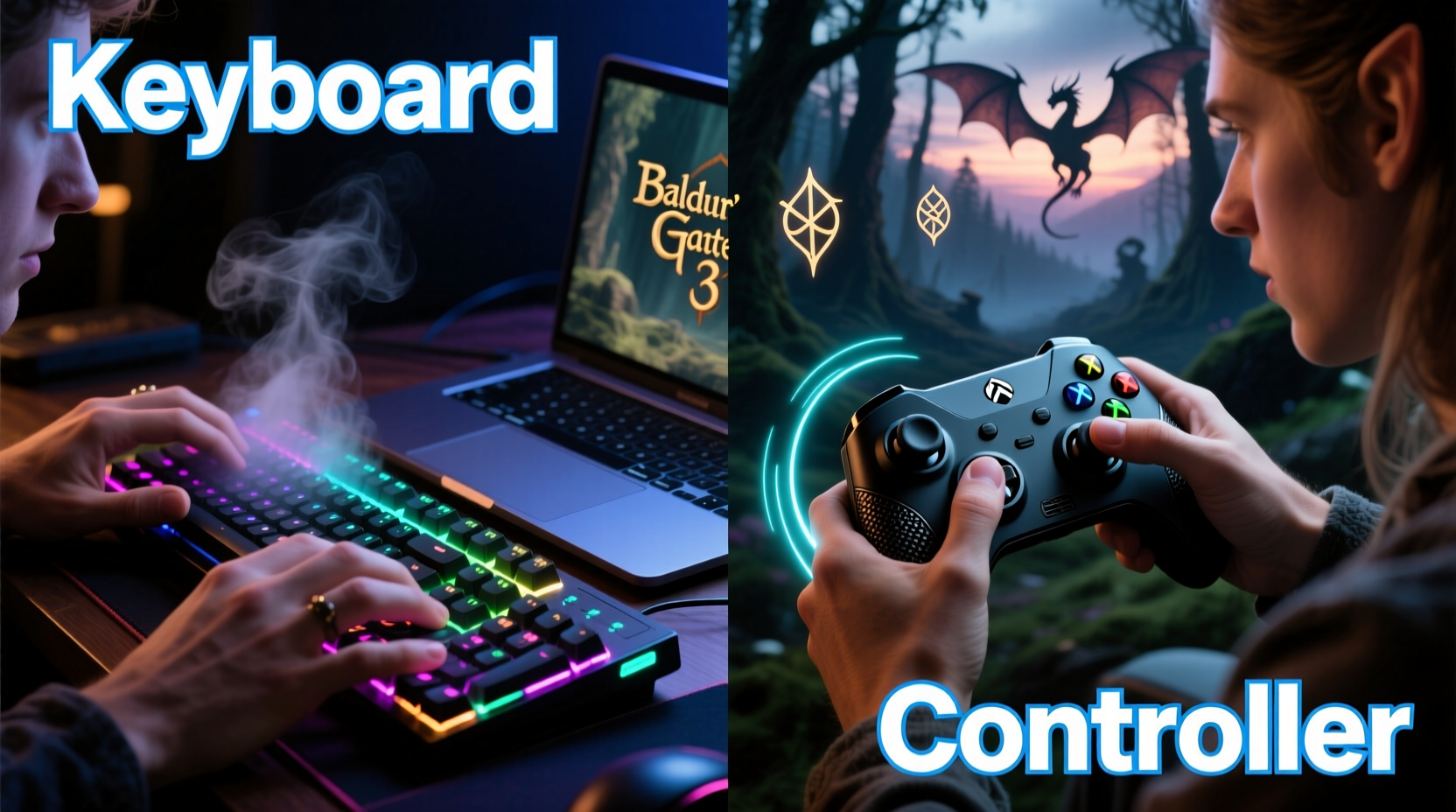
Baldur’s Gate 3 is built on turn-based D&D 5e mechanics, where positioning, line of sight, and ability targeting matter immensely. In these scenarios, the keyboard and mouse excel. Clicking to move characters allows pixel-perfect placement, critical when squeezing through narrow cover or avoiding hazardous terrain like grease patches or fire spells. Targeting area-of-effect abilities such as *Fireball* or *Sleep* becomes intuitive with cursor-based selection, letting players preview zones before committing.
Combat in Baldur’s Gate 3 rewards foresight and micro-management. Assigning hotkeys (via Ctrl+number) lets players execute actions swiftly—no need to open radial menus mid-turn. Need to use a potion? Press Ctrl+4. Cast *Shield* as an opportunity attack? That’s bound to a single key. This speed reduces downtime and keeps tension high, especially during difficult encounters like the goblin captain fight or the final showdown with Orpheus.
Outside of battle, navigating dialogue is smoother with a mouse. Hovering over NPC portraits reveals names and relationship statuses. Scrolling through branching conversations feels natural, and selecting choices is instantaneous. For players who lean into role-playing—reading every journal entry, inspecting every object, parsing dialogue tone—the precision of mouse input supports deeper engagement without friction.
The Intuitive Flow: Controller for Cinematic Engagement
For many, a controller fosters a more relaxed, cinematic experience. Holding a familiar pad creates continuity for those transitioning from console RPGs like The Witcher 3 or Mass Effect. The tactile feedback of triggers and thumbsticks can make exploration feel organic—walking through the Blighted Village, approaching a campfire, or drawing a weapon gains a physical rhythm.
Navigating dialogue with a controller is surprisingly effective. Larian implemented a smart radial system that groups responses by tone—Charm, Intimidate, Reason, etc.—making social interactions feel deliberate. Using the right stick to select options mimics choosing a stance, reinforcing the role-playing aspect. There’s a psychological weight to pushing forward on the stick to intimidate a bandit or tilting up to charm a noble.
“Controllers create emotional proximity. The lack of intermediary tools—no screen cursor, no keyboard—makes you feel like the character, not the tactician.” — Marcus Tran, Game Design Analyst at Playfront Insights
In exploration, camera control remains responsive on a gamepad. While panning with a stick lacks the speed of a mouse swipe, it encourages slower observation—scanning ruins for hidden levers, watching ambient animations, absorbing environmental storytelling. For players prioritizing narrative over optimization, this pacing enhances immersion rather than hinders it.
Comparative Breakdown: Input Methods Side-by-Side
| Feature | Keyboard & Mouse | Controller |
|---|---|---|
| Movement Precision | High – exact tile placement | Medium – analog drift possible |
| Combat Targeting | High – cursor-based aiming | Medium – requires menu cycling |
| Hotkey Accessibility | Excellent – full customization | Fair – limited quick slots |
| Dialogue Navigation | Fast – point and click | Immersive – tone-based radial |
| Inventory Management | Efficient – drag and drop | Slower – button-heavy menus |
| Cinematic Feel | Lower – tactical focus | Higher – seamless integration |
| Learning Curve | Steeper for new PC players | Gentler for console veterans |
This comparison underscores a central truth: neither input is universally superior. Instead, they serve different playstyles. If you approach Baldur’s Gate 3 as a tactical challenge—a puzzle of dice rolls, cover angles, and action economy—keyboard and mouse provide the necessary precision. But if you prioritize character embodiment and narrative flow, the controller’s simplicity may draw you deeper into the role.
A Real Player’s Journey: Choosing Between Efficiency and Emotion
Consider Lena, a long-time tabletop D&D player who approached Baldur’s Gate 3 looking for authenticity. She began on keyboard and mouse, appreciating the clarity of initiative order and spell ranges. But she found herself distracted during emotional scenes—like Shadowheart’s confession in the Emerald Grove—by the need to manage UI elements. “I was clicking through dialogue while also checking my party’s HP,” she recalls. “It felt like managing spreadsheets, not sharing secrets under moonlight.”
She switched to a DualSense controller. Though inventory management slowed her down, she noticed a shift in presence. “Holding the controller, feeling the subtle haptics when rain hits the screen—I wasn’t just playing a game. I was *there*. Even fumbling through a radial menu made me pause and consider what my character would really say.” Her combat effectiveness dipped slightly, but her attachment to the story deepened.
Lena’s experience illustrates a common trade-off: efficiency versus embodiment. The controller didn’t make her a better tactician—but it made her a more invested participant.
Optimizing Your Choice: A Step-by-Step Guide
Choosing the right input shouldn’t be guesswork. Follow this sequence to align your control scheme with your preferred experience:
- Define your primary goal: Are you here for strategic combat mastery, lore exploration, or character-driven storytelling?
- Test both inputs in Act 1: Play the first few hours using keyboard/mouse, then restart with a controller. Note where you feel most engaged.
- Evaluate pain points: Did you struggle with targeting spells on controller? Did mouse usage break emotional scenes?
- Customize accordingly: Rebind keys or adjust sensitivity to reduce friction. On controller, map essential potions to bumpers.
- Commit for consistency: Switching back and forth disrupts muscle memory. Pick one and stick with it past Act 1.
Actionable Checklist: Maximizing Immersion Based on Input
- ✅ Play the prologue with both inputs before deciding
- ✅ Customize hotkeys or button mappings within the first hour
- ✅ Disable unnecessary HUD elements to reduce visual clutter
- ✅ Use controller haptics (if available) to enhance environmental feedback
- ✅ Keep a notebook for lore tracking if relying less on fast UI access
- ✅ Adjust camera sensitivity based on your device for smoother panning
- ✅ Save before major battles when adapting to a new control scheme
Frequently Asked Questions
Can I switch between keyboard and controller during my playthrough?
Yes—Baldur’s Gate 3 automatically detects input devices and switches UI layouts accordingly. However, frequent switching may disrupt muscle memory and immersion. It’s best to choose one and adapt fully.
Is combat significantly harder on controller?
Not inherently. While targeting is less precise, the game balances input methods. Many players complete the hardest difficulty (“Tactical”) using only a controller. It requires more reliance on auto-targeting and pre-battle planning, but it’s entirely viable.
Does using a controller limit access to any features?
No. All gameplay systems—including inventory, spell preparation, and stealth—are fully accessible on controller. Some actions take more steps, but nothing is locked behind input type.
Final Verdict: Immersion Is Personal
The question of whether keyboard or controller offers better immersion in Baldur’s Gate 3 has no universal answer. It depends on what immersion means to you. For some, it’s the thrill of perfectly executing a *Grease* + *Fire Bolt* combo from 30 feet away—every die roll, every movement calculated. For others, it’s whispering a lie during a persuasion check, heart pounding, feeling the weight of consequence in their hands, not their keystrokes.
Keyboard and mouse offer unmatched control, transforming players into battlefield conductors. Every decision is crisp, every action immediate. But that same precision can distance you from the character—you’re managing units, not living a life.
Controllers, meanwhile, blur the line between player and avatar. You don’t click “Intimidate”—you press forward, lean into the moment, let the rumble in your palms echo the tension on screen. It’s less about winning fights efficiently and more about surviving them meaningfully.
Larian’s achievement lies in supporting both paths without compromise. Whether you’re mapping intricate macros or leaning into the simplicity of a button press, Baldur’s Gate 3 adapts. The real mastery isn’t in picking the “best” input—it’s in choosing the one that makes Faerûn feel real to you.




 浙公网安备
33010002000092号
浙公网安备
33010002000092号 浙B2-20120091-4
Comments
No comments yet. Why don't you start the discussion?