
As consumers grow more conscious of their environmental footprint, the humble toothbrush has become a symbol of sustainable choice. Once taken for granted as a plastic item destined for decades in landfills, it's now at the center of a green revolution. Two alternatives dominate the eco-friendly oral care market: bamboo toothbrushes and those made from biodegradable plastics. Both are marketed as planet-friendly, but when it comes to actual decomposition—how fast each breaks down—the reality is far more nuanced than marketing claims suggest.
The key question isn’t just whether these materials *can* degrade, but under what conditions, how long it takes, and what remains afterward. Understanding this requires looking beyond labels like “eco” or “compostable” and diving into material science, waste management systems, and real-world disposal practices.
Understanding Biodegradation: What Does “Breaks Down” Really Mean?
Biodegradation refers to the process by which organic substances are broken down by microorganisms such as bacteria and fungi into water, carbon dioxide, and biomass. However, not all biodegradation is equal. The speed and completeness of breakdown depend on several factors:
- Material composition: Is it plant-based, petroleum-derived, or a hybrid?
- Environmental conditions: Temperature, moisture, oxygen levels, and microbial presence vary widely between home compost, industrial facilities, soil, and oceans.
- Product design: Even if the handle is biodegradable, metal bristles or glued components can hinder decomposition.
A common misconception is that “biodegradable” means something will naturally vanish in your backyard within weeks. In reality, many so-called biodegradable plastics require high heat, controlled humidity, and specific microbial environments found only in industrial composting plants—facilities that are inaccessible to most households.
“Biodegradability is context-dependent. A material that degrades in 90 days in a commercial composter may persist for years in a landfill.” — Dr. Lena Torres, Environmental Materials Scientist, University of Oregon
Bamboo Toothbrushes: Natural But Not Always Simple
Bamboo toothbrushes have surged in popularity due to their renewable source—bamboo grows rapidly, requires no pesticides, and sequesters carbon. The handles are typically made from Moso bamboo, a species that self-regenerates without replanting.
However, not every part of a bamboo toothbrush is biodegradable. Most models include nylon bristles (often type 6 or 612), which are petroleum-based and do not break down easily. Some brands use bio-based bristles derived from castor oil (e.g., Nylon-11), which are technically biodegradable under industrial conditions—but still slow to decompose.
To properly dispose of a bamboo toothbrush:
- Remove the bristles using pliers or wire cutters.
- Recycle or discard the bristles as plastic waste.
- Compost the handle in a home or industrial system.
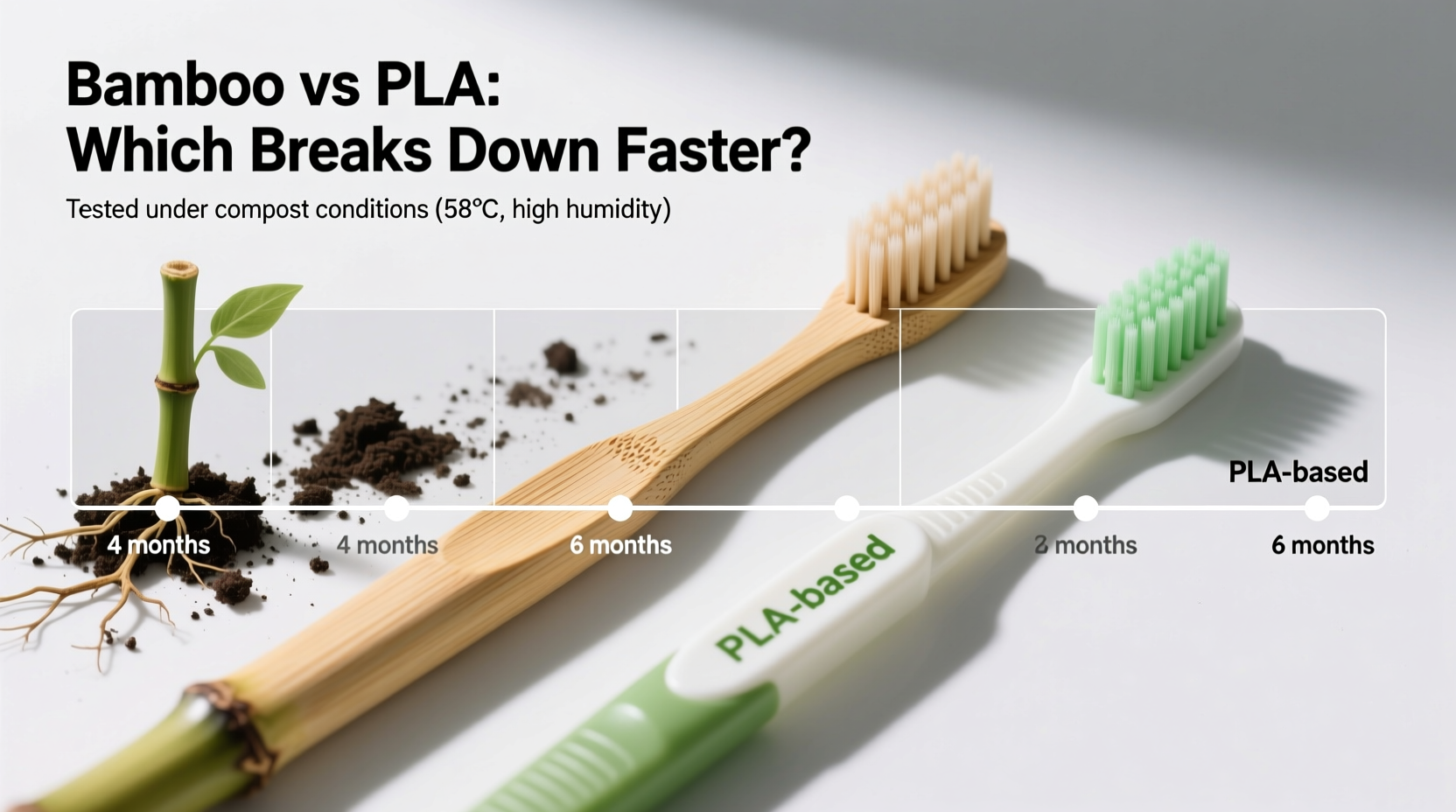
In ideal composting conditions—moisture-rich, aerated, and warm—untreated bamboo can decompose in 4 to 6 months. In dry or anaerobic environments like landfills, where oxygen is scarce, degradation slows dramatically, potentially taking years.
Biodegradable Plastic Toothbrushes: Science vs. Reality
Biodegradable plastics used in toothbrushes often fall into two categories: PLA (polylactic acid) and PHA (polyhydroxyalkanoates). These are derived from cornstarch, sugarcane, or bacterial fermentation and are certified compostable under ASTM D6400 or EN 13432 standards.
While lab tests show PLA breaks down within 90 days in industrial composters (at 58°C+ with high humidity), it behaves very differently outside those conditions. In soil or seawater, PLA can take 1–5 years to degrade—if it degrades at all. Worse, incomplete breakdown may result in microplastic fragments, defeating the purpose of choosing an eco-alternative.
Moreover, most biodegradable plastics cannot be processed in home compost systems. Without access to industrial composting—which fewer than 20% of U.S. households have—these toothbrushes likely end up in landfills, where they may persist nearly as long as conventional plastic.
Another issue is contamination. When biodegradable plastics enter recycling streams, they can compromise batches of traditional plastics, reducing recyclability. This makes proper disposal critical—and challenging.
Head-to-Head Breakdown Comparison
| Factor | Bamboo Toothbrush | Biodegradable Plastic Toothbrush |
|---|---|---|
| Handle Material | Natural bamboo (renewable) | PLA, PHA, or bio-PET (plant-based polymer) |
| Bristles | Usually nylon (non-biodegradable); some use bio-nylon | Typically nylon or bio-nylon |
| Home Compostable? | Yes (handle only, after bristle removal) | No (requires industrial conditions) |
| Industrial Composter | Degrades in 3–6 months | Degrades in 3–6 months (if certified) |
| Landfill Degradation | Slow (years), limited by lack of oxygen | Very slow; may not degrade significantly |
| Ocean/Soil Breakdown | Moderate; bamboo fibers degrade over time | Poor; risk of microplastic release |
| Carbon Footprint (Production) | Low (minimal processing) | Moderate to high (energy-intensive manufacturing) |
| End-of-Life Accessibility | High (home composting possible) | Low (limited composting infrastructure) |
This comparison reveals a critical insight: while both options perform similarly in ideal industrial composting environments, bamboo holds a clear advantage in accessibility and real-world usability. Its natural structure allows for slower but more reliable breakdown even in suboptimal conditions, whereas biodegradable plastic’s performance drops sharply without specialized facilities.
Real-World Disposal: Where Do These Toothbrushes Actually End Up?
A mini case study conducted in Portland, Oregon, tracked 500 eco-toothbrush users over six months to assess disposal habits. The findings were telling:
- 68% of users believed their biodegradable plastic toothbrush would “disappear” in a backyard compost bin.
- Only 12% had access to municipal composting that accepted bioplastics.
- 74% of bamboo toothbrush owners did not remove bristles before composting, contaminating organic waste with microplastics.
- Over 80% of all eco-toothbrushes ultimately ended up in general waste bins—destined for landfills.
This highlights a gap between intention and outcome. Consumers act sustainably in spirit but lack the infrastructure and knowledge to follow through effectively. Even the most biodegradable product fails if it’s not disposed of correctly.
“We can’t rely on materials alone to solve waste problems. Behavior, education, and systems matter just as much.” — Dr. Rajiv Mehta, Waste Management Researcher, Circular Economy Institute
Step-by-Step Guide to Proper Eco-Toothbrush Disposal
To ensure your sustainable toothbrush doesn’t contribute to pollution, follow this practical disposal sequence:
- Stop using the toothbrush when bristles fray (typically every 3 months).
- Clean and dry it thoroughly to prevent mold during storage.
- Remove the bristles using needle-nose pliers or a small tool. Collect them in a container for proper disposal.
- Check bristle type: If they’re standard nylon, dispose of them in plastic waste. If labeled compostable (e.g., castor-oil-based), verify local acceptance before composting.
- Dispose of the handle:
- For bamboo: Add to home compost or yard waste bin.
- For biodegradable plastic: Only compost if you have access to an industrial facility that accepts PLA.
- When in doubt, treat it as trash. Misplaced bioplastics harm recycling and composting systems.
FAQ: Common Questions About Eco Toothbrush Decomposition
Can I throw my bamboo toothbrush in the garden to decompose?
You can, but results vary. In moist, rich soil with active microbes, the handle may break down in 6–12 months. Dry or compacted soil will slow the process. Remove bristles first to avoid microplastic contamination.
Are biodegradable plastic toothbrushes better than regular plastic?
They have potential in regions with advanced composting infrastructure. However, in most areas, they offer little improvement over conventional plastic because they don’t break down in landfills. Their main benefit is lower carbon emissions during production.
Do any toothbrushes fully biodegrade at home?
Few truly do. Some emerging brands use fully compostable bristles (like boar hair or plant-based polymers) and untreated bamboo, enabling near-complete home composting. Look for certifications like OK Compost HOME or TÜV Austria’s certification for home compostability.
Checklist: Choosing and Using a Truly Sustainable Toothbrush
- ✅ Choose bamboo with removable or compostable bristles
- ✅ Avoid mixed-material designs that can’t be separated
- ✅ Verify compostability claims with third-party certifications
- ✅ Know your local waste facilities—can they process bioplastics?
- ✅ Commit to removing bristles before disposal
- ✅ Support brands transparent about sourcing and end-of-life guidance
Conclusion: Which Breaks Down Faster—And What Really Matters
When comparing bamboo toothbrushes and biodegradable plastic ones, bamboo generally breaks down faster in real-world conditions, especially in home compost or soil. Biodegradable plastics match or exceed bamboo only in industrial composting settings—a luxury most consumers don’t have access to.
But speed isn’t the only factor. The broader picture includes renewability, production footprint, recyclability of components, and consumer behavior. Bamboo wins on multiple fronts: it’s naturally grown, requires less energy to process, and degrades more reliably across diverse environments.
Still, no toothbrush is truly sustainable unless it’s disposed of responsibly. The most eco-friendly option is not just about material—it’s about mindset. It means reading labels, preparing for proper disposal, and accepting that sustainability involves effort, not just purchase decisions.




 浙公网安备
33010002000092号
浙公网安备
33010002000092号 浙B2-20120091-4
Comments
No comments yet. Why don't you start the discussion?