
Dungeons & Dragons (D&D) has captivated imaginations for decades, evolving from a niche tabletop game into a global phenomenon. Whether you've seen it on streaming platforms like Critical Role or heard friends talk about epic quests and dramatic betrayals, the allure of stepping into a fantasy world as a wizard, rogue, or paladin is undeniable. But where do you start? Unlike video games, D&D doesn’t come with an installable tutorial. Instead, it begins with books, dice, and imagination. This guide walks through everything a newcomer needs to know—focusing on the essential rulebooks, understanding dice mechanics, and assembling your first toolkit for adventure.
Understanding the Core of D&D
D&D is a collaborative storytelling game where one player acts as the Dungeon Master (DM), guiding the narrative and controlling non-player characters (NPCs), while others play adventurers making choices that shape the story. There are no fixed levels or win conditions—only exploration, roleplay, and dice-driven outcomes. Success hinges on creativity, teamwork, and a willingness to embrace unpredictability.
The game runs on the 5th edition ruleset, currently the most popular and accessible version. It streamlines mechanics without sacrificing depth, making it ideal for beginners. Before diving in, you’ll need two foundational elements: rulebooks and dice. These tools provide structure and randomness—the backbone of every dungeon crawl and diplomatic negotiation.
Essential Rulebooks: Your Foundation for Play
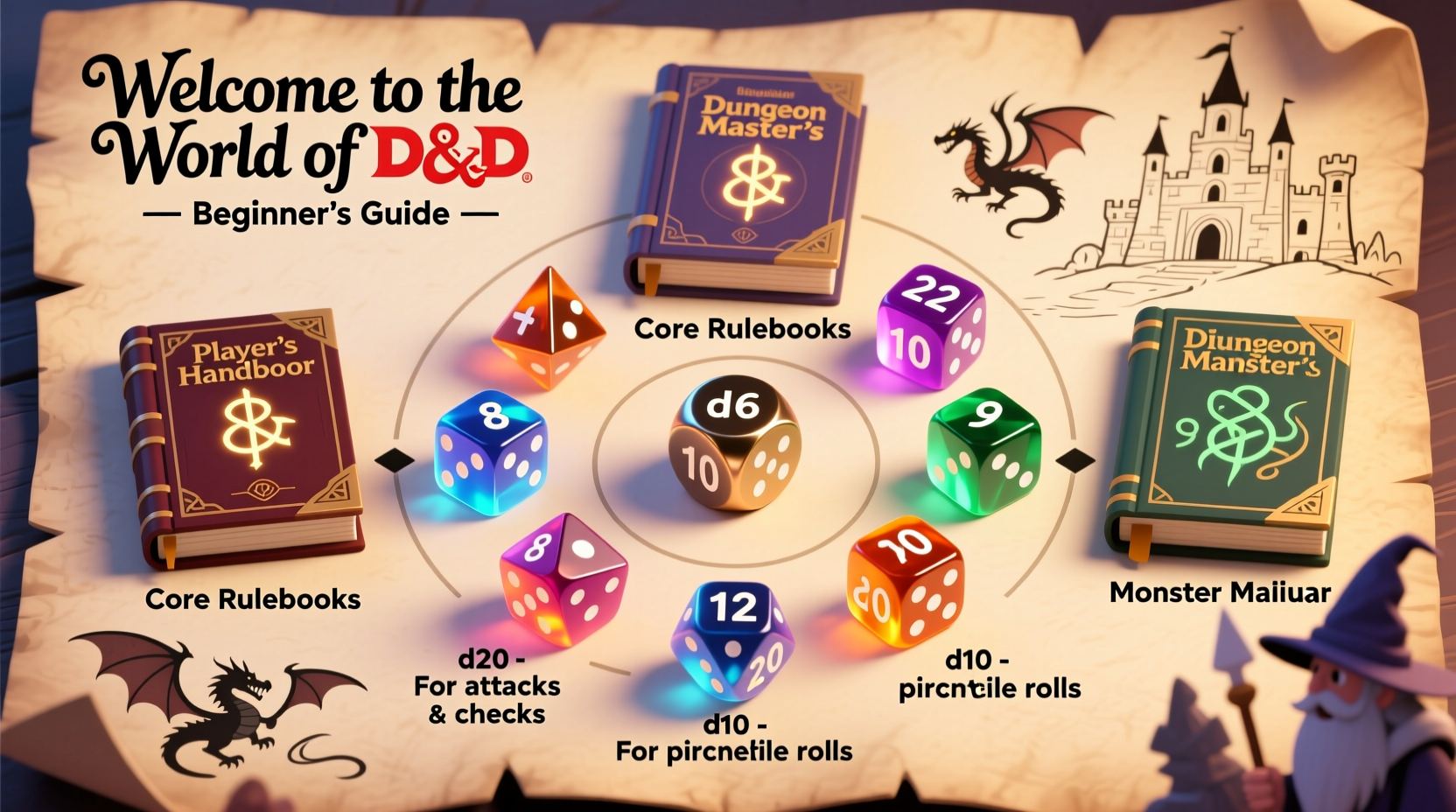
You don’t need every book ever published to enjoy D&D, but three core rulebooks form the backbone of gameplay. They’re designed to work together, each serving a distinct purpose.
| Book | Purpose | Key Contents |
|---|---|---|
| Player’s Handbook (PHB) | Rules for character creation and player actions | Races, classes, spells, equipment, combat, and skill checks |
| Dungeon Master’s Guide (DMG) | Tools for running the game and building worlds | World-building advice, magic items, encounter balancing, campaign design |
| Monster Manual (MM) | Collection of creatures and adversaries | Stats, lore, and abilities for hundreds of monsters—from goblins to dragons |
The Player’s Handbook is the most important purchase for new players. It contains all the rules needed to create a character, including choosing a race (like elf or dwarf), class (such as fighter or sorcerer), and abilities. It also explains how to make ability checks, use weapons, cast spells, and navigate social interactions—all governed by dice rolls.
The Monster Manual is primarily for the DM, who uses it to populate encounters. While players don’t need their own copy, having access during sessions helps understand enemy capabilities. The Dungeon Master’s Guide is more advanced and best approached after gaining experience. It includes guidance on creating custom adventures, modifying rules, and rewarding players with unique loot.
Alternative Entry Points: Starter Sets and Free Resources
Not everyone wants to invest in all three core books immediately. Wizards of the Coast offers the D&D Starter Set, a budget-friendly box that includes a condensed rulebook, pre-generated characters, a beginner-friendly adventure (Lost Mine of Phandelver), and a set of dice. It’s ideal for groups trying the game for the first time.
Additionally, the official Basic Rules PDF is free and legally available on the D&D website. It covers the essentials of character creation and gameplay up to level 5, effectively replacing the need for the full Player’s Handbook in early sessions.
“D&D isn’t about knowing every rule—it’s about telling stories together. The books are tools, not barriers.” — Chris Perkins, Principal Narrative Designer at Wizards of the Coast
Your First Dice Set: More Than Just Randomness
No D&D game is complete without dice. These small polyhedrons determine success, failure, damage, and fate. A standard set includes seven dice, each serving a different mechanical purpose:
- d4 – Four-sided die, used for minor damage (e.g., daggers)
- d6 – Six-sided die, common for damage and some ability checks
- d8 – Eight-sided die, mid-tier weapon damage
- d10 – Ten-sided die, often used in pairs for percentage rolls (d100)
- d12 – Twelve-sided die, high-damage weapons like greataxes
- d20 – Twenty-sided die, the most important—used for attacks, saving throws, and skill checks
- d100 – Two d10s (one labeled 0–9, one 00–90) to generate a number from 1–100
The d20 is central to gameplay. When attempting an action—like sneaking past a guard or persuading a noble—you roll a d20, add relevant modifiers (based on skills and stats), and compare the total to a Difficulty Class (DC). Roll equal to or higher than the DC, and you succeed.
Dice come in various materials (plastic, resin, metal) and styles (translucent, engraved, themed). For beginners, a standard plastic set costing $5–$10 is perfectly functional. Over time, many players collect themed sets—dragon-shaped dice, gemstone resins, or glow-in-the-dark variants—as personal expressions of their gaming identity.
How Dice Influence Gameplay and Storytelling
Dice don’t just decide outcomes—they shape narratives. A critical failure (rolling a 1 on a d20) might mean your sword breaks mid-swing or you accidentally insult the king. A natural 20 (maximum roll) could let you disarm a trap with flair or deliver a monologue so persuasive the enemy surrenders.
Some DMs encourage “narrative rolling,” where players describe what they’re doing before rolling. This blends mechanics with creativity, making even routine checks part of the story. For example, instead of saying “I roll Perception,” a player might say, “I crouch near the tapestry, listening for hidden passages,” prompting a more vivid description of the outcome.
Step-by-Step: Building Your D&D Toolkit
Starting D&D doesn’t require mastery—just preparation. Follow this sequence to assemble your essentials and join your first session confidently.
- Determine your role: Decide whether you want to be a player or the DM. Players focus on one character; the DM manages the world and challenges.
- Acquire core materials:
- Players: Get the Player’s Handbook or download the free Basic Rules.
- DMs: Start with the Starter Set or acquire the PHB, MM, and DMG over time.
- Buy a dice set: Choose a standard 7-die polyhedral set. Consider extras if playing digitally or sharing with others.
- Create your first character: Use the PHB or online tools to pick race, class, background, and equipment. Allocate ability scores using standard array or point buy.
- Join or form a group: Find players through local game stores, online communities (Reddit, Discord), or among friends.
- Play a starter adventure: Run or participate in Lost Mine of Phandelver or another beginner module to learn pacing and mechanics.
- Learn by doing: Don’t memorize every rule. Focus on understanding initiative, combat rounds, and ability checks during actual play.
This process typically takes a few days to a week, depending on availability of materials and scheduling. Many newcomers worry about “doing it right,” but D&D is inherently flexible. Rules can be adjusted, characters retconned, and mistakes turned into plot points.
Mini Case Study: From Curiosity to Campaign
Sarah, a college student with no prior tabletop experience, watched a D&D livestream and became intrigued. She bought the Starter Set for $20, invited three friends, and volunteered to be DM despite feeling unprepared. Using the included adventure booklet, she ran her first session—nervous but excited.
Her players fumbled through combat, misread traps, and laughed at absurd dice rolls. One player rolled three natural 1s in a row while trying to climb a wall. Instead of frustration, Sarah turned it into a running joke: “The wall is cursed against halflings!” By session three, the group had bonded, created backstories, and asked to keep going beyond the starter module.
Sarah later purchased the DMG and joined a DM advice Discord server. Within months, she was designing original quests. Her journey shows that expertise grows through practice—not prerequisites.
Frequently Asked Questions
Do I need all three core books to start playing?
No. The Player’s Handbook is essential for players. The Monster Manual and DMG are helpful for DMs but not required at first. The free Basic Rules and Starter Set provide enough content for early gameplay.
Can I play D&D online?
Absolutely. Platforms like Roll20, Foundry VTT, and Fantasy Grounds allow virtual play with digital dice, maps, and character sheets. Many groups meet remotely using video calls and shared screens.
What if I roll poorly all the time?
Dice are random, and streaks happen. Good gameplay isn’t about perfect rolls—it’s about creative problem-solving. A clever idea can bypass a failed check. Some DMs also use “advantage” (rolling two d20s and taking the higher) to reward smart tactics.
Checklist: Your D&D Starter Kit
- ☐ Decide: Player or Dungeon Master?
- ☐ Obtain rulebook(s): PHB or free Basic Rules
- ☐ Purchase a 7-die polyhedral set
- ☐ Create or select a character (use pre-gens if needed)
- ☐ Find a group (friends, local store, online community)
- ☐ Schedule first session with a simple adventure
- ☐ Bring pencils, paper, dice, and an open mind
This checklist ensures you’re prepared without overcomplicating the start. Once you’ve completed it, you’re ready to roll for initiative.
Final Thoughts: Begin Your Adventure
Starting D&D is less about collecting gear and more about embracing curiosity. The rulebooks provide structure, the dice inject surprise, and the people around the table bring the magic to life. You don’t need to be an expert to contribute—only willing to imagine, collaborate, and laugh when things go sideways.
Every legendary campaign begins with a single session. Whether you're casting fireball for the first time or narrating a dragon’s ancient riddle, you’re part of a tradition of storytelling that spans generations. Pick up your dice, open the Player’s Handbook, and take that first step into a world limited only by your imagination.




 浙公网安备
33010002000092号
浙公网安备
33010002000092号 浙B2-20120091-4
Comments
No comments yet. Why don't you start the discussion?