
When a recipe calls for scallions but you only have chives—or vice versa—understanding how to substitute one for the other without compromising flavor or texture becomes essential. While both belong to the Allium family and share a mild onion-like taste, they differ significantly in intensity, structure, and culinary function. Chives offer a delicate, grassy sharpness with subtle garlic notes, while scallions provide a more pronounced onion flavor with crisp, edible stalks and tender bulbs. Substituting between them requires careful consideration of form, potency, and intended use. For home cooks aiming to maintain balance in salads, soups, garnishes, or sautéed dishes, knowing which alternative works best—and how to adjust quantities and techniques—is key to preserving the integrity of the dish.
Definition & Overview
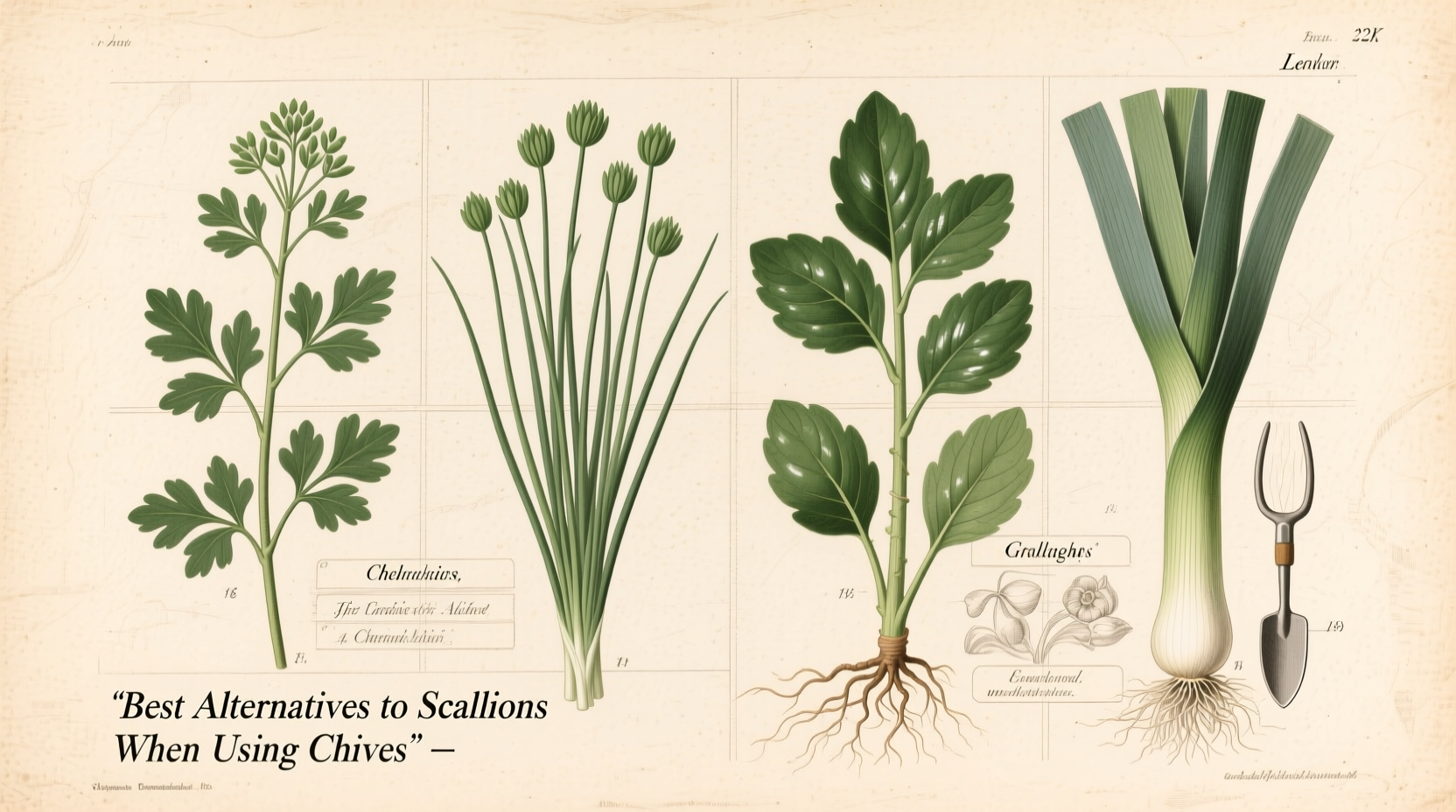
Chives (Allium schoenoprasum) are the smallest and most delicate member of the onion family. They grow in thin, hollow green tubes and are almost exclusively used fresh. Unlike other alliums, chives do not develop a bulb, and their flavor is subtle—bright, mildly pungent, with faint garlic undertones. They are prized primarily as a finishing herb, added at the end of cooking to preserve their aroma and color.
Scallions, also known as green onions, are young onions harvested before bulb development. They consist of a white cylindrical base that tapers into long green stalks. Both parts are edible, with the white end offering a sharper, more concentrated onion flavor and the green portion providing a milder, fresher bite. Scallions are used both raw and cooked and contribute both flavor and texture to dishes.
Because chives lack the structural body and deeper onion essence of scallions, substituting one for the other isn't always straightforward. However, several viable alternatives can bridge the gap when chives are used in place of scallions—or when you need to replace scallions and only have chives on hand.
Key Characteristics
| Attribute | Chives | Scallions |
|---|---|---|
| Flavor Profile | Mild, grassy, subtly garlicky, faintly onion-like | Bright, crisp, moderately sharp (white part), milder (green part) |
| Aroma | Faint, herbal, fresh-cut grass | Pronounced onion scent, especially when cut |
| Color & Form | Slender, hollow green tubes; no bulb | White base with elongated green stalks; small immature bulb |
| Heat Sensitivity | High—loses flavor and wilts quickly when cooked | Moderate—can be sautéed, grilled, or eaten raw |
| Culinary Function | Finishing herb, garnish, raw addition | Flavor base, textural component, garnish, cooked ingredient |
| Shelf Life (Refrigerated) | 5–7 days in damp paper towel or water | 7–10 days when stored properly |
Practical Usage: How to Use Chives as a Scallion Substitute
While chives cannot fully replicate the textural presence or depth of scallions, they can serve as a functional stand-in in specific applications—especially where appearance and freshness matter more than crunch or strong onion flavor.
In cold dishes such as potato salad, creamy dips, deviled eggs, or cottage cheese toppings, chives work well as a visual and aromatic proxy for finely chopped scallions. Their similar green hue and fine diameter allow them to mimic the look of minced scallion greens, though the flavor will be less assertive.
For hot applications, such as stir-fries, omelets, or soups, adding chives requires timing and adjustment. Because they wilt within seconds of heat exposure, they should be stirred in during the final moments of cooking or sprinkled on after plating. To compensate for their weaker flavor, consider increasing the quantity by 50–100%. For example:
- If a recipe calls for 1 tablespoon of finely sliced scallions, use 1.5 tablespoons of chives.
- For a garnish on baked potatoes or tacos, double the amount of chives to match the sensory impact of scallions.
In sauces and dressings—particularly yogurt-based ones like tzatziki or herbed sour cream—chives blend seamlessly and often outperform scallions due to their uniform texture and lack of fibrous bits. Their smooth integration makes them ideal for emulsified preparations where consistency is critical.
Pro Tip: When substituting chives for scallions in cooked dishes, enhance the onion note by combining chives with a pinch of onion powder (1/8 tsp per serving) or a few drops of reconstituted onion juice. This builds back the missing depth without overwhelming the dish.
Variants & Types of Chives and Related Alliums
Not all chives are created equal. Several varieties and related herbs can influence substitution success when replacing scallions:
- Common Chives – The standard variety found in most supermarkets. Best for garnishing and raw applications.
- Garlic Chives (Chinese Chives) – Flat, wider leaves with a distinct garlic-onion hybrid flavor. These come closer to mimicking scallion complexity and can be lightly sautéed. Ideal in Asian stir-fries, dumpling fillings, or noodle bowls.
- Wild Chives – Smaller and more pungent than cultivated types, often foraged. Use sparingly due to stronger flavor.
- Curry Chives – A misnomer; these are ornamental and not typically used in cooking.
Among these, **garlic chives** are the most effective substitute for scallions in savory dishes. Their broader leaf structure and bolder taste allow them to hold up better in cooking, and their flavor profile bridges the gap between mild onion and aromatic garlic—making them particularly useful in recipes where scallions contribute more than just color.
Comparison with Similar Ingredients
Several alliums are commonly mistaken for or used interchangeably with chives and scallions. Understanding their differences ensures accurate substitutions.
| Ingredient | Similarities to Scallions | Differences from Scallions | Best Used When... |
|---|---|---|---|
| Chives | Green color, tubular shape, mild onion note | No bulb, much milder, very heat-sensitive | Finishing touch needed; texture not critical |
| Garlic Chives | Can be used raw or cooked; green stalks | Garlicky flavor, flat leaves, stronger aroma | Asian cuisine; bold flavor acceptable |
| Leeks | Part of the same family; layered white base | Larger, require extensive cleaning, sweeter when cooked | Slow-cooked dishes; stocks; braises |
| Shallots | Mild onion-garlic blend | Bulbous, not green; must be peeled and chopped | Sauces, vinaigrettes; depth over texture |
| Onion Sprouts / Scallion Greens Only | Identical green portion | Lack white bulb; may be tougher | Only green parts called for in recipe |
“In professional kitchens, we often use garlic chives as a creative twist on scallions in dim sum and noodle dishes. They bring a different dimension—not a perfect replacement, but an upgrade in context.” — Chef Lin Mei, Executive Chef at Banyan Asian Eatery
Practical Tips & FAQs
Can I use chives instead of scallions in scrambled eggs?
Yes, but add them at the very end of cooking. Since chives cook down rapidly, stirring them in during the last 30 seconds preserves their flavor and color. Use about 1.5 times the amount of chives compared to scallions for equivalent taste impact.
What if I only have dried chives?
Dried chives are significantly less potent and lack the fresh vibrancy of either scallions or fresh chives. They should not be used as a direct substitute in raw dishes. In cooked applications, use 1 teaspoon of dried chives per tablespoon of fresh, but pair with a pinch of onion powder to restore lost depth.
How do I store chives to extend shelf life?
Treat fresh chives like cut flowers: trim the ends, place them upright in a glass with an inch of water, cover loosely with a plastic bag, and refrigerate. Change the water every two days. This method keeps them crisp for up to 10 days.
Are chive blossoms edible? Can they replace scallions?
Yes, chive blossoms are edible and carry a mild onion flavor. While they don’t mimic the texture of scallions, they make an elegant garnish on salads, soups, or appetizers. Use the purple florets whole or separated into petals for a pop of color and subtle allium essence.
Which dishes tolerate chives-as-scallions substitution best?
Dishes where scallions are used primarily for visual appeal or mild flavor enhancement adapt well. Examples include:
- Creamy potato soup (garnish)
- Bagels with cream cheese
- Seafood cocktails
- Soft polenta with herbs
- Omelets and frittatas (added late)
Which dishes should avoid this substitution?
Avoid replacing scallions with chives in recipes requiring:
- Textural contrast (e.g., Thai larb, where scallions provide crunch)
- Long cooking times (e.g., stews, where scallions soften gradually)
- Balanced white-and-green presentation (e.g., scallion pancakes, where layers matter)
Alternative Strategies When Chives Fall Short
When chives alone aren’t enough to replace scallions, combine them with other ingredients to reconstruct the full sensory experience:
- Blend chives with leek greens: Finely chop the green tops of leeks and mix with chives in a 1:1 ratio. Leek greens offer bulk and mild onion flavor, while chives add brightness.
- Add texture with cucumber or celery: For cold salads needing crunch, dice a small amount of seedless cucumber or inner celery stalks and fold in with chives to simulate the mouthfeel of scallions.
- Use shallot confit + chives: Gently caramelize a small amount of finely diced shallot until soft and sweet, then cool and mix with fresh chives. This combo delivers both depth and freshness.
- Infuse oil with onion skins: Simmer onion peels in olive oil for 10 minutes, strain, and drizzle over dishes finished with chives. This reintroduces the earthy backbone lost when skipping scallion whites.
Quick Fix Ratio Guide: When substituting chives for scallions:
• Raw/Cold Dishes: 1.5x chives by volume
• Cooked Dishes: 2x chives + pinch of onion powder
• Garlic Chives: Use 1:1 for scallion greens only
• No chives? Try finely sliced leek greens or ramps (in season).
Summary & Key Takeaways
Chives can serve as a practical alternative to scallions in many culinary contexts, particularly when used thoughtfully and supplemented where necessary. While they lack the structural integrity and robust onion character of scallions, their visual similarity and fresh aroma make them suitable for garnishes, cold dishes, and last-minute additions to warm plates.
The success of the substitution hinges on three factors: adjusting quantity to account for milder flavor, respecting heat sensitivity by adding chives late, and enhancing depth when needed with supporting ingredients like onion powder, garlic chives, or leek greens.
Garlic chives emerge as the strongest contender among chive varieties, offering a more complex flavor and greater versatility in cooked applications. Meanwhile, understanding the limitations—such as unsuitability in crunchy salads or slow-cooked bases—helps prevent disappointing results.
Ultimately, substitution is not about perfection but adaptation. With a nuanced approach, home cooks can maintain flavor harmony and aesthetic appeal even when pantry constraints arise. Whether you're garnishing a bowl of borscht or folding herbs into a quiche, knowing how to leverage chives in place of scallions expands your flexibility without sacrificing quality.
Got a favorite chive hack or scallion swap? Share your kitchen wisdom in the comments—your tip might help another cook facing the same dilemma tonight.




 浙公网安备
33010002000092号
浙公网安备
33010002000092号 浙B2-20120091-4
Comments
No comments yet. Why don't you start the discussion?