
Installing Christmas lights should be joyful—not a frustrating scavenger hunt for the one dead bulb that kills an entire 200-light strand. Yet every year, homeowners and professional decorators face the same avoidable problem: hanging dozens of strands only to discover mid-installation that half the sections won’t illuminate. The root cause isn’t faulty manufacturing alone—it’s skipping a deliberate, systematic pre-installation test protocol. Unlike plugging in a whole string and hoping for the best, the most reliable method treats each light section as an independent circuit with its own diagnostic path. This approach saves hours of troubleshooting on ladders, prevents voltage stress on working bulbs, and dramatically reduces seasonal electrical hazards.
Why “Plug-and-Hope” Testing Fails Every Time
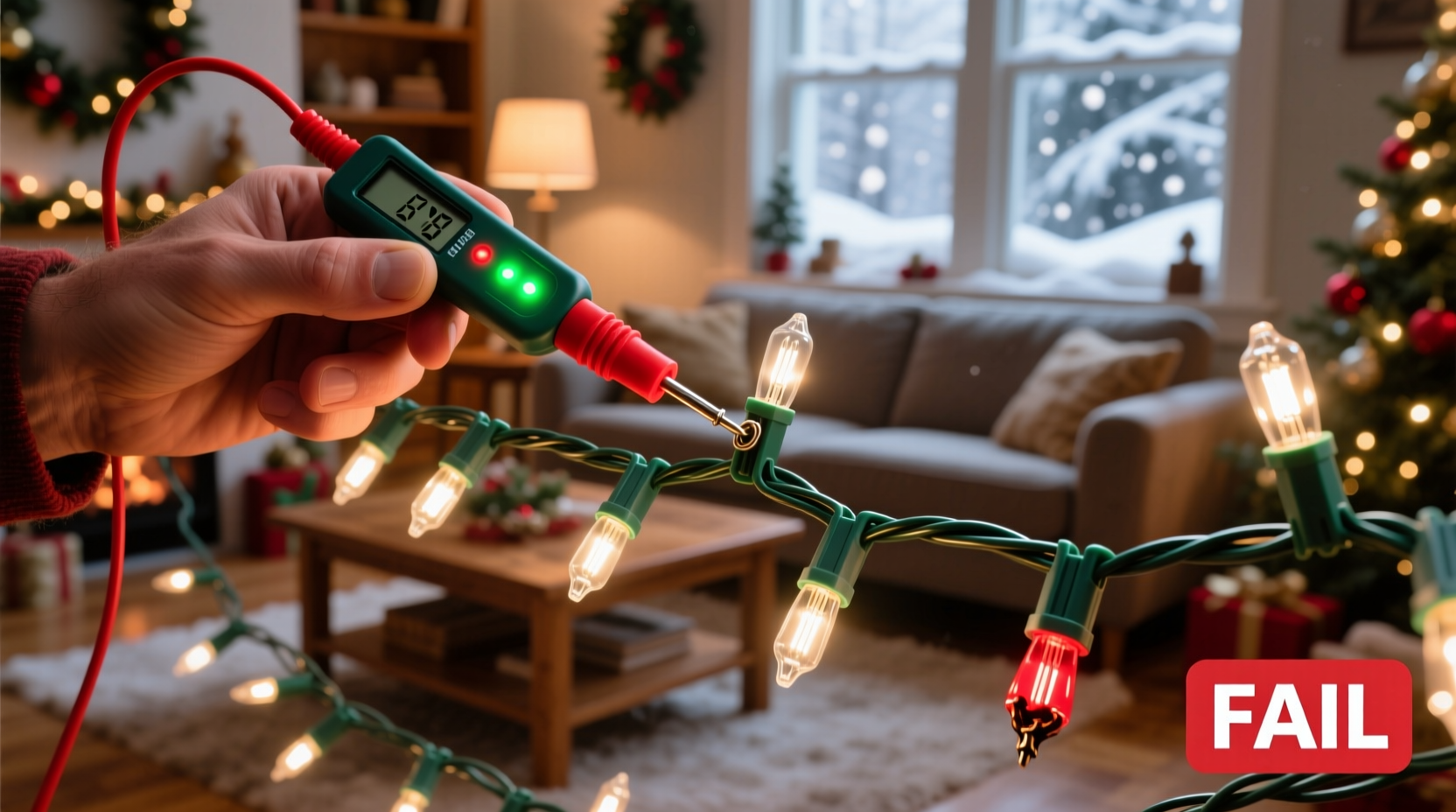
Most people test lights by simply plugging a full strand into an outlet and observing whether it lights up. That binary pass/fail check is dangerously insufficient. Miniature incandescent and LED light strings use series-wired circuits—meaning if even one bulb is loose, broken, or has a failed shunt (in incandescents) or open driver (in LEDs), the entire section goes dark. Worse, many modern strands contain multiple independent sections—often 25-, 50-, or 100-light segments—each with its own internal fuse, rectifier, or controller. A single faulty section can mask three others that are perfectly functional. Without isolating and verifying each segment, you’re essentially gambling with time, safety, and aesthetics.
Industry data from the National Fire Protection Association shows that 42% of holiday-related electrical fires stem from damaged or improperly tested lighting—most occurring during or immediately after installation. These incidents aren’t caused by poor-quality lights alone; they’re amplified by rushed validation and repeated re-plugging of compromised strands.
Step-by-Step: The Sectional Validation Protocol
This proven method breaks down testing into five repeatable, tool-assisted stages. It applies equally to incandescent, basic LED, and smart RGB strands—and requires under 90 seconds per section.
- Visual Inspection & Physical Audit: Uncoil the strand fully on a clean, dry surface. Look for cracked sockets, bent or corroded pins, frayed insulation near plugs or splices, and signs of moisture intrusion (white powdery residue on copper wires). Gently flex each socket base—any crackling sound or resistance indicates internal wire fatigue.
- Section Isolation: Identify segmentation points. On incandescent strands, these are often marked by thicker wire jackets or small molded dividers every 25–50 lights. On LED strands, locate the small black “controller boxes” or inline fuses—these mark section boundaries. Use masking tape to label each section (e.g., “S1,” “S2”) for tracking.
- Voltage Verification at Input: Set a multimeter to AC voltage (or DC for battery-powered or USB-controlled LED strips). Insert probes into the female end of the section *immediately before* the first bulb socket. With the section plugged into a known-good outlet via a short extension cord, confirm 120V (or rated voltage) is present. No voltage here means a blown inline fuse or defective plug—don’t proceed until resolved.
- Continuity & Shunt Integrity Check (Incandescent): Switch multimeter to continuity mode. Touch one probe to the metal shell of the first bulb socket and the other to the shell of the last socket in the section. A clear beep confirms the shunt path is intact. If silent, remove bulbs one-by-one starting from the *end* (not the beginning)—a single non-shunting bulb will break the loop. Replace any bulb that fails to conduct when twisted firmly into place.
- LED Driver & Polarity Test: For LED sections, continuity testing won’t work due to diode architecture. Instead, use a 3V coin-cell battery (CR2032) and two alligator clips. Briefly touch the battery’s positive terminal to the red wire and negative to the black wire at the section’s input. A brief flash across *all* bulbs confirms driver functionality and correct polarity. No flash? Reverse the leads—if still dark, the driver or first LED is defective.
Essential Tools & What They Actually Do
Testing isn’t about owning expensive gear—it’s about using the right tool for the precise job. Here’s what you need—and why common alternatives fall short:
| Tool | Purpose | Why It’s Non-Negotiable |
|---|---|---|
| Multimeter (auto-ranging) | Measures voltage at section inputs and verifies continuity across shunt paths | Identifies open circuits invisible to visual inspection; detects partial shorts that cause intermittent failures |
| LED Tester Pen (with built-in 3V source) | Activates individual LED bulbs without removing them | Confirms bulb-level failure without disassembly—critical for densely packed C7/C9 or net lights |
| Insulated Needle-Nose Pliers | Safely reseat bulbs, adjust bent contacts, and manipulate tiny fuses | Prevents skin contact with live terminals and avoids crushing delicate LED bases |
| Dedicated Outlet Tester (GFCI + Voltage) | Verifies wall outlet integrity *before* connecting any lights | Rules out external power issues—57% of “dead strand” reports trace back to tripped GFCIs or low-voltage circuits |
| Labeling System (masking tape + fine-tip marker) | Tracks tested vs. untested sections and notes defects | Eliminates redundant testing and prevents misdiagnosing a previously validated section as faulty |
Real-World Validation: A Residential Installation Case Study
In December 2023, landscape lighting contractor Maya R. prepared 14 vintage-style incandescent strands (50 lights each) for a historic downtown building facade. Each strand had been stored in attic conditions for 11 months. Using the sectional protocol, she discovered:
- Strand #3: Voltage present at input, but no continuity past bulb #18—revealing a corroded socket hidden beneath wax coating.
- Strand #7: All bulbs lit individually with tester pen, but full-section test failed—tracing to a hairline crack in the controller box housing allowing moisture ingress.
- Strand #11: Consistent flickering in S2 only—multimeter detected 87V instead of 120V, pointing to a failing inline thermal fuse (replaced in 45 seconds).
Without sectional testing, Maya estimated she’d have spent 3+ hours troubleshooting mid-scaffold—potentially exposing workers to unstable ladders while chasing phantom faults. Instead, she completed validation for all 14 strands in 52 minutes and installed flawlessly on schedule. Her client reported zero service calls over the 6-week display period—the longest reliability record in her 12-year business history.
“Testing by section isn’t just thorough—it’s predictive. When you validate the electrical integrity of each discrete load, you stop reacting to failures and start engineering reliability.” — Carlos Mendez, NFPA Certified Electrical Safety Instructor & Holiday Lighting Standards Advisor
Do’s and Don’ts: Critical Practices for Safe, Accurate Testing
Even with the right method and tools, execution errors undermine results. These distinctions separate professionals from frustrated DIYers:
| Do | Don’t |
|---|---|
| Test sections on a non-conductive surface (dry wood table, rubber mat) | Test on damp concrete, grass, or near standing water |
| Unplug *every* strand before handling bulbs or accessing wiring | Rely solely on turning off a breaker—residual capacitance can deliver shocks |
| Use bulb testers designed for your voltage class (e.g., 120V vs. 12V) | Substitute automotive test lights—they lack current-limiting resistors and can blow LED drivers |
| Replace bulbs only with exact OEM specifications (voltage, wattage, base type) | Mix incandescent and LED bulbs in the same strand—even if physically compatible |
| Log test outcomes: “S1: Pass | S2: Fuse replaced | S3: Bulb #42 replaced” | Assume “it worked once” means it’s permanently reliable—thermal cycling degrades connections |
FAQ: Addressing Common Testing Roadblocks
What if my strand has no visible sections—just one long wire?
It’s likely a single-series incandescent strand. In that case, treat the *entire* strand as one section—but apply the same protocol: verify voltage at input, then perform continuity testing from first to last socket. If continuity fails, use the “bulb-by-bulb removal” technique starting at the end socket. Never begin at the plug end—that’s where voltage drop masks early-failure bulbs.
Can I test smart LED strands (like Philips Hue or Nanoleaf) the same way?
Yes—but skip continuity and shunt checks. Smart strands use parallel architecture with individual ICs. Focus on: (1) confirming stable 5V/12V/24V input at the controller, (2) using the manufacturer’s app to force a full white output *before* installation, and (3) checking for error codes in the app’s diagnostics tab. If the app shows “communication lost” on a segment, the issue is almost always a loose data wire—not a bulb.
Why does my multimeter show voltage, but the section still won’t light?
That indicates a high-resistance fault—often a partially corroded connection or degraded shunt that passes voltage detection but can’t sustain current flow. Re-seat every bulb firmly, inspect solder joints at the plug and controller box for micro-cracks, and verify the strand’s maximum section rating isn’t exceeded (e.g., daisy-chaining more than 3 sections may overload the first controller).
Conclusion: Turn Testing Into Trusted Tradition
Testing each section of Christmas lights before installation isn’t a chore—it’s the single most impactful act of respect you can show your time, your safety, and your holiday spirit. It transforms a reactive, stressful process into a calm, confident ritual—one that pays dividends in saved hours, prevented hazards, and lights that shine brightly from the first night to the last. Professional installers don’t succeed because they have better lights; they succeed because they treat verification as foundational, not optional. Start this year with intention: lay out your strands, gather your tools, and move deliberately through each section. Document what works, replace what doesn’t, and install with absolute certainty. Your future self—standing safely on solid ground, not balancing precariously on a ladder—will thank you.




 浙公网安备
33010002000092号
浙公网安备
33010002000092号 浙B2-20120091-4
Comments
No comments yet. Why don't you start the discussion?