
In a world of constant notifications and digital overload, finding moments of calm and cognitive clarity is more important than ever. Mobile puzzle games offer a rare blend of mental stimulation and tranquility—challenging your brain while helping you unwind. Unlike fast-paced action titles or social media scrolling, well-designed puzzle games engage logic, memory, and pattern recognition without overwhelming the senses. The right game can improve concentration, delay cognitive decline, and even lower stress levels. This guide explores top-tier mobile puzzle games that balance intellectual engagement with soothing gameplay, backed by neuroscience insights and real-world user experiences.
The Cognitive Benefits of Puzzle Games
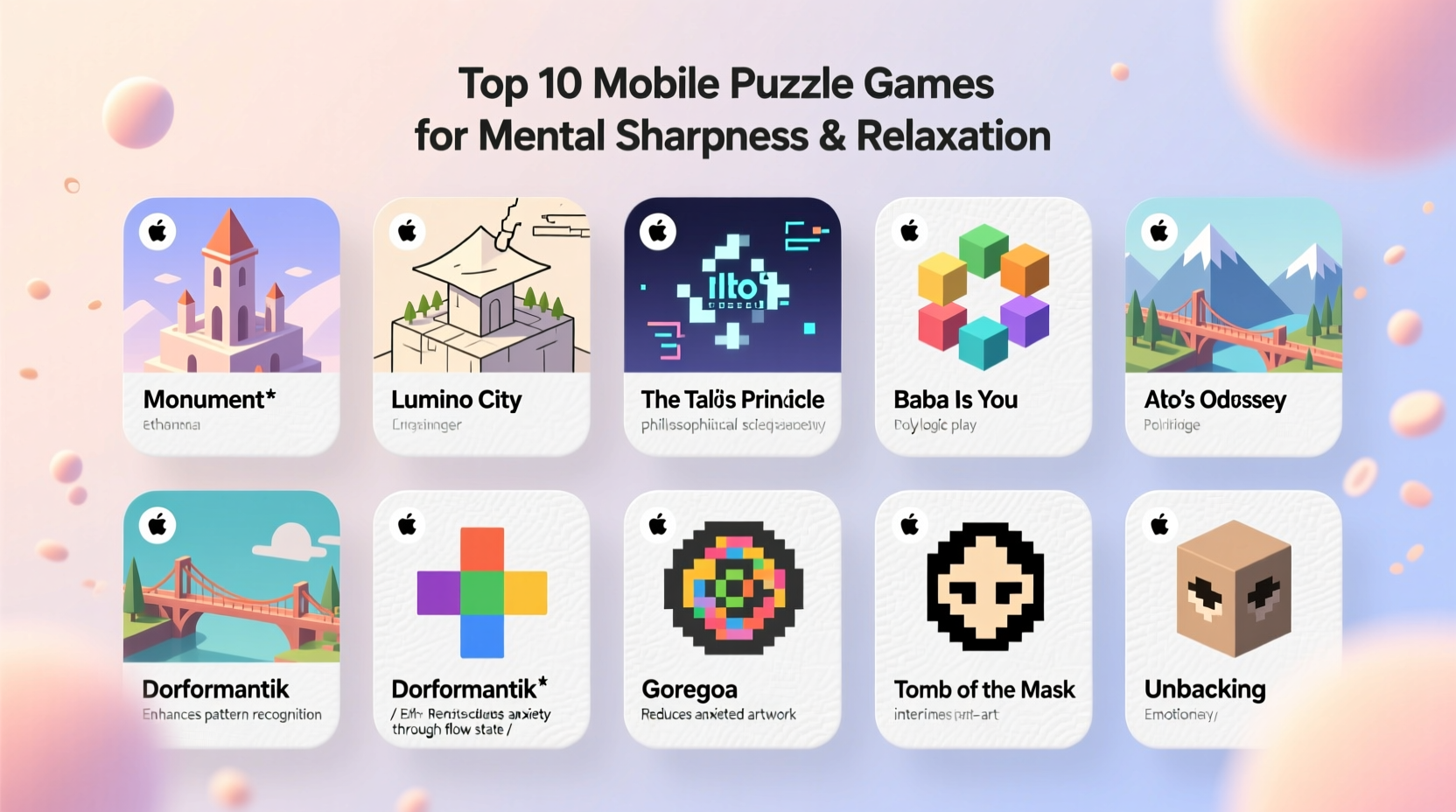
Puzzle games are not just entertainment—they’re mental workouts. Research from the Journal of Aging and Health shows that regular engagement in problem-solving activities can slow age-related cognitive decline. Tasks like spatial reasoning, sequential thinking, and short-term memory recall are directly exercised when solving puzzles. What sets mobile puzzle games apart is their accessibility: a few minutes during a commute or coffee break can yield measurable benefits.
Neuroplasticity—the brain’s ability to reorganize itself by forming new neural connections—is enhanced through consistent, moderate challenge. Games that introduce gradual difficulty curves encourage sustained engagement without frustration. Moreover, the tactile interface of smartphones adds a kinesthetic element, reinforcing learning and retention. When designed with intention, these games become tools for mindfulness as much as mental agility.
“Puzzle play is one of the most effective low-effort, high-return habits for maintaining cognitive resilience.” — Dr. Lena Torres, Cognitive Neuroscientist, University of Toronto
Top 5 Puzzle Games for Mental Sharpness and Relaxation
Not all puzzle games deliver equal value. Some prioritize speed or competition, increasing anxiety rather than reducing it. The following selections emphasize thoughtful design, calming aesthetics, and progressive challenge—ideal for both sharpening the mind and decompressing after a long day.
1. Monument Valley (iOS, Android)
A masterpiece of visual storytelling and optical illusion, Monument Valley uses impossible geometry and serene soundscapes to guide players through minimalist architectural puzzles. Each level requires manipulating pathways in three-dimensional space, challenging spatial awareness and patience. Its lack of timers or penalties fosters a meditative experience. Users report improved visualization skills and reduced mental fatigue after regular play.
2. Threes! (iOS, Android)
Often credited as the precursor to 2048, Threes! combines number strategy with elegant design. Slide tiles on a 4x4 grid to combine multiples of three, aiming for higher values. The game demands foresight and planning, engaging working memory and decision-making circuits. Unlike addictive clones, Threes! includes expressive tile personalities and cheerful audio cues that make failure feel playful rather than punishing.
3. The Room Series (iOS, Android)
For those who enjoy tactile problem-solving, The Room offers intricate mechanical puzzles within mysterious, atmospheric environments. Players manipulate gears, dials, and hidden compartments using intuitive touch controls. The layered complexity strengthens attention to detail and logical sequencing. While slightly darker in tone, its deliberate pacing and absence of jump scares make it suitable for focused, immersive sessions.
4. Mini Metro (iOS, Android)
Tasked with designing efficient subway maps as cities grow, players must balance resource allocation and anticipate future needs. Mini Metro trains executive function—especially planning and adaptability. The clean vector graphics and soft piano score create a zen-like rhythm. Many users incorporate it into their morning routine to activate strategic thinking before work.
5. Flow Free (iOS, Android)
Deceptively simple, Flow Free challenges players to connect colored dots with non-intersecting pipes across a grid. Early levels build basic pattern recognition; later stages require advanced path optimization. It’s particularly effective for improving visual tracking and inhibitory control—the ability to suppress impulsive moves. With thousands of levels and no ads in the premium version, it’s ideal for bite-sized daily practice.
Choosing the Right Game for Your Goals
Your objectives should guide your selection. Are you looking to relieve stress after work? Or boost processing speed for professional tasks? The table below compares key features to help match games with personal goals.
| Game | Mental Skill Targeted | Stress Level | Session Length | Best For |
|---|---|---|---|---|
| Monument Valley | Spatial Reasoning | Very Low | 5–10 min per level | Relaxation & Creativity |
| Threes! | Working Memory | Low | 8–12 min | Daily Cognitive Warm-up |
| The Room | Sequential Logic | Moderate | 20–30 min | Focused Problem-Solving |
| Mini Metro | Strategic Planning | Low-Moderate | 10–15 min | Executive Function Training |
| Flow Free | Visual Processing | Very Low | 3–7 min | Rapid Focus Drills |
Building a Brain-Healthy Gaming Habit: A Step-by-Step Guide
Integrating puzzle games into your routine isn’t about playing more—it’s about playing wisely. Follow this five-step process to maximize cognitive gains while avoiding digital burnout.
- Assess Your Needs: Determine whether you seek relaxation, sharper focus, or memory improvement. Align your choice of game accordingly.
- Set Time Boundaries: Limit sessions to 10–15 minutes unless engaged in longer-form puzzles like The Room. Use phone timers to prevent overplay.
- Play at Optimal Times: Morning sessions enhance alertness; evening play should favor calming games like Monument Valley to avoid stimulation before sleep.
- Track Progress Mindfully: Note improvements in speed, accuracy, or reduced frustration. Avoid obsessing over scores—focus on the process.
- Rotate Titles Weekly: Varying games prevents skill plateaus and engages different cognitive domains. Example rotation: Threes! → Flow Free → Mini Metro → Monument Valley.
Real-World Impact: A Case Study
James R., a 52-year-old project manager from Portland, began experiencing midday mental fog and difficulty prioritizing tasks. After reading about cognitive maintenance, he downloaded Mini Metro and committed to two 10-minute sessions daily—one before lunch, one after. Within three weeks, he reported better meeting focus and fewer missed deadlines. “I didn’t expect a game to change how I organize my work,” he said. “But mapping train lines somehow trained me to see workflow bottlenecks faster.” His physician noted improved verbal recall during a routine check-up, attributing it partially to consistent mental exercise.
This aligns with findings from a 2022 study at King’s College London, where adults over 50 who played spatial and logic puzzles for 12 weeks showed a 15% improvement in processing speed compared to controls.
Common Pitfalls and How to Avoid Them
Even beneficial habits can go awry. Below are frequent missteps and practical corrections:
- Pitfall: Chasing High Scores – Obsession with performance can increase cortisol levels, counteracting relaxation benefits. Solution: Disable leaderboards or play offline modes.
- Pitfall: Playing Late at Night – Blue light and mental activation may disrupt sleep. Solution: Reserve stimulating games for mornings; switch to passive puzzles like jigsaws in the evening.
- Pitfall: Ignoring Physical Posture – Hunching over the phone strains neck and eyes. Solution: Use a stand, maintain eye-level screen height, and take posture breaks every 10 minutes.
- Pitfall: Sticking to One Game – Cognitive variety is crucial. Solution: Rotate between at least three different puzzle types monthly.
Essential Checklist for Maximizing Benefits
Use this checklist weekly to ensure your puzzle gaming remains productive and enjoyable:
- ✅ Choose games with no time pressure or penalties
- Prioritize titles that reward patience and exploration.
- ✅ Limit sessions to under 15 minutes for casual play
- Longer sessions are acceptable only for immersive experiences like The Room.
- ✅ Play in distraction-free environments
- Use noise-canceling headphones or quiet corners to deepen focus.
- ✅ Combine with breathwork or light stretching
- Enhances parasympathetic activation, boosting relaxation effects.
- ✅ Review progress monthly
- Note changes in concentration, mood, or problem-solving confidence.
Frequently Asked Questions
Can puzzle games really improve memory?
Yes, but selectively. Games requiring memorization of patterns, sequences, or spatial layouts—like Threes! or The Room—activate the hippocampus and prefrontal cortex. Regular play strengthens neural pathways associated with short-term recall. However, gains are most significant when combined with healthy sleep and physical activity.
How much time should I spend on puzzle games each day?
For cognitive benefits without strain, aim for 10–20 minutes daily. Split into two sessions if preferred. More than 30 minutes risks diminishing returns due to mental fatigue. Quality of engagement matters more than duration.
Are free puzzle games as effective as paid ones?
Some are, but many free versions include intrusive ads, timers, or manipulative mechanics that undermine relaxation. Paid or ad-free versions (e.g., Threes! vs. 2048 clones) typically offer superior design, balanced difficulty, and intentional pacing. When possible, invest in premium editions for optimal experience.
Final Thoughts: Make Every Minute Count
In an era where screen time is often seen as passive consumption, mobile puzzle games represent a powerful exception. They transform idle moments into opportunities for growth, clarity, and calm. The best ones don’t just pass time—they enrich it. Whether you're navigating the surreal architecture of Monument Valley or optimizing transit routes in Mini Metro, you’re doing more than solving puzzles. You’re building resilience, focus, and presence.
Start small. Pick one game from this list. Commit to five minutes a day. Notice how your thinking shifts, how your stress eases, how solutions appear more readily in daily life. Over time, these micro-sessions compound into lasting mental agility.




 浙公网安备
33010002000092号
浙公网安备
33010002000092号 浙B2-20120091-4
Comments
No comments yet. Why don't you start the discussion?