
The year 2025 has ushered in a golden era for retro gaming enthusiasts. With advancements in emulation accuracy, hardware miniaturization, and licensing agreements, major console manufacturers have revisited their most iconic systems—repackaging them with modern enhancements while preserving the authentic feel of classic gaming. These re-releases aren’t just novelty items; they represent a convergence of nostalgia, accessibility, and collector appeal. Whether you’re building a curated library of vintage-inspired hardware or simply want to relive childhood memories with improved performance, the latest wave of retro consoles offers compelling reasons to invest.
Manufacturers have learned from past iterations: gone are the days of underpowered ports and missing games. The 2025 models boast higher-resolution outputs, built-in save states, online multiplayer support, and even licensed third-party controller compatibility. More importantly, many of these devices now include previously unreleased prototypes or region-exclusive titles, making them valuable not only as playables but also as archival pieces.
Why Retro Consoles Are Making a Comeback in 2025
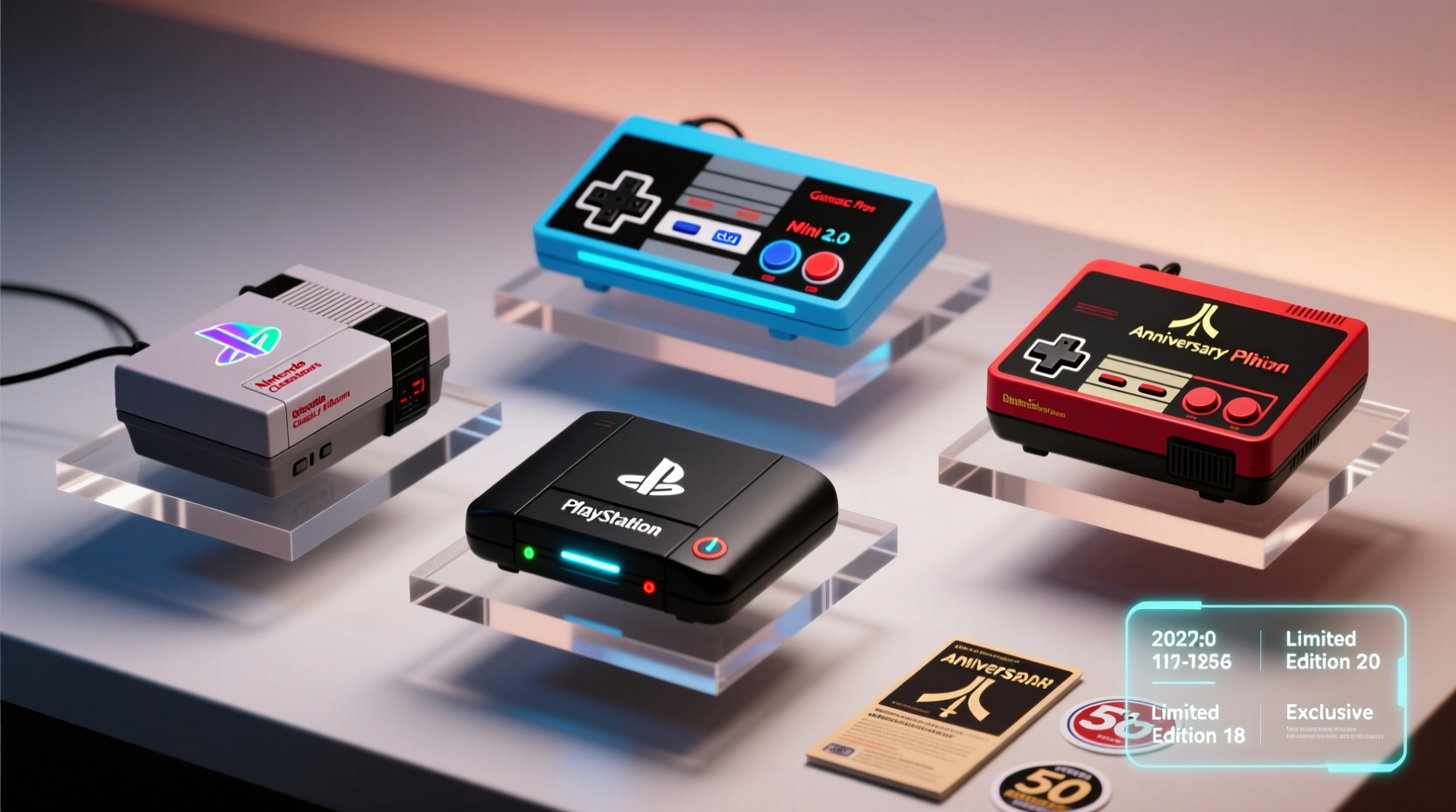
The resurgence isn't accidental. Several factors have aligned to make this the perfect moment for retro re-releases. First, the original players of the NES, SNES, Sega Genesis, and PlayStation are now adults with disposable income—and many are eager to reconnect with formative experiences. Second, younger gamers are discovering classic titles through emulation and streaming, creating demand for official, legal ways to experience them.
Additionally, companies like Nintendo, Sega, and Sony recognize that their back catalogs contain timeless design principles—tight level design, meaningful progression, and minimal reliance on microtransactions—that contrast sharply with today’s bloated live-service games. Re-releasing these systems allows them to monetize legacy IP without developing new content from scratch.
“Retro re-releases are more than cash grabs—they’re cultural preservation efforts wrapped in smart business strategy.” — Marcus Tran, Senior Curator at the Digital Game History Archive
Top 5 Retro Consoles Re-Released in 2025
This year's lineup stands out due to improved curation, technical upgrades, and attention to detail. Below are the most significant retro console re-releases of 2025 that merit serious consideration for any collector.
1. Nintendo Entertainment System: Legacy Edition (2025)
Nintendo’s second iteration of its NES Classic line arrives with substantial improvements. The 2025 NES: Legacy Edition includes 60 pre-loaded games—up from the original 30—including rare North American exclusives like *StarTropics* and *Zelda II: The Adventure of Link*. For the first time, it supports 1080p output via HDMI and features rewind functionality powered by FPGA-based emulation.
Notably, the unit includes a hidden folder accessible via a button combination that contains prototype versions of canceled games such as *Famicom Detective Club* (English fan translation included). The redesigned controller uses modern PCBs for better durability while maintaining the original aesthetic.
2. Sega Genesis Mini 3: The Arcade Collection
Sega continues its winning streak with the Genesis Mini 3, which shifts focus from home console ports to arcade-perfect renditions of Sega’s coin-op classics. Titles like *Golden Axe*, *Altered Beast*, and *Shinobi* run on near-original ROMs, achieving frame-accurate timing thanks to custom ASIC chips.
The system includes 45 games total, with 15 available exclusively through firmware updates post-launch—a strategy aimed at encouraging long-term engagement. It also supports Bluetooth audio and dual-wireless controllers with turbo fire buttons mapped to shoulder triggers.
3. Atari 5200+ (Reimagined)
A surprise entry, the Atari 5200+ is a modern recreation of the short-lived 1982 console, enhanced with full cartridge slot compatibility and an SD card reader for digital ROM loading. Unlike previous miniaturized releases, this version is built around open-source firmware (based on MiSTer project cores), allowing cycle-accurate emulation across multiple Atari platforms including 7800, 2600, and 8-bit computers.
The package includes a replica joystick with analog-to-digital conversion, ensuring responsive gameplay. Its transparent casing reveals internal circuitry lit by soft blue LEDs, appealing to both hobbyists and display collectors.
4. TurboGrafx-16 Mini Deluxe
Hudson Soft’s cult favorite gets a proper tribute with the 2025 TurboGrafx-16 Mini Deluxe. This model doubles the game count from the 2020 release (now 70 titles) and adds support for Japanese HuCard insertion via a USB adapter. Included are essential shooters (*Soldier Blade*, *Battle Lode Runner*) and RPGs (*Ys Book I & II*, *Keith Courage in Alpha Zones*).
For purists, there’s a “Hard Mode” toggle that disables save states and forces single-life runs—ideal for speedrun training. The system also integrates with PC via USB-C, enabling direct ROM transfer for homebrew developers.
5. Sony PlayStation Classic 2: Final Edition
Sony corrects the missteps of its 2018 release with a definitive 2025 edition. The new PlayStation Classic 2 ships with 50 hand-curated titles selected by fan vote, including heavy hitters like *Metal Gear Solid*, *Final Fantasy VII*, *Castlevania: Symphony of the Night*, and *Tony Hawk’s Pro Skater 2*.
It features adaptive upscaling (up to 4K), rumble-enabled replica DualShock controllers, and optional online leaderboards for select racing and fighting games. Perhaps most excitingly, it includes a development mode that allows users to explore early builds of *Crash Bandicoot* and *Spyro the Dragon*—complete with unused levels and debug menus.
Comparison Table: Key Features at a Glance
| Console | Resolution Support | Preloaded Games | Save States | Special Features |
|---|---|---|---|---|
| NES: Legacy Edition | 1080p | 60 | Yes (with rewind) | Prototype games folder, CRT filter |
| Sega Genesis Mini 3 | 1080p | 45 (15 unlockable) | Yes | Arcade-perfect emulation, Bluetooth audio |
| Atari 5200+ | 720p–1080p | SD card loaded | Yes (per core) | FPGA-based accuracy, open firmware |
| TurboGrafx-16 Mini Deluxe | 1080p | 70 | Yes (optional disable) | HuCard adapter, dev mode |
| PlayStation Classic 2 | Up to 4K | 50 | Yes + cloud sync | Online leaderboards, beta builds |
How to Choose the Right Console for Your Collection
Selecting which retro console to add depends on your priorities: historical significance, game library depth, technical fidelity, or resale potential. Consider the following criteria before purchasing:
- Game Library Relevance: Does it include must-play titles from your favorite genre? RPG fans will lean toward the PlayStation Classic 2, while platformer lovers may prefer the NES Legacy Edition.
- Emulation Accuracy: FPGA-based systems like the Atari 5200+ offer near-original hardware behavior, crucial for competitive players.
- Expandability: Units supporting external storage or cartridge input (e.g., TurboGrafx-16 Mini Deluxe) provide greater long-term flexibility.
- Build Quality: Check materials and controller ergonomics. Some replicas use brittle plastics that yellow over time.
- Licensing and Updates: Official releases receive patches and additional games; clones do not.
Checklist: What to Verify Before Buying
- Confirm the list of pre-installed games matches expectations
- Ensure HDMI output compatibility with your display
- Test controller latency if possible (especially for fast-paced games)
- Verify firmware update availability and frequency
- Check return policy in case of defects or software bugs
Real Example: A Collector’s Journey with the Genesis Mini 3
Daniel Reyes, a retro game archivist based in Austin, Texas, purchased the Sega Genesis Mini 3 on launch day. Initially skeptical due to mixed results from earlier mini-consoles, he was won over within hours. “I booted up *Thunder Force III* and immediately noticed zero input lag,” he said. “The music played at perfect pitch, and the parallax scrolling was smooth—just like the arcade cabinet I played in 1991.”
Daniel used the system’s firmware update feature to unlock *Phantasy Star IV*, a title he’d never completed due to losing his original cartridge. He now streams weekly retro challenges using the console and credits its reliability for reigniting his passion for preservation. “It’s not just a toy—it’s a working museum exhibit,” he noted.
Preserving Value: Tips for Long-Term Collectibility
Retro consoles can appreciate in value, especially limited editions or those discontinued early. To maximize longevity and collectible status:
- Limit power cycles—frequent on/off switching stresses capacitors.
- Use surge protectors to guard against voltage spikes.
- Avoid constant operation; let units cool down between sessions.
- Update firmware only when necessary, as some updates remove homebrew access.
“The most valuable retro units in five years won’t be the ones played daily—they’ll be the ones maintained with care and documented thoroughly.” — Lena Choi, Vintage Electronics Appraiser
FAQ: Common Questions About 2025 Retro Releases
Are these re-releases region-free?
Most are region-free in terms of video output (NTSC/PAL selectable), but game libraries vary slightly by region. The PlayStation Classic 2, for example, includes *Destruction Derby* in Europe but replaces it with *Twisted Metal* in North America.
Can I connect my own controllers?
Yes, many support third-party USB or Bluetooth controllers. However, using non-official pads may void warranty if damage occurs. The NES Legacy Edition officially certifies several aftermarket wireless options.
Will these consoles work indefinitely, or could they become obsolete?
Unlike subscription-based services, these are standalone devices with embedded software. As long as components remain functional, they should continue working. Firmware is stored on flash memory, which typically lasts 10+ years under normal conditions.
Conclusion: Build With Purpose, Play With Passion
The retro consoles re-released in 2025 represent more than sentimental throwbacks—they are meticulously crafted bridges between generations of gamers. Each system combines historical authenticity with modern usability, offering something valuable whether you're introducing classics to a new audience or deepening your personal archive.
These aren't impulse buys; they're investments in culture, craftsmanship, and memory. By choosing wisely, maintaining carefully, and engaging thoughtfully with the community, your collection can grow into a lasting testament to gaming’s evolution. Don’t just collect hardware—curate experiences. Start exploring, start playing, and preserve the legacy one cartridge at a time.




 浙公网安备
33010002000092号
浙公网安备
33010002000092号 浙B2-20120091-4
Comments
No comments yet. Why don't you start the discussion?