
Soup clicker games—also known as incremental or idle cooking games—have surged in popularity due to their addictive blend of simplicity, progression mechanics, and satisfying visual feedback. At first glance, these games appear effortless: click a pot, make soup, earn coins, upgrade ingredients. But beneath the surface lies a strategic depth that separates casual players from true soup tycoons. Understanding how to manage resources, prioritize upgrades, and plan long-term growth is essential for maximizing efficiency and reaching endgame milestones. Whether you're playing a browser-based soup simulator or a mobile idle cooker, mastering the underlying systems will dramatically accelerate your progress.
Definition & Overview
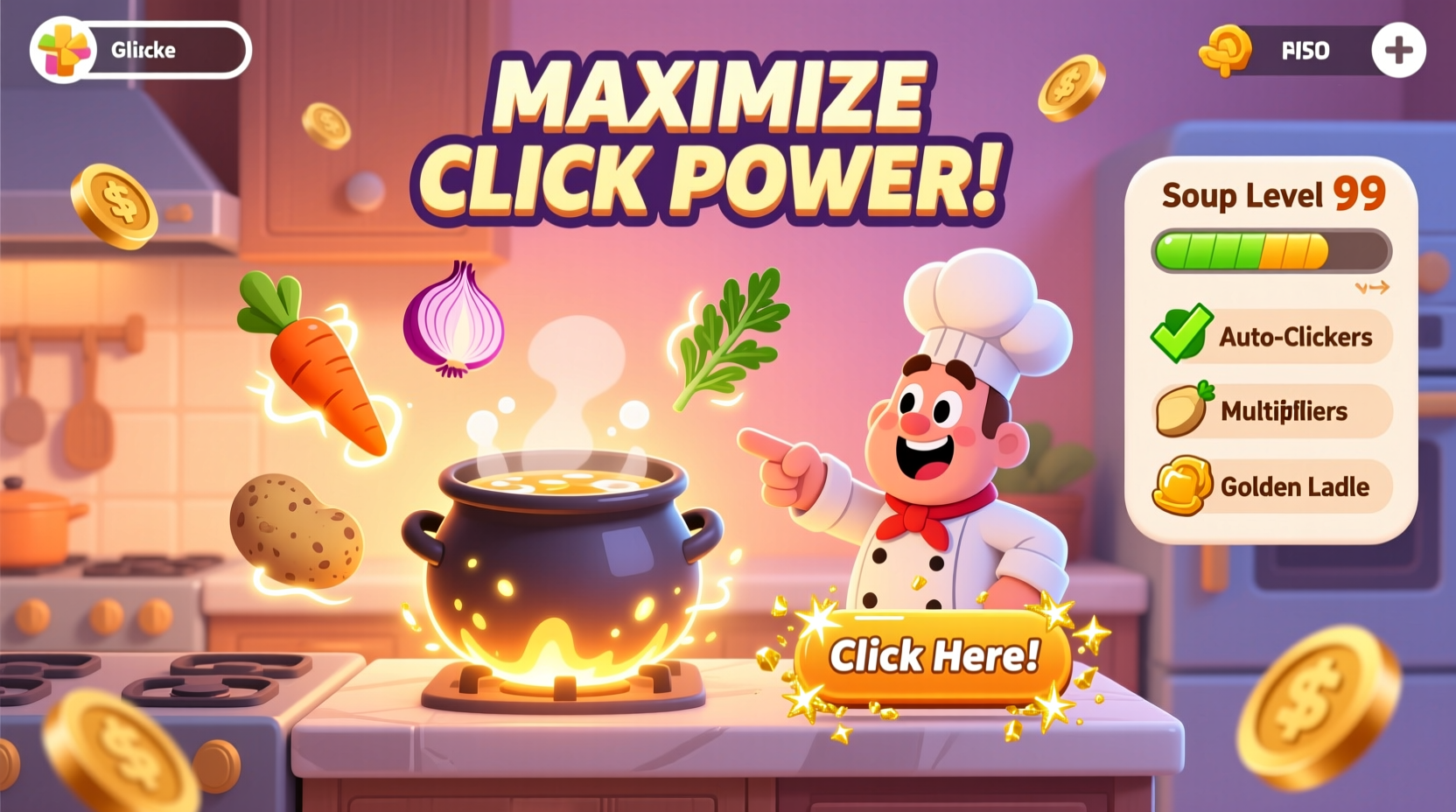
A soup clicker game is a type of incremental (or \"idle\") game where players generate currency—typically coins or ingredients—by clicking on a central object, such as a soup pot. This currency is used to purchase automated producers (like chefs, stoves, or farms), enhance production rates, unlock new recipes, and expand kitchen capabilities. The core loop involves short bursts of active clicking followed by passive income generation through upgrades. Over time, exponential growth kicks in, allowing massive output even when the player is away.
These games are rooted in the broader genre of clicker/idle games popularized by titles like *Cookie Clicker*, but they distinguish themselves with thematic elements centered around cooking, flavor development, and culinary expansion. Players don’t just produce abstract units—they craft tangible dishes, experiment with seasonings, and build virtual restaurants or food empires.
The appeal lies in both immediate gratification and long-term planning. Early stages reward rapid clicking and quick decisions, while mid-to-late game demands careful optimization of upgrade paths, multiplier stacking, and timing of special events.
Key Characteristics
- Progression Model: Exponential growth driven by cumulative upgrades and multipliers.
- Core Mechanic: Clicking generates base currency; automation reduces reliance on manual input.
- Resource Types: Coins, ingredients (e.g., carrots, onions, broth), prestige points, and rare spices.
- Game Phases: Active clicking → semi-idle → fully idle with periodic check-ins.
- Engagement Loops: Unlock trees, achievement systems, limited-time boosts, and leaderboard competition.
- Monetization (if applicable): Optional ads for bonuses, cosmetic upgrades, or one-time purchases for progress acceleration.
Practical Usage: How to Play Strategically
While anyone can start clicking a pot, winning at soup clicker games requires deliberate strategy. Success hinges not on reflexes, but on understanding the internal economy and making optimal investment choices early and consistently.
Prioritize Upgrades That Multiply Output
Not all upgrades are created equal. Early in the game, you’ll be tempted to buy every available option—but focus first on upgrades that provide multiplicative effects rather than additive ones. For example:
- Additive: “+0.5 soup per click” increases linearly.
- Multiplicative: “Double soup from onions” scales exponentially as onion production grows.
Always favor percentage-based boosts. These compound over time and become disproportionately powerful in later stages.
Invest in Automation Before Aesthetics
Many games offer cosmetic upgrades—fancy ladles, themed kitchens, animated chefs. While fun, they rarely impact gameplay. Delay these until core production systems are stable. Instead, invest in:
- Auto-stirrers (automate clicking)
- Chef hires (passive soup generation)
- Ingredient farms (auto-generate raw materials)
- Storage expansions (prevent overflow caps)
Automation allows you to scale without constant attention, which is critical once you enter idle phases.
Time Your Prestige Resets Wisely
Most advanced soup clicker games include a prestige system: reset your progress in exchange for permanent multipliers (often called “seasonings,” “spice levels,” or “culinary mastery”). However, resetting too early wastes potential; waiting too long delays compounding benefits.
The optimal moment to prestige is when your current run’s peak earning rate plateaus and further upgrades would take several minutes or longer to pay off. Use this rule of thumb:
Reset when the time required to earn your next major upgrade exceeds 5–10% of your total play session duration.
After each reset, you’ll return stronger, unlocking faster growth cycles. Track your gains across runs to identify diminishing returns.
Pro Tip: Some games grant bonus multipliers based on achievements reached during a run (e.g., “Serve 1 million bowls”). Complete key milestones before prestiging to maximize rewards.
Leverage Multi-Tier Upgrade Trees
Advanced games feature interconnected upgrade systems. For instance:
- Carrot → Carrot Farm → Automated Harvester → Organic Carrot Boost
- Broth Base → Flavor Infusion → Umami Catalyst → Master Stock
Unlocking higher tiers often requires significant investment in lower ones. Plan your path: if a top-tier upgrade offers 10x output but costs 100x more than alternatives, assess whether intermediate gains justify the delay.
In many cases, it's better to balance multiple parallel tracks (vegetables, proteins, seasonings) rather than hyper-focus on one. Balanced ecosystems generate synergistic bonuses.
Variants & Types of Soup Clicker Games
Soup clicker mechanics vary across platforms and designs. Recognizing the type you’re playing helps tailor your strategy.
| Type | Description | Strategy Implications |
|---|---|---|
| Pure Idle | Minimal clicking; almost entirely automated after setup. | Focus on early automation. Manual input has negligible impact. |
| Clicker-Dominant | Manual clicks are primary source of early income. | Click aggressively early; automate only after reaching threshold. |
| Recipe-Based | Players combine ingredients into specific soups with unique yields. | Learn high-value recipes; stockpile rare components. |
| Prestige-Heavy | Frequent resets with escalating multipliers. | Optimize reset timing; track seasoning gain per hour. |
| Multiplayer/Leaderboard | Competitive rankings based on real-time output. | Use timed boosts strategically; monitor rival activity patterns. |
Some hybrid versions incorporate mini-games (e.g., stirring rhythm challenges, ingredient sorting puzzles) or seasonal events (holiday soups, limited-edition chefs). Adaptability becomes crucial in these formats.
Comparison with Similar Games
Soup clickers share DNA with other incremental titles, but key differences affect strategy.
| Game Type | Similarities | Differences |
|---|---|---|
| Cookie Clicker | Same core loop: click → upgrade → automate → prestige. | No recipe complexity; fewer resource types; purely abstract. |
| Farm Simulators | Resource farming, storage limits, time-based growth. | More emphasis on scheduling; less exponential scaling. |
| Cooking RPGs | Recipe crafting, ingredient combos, flavor profiles. | Story-driven; less focus on idle mechanics. |
| Tapper-Style Games | Fast-paced serving mechanics, customer satisfaction. | Skill-based timing; no persistent upgrades. |
The unique value of soup clickers lies in their fusion of culinary themes with deep progression systems. This makes them more engaging for players who enjoy both narrative flavor and mathematical optimization.
Practical Tips & FAQs
When should I stop clicking manually?
Once auto-clickers and chefs generate over 80% of your total output, manual clicking becomes optional. Use it only during boost periods or to trigger special effects (e.g., “Critical Stir” chance).
How do I handle resource bottlenecks?
Bottlenecks occur when one ingredient limits overall soup production. To resolve:
- Identify the limiting factor (e.g., onions running out).
- Purchase dedicated farms or extractors for that item.
- Check for upgrades that reduce consumption rates.
- Switch temporarily to soup variants requiring less of the scarce ingredient.
Are in-app purchases worth it?
Rarely necessary. Most games are balanced so that dedicated play yields equivalent results. However, one-time purchases for ad removal or cosmetic packs can improve experience without creating unfair advantages—if the game follows ethical monetization.
What’s the best way to use boosters?
Stack them. Never use a 2x coin booster alone. Combine with:
- Prestige multipliers active
- Full ingredient reserves
- Active holiday events (if applicable)
This creates peak efficiency windows where gains are multiplied 4x, 8x, or more.
How long does a typical prestige run last?
Varies by game and skill level. Beginners may reset every 30–60 minutes. Experts optimize runs lasting 2–4 hours for maximum seasoning yield. Use alarms or timers to avoid overshooting.
Can I play effectively on mobile?
Yes—but with caveats. Mobile versions often sync progress via cloud saves. However, background processing may be limited due to battery optimization. Close other apps, disable battery saver mode, and consider using a tablet for longer sessions.
Do offline earnings matter?
They do, but cap quickly. Most games limit offline gains to 2–4 hours of equivalent play. Don’t expect massive windfalls from being away. Still, consistent daily logins compound significantly over weeks.
Is there a ‘best’ soup to focus on?
In recipe-based variants, yes. Look for soups with:
- High coin yield per unit time
- Low ingredient cost ratio
- Multiplier bonuses (e.g., “+10% to all seafood soups”)
Track output manually if needed. Switch production lines as upgrades unlock.
Data Tip: Keep a simple spreadsheet or notes tracking: Run Duration | Total Soup Made | Seasoning Gained | Key Upgrades Unlocked. Over time, this reveals optimal reset thresholds.
Expert Insight: The Psychology of Incremental Progress
“The brilliance of soup clickers isn't in the soup—it's in the feedback loop. Each upgrade triggers a dopamine hit, and the illusion of endless progress keeps players engaged for hundreds of hours. Smart players recognize this and treat the game like a system to exploit, not just enjoy.”
— Dr. Lena Torres, Cognitive Game Design Researcher, MIT Media Lab
Understanding the psychological hooks allows you to maintain control. Set personal goals (e.g., “Reach 1 billion soup before resetting”) and stick to them. Avoid endless grinding without purpose.
Summary & Key Takeaways
Winning at soup clicker games isn’t about clicking faster—it’s about thinking smarter. The most successful players apply economic principles, systems thinking, and disciplined timing to dominate the kitchen hierarchy.
Key strategies include:
- Favor multiplicative upgrades over additive ones.
- Automate early and continuously expand passive income.
- Time prestige resets to balance short-term loss with long-term gain.
- Balance multiple upgrade tracks instead of overspecializing.
- Stack boosters during peak production phases.
- Monitor bottlenecks and adjust ingredient sourcing dynamically.
- Use data to refine future runs and minimize wasted effort.
Remember, the goal isn’t just to make soup—it’s to build an empire where soup flows endlessly, even while you sleep. With the right approach, you’ll go from kitchen novice to culinary overlord in record time.
Final Challenge: Try a “no-click” run. After your initial setup, don’t click manually. Rely solely on automation and upgrades. It’s a powerful test of true optimization—and often leads to breakthrough insights.




 浙公网安备
33010002000092号
浙公网安备
33010002000092号 浙B2-20120091-4
Comments
No comments yet. Why don't you start the discussion?