
Folding a fitted sheet has long been considered one of the most frustrating household tasks. The elastic corners twist, the fabric bunches, and no matter how many times you try, the result rarely looks neat. But there’s a solution that transforms chaos into order: the military method. Used by service members who must maintain immaculate living quarters, this technique produces a compact, rectangular fold that stacks cleanly and stores efficiently. No more crumpled ball of fabric at the back of your linen closet—just crisp, professional results.
The military method works because it treats the fitted sheet as a structured object, not a shapeless mess. By aligning corners systematically and folding with precision, you eliminate guesswork and create consistency. Whether you're preparing for deployment, organizing a dorm room, or simply tired of wrestling with laundry, mastering this method brings lasting peace to your linen routine.
Why the Military Method Works
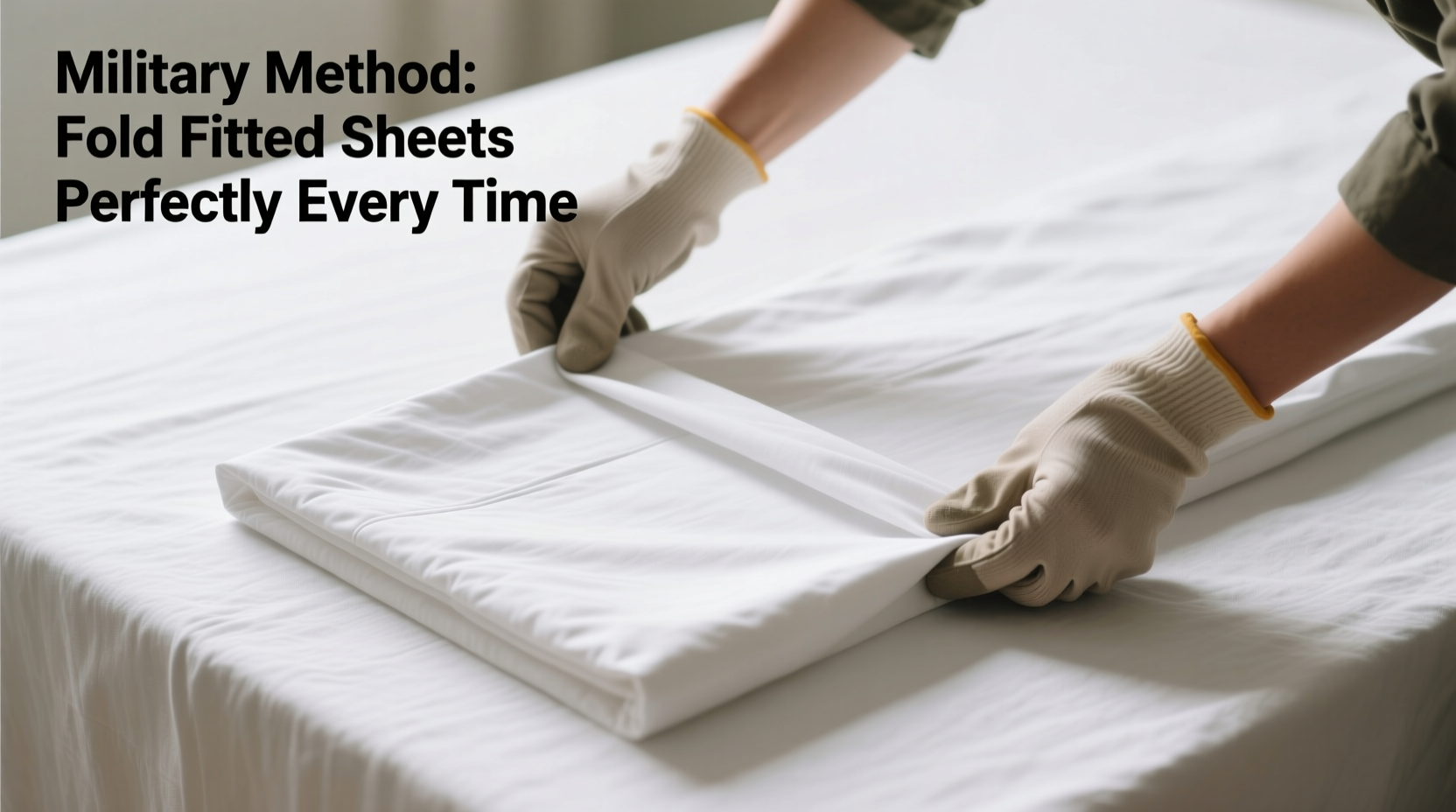
Military personnel are trained in efficiency, discipline, and space optimization. In barracks and field conditions, every inch counts, and clutter is unacceptable. That mindset extends to laundry. Soldiers aren’t allowed to toss clothes into drawers—they must fold them uniformly so that uniforms, bedding, and gear can be stored tightly and accessed quickly.
The military method for folding fitted sheets leverages this same philosophy. Instead of fighting the elasticity, it uses the corners as anchor points. By matching opposing corners and smoothing out tension, the sheet becomes manageable. Then, through a series of deliberate folds, it’s transformed into a tidy rectangle indistinguishable from a flat sheet.
“Discipline in small things leads to excellence in all things.” — U.S. Army Training Manual
This principle applies perfectly to household organization. Taking a few extra minutes to fold properly saves time later when searching for clean linens. It also prolongs the life of your sheets by reducing creases and tangles that lead to wear.
Step-by-Step Guide to the Military Fold
Follow these steps carefully. With practice, the entire process takes less than two minutes.
- Hold the sheet upside down. Pick up the fitted sheet and turn it inside out so the elastic edges face outward. This makes it easier to identify and match corners.
- Insert your hands into two adjacent corners. Reach into one corner with your right hand and the connected corner with your left. Keep the fabric taut but don’t stretch it.
- Flip one corner over the other. Take the corner in your right hand and flip it over the one in your left, so both are nested together. You now have two joined corners in one hand.
- Locate the opposite corners. Using your free hand, find the remaining two corners (the ones diagonally across). Reach in and grab them just as you did before.
- Nest all four corners together. Flip one pair over the other so all four corners are stacked neatly in one bundle. At this point, the sheet should resemble a loose square with no visible elastic.
- Lay the sheet flat on a surface. Smooth it out gently, ensuring there are no twists or puckers. The right side (outside) should now be facing up.
- Fold in the sides. Bring the left and right edges toward the center, creating a long rectangle. Adjust as needed to keep alignment clean.
- Create thirds or quarters. Fold one end toward the middle, then fold the opposite end over it. For thicker sheets, fold in half once more to achieve a compact block.
- Store immediately. Place the folded sheet in your linen closet, ideally stacked with matching sets.
Common Mistakes and How to Avoid Them
Even with clear instructions, people often stumble at predictable points. Here are frequent errors and how to correct them:
| Mistake | Why It Happens | Solution |
|---|---|---|
| Corners come undone during folding | Poor nesting or insufficient flipping | Ensure each corner is fully inverted over its partner before moving on |
| Sheet remains bunched or wrinkled | Folding too quickly without smoothing | Pause after laying the sheet flat to iron out creases with your palms |
| Final fold is uneven or lopsided | Edges not aligned during side folds | Use visual landmarks—like seams or patterns—to guide straight folds |
| Sheet won’t lie flat after corner pairing | Sheet was turned right-side-out too early | Keep it inside out until all corners are matched |
A key insight: do not rush the corner-matching phase. This is the foundation of the entire fold. If the corners aren’t securely paired, the rest will collapse. Work slowly at first, focusing on precision rather than speed.
Real Example: From Frustration to Mastery
Sarah, a college freshman living in a shared dorm, used to stuff her fitted sheets into a drawer in a tangled heap. “I’d pull one out and spend five minutes untangling it,” she said. “Sometimes I’d just give up and use a blanket instead.” After watching a quick tutorial on the military method, she decided to try it during spring break laundry day.
Her first attempt took nearly five minutes and ended in mild frustration. But by the third try, she had it down. “It clicked when I realized I didn’t need to stretch the fabric—just guide it.” Now, she teaches the method to her roommate and posts time-lapse videos on social media showing how clean her linen drawer looks. “It feels like a tiny victory every time I fold one,” she says.
Benefits Beyond Neatness
The military fold isn’t just about aesthetics—it offers practical advantages that improve daily life.
- Saves space. Rectangular folds stack vertically, maximizing shelf capacity. This is especially useful in small apartments or RVs.
- Reduces wrinkles. Proper folding minimizes creasing, meaning fewer ironing sessions before putting sheets on the bed.
- Extends sheet life. Less twisting and pulling reduces stress on fibers and seams, slowing wear and tear.
- Improves inventory control. When every set looks uniform, it’s easy to spot missing pillowcases or mismatched sizes.
- Builds confidence. Mastering a notoriously difficult task provides a psychological boost—proof that persistence pays off.
“The ability to organize your environment reflects your ability to organize your mind.” — Marie Kondo, Organizing Consultant
This sentiment resonates deeply with the military approach. Order isn’t imposed arbitrarily; it supports mental clarity and operational readiness. Applying this standard at home creates a ripple effect—tidier spaces lead to calmer routines.
Checklist: Perfect Fitted Sheet Fold Every Time
Use this checklist whenever you fold a fitted sheet. Hang it near your laundry area or save it digitally for reference.
- ☐ Turn sheet inside out before starting
- ☐ Match adjacent corners by flipping one over the other
- ☐ Grab opposite corners and nest all four together
- ☐ Lay sheet flat, right side up, and smooth completely
- ☐ Fold sides inward to form a rectangle
- ☐ Fold lengthwise into thirds or quarters
- ☐ Store immediately with matching set
- ☐ Repeat for consistency across all linens
Frequently Asked Questions
Can the military method work with deep-pocket sheets?
Yes. Deep pockets add extra fabric, but the principle remains the same. After nesting the corners, take a moment to tuck excess material inward before laying the sheet flat. This prevents bulging during the final folds.
What if my sheet is still wrinkled after folding?
Wrinkles usually occur when the sheet isn’t smoothed adequately before folding. Try laying it on a larger surface like a bed or table, and run your hands firmly from center to edges. If wrinkles persist, consider folding while slightly damp and letting it air-dry in the folded state—a trick used in military laundries.
Is this method suitable for king-sized sheets?
Absolutely. Larger sheets require more space to lay flat, but the folding sequence is identical. Use a clear floor area or a large countertop. You may need an extra fold at the end to reduce bulk, but the outcome is just as tidy.
Expert Tips for Long-Term Success
To make this method stick, integrate it into your existing laundry workflow. Experts recommend the following habits:
- Fold immediately after drying. Warm sheets are more pliable and less likely to resist smoothing.
- Pair sets before storing. Place matching flat sheets and pillowcases inside the folded fitted sheet to keep kits together.
- Label shelves or bins. Use tags or dividers to designate storage areas by bed size (twin, queen, king).
- Teach others in the household. Consistency matters—everyone should use the same method to maintain order.
- Reassess quarterly. Open your linen closet every few months to re-fold any misshapen bundles and refresh the system.
Conclusion: Take Control of Your Linen Closet
The frustration of folding fitted sheets doesn’t have to be a permanent part of your routine. The military method proves that with the right technique, even the most unwieldy laundry challenge can be mastered. It’s not magic—it’s mechanics, repetition, and respect for process.
Start today. Pull out one fitted sheet and walk through each step slowly. Don’t worry about speed. Focus on accuracy. Within a week, you’ll fold with confidence, and your linen closet will reflect that transformation. More than just a cleaning hack, this skill represents self-discipline, attention to detail, and pride in your personal environment.




 浙公网安备
33010002000092号
浙公网安备
33010002000092号 浙B2-20120091-4
Comments
No comments yet. Why don't you start the discussion?