
For retro gaming enthusiasts and modern collectors alike, organizing a growing library of game cartridges can quickly become overwhelming. Whether you’re curating a nostalgic SNES collection or managing a full catalog of Switch titles, how you store and categorize your games directly impacts accessibility, preservation, and enjoyment. Two of the most popular and effective methods—organizing by series and by release date—offer distinct advantages depending on your goals. Understanding the strengths of each system allows you to build a personalized, functional, and visually satisfying archive that grows with your collection.
Why Organization Matters for Game Cartridge Collectors
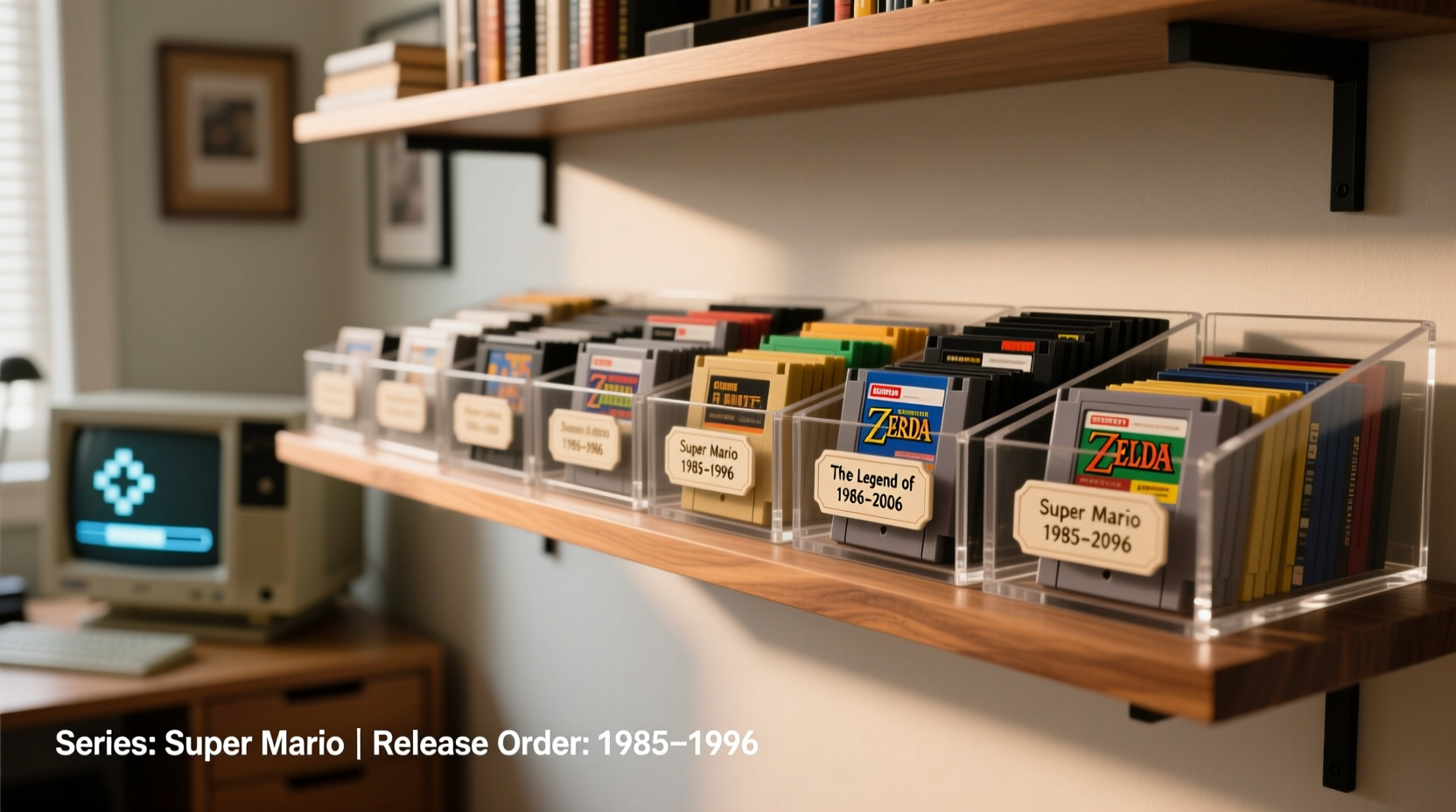
A disorganized stack of cartridges leads to frustration, lost items, and potential damage. Without a clear system, finding a specific title can take minutes instead of seconds. More importantly, poor organization often results in mishandling—dropped cases, scratched labels, or mislabeled boxes. A thoughtful structure not only saves time but also protects your investment. Games from the 80s and 90s are increasingly valuable, and even newer physical releases may appreciate over time.
Effective organization supports both usability and long-term preservation. It makes it easier to rotate games on display, track which titles you own, and share your collection with others. For parents or educators using retro consoles, a well-ordered system helps children find games independently and return them correctly. Ultimately, the right method turns chaos into clarity—and enhances the joy of collecting.
Organizing by Series: Building Thematic Collections
Grouping cartridges by franchise or series is one of the most intuitive approaches, especially for fans deeply connected to particular universes. This method emphasizes storytelling continuity, character development, and brand loyalty. Think of arranging every Zelda title together—from A Link to the Past to Link’s Awakening on Switch—or lining up all Mario platformers in chronological order within their sub-series.
This approach works particularly well when your collection spans multiple consoles. For example, a dedicated shelf could house all Pokémon games across Game Boy, DS, and 3DS, grouped by generation. Within each console section, further sorting by release date adds precision. The visual appeal of seeing an entire series laid out chronologically is undeniable—it tells a story at a glance.
One major benefit of series-based organization is ease of access during themed play sessions. Want to replay the evolution of Metroid? You can pull the entire sequence without searching through unrelated titles. It also simplifies inventory tracking; missing entries become immediately apparent.
“Collectors who organize by series tend to engage more deeply with narrative arcs and design evolution across generations.” — David Lin, Video Game Archivist & Curator at the National Gaming Museum
Advantages of Series-Based Sorting
- Enhances thematic immersion and storytelling context
- Facilitates complete set completion (e.g., all mainline Fallout RPGs)
- Simplifies gift-giving and sharing with family members who prefer certain franchises
- Improves visual coherence on shelves or in display cases
Challenges to Consider
- Some games belong to multiple series (e.g., Super Smash Bros. features characters from various franchises)
- Spin-offs or crossovers may not fit neatly into one category
- Limited flexibility if you frequently acquire non-mainline entries
Organizing by Release Date: A Historical Timeline Approach
Chronological organization arranges cartridges strictly by original release date, creating a timeline of gaming history. This method appeals to historians, preservationists, and those interested in technological progression. When sorted this way, you can trace the evolution of graphics, gameplay mechanics, and industry trends simply by walking down the shelf.
For example, placing Tetris (1989) before Super Mario World (1990), followed by Donkey Kong Country (1994), reflects not just publishing dates but also shifts in audiovisual capabilities. This system shines when your collection spans decades and multiple platforms. Each cartridge becomes a timestamp—a snapshot of what was possible and popular at a given moment.
Release-date sorting also supports objective decision-making. Unlike subjective genre classifications or ambiguous series boundaries, publication dates are fixed and verifiable. Online databases like MobyGames or Nintendo’s official archives provide accurate data for cross-referencing.
How to Implement a Release-Date System
- Gather all cartridges and record their official North American (or regional) release dates.
- Decide whether to sort globally (across all systems) or per console.
- Use a spreadsheet to list titles, platforms, and dates for reference.
- Arrange physically using labeled bins or shelving units marked with years or ranges (e.g., 1985–1990).
- Maintain a digital log updated with each new acquisition.
Sorting across platforms requires careful attention to detail. Should a 1998 N64 title come before or after a 1997 PlayStation game? Consistency is key. Most collectors opt for strict calendar-year ordering regardless of console.
| Game Title | Platform | Release Year | Series |
|---|---|---|---|
| Tetris | NES | 1989 | Tetris |
| Super Mario Bros. 3 | NES | 1988 | Mario |
| The Legend of Zelda: Ocarina of Time | N64 | 1998 | Zelda |
| Metroid Prime | GameCube | 2002 | Metroid |
| Pokémon Sword | Switch | 2019 | Pokémon |
Hybrid Systems: Combining Series and Chronology
Many serious collectors find that neither pure series nor pure date sorting offers complete satisfaction. A hybrid model bridges the gap by layering both principles. Start with broad categories—such as platform or publisher—then group by series, and finally sort within each series by release date.
For instance:
- Section 1: Nintendo Consoles
- Zelda Series → Link’s Awakening (GB, 1993), Ocarina of Time (N64, 1998), Wind Waker (GC, 2003)
- Mario Platformers → Super Mario Bros. (NES, 1985), Super Mario World (SNES, 1990)
- Section 2: Sega Systems
- Sonic the Hedgehog → Sonic 1 (Genesis, 1991), Sonic 2 (Genesis, 1992)
This tiered strategy maximizes both emotional resonance and historical accuracy. It allows you to celebrate beloved franchises while still honoring the broader arc of video game development. Moreover, it scales efficiently as your collection expands—you can add new sections without disrupting existing logic.
Real Example: Sarah’s Hybrid Collection
Sarah, a high school teacher and lifelong gamer, inherited her father’s NES library and has since built a 150-title collection spanning eight consoles. Initially overwhelmed, she adopted a hybrid system after visiting a local retro gaming expo. She now organizes her shelves first by console, then by genre (platformer, RPG, puzzle), and finally by series and release year within each genre.
“It took me a weekend to sort everything,” she says, “but now I can plan themed lessons around gaming history. My students love seeing how Pac-Man evolved from arcade to handheld. And when my nephew visits, he knows exactly where to find the Donkey Kong games.” Her system supports both educational use and personal enjoyment—proof that thoughtful organization serves multiple purposes.
Essential Tips for Maintaining Your System
No organizational method lasts without maintenance. Dust, relocation, and new purchases can disrupt even the most elegant setup. Follow these practices to keep your system functional over time.
Checklist: Maintaining Your Cartridge Organization
- ✅ Audit your collection quarterly to ensure all items are accounted for
- ✅ Wipe down cartridges with a microfiber cloth before storing
- ✅ Update your digital inventory whenever you buy or sell a game
- ✅ Store cartridges vertically with spine labels facing outward for readability
- ✅ Avoid direct sunlight and humid environments to prevent warping and mold
- ✅ Use archival-quality sleeves or cases for rare or valuable editions
Digital tools can enhance physical organization. Apps like Collectorz, GameVault, or even spreadsheets help track condition, value, and location. Some collectors assign QR codes to each shelf, linking to a shared database accessible via smartphone.
Frequently Asked Questions
Should I organize by region or language?
Only if you're a completist or reseller. Most casual collectors prioritize gameplay over regional variants. However, if you own Japanese Famicom titles or PAL versions, consider grouping them separately to preserve authenticity and avoid confusion.
What if a game belongs to multiple series?
Choose the primary affiliation based on gameplay or narrative focus. For example, Luigi’s Mansion belongs under Luigi rather than Mario, despite crossover elements. If uncertain, create a “Crossover & Compilation” section for edge cases.
Is it better to sort globally or by console?
Sorting by console first provides clearer context and prevents mixing incompatible hardware. Global sorting works only if you have deep knowledge of cross-platform release timelines and don’t mind pulling from different shelves for one console.
Final Thoughts: Choose What Serves Your Purpose
There is no single “correct” way to organize game cartridges. The best method depends on how you use your collection. If you play regularly and enjoy revisiting sagas, organizing by series creates a rewarding narrative journey. If you appreciate gaming as cultural history, release-date sorting offers intellectual depth and clarity. Many find balance in a hybrid model that honors both passion and precision.
Whatever system you choose, consistency and care matter most. Take time to evaluate your habits, space, and goals. Start small—sort one console at a time—and refine as needed. A well-organized collection isn’t just easier to manage; it becomes a source of pride, conversation, and lasting enjoyment.




 浙公网安备
33010002000092号
浙公网安备
33010002000092号 浙B2-20120091-4
Comments
No comments yet. Why don't you start the discussion?