
If you're still using a Bluetooth speaker from a few years ago, you might be wondering whether it's time to upgrade. With Bluetooth 5.0 now standard in most new audio devices, manufacturers tout longer range, faster speeds, and better battery efficiency. But how much of a difference does it actually make in everyday use? For someone who values sound quality, convenience, and seamless connectivity, understanding the real-world impact of Bluetooth 5.0 versus older versions—like 4.0, 4.1, or 4.2—is essential before deciding whether to replace a working speaker.
Understanding the Evolution of Bluetooth Technology
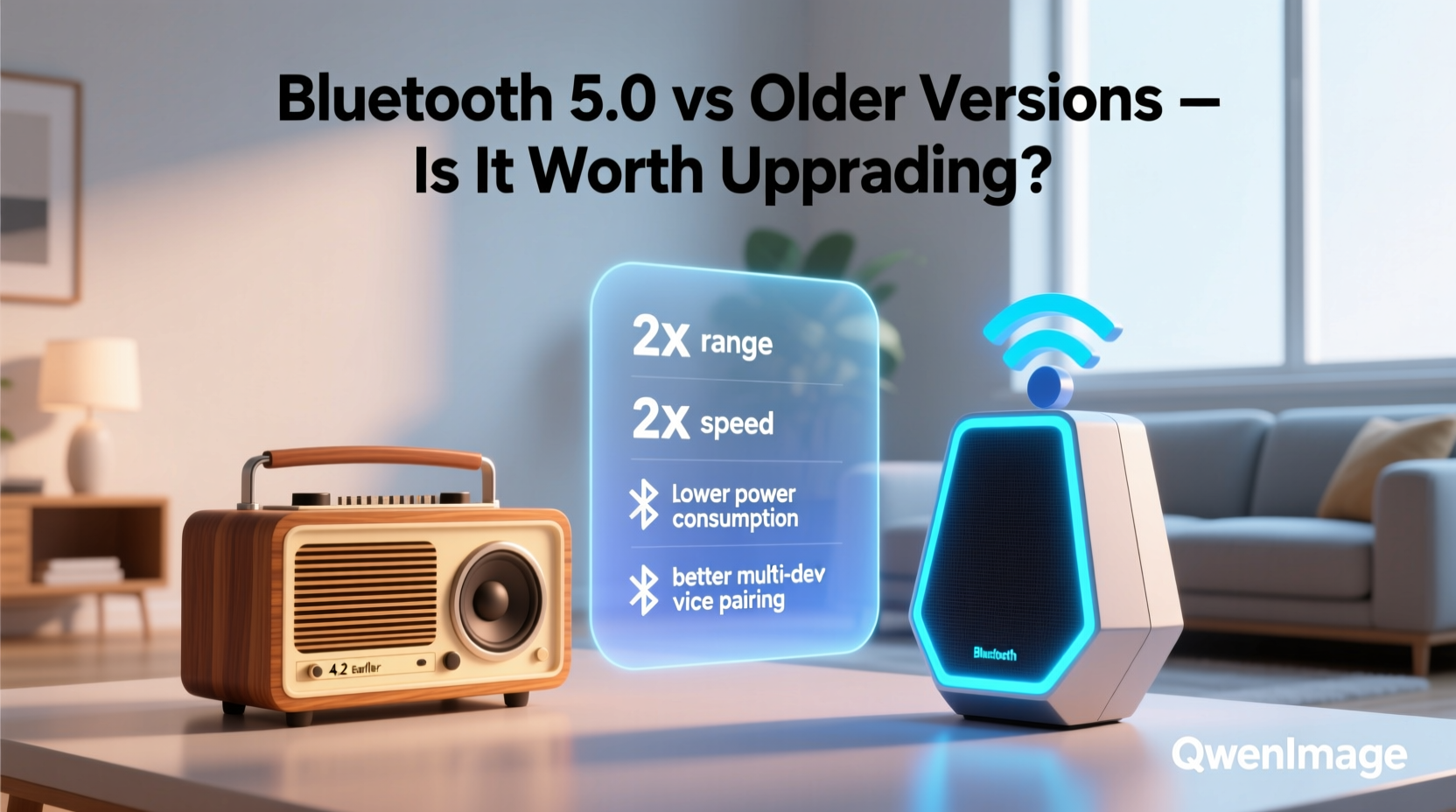
Bluetooth has evolved significantly since its early days. Each version brings incremental improvements in data transfer, power consumption, and connection stability. Bluetooth 4.0 introduced the \"Low Energy\" (BLE) feature, which was a game-changer for wearable devices and accessories that needed long battery life. Versions 4.1 and 4.2 refined this further with better coexistence with LTE signals and improved data throughput.
Then came Bluetooth 5.0 in 2016—a major leap forward. It wasn't just a minor update; it doubled the speed, quadrupled the range, and increased broadcasting capacity eightfold compared to Bluetooth 4.2. These aren't just technical specs on paper—they translate into tangible improvements in how devices interact, especially in home audio setups.
“Bluetooth 5.0 fundamentally changed the landscape for wireless audio by enabling stable, high-quality connections at greater distances without sacrificing battery life.” — Dr. Alan Reeves, Wireless Communication Engineer
Key Differences: Bluetooth 5.0 vs Older Versions
To assess whether an upgrade is worthwhile, it helps to break down the core differences between Bluetooth 5.0 and its predecessors. The table below compares key specifications across versions:
| Feature | Bluetooth 4.0 | Bluetooth 4.2 | Bluetooth 5.0 |
|---|---|---|---|
| Max Data Speed | 1 Mbps | 1 Mbps | 2 Mbps |
| Theoretical Range | 10 meters (33 ft) | 50 meters (164 ft) | 200 meters (656 ft) |
| Broadcast Message Capacity | 31 bytes | 31 bytes | 255 bytes |
| Power Efficiency | Moderate | Improved | Significantly Improved |
| Audio Streaming Stability | Fair (prone to dropouts) | Good | Excellent |
While theoretical numbers are helpful, real-world performance depends on environment, obstacles, and device compatibility. Still, the jump from 4.2 to 5.0 is substantial, particularly in environments where walls, furniture, or interference from other wireless devices weaken signals.
Real-World Benefits of Bluetooth 5.0
The promise of double the speed and four times the range sounds impressive, but what does it mean when you're actually using your speaker?
Extended Range Without Dropouts: In practical terms, Bluetooth 5.0 allows you to move from room to room—say, from kitchen to backyard—without losing audio. Older speakers often cut out beyond 30 feet, especially through walls. With Bluetooth 5.0, stable connections can extend up to 100 feet indoors and even farther outdoors, making it ideal for larger homes or outdoor gatherings.
Faster Pairing and Dual Audio: Some Bluetooth 5.0-enabled speakers support dual audio, meaning you can connect two speakers simultaneously from one device. This lets you create a stereo pair or fill multiple rooms with synchronized sound—something rarely possible with older versions.
Better Battery Life: Despite higher performance, Bluetooth 5.0 is more energy-efficient. Devices spend less time searching for connections and transmit data more quickly, reducing active radio usage. For portable speakers, this can mean several extra hours of playback on a single charge under similar conditions.
A Real Example: Sarah’s Outdoor Setup
Sarah owns a mid-range Bluetooth 4.1 speaker she bought three years ago. She uses it during weekend barbecues in her backyard, about 40 feet from her phone inside the house. Over time, she noticed frequent audio stutters and disconnections when stepping too far away. After upgrading to a Bluetooth 5.0 model, she could walk freely between the deck and garden without interruption—even when her phone was tucked in a kitchen drawer. The improvement wasn’t just about distance; the connection felt more reliable, with quicker reconnection after temporary obstructions.
When Upgrading Makes Sense
Not every user will benefit equally from upgrading. Here’s a checklist to help determine if switching to a Bluetooth 5.0 speaker is worth it for you:
- You frequently experience audio dropouts or lag with your current speaker
- You use your speaker in large spaces or outdoors
- Your smartphone or audio source supports Bluetooth 5.0 or later
- You want to connect two speakers wirelessly for stereo or multi-room sound
- Battery life is a concern, and you value longer playtime per charge
- You plan to keep your speaker for several years and want future-proof tech
If most of these apply, then yes—the upgrade is likely worth it. However, if your current speaker works reliably within a small apartment and you rarely push its limits, the marginal gains may not justify the cost.
Step-by-Step: How to Evaluate Your Upgrade Path
- Check your current speaker’s Bluetooth version. Look up the model online or consult the manual. If it’s 4.0 or earlier, the upgrade will bring noticeable improvements.
- Assess your usage patterns. Do you move around while listening? Use it outside? Need consistent volume across rooms?
- Verify your source device compatibility. Most smartphones from 2017 onward support Bluetooth 5.0. Check your phone’s specs in settings or online.
- Test range limitations. Walk away from your speaker while playing music. Note where the signal degrades. If it happens within 20–30 feet, Bluetooth 5.0 could solve this.
- Research models with Bluetooth 5.0 features. Prioritize those offering dual pairing, low latency, and strong battery ratings.
- Consider total cost vs. benefit. A $100 upgrade should deliver meaningful improvements, not just marginally better specs.
Frequently Asked Questions
Can Bluetooth 5.0 improve sound quality?
Not directly. Bluetooth 5.0 doesn’t enhance audio resolution, but its higher bandwidth and stability reduce compression artifacts and dropouts, leading to a smoother, more consistent listening experience—especially with high-bitrate codecs like aptX HD or LDAC (if supported).
Will my old devices work with a Bluetooth 5.0 speaker?
Yes. Bluetooth is backward compatible. A Bluetooth 5.0 speaker will work with older phones or tablets, but you’ll only get the performance level of the oldest device in the connection. So pairing a 5.0 speaker with a Bluetooth 4.0 phone means you’re limited to 4.0 capabilities.
Is Bluetooth 5.2 or 5.3 much better than 5.0?
Incrementally, yes. Later versions offer improved power management, better audio synchronization (LE Audio), and enhanced location services. But for most consumers, Bluetooth 5.0 already delivers excellent performance. Unless you need cutting-edge features, 5.0 remains highly capable.
Final Verdict: Should You Upgrade?
If your current speaker struggles with range, disconnects often, or limits your lifestyle, upgrading to Bluetooth 5.0 is a smart move. The combination of extended reach, stronger signal resilience, and improved efficiency makes a real difference in daily use—particularly in dynamic environments. However, if your existing setup meets your needs and you're not pushing its boundaries, holding off is perfectly reasonable.
Technology upgrades should serve your habits, not dictate them. Bluetooth 5.0 isn’t revolutionary for everyone, but for those who demand reliability beyond a single room or enjoy wireless freedom, it removes many of the frustrations that plagued earlier generations.




 浙公网安备
33010002000092号
浙公网安备
33010002000092号 浙B2-20120091-4
Comments
No comments yet. Why don't you start the discussion?