
When The Legend of Zelda: Breath of the Wild launched in 2017, it did so simultaneously on two platforms: the Nintendo Wii U and the newly released Nintendo Switch. For many fans, this created a dilemma—should they play on their existing console or invest in a new system for what was essentially the same game? Over time, as the Switch gained dominance and the Wii U faded into obsolescence, the conversation evolved. Today, most players considering the game are choosing between buying the physical Switch cartridge or tracking down a used Wii U bundle. But beyond availability, does the Switch version offer tangible benefits that justify its staying power—and potential premium price?
The answer isn’t just about graphics or battery life. It’s about how the experience integrates into your lifestyle, how future-proof the platform is, and whether subtle enhancements add up to a meaningfully better adventure across Hyrule.
Performance and Visual Fidelity
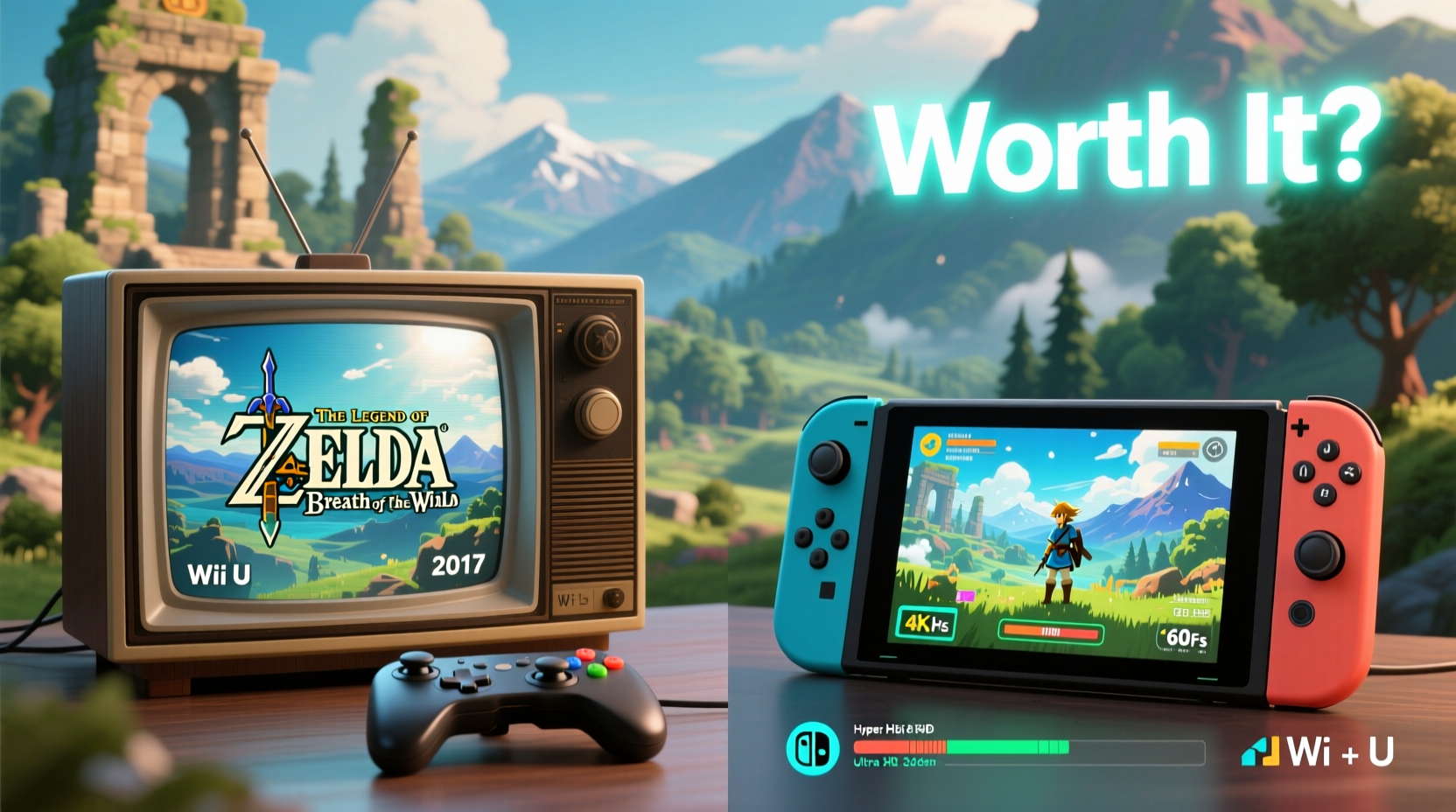
At first glance, both versions render the same vast open world with identical art design, enemy placement, and physics behavior. However, under the hood, the Switch holds a consistent edge in stability and visual output.
The Wii U version runs at 900p resolution when docked and drops to 720p in handheld mode via the GamePad. The Switch, meanwhile, targets 990p when docked and maintains 720p in handheld—but with a crucial difference: superior anti-aliasing and more stable frame pacing. While neither console achieves a locked 30fps in all scenarios (especially during intense weather effects or crowded areas), the Switch version experiences fewer stutters and recovers more quickly from performance dips.
Additionally, the OLED model of the Switch (released in 2021) enhances the handheld experience significantly. Its higher contrast ratio, deeper blacks, and improved brightness make exploring dense forests or dark caves far more immersive than on the original Switch screen—or the dimmer, lower-resolution Wii U GamePad.
“Even small improvements in clarity and responsiveness can deepen player immersion in expansive worlds like Hyrule.” — David Luehrsen, Senior Game Analyst at Digital Frontiers
Portability and Flexibility
This is where the Switch doesn’t just win—it redefines the experience. The Wii U’s GamePad allows limited off-TV play, but only within range of the console and with a bulky, short-lived battery. True portability is nonexistent.
In contrast, the Switch offers seamless transition between TV and handheld modes. You can start climbing a mountain on your living room TV, undock the system, and continue your ascent during a commute or while lounging in bed. This flexibility encourages longer engagement and fits naturally into modern gaming habits.
For travelers or players without consistent access to a TV setup, the Switch becomes not just preferable but essential. Even if you primarily play docked, knowing you can pick up and go adds psychological value—few gamers regret the option, even if used sparingly.
Hardware Longevity and Support
The Wii U was discontinued in 2017, shortly after the Switch launched. No further system updates have been issued since 2020, and online services are minimally maintained. Finding replacement parts, digital codes, or functional used units grows harder every year.
The Switch, by contrast, remains actively supported. While newer models like the Switch OLED have replaced the original, backward compatibility ensures any current or future Switch will run Breath of the Wild. Furthermore, downloadable content such as the Expansion Pass transfers seamlessly between systems using a single Nintendo Account.
If you plan to keep playing long-term or pass the game down, the Switch ecosystem provides continuity the Wii U simply cannot match.
Detailed Comparison: Switch vs Wii U
| Feature | Wii U | Switch |
|---|---|---|
| Docked Resolution | 900p | 990p |
| Handheld Resolution | 720p (GamePad) | 720p (better scaling) |
| Frame Rate Stability | Frequent drops | Moderate drops, faster recovery |
| Portability | Limited (within Wi-Fi range) | Full (anywhere) |
| Battery Life (Handheld) | N/A (GamePad charges while in use) | 3–5.5 hrs (varies by model) |
| Expansion Pass Support | Yes | Yes (with account sync) |
| Current System Support | None (discontinued) | Active (updates, repairs, sales) |
| Controller Options | GamePad, Pro Controller | Pro Controller, Joy-Cons, third-party |
User Experience: A Real-World Example
Consider Sarah, a college student who bought the Wii U version of BotW at launch. She loved the game but found herself abandoning it after six months—not because she lost interest, but because her GamePad battery degraded and her TV setup changed with dorm life. When she received a Switch Lite as a gift two years later, she repurchased the game digitally. Within weeks, she completed 90% of the map.
“I didn’t realize how much the inability to play anywhere was holding me back,” she said. “On the Switch Lite, I played during breaks, on the bus, before class. The game fit into my day instead of requiring me to schedule around it.”
Sarah’s story reflects a broader trend: convenience directly impacts completion rates and emotional connection to games with high time investment.
Step-by-Step: How to Decide Which Version Is Right for You
- Evaluate your primary play style. Do you mostly game on a TV, or do you value mobility? If portability matters, the Switch wins outright.
- Check your current hardware. If you already own a Wii U in good condition and don’t travel often, the Switch upgrade may not be urgent.
- Assess long-term value. Will you keep the system for future games? The Switch has a library of over 100 exclusive titles; the Wii U does not.
- Factor in resale and availability. Used Switch consoles are widely available and retain value. Wii U units are harder to find and depreciate faster.
- Consider display quality. If you care about sharp visuals and color accuracy—especially in handheld mode—the Switch OLED is vastly superior.
FAQ
Can I transfer my save data from Wii U to Switch?
No. Save files are tied to the console and cannot be migrated. You’d need to restart your adventure from the beginning.
Does the Switch version have exclusive content?
No. Both versions include the full base game and support the same Expansion Pass DLC. There is no exclusive in-game content on either platform.
Is Breath of the Wild easier to run on Switch than Wii U?
Not necessarily easier, but more consistently optimized. The Switch handles dynamic loading and draw distances slightly better, reducing pop-in and stutter during fast traversal.
Final Verdict: Is the Switch Version Worth It?
If you're starting fresh or looking to revisit Hyrule, the Switch version is unequivocally worth it. The combination of portable gameplay, better screen quality, ongoing system support, and integration with Nintendo’s current ecosystem makes it the definitive way to experience Breath of the Wild.
Even for die-hard Wii U owners, the limitations of an obsolete platform eventually outweigh nostalgia. Unless you’re committed to preserving legacy hardware for collection purposes, there’s little practical reason to choose the older version today.
The Switch doesn’t just play the game—it enhances how you live with it. Whether you're scaling cliffs in handheld mode or marveling at thunderstorms on a large TV, the experience feels more cohesive, more accessible, and ultimately more rewarding.




 浙公网安备
33010002000092号
浙公网安备
33010002000092号 浙B2-20120091-4
Comments
No comments yet. Why don't you start the discussion?