
For many professionals, students, and creatives, ambient sound is no longer a background luxury—it’s a productivity necessity. Whether you're coding under tight deadlines, writing a novel, or studying for exams, the right kind of noise can make the difference between distraction and deep focus. Among the most popular options are brown noise and white noise. But which one truly enhances concentration? While both fall under the umbrella of “colored noise,” they differ significantly in tone, frequency, and psychological impact. Understanding these differences can help you choose the optimal auditory backdrop for sustained mental performance.
What Is White Noise?
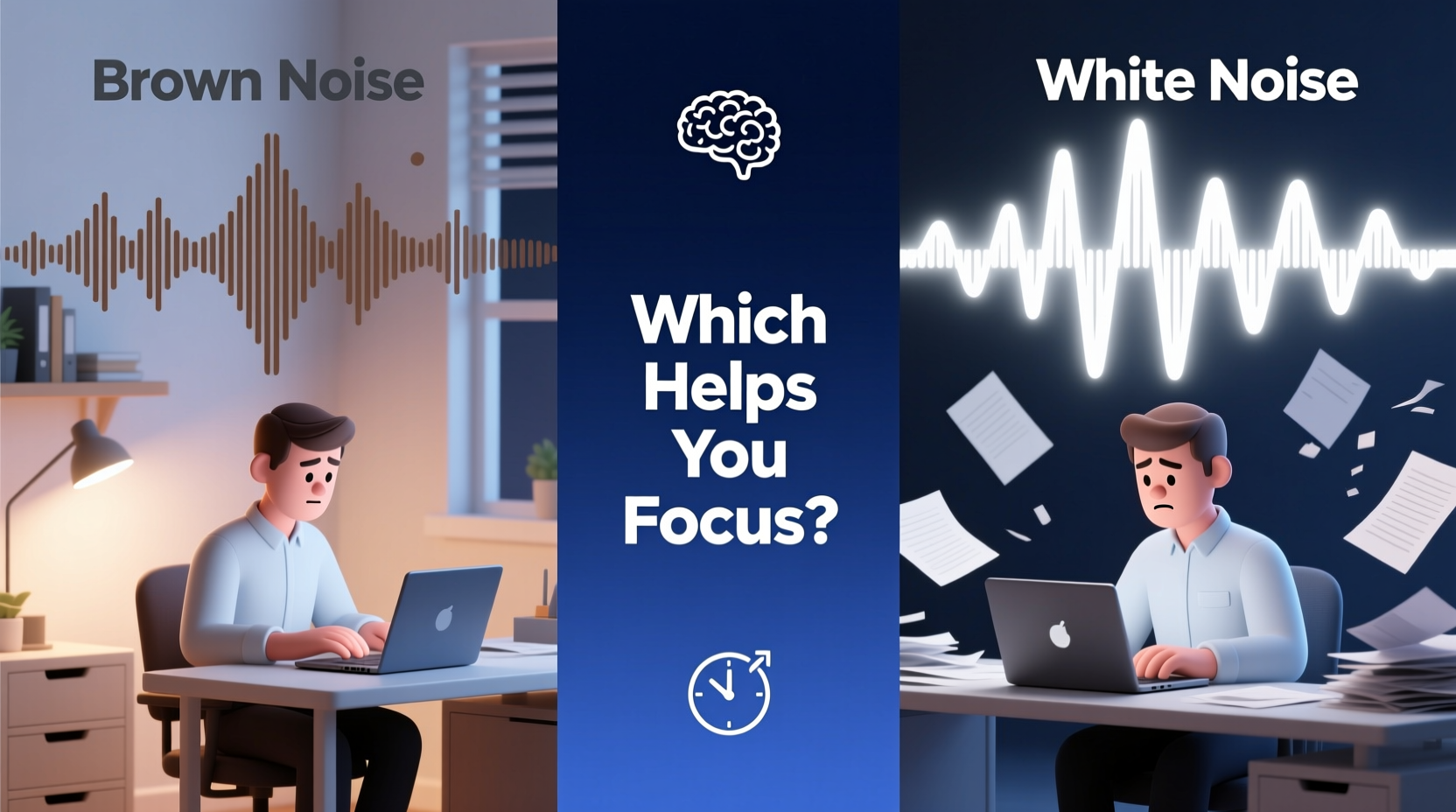
White noise is a consistent, even blend of all audible frequencies, distributed with equal intensity across the spectrum. Think of it as the audio equivalent of static on an old television—steady, unchanging, and all-encompassing. Common sources include fans, air purifiers, and dedicated white noise machines or apps.
The science behind white noise lies in its ability to mask sudden environmental sounds. A door slamming, a phone buzzing, or a dog barking—all of these abrupt noises can pull your attention away from a task. White noise acts like an acoustic blanket, filling the auditory space so that interruptions become less noticeable.
“White noise works by raising the baseline level of ambient sound, making transient disturbances less jarring to the brain.” — Dr. Laura Simmons, Cognitive Neuroscientist at Stanford University
Studies have shown that white noise can improve focus in certain environments, especially open offices or noisy households. However, its high-frequency emphasis can feel harsh or grating over time, particularly for people sensitive to treble tones. This has led many users to explore alternatives like brown noise.
What Is Brown Noise?
Brown noise, sometimes inaccurately called “brownian noise,” emphasizes lower frequencies and rolls off sharply at higher pitches. It’s deeper, fuller, and often described as resembling a strong waterfall, distant thunder, or a powerful gust of wind. Unlike white noise, which feels flat and uniform, brown noise has a rumbling quality that many find more soothing and immersive.
The name originates from Brownian motion—the random movement of particles in fluid—but the naming convention doesn’t imply a direct scientific link. Instead, it reflects how the power density decreases with increasing frequency (specifically, 6 dB per octave). This creates a sound profile that’s heavier on bass and gentler on the ears.
Because of its low-frequency dominance, brown noise may be more effective for long-duration focus tasks. It doesn't stimulate the auditory cortex as intensely as white noise, reducing listener fatigue. Many users report that brown noise helps them stay in a state of calm alertness without feeling overstimulated.
Why Brown Noise Feels More Natural
Human hearing evolved in natural environments where low-frequency sounds—such as wind, water, and animal movements—were dominant. Brown noise mimics these primal acoustics, potentially triggering a subconscious sense of safety and rhythm. This may explain why some people find it easier to concentrate or even fall asleep with brown noise playing in the background.
“I’ve used brown noise during marathon coding sessions for years. It’s like a sonic anchor—keeps my mind from drifting.” — Marcus Tran, Software Engineer at a Silicon Valley startup
Comparing Brown Noise and White Noise: A Practical Breakdown
To understand which type of noise supports focus better, it's important to compare their characteristics side-by-side. The table below outlines key differences relevant to work performance.
| Feature | White Noise | Brown Noise |
|---|---|---|
| Frequency Distribution | Equal energy across all frequencies | More energy in low frequencies, drops off at higher ones |
| Sound Quality | Flat, hissy (like TV static) | Deep, rumbling (like a waterfall) |
| Best For | Masking sudden noises, short bursts of focus | Sustained concentration, calming overstimulation |
| Potential Drawbacks | Can feel harsh; may cause auditory fatigue | May be too quiet at higher frequencies to mask speech |
| Ideal Work Contexts | Open offices, busy homes, light study | Deep work, creative writing, programming, ADHD focus |
Real-World Example: How One Writer Found Her Focus Sound
Sophie Kim, a freelance journalist based in Portland, struggled for years with distractions while writing articles from her apartment near a busy intersection. She initially tried white noise, but found it too sharp—after two hours, she’d develop a slight headache. She experimented with pink noise next, then finally discovered brown noise through a recommendation on a productivity forum.
“I turned it on one afternoon while drafting a feature story,” she recalled. “It was like someone had lowered the volume on my nervous system. I wrote for four uninterrupted hours—the longest stretch I’d had in months.”
Sophie now uses brown noise daily, typically at 55–60 decibels, played through over-ear headphones. She pairs it with the Pomodoro technique, using 25-minute blocks followed by five-minute breaks. Her output has increased by nearly 40%, and she rarely edits pieces for focus-related inconsistencies anymore.
Step-by-Step Guide to Choosing Your Focus Noise
Not everyone responds to colored noise the same way. Here’s a structured approach to finding what works best for your brain and environment.
- Assess your workspace: Is it quiet but prone to sudden noises (e.g., doors, phones), or consistently loud (e.g., café, shared office)? High variability favors white noise; steady low hums may benefit from brown.
- Test both types for 3 days each: Dedicate three full workdays to white noise and three to brown. Use the same app or device for consistency.
- Track your focus and mood: Keep a simple log. Note how long you stayed on task, whether you felt distracted, and if you experienced any discomfort (e.g., ear fatigue, tension).
- Adjust volume and delivery method: Try speakers versus headphones. Volume should be present but not dominant—around the level of a quiet conversation.
- Consider personal sensitivities: If you have tinnitus, sensory processing issues, or ADHD, consult anecdotal evidence and studies. Many with ADHD report better results with brown noise due to its grounding effect.
- Re-evaluate monthly: Preferences can shift. Re-test every few weeks, especially if your work demands change.
Checklist: Optimizing Your Noise Setup for Maximum Focus
- ✅ Choose a reliable source (app, speaker, or website) with minimal ads or interruptions
- ✅ Set volume between 50–60 dB—loud enough to mask distractions but not overpowering
- ✅ Use noise-canceling or over-ear headphones for immersive experience
- ✅ Avoid looping tracks with subtle beats or variations that draw attention
- ✅ Combine with other focus tools (e.g., website blockers, task lists) for synergy
- ✅ Take regular breaks to prevent auditory fatigue
- ✅ Experiment with mixing brown noise with very low-volume instrumental music (e.g., lo-fi piano)
Frequently Asked Questions
Can brown noise improve concentration for people with ADHD?
Emerging research and anecdotal reports suggest yes. Many individuals with ADHD find that brown noise provides a rhythmic, predictable auditory input that helps regulate attention. A 2022 pilot study published in *Frontiers in Psychology* found that participants with ADHD showed improved task accuracy and reduced mind-wandering when exposed to low-frequency noise compared to silence.
Is it safe to listen to brown or white noise all day?
In moderation, yes. However, prolonged exposure at high volumes (above 70 dB) can contribute to hearing strain or even long-term auditory damage. Limit continuous use to 4–6 hours per day, take breaks, and keep volume moderate. Never sleep with noise machines at maximum volume over extended periods.
What about pink noise? Where does it fit in?
Pink noise falls between white and brown in frequency distribution—balanced across octaves, with slightly more weight in the mid-lows. It’s often described as “even” or “natural,” similar to rustling leaves. Some studies link pink noise to improved memory consolidation during sleep, but for daytime focus, brown noise tends to outperform it in user satisfaction due to its deeper resonance.
Expert Insight: The Neuroscience of Sound and Focus
The brain’s response to noise isn’t just about masking distractions—it’s about regulating neural oscillations. When we enter a state of deep focus, our brains operate in alpha and theta wave patterns, associated with relaxed alertness. Certain types of noise can entrain these rhythms, essentially guiding the brain into a productive groove.
“Low-frequency sounds like brown noise may enhance thalamocortical regulation, helping filter irrelevant stimuli. It’s not just masking noise—it’s actively shaping brain activity.” — Dr. Elena Rodriguez, Sleep and Cognition Researcher, UC Berkeley
This neuro-modulatory effect explains why some people don’t just prefer brown noise—they perform better with it. It doesn’t merely cover up distractions; it alters the internal environment of the mind.
Conclusion: Match the Noise to Your Mind, Not the Trend
The debate between brown noise and white noise isn’t about declaring a universal winner—it’s about alignment. White noise excels in chaotic, unpredictable environments where sudden sounds threaten focus. Its broad-spectrum coverage makes it a reliable shield against auditory intrusions.
Brown noise, on the other hand, offers something deeper: a sense of stability. For those engaged in prolonged cognitive work, creative endeavors, or tasks requiring emotional regulation, its low-frequency warmth can act as a mental stabilizer. It’s particularly valuable in an age of constant digital interruption, offering a return to rhythm and depth.
The truth is, the best noise for focus is the one that lets you forget it’s there—while still doing its job. Whether you lean toward the crisp neutrality of white noise or the earthy resonance of brown, the goal remains the same: to create a sonic sanctuary where your mind can thrive.




 浙公网安备
33010002000092号
浙公网安备
33010002000092号 浙B2-20120091-4
Comments
No comments yet. Why don't you start the discussion?