
When stepping into the world of drone flying, one of the first questions new enthusiasts face is whether to invest in a budget-friendly model or go straight for a high-end machine. With prices ranging from under $100 to over $2,000, the decision isn’t trivial. Many assume that spending more means faster progress, better flight experience, and fewer crashes. But is that really true for beginners? The answer isn't as straightforward as it seems. While premium drones offer advanced features and superior image quality, they may not always be the best starting point for someone still mastering basic controls.
The reality is that beginner pilots often lack the muscle memory, spatial awareness, and situational judgment needed to fully utilize—and protect—a high-end drone. In fact, many experienced flyers recommend starting modestly. This article explores the real differences between budget and high-end drones, evaluates what beginners truly need, and provides practical guidance on making a smart investment without sacrificing long-term growth.
Understanding the Key Differences
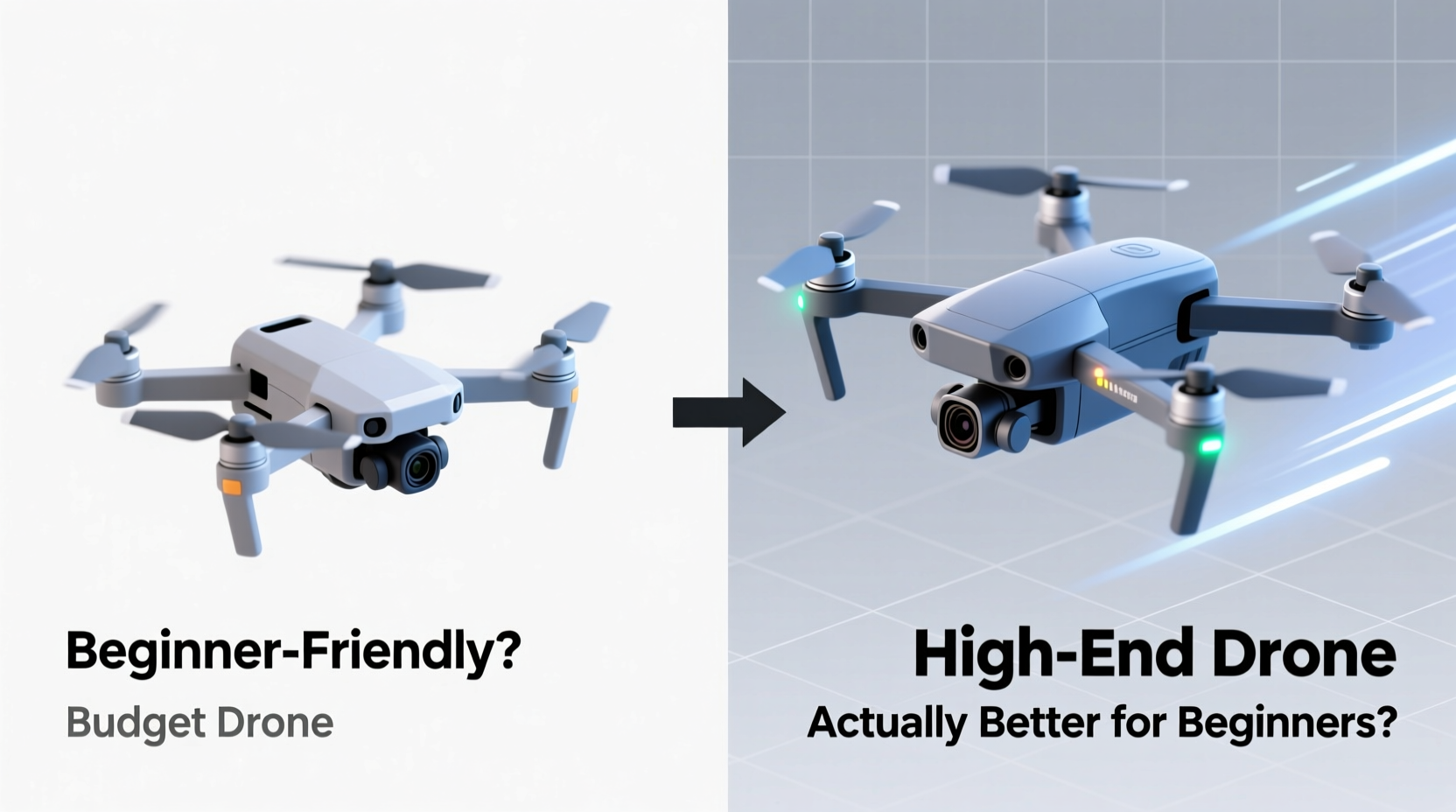
Before deciding which category fits your needs, it's essential to understand what separates budget drones from their high-end counterparts. These distinctions go beyond price tags and include build quality, flight capabilities, camera performance, safety features, and repair costs.
Budget drones—typically priced under $300—are designed for entry-level users. They prioritize simplicity, lightweight construction, and ease of use. Most come with basic cameras (if any), limited flight range, and minimal obstacle avoidance. However, they’re often durable, compact, and forgiving when crashes happen—something every new pilot should expect.
High-end models, like those from DJI’s Mavic or Inspire series, deliver professional-grade video stabilization, extended flight times (up to 40 minutes), GPS precision, intelligent flight modes, and advanced obstacle detection. Their cameras can shoot 4K at high frame rates with adjustable apertures and log profiles ideal for post-processing. But these benefits come with complexity, fragility, and steep financial consequences if flown recklessly.
“Beginners don’t crash because they’re bad pilots—they crash because they’re learning. Starting on an expensive drone is like practicing stick-shift driving in a Lamborghini.” — Jordan Lee, UAV Flight Instructor and Drone Safety Advocate
Performance Comparison: What You Actually Get
To illustrate the gap between budget and high-end options, consider how key performance metrics stack up across typical models in each category.
| Feature | Budget Drones (e.g., Ryze Tello, Holy Stone HS720E) | High-End Drones (e.g., DJI Mavic 3, Autel EVO II) |
|---|---|---|
| Price Range | $99 – $300 | $1,000 – $2,500+ |
| Flight Time | 10–25 minutes | 30–45 minutes |
| Camera Quality | 720p–4K (often compressed) | 4K–6K RAW video, 20MP+ photos |
| Obstacle Avoidance | Limited or none | 360° sensors, AI-based detection |
| GPS & Return-to-Home | Basic GPS on mid-tier models | Advanced dual-band GPS, precise RTH |
| Wind Resistance | Level 3–4 (moderate gusts) | Level 5–6 (strong winds) |
| Learning Curve | Gentle, intuitive interface | Complex menus, multiple settings |
| Repair Cost After Crash | $20–$80 per part | $150–$600+ (motor, gimbal, arm) |
The data shows a clear trade-off: high-end drones offer superior technical performance but demand greater responsibility. For a beginner still learning orientation and throttle control, even minor mistakes can lead to costly damage. A cracked propeller on a budget drone might cost $5 to replace; the same impact could bend a carbon fiber arm on a Mavic Pro, triggering a $200 service bill.
Why Beginners Often Benefit from Budget Models
There’s a psychological advantage to flying a less expensive drone that many overlook. When you're not paralyzed by fear of breaking a $1,500 piece of equipment, you're more likely to experiment, push boundaries, and learn from errors. That freedom accelerates skill development far more than specs ever could.
Budget drones also tend to have simplified controls. Features like automatic takeoff/landing, headless mode, and altitude hold reduce cognitive load during early flights. Some even integrate directly with smartphone apps that simulate flight training before going airborne. This low-pressure environment fosters confidence.
Moreover, most modern budget drones now include surprisingly capable features. The Ryze Tello, for example, supports programmable flight paths via Scratch coding—an excellent tool for younger learners or STEM education. Meanwhile, models like the Holy Stone HS720E offer foldable designs, brushless motors, and 4K cameras at under $250, blurring the line between entry-level and mid-tier performance.
Starting with a budget model allows beginners to:
- Learn orientation and directional control without panic
- Practice emergency maneuvers safely
- Understand battery management and signal limits
- Develop visual tracking skills before relying on automation
- Build maintenance habits through simple repairs
A Real-World Example: Learning the Hard Way
Take the case of Daniel, a photography student eager to add aerial shots to his portfolio. Excited by YouTube reviews, he purchased a DJI Air 3 for $1,099 as his first drone. Confident after watching tutorials, he launched it near a wooded park. Within minutes, disoriented by the bird’s-eye view, he lost track of its direction. Attempting a sharp turn, it clipped a tree branch and fell 30 feet into thick underbrush.
The drone survived the fall, but the gimbal was misaligned and the front sensor housing cracked. Repair cost: $380. Discouraged and anxious about repeating the mistake, Daniel grounded the drone for two months. He eventually sold it at a loss and bought a used DJI Mini 2 SE for $299. This time, he committed to structured practice.
Over the next six weeks, he flew in safe zones, practiced landing drills, and studied FAA guidelines. By the time he upgraded back to a higher-end model, he had logged over 15 hours of stable flight time and developed strong situational awareness. “I wasted money by skipping the learning curve,” Daniel admitted. “Now I tell everyone: fly cheap first, fly smart later.”
When a High-End Drone Might Make Sense for a Beginner
While rare, there are scenarios where a beginner might reasonably start with a high-end drone. These exceptions usually involve specific goals, prior experience, or access to mentorship.
For instance, someone transitioning from piloting RC planes or FPV racing quads already has hand-eye coordination and understands throttle sensitivity. Similarly, professionals entering commercial drone work—such as real estate agents or surveyors—may need broadcast-quality footage immediately, justifying the upfront investment despite inexperience.
In such cases, pairing the purchase with formal training significantly reduces risk. Many manufacturers offer bundled courses with premium drones. DJI’s Enterprise program includes remote pilot certification prep, while third-party platforms like Pilot Institute provide interactive simulations tailored to specific models.
If choosing this path, follow this checklist to minimize early setbacks:
Checklist: Safely Starting with a High-End Drone
- Enroll in a certified drone training course before first flight
- Purchase comprehensive insurance (e.g., Skywatch AirCare or DJI Care Refresh)
- Begin all flights in P-GPS mode with obstacle avoidance enabled
- Limit initial range to line-of-sight only (no BVLOS)
- Practice in wide-open areas away from trees, power lines, and crowds
- Use propeller guards during early sessions
- Review flight logs weekly to identify risky patterns
Step-by-Step Path to Mastery Without Breaking the Bank
For most beginners, the optimal journey follows a progressive path that balances cost, safety, and skill growth. Here’s a realistic timeline:
- Weeks 1–4: Start with a sub-$200 drone. Focus on takeoffs, landings, hovering, and turning. Master orientation so you can confidently fly backward relative to the controller.
- Months 2–3: Upgrade to a mid-range model (~$300–$500). Look for GPS stabilization, return-to-home, and decent camera quality. Begin exploring automated flight modes like waypoints and circle orbits.
- Month 4+: Enroll in Part 107 prep (if in the U.S.). Study airspace rules, weather interpretation, and NOTAMs. Consider getting FAA-certified if interested in commercial use.
- Months 5–6: Evaluate upgrade options. By now, you’ll know your flying style—cinematic, racing, mapping—and can choose a high-end model aligned with your goals.
- Ongoing: Join a local drone club or online community. Share footage, get feedback, and participate in group flights under supervision.
This approach builds competence gradually while minimizing financial exposure. It also helps avoid “feature overwhelm”—a common issue where new pilots disable useful tools simply because they don’t understand them.
Frequently Asked Questions
Can I learn to fly well using only a budget drone?
Absolutely. Flying fundamentals—orientation, throttle control, wind compensation—are universal across all drones. Mastering these on an affordable model gives you a stronger foundation than relying on automation in expensive systems.
Do high-end drones crash less?
They have more safeguards, yes—but human error remains the leading cause of incidents. A beginner flying a top-tier drone without proper training is still likely to make orientation mistakes, especially in complex environments. Obstacle avoidance helps, but it’s not foolproof.
Will I regret buying a cheap drone?
Only if you expect professional results. Budget drones won’t match cinema-grade stabilization or dynamic range. But as a learning tool, they’re invaluable. Most experienced pilots look back fondly on their first wobbly flights—it’s part of the journey.
Conclusion: Invest in Skills, Not Just Specs
The question isn’t whether high-end drones perform better—it’s whether their advantages matter to someone just beginning. For most beginners, the answer is no. The early stages of drone piloting are messy, unpredictable, and full of mistakes. That’s normal. That’s necessary.
Rather than chasing specs, focus on building core competencies: spatial awareness, manual control, risk assessment, and mechanical empathy. These skills transfer across all drones and last far longer than any single device. A $120 drone that teaches you humility and patience is worth more than a $1,500 one that sits unused out of fear.
Start small. Fly often. Learn from every flight—even the failed ones. Then, when you’re ready, upgrade with confidence, knowing you’ve earned the right to wield powerful technology responsibly.




 浙公网安备
33010002000092号
浙公网安备
33010002000092号 浙B2-20120091-4
Comments
No comments yet. Why don't you start the discussion?