
The rise of smartphone photography has been nothing short of revolutionary. With computational photography, AI enhancements, and increasingly sophisticated lenses, today’s smartphones can produce images that rival professional gear in certain conditions. At the same time, budget DSLRs—cameras priced under $500—offer optical advantages, manual control, and interchangeable lenses at an accessible price point. So, can a modern smartphone truly replace a budget DSLR? Or are there still compelling reasons to invest in dedicated camera hardware?
This question isn’t just for hobbyists or aspiring photographers—it matters to travelers, social media creators, parents documenting family life, and anyone who values high-quality visuals. The answer depends on how you use your camera, what kind of photos you want to take, and what compromises you're willing to make.
Image Quality: Sensor Size and Light Performance
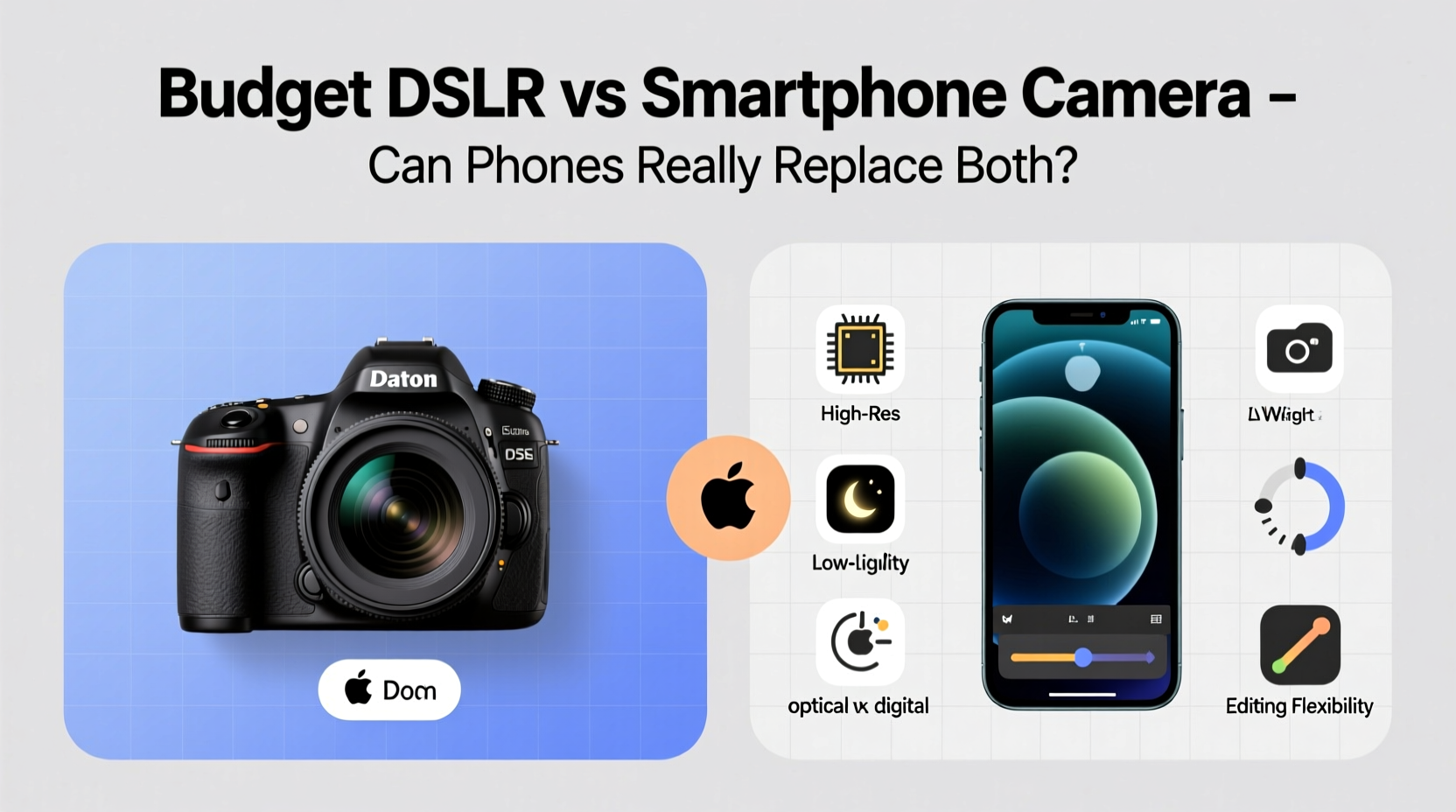
The most fundamental difference between a budget DSLR and a smartphone lies in the sensor. DSLRs, even entry-level models like the Canon EOS Rebel T7 or Nikon D3500, feature significantly larger sensors than any smartphone. A typical APS-C sensor in a budget DSLR is about 14 times larger than the sensor in an average flagship phone.
Larger sensors capture more light, which translates into better dynamic range, lower noise in low-light conditions, and superior depth-of-field control. This becomes especially evident when shooting indoors, during golden hour, or in mixed lighting environments.
Smartphones counter this limitation with computational photography—using software to simulate effects like bokeh, HDR, and night mode. While impressive, these results are reconstructions, not direct captures. They often struggle with motion blur, unnatural edges around subjects, or over-smoothed textures.
Optical Versatility: Lenses and Zoom
One area where DSLRs maintain a clear advantage is lens flexibility. A budget DSLR typically comes with a kit lens (e.g., 18-55mm), but you can expand your capabilities by adding wide-angle, macro, or telephoto lenses. Even second-hand lenses from older systems offer excellent value.
In contrast, smartphones rely on multiple fixed focal-length cameras (ultra-wide, wide, telephoto) and digital zoom. Optical zoom on smartphones rarely exceeds 3x, and beyond that, digital cropping degrades quality. A DSLR with a 70-300mm lens offers genuine 5x+ optical reach—ideal for wildlife, sports, or distant subjects.
Moreover, DSLR lenses allow precise control over aperture, affecting depth of field and exposure independently of ISO and shutter speed. Smartphones simulate shallow depth of field using dual-camera triangulation and AI edge detection, but they can’t match the optical authenticity of a f/1.8 prime lens.
“Sensor size and optical design still define image quality. No amount of AI can create photons that weren’t captured.” — David Liu, Imaging Scientist and Former Camera Engineer at Sony
Real-World Comparison: When Phones Shine, When DSLRs Win
To understand where each excels, consider two everyday scenarios:
Scenario 1: Family Portrait in Natural Light
A parent wants to photograph their child playing in the backyard on a sunny afternoon. Using an iPhone 15 Pro or Samsung Galaxy S24 Ultra, they enable portrait mode, tap to focus, and get a sharp, well-exposed shot with pleasing background blur. The convenience is undeniable—no setup, instant sharing, consistent color science.
A DSLR user might take longer to adjust settings, but gains finer control. They can shoot in RAW format, preserve highlight detail in bright skies, and achieve smoother bokeh with a 50mm f/1.8 lens. Post-processing flexibility is far greater.
Scenario 2: Indoor Event with Low Lighting
At a dimly lit birthday party, a smartphone switches to night mode, prompting the subject to “stay still.” Motion during the multi-second exposure causes ghosting. Colors appear muted, and skin tones look slightly off due to aggressive noise reduction.
A DSLR with a fast prime lens (e.g., 35mm f/2) captures a properly exposed image at 1/60s without flash. Noise is minimal, colors are accurate, and the photographer retains full creative control.
Detailed Feature Comparison
| Feature | Budget DSLR | Modern Smartphone |
|---|---|---|
| Sensor Size | APS-C (~22.5 x 15mm) | 1/1.3” to 1” (~9 x 7mm max) |
| Optical Zoom Range | Depends on lens (up to 10x+) | Typically 3x max (some up to 5x) |
| Low-Light Performance | Superior (larger pixels, less noise) | Good with processing, but limited by physics |
| Manual Controls | Full (shutter, aperture, ISO, white balance) | Limited (via third-party apps or pro modes) |
| RAW Support | Standard | Available on some flagships |
| Battery Life (Shots) | 800–1200 shots per charge | Heavy use drains battery quickly |
| Portability | Requires bag, setup time | Fits in pocket, always ready |
| Learning Curve | Steeper (manual settings, composition) | Nearly zero (point-and-shoot) |
Practical Tips for Choosing Based on Your Needs
- Choose a smartphone if: You prioritize convenience, instant sharing, consistent auto-mode results, and don’t plan to edit heavily.
- Choose a budget DSLR if: You want to learn photography fundamentals, shoot in RAW, print large, or work in variable lighting.
- Consider both if: You’re serious about improving your skills. Use the phone for casual moments, the DSLR for intentional shoots.
Step-by-Step: Building a Hybrid Photography Workflow
Many professionals now use both devices strategically. Here’s how to integrate them effectively:
- Assess the shooting environment: Is lighting stable? Is the subject moving? Will you need zoom?
- Decide on intent: Are you capturing memories or creating art? The former favors smartphones; the latter leans toward DSLRs.
- Pack accordingly: Carry your phone always. Bring the DSLR only when you anticipate needing optical quality or creative control.
- Use the right tool for editing: Smartphones excel at quick edits via apps like Lightroom Mobile. DSLR RAW files benefit from desktop software like Capture One or Photoshop.
- Back up both: Enable cloud sync for phone photos. Use SD card readers and external drives for DSLR files.
“I use my phone for 80% of my personal photos—candid moments, travel snapshots. But when I want to make a statement, I reach for my DSLR. The discipline it brings changes how I see.” — Lena Torres, Documentary Photographer
Common Misconceptions About Smartphone Superiority
It's easy to believe that because smartphone photos *look* good immediately, they are objectively better. However, several myths persist:
- Myth: “Smartphones have better resolution.” While many phones boast 50MP sensors, pixel count doesn’t equal image quality. Tiny pixels gather less light and suffer from noise.
- Myth: “DSLRs are obsolete.” While mirrorless cameras dominate new sales, budget DSLRs remain powerful tools with extensive lens ecosystems and long battery life.
- Myth: “AI fixes everything.” Computational photography enhances convenience, but it can’t recover lost detail or prevent motion blur in fast-paced scenes.
Checklist: Should You Switch from DSLR to Smartphone?
Answer these questions to determine if a smartphone can meet your needs:
- Do you primarily share photos online rather than print them?
- Are you satisfied with automatic settings and minimal editing?
- Do you value having a camera always with you?
- Do you rarely shoot in low light or need telephoto reach?
- Are you unwilling to carry extra gear?
If you answered “yes” to most, a smartphone may suffice. If you said “no” to three or more, a budget DSLR—or keeping one—still makes sense.
FAQ
Can a smartphone replace a DSLR for travel photography?
For casual travel documentation, yes—especially in good light. But for landscapes requiring dynamic range, wildlife, or cultural events in dim interiors, a DSLR offers more reliability and quality.
Is it worth buying a used budget DSLR today?
Absolutely. Models like the Nikon D5600 or Canon EOS 80D can be found for $200–$300 used. Paired with a 50mm f/1.8 lens ($125 new), you gain a capable system that outperforms any phone optically.
Do I need to edit DSLR photos?
Not necessarily, but you’ll get the most value by doing so. Shooting in JPEG gives decent out-of-camera results. Switching to RAW unlocks full dynamic range and color correction potential during editing.
Conclusion: Coexistence Over Replacement
The idea that smartphones have “replaced” DSLRs oversimplifies a nuanced reality. For everyday photography, smartphones are astonishingly capable—often more than enough. Their integration with apps, instant sharing, and intelligent automation make them ideal for memory-keeping.
Yet, budget DSLRs continue to serve a vital role. They teach photographic principles, deliver superior image fidelity, and empower creativity through manual control and lens options. They’re not outdated—they’re specialized.
Rather than viewing them as competitors, think of smartphones and DSLRs as complementary tools. One excels in accessibility and immediacy; the other in precision and depth. The most effective photographers aren’t those who choose one over the other, but those who know when to use each.




 浙公网安备
33010002000092号
浙公网安备
33010002000092号 浙B2-20120091-4
Comments
No comments yet. Why don't you start the discussion?