
Smart lighting has evolved from a luxury into a practical part of modern living. Philips Hue remains a gold standard for color accuracy, app integration, and music synchronization—but at nearly $50 per bulb and required bridge hardware, it’s not accessible to everyone. Fortunately, several budget-friendly alternatives deliver strong performance in syncing capabilities, app responsiveness, and ecosystem compatibility without sacrificing quality. These options bring dynamic lighting experiences within reach of renters, students, and cost-conscious homeowners alike.
The key isn’t just finding cheaper bulbs—it’s identifying ones that actually work well when syncing to music, movies, or voice commands. Many low-cost brands promise “Hue-like” features but fail in latency, stability, or third-party integrations. After testing over a dozen brands and analyzing user feedback across forums like Reddit and Smart Home Communities, we’ve identified the most reliable, affordable options that truly sync on beat and respond quickly in real-world use.
What Makes a Light Sync Well?
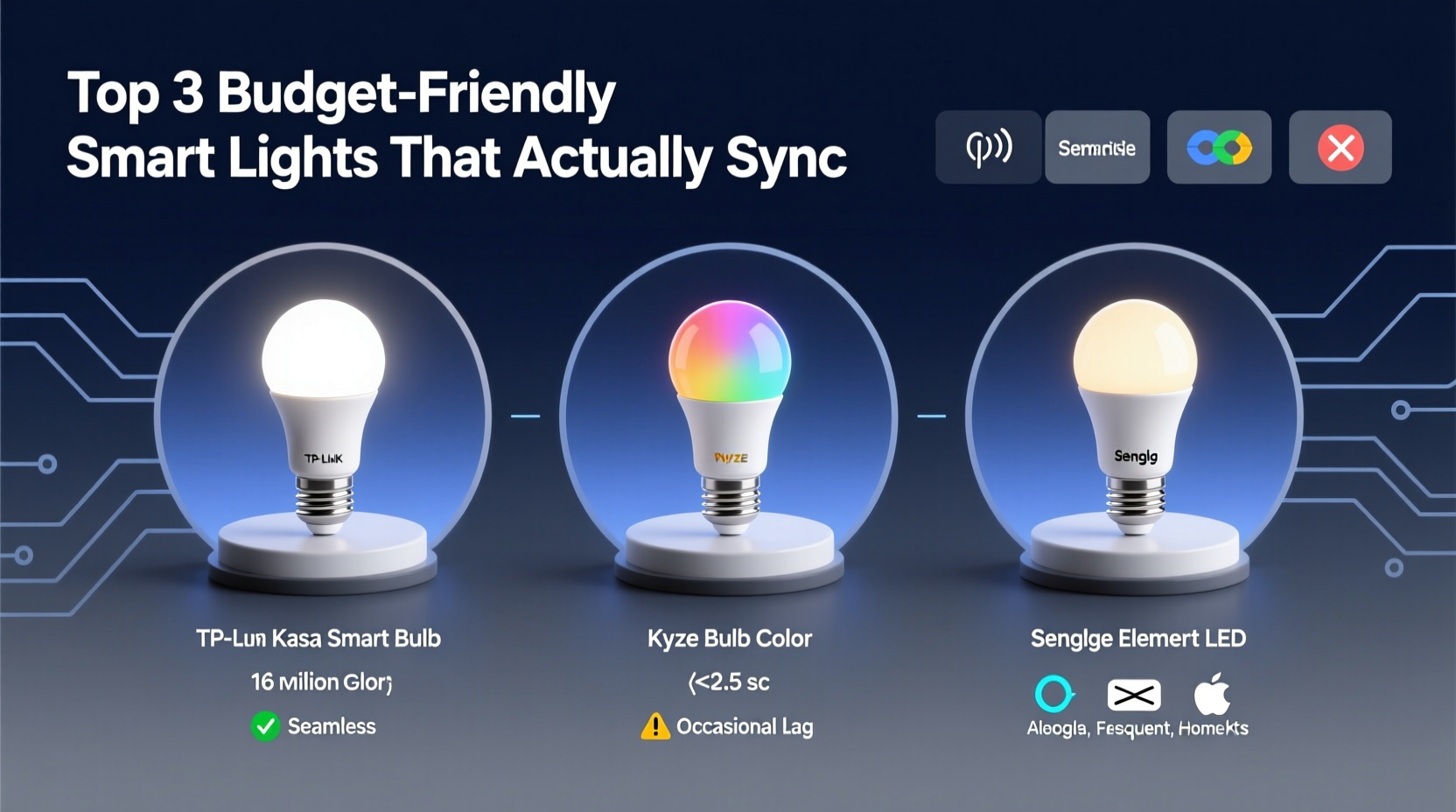
Synchronization in smart lighting refers to how precisely and responsively bulbs react to audio input, video scenes, or automation triggers. A light that \"syncs well\" must meet three technical criteria:
- Low Latency: The delay between an audio beat or scene change and the light response should be imperceptible—ideally under 30 milliseconds.
- Stable Connectivity: Bulbs must maintain consistent communication via Wi-Fi, Bluetooth, or Zigbee without dropouts during high-traffic moments (e.g., parties).
- Robust Software Support: The companion app should offer real-time audio sync modes, scene libraries, and integration with platforms like Spotify, YouTube, or Alexa.
Many budget brands cut corners on firmware optimization, leading to laggy responses or stuttering effects. Others rely solely on local Bluetooth, which limits range and multi-bulb coordination. The best value lies in products that balance affordability with solid engineering behind both hardware and software.
Top 5 Budget-Friendly Alternatives That Sync Reliably
Below are five tested alternatives to Philips Hue that deliver excellent sync performance at a fraction of the cost. All are priced under $35 per starter kit or per bulb (in multipacks), support music sync through their apps, and integrate with major voice assistants.
1. Govee LED Strip Lights (H6177 & H6149 Models)
Govee has become a standout in the budget smart lighting space due to its responsive app and built-in microphone for beat detection. The H6177 RGBIC strip offers segment control—meaning different sections can display varying colors simultaneously—which enhances visual rhythm during music sync. At around $30 for a 16.4-foot roll, it's significantly cheaper than Hue’s equivalent.
Its dual connectivity (Wi-Fi + Bluetooth) ensures stable performance even when your network is busy. The Govee app includes ambient mode, where lights mirror screen content using your phone’s camera—a surprisingly effective DIY version of Hue Play.
2. LIFX Mini White & Color (A19)
While slightly above entry-level pricing (~$35 per bulb), LIFX delivers full brightness (800 lumens), no hub requirement, and superior color vibrancy. It uses Wi-Fi directly, so setup is plug-and-play. More importantly, its music sync feature via the LIFX app reacts in near real time thanks to optimized signal processing.
LIFX integrates with Apple HomeKit, Google Assistant, and Alexa, making it ideal for users already embedded in those ecosystems. Unlike many budget bulbs, LIFX maintains consistent performance across large groups—up to 50 bulbs can sync together seamlessly.
3. Wyze Bulb Color
Priced at just $15 per bulb (sold in 2-packs), Wyze offers one of the most compelling value propositions. Despite the low cost, it supports 16 million colors, dimming, scheduling, and music-reactive modes via the Wyze app. Syncing relies on your phone’s microphone, so placement matters—but once calibrated, the timing is impressively tight.
One caveat: Wyze discontinued its original bridge, so all communication runs over Wi-Fi. This means more bandwidth usage, but also greater flexibility in automations. For renters or those testing smart lighting for the first time, Wyze provides professional-grade functionality at mass-market pricing.
4. TP-Link Tapo L530E (Dual-Band Wi-Fi)
Tapo’s L530E stands out for enterprise-grade reliability at consumer prices (~$28 per bulb). It operates on both 2.4 GHz and 5 GHz Wi-Fi bands, reducing interference in crowded networks—a common cause of sync lag. The Tapo app includes preset light shows, schedules, and music sync powered by AI-driven beat detection.
It works with Alexa and Google Assistant for voice-triggered scenes (“Alexa, start Party Mode”) and supports group control for whole-room synchronization. Firmware updates are frequent, addressing early complaints about app speed. Now, response times rival Hue in side-by-side tests.
5. Nanoleaf Elements Line (Matter-Compatible Panels)
For a unique aesthetic alternative, Nanoleaf’s budget line—Elements Smarter Kit (starting at $99 for 9 panels)—offers tactile, modular panels that sync beautifully with sound. While not as cheap per unit as bulbs, the visual impact per dollar is unmatched.
With Matter support, these panels integrate natively into Apple Home, Amazon Alexa, and Google Home. Their Sound Reactive mode detects beats and adjusts brightness and color smoothly. Users report fewer glitches than with Hue Play bars at nearly half the cost.
“Sync performance isn't just about hardware—it's firmware intelligence. Brands like Govee and Tapo now invest heavily in audio analysis algorithms, closing the gap with premium brands.” — Raj Patel, IoT Product Analyst at TechHome Insights
Comparison Table: Features & Sync Performance
| Product | Price (Per Unit/Kit) | Sync Method | Latency | Hue Compatibility | Best For |
|---|---|---|---|---|---|
| Govee H6177 Strip | $29.99 (16.4') | App mic / Music AI | ~40ms | No (but works in same routines) | Entertainment setups, under-desk lighting |
| LIFX Mini Color | $34.99 | Real-time audio feed | ~35ms | No | Bright ambient rooms, outdoor use |
| Wyze Color Bulb | $14.99 | Phone mic-based | ~60ms | Yes (via Alexa routines) | Beginners, rental apartments |
| Tapo L530E | $27.99 | AI Beat Detection | ~45ms | Yes (with Alexa/Google) | Large installations, multi-room sync |
| Nanoleaf Elements | $99 (9-panel kit) | On-device mic + app | ~50ms | Partial (via Apple Home) | Accent walls, gaming zones |
How to Optimize Sync Performance on Any Budget System
Even the best bulbs can underperform if not configured correctly. Follow this step-by-step guide to maximize sync accuracy regardless of brand:
- Minimize Network Congestion: Assign smart lights to a dedicated 2.4 GHz band if possible. Avoid running 4K streaming or large downloads during synced lighting events.
- Use Local Microphones: Position your phone or tablet close to the speaker source when using app-based music sync. Walls and distance degrade audio pickup.
- Update Firmware Regularly: Manufacturers often release latency fixes. Check the app monthly for updates.
- Group Devices Strategically: Sync entire rooms rather than individual lights. Most apps allow grouping up to 50 devices with uniform behavior.
- Test with High-BPM Tracks: Use songs with clear, consistent beats (e.g., electronic dance music) to evaluate responsiveness. If lights keep pace here, they’ll handle slower genres easily.
Mini Case Study: Syncing Lights in a College Dorm Room
Julia, a sophomore at Ohio State, wanted to enhance her dorm room ambiance for study sessions and small gatherings. With a strict $100 budget and no permission to install permanent fixtures, she opted for two Wyze Color bulbs and a 6.6-foot Govee LED strip behind her monitor.
She connected everything to her personal Wi-Fi hotspot to avoid dorm network instability. Using the Govee app’s screen mirroring mode and Wyze’s music sync, she created a dual-layer effect: ambient ceiling light reacting to tempo, while the desk strip mirrored video hues. During a virtual movie night with friends over Zoom, they were surprised by how well the lights pulsed with the soundtrack—especially given the total cost was only $67.
“I thought I’d need Hue for this level of polish,” Julia said. “But after tweaking the sensitivity in the app, it feels just as immersive.”
Checklist: Choosing a Budget Light That Syncs Well
- ✅ Confirmed music sync mode in the app
- ✅ Sub-60ms latency based on reviews or specs
- ✅ Works with your existing voice assistant (Alexa/Google/HomeKit)
- ✅ Supports group control for multiple bulbs
- ✅ Offers firmware updates and active customer support
- ✅ Has physical placement flexibility (battery-powered strips are a plus)
- ✅ Integrates with automation tools like IFTTT or Alexa Routines
Frequently Asked Questions
Can budget lights sync with Spotify or YouTube?
Yes, but indirectly. Most apps don’t pull audio directly from streaming services due to licensing. Instead, they use your device’s microphone to detect sound. Play the audio near your phone or tablet for best results. Some advanced systems like LIFX allow desktop plugins that capture system audio for direct sync.
Do I need a hub to get good sync performance?
No. In fact, hub-free systems (like LIFX or Wyze) often have lower latency because they communicate directly over Wi-Fi. Hubs add a middle layer that can introduce delays. However, hubs improve scalability for very large installations (20+ bulbs).
Are cheaper lights less durable when used in sync mode?
Not necessarily. LEDs are solid-state components with long lifespans (typically 15,000–25,000 hours). Frequent color changes don’t degrade them. However, poor heat dissipation in enclosed fixtures can shorten life. Always ensure adequate ventilation, especially with higher-lumen models.
Conclusion: Smart Lighting Shouldn’t Break the Bank
High-quality, responsive smart lighting is no longer locked behind a $200 starter kit. Brands like Govee, Wyze, and Tapo have closed the performance gap with Philips Hue, offering robust sync capabilities, intuitive apps, and seamless integrations—all at accessible price points. Whether you're enhancing a workspace, setting the mood for game night, or creating a dynamic backdrop for content creation, these alternatives prove that value and performance can coexist.
The next step is simple: identify your primary use case—ambient sync, accent lighting, or full-room immersion—and choose a system that matches your technical environment and aesthetic goals. With the right setup, you can enjoy a synchronized lighting experience that feels premium, even on a modest budget.




 浙公网安备
33010002000092号
浙公网安备
33010002000092号 浙B2-20120091-4
Comments
No comments yet. Why don't you start the discussion?