
Choosing the right toys for children isn't just about entertainment—it's about laying the foundation for lifelong learning. Two of the most popular developmental tools are building block sets and jigsaw puzzles. Both have long been staples in early childhood education, but they nurture different skills and offer unique advantages. Understanding how each contributes to cognitive, physical, emotional, and social growth can help parents and caregivers make informed decisions tailored to their child’s needs.
Cognitive Development: Problem-Solving and Spatial Reasoning
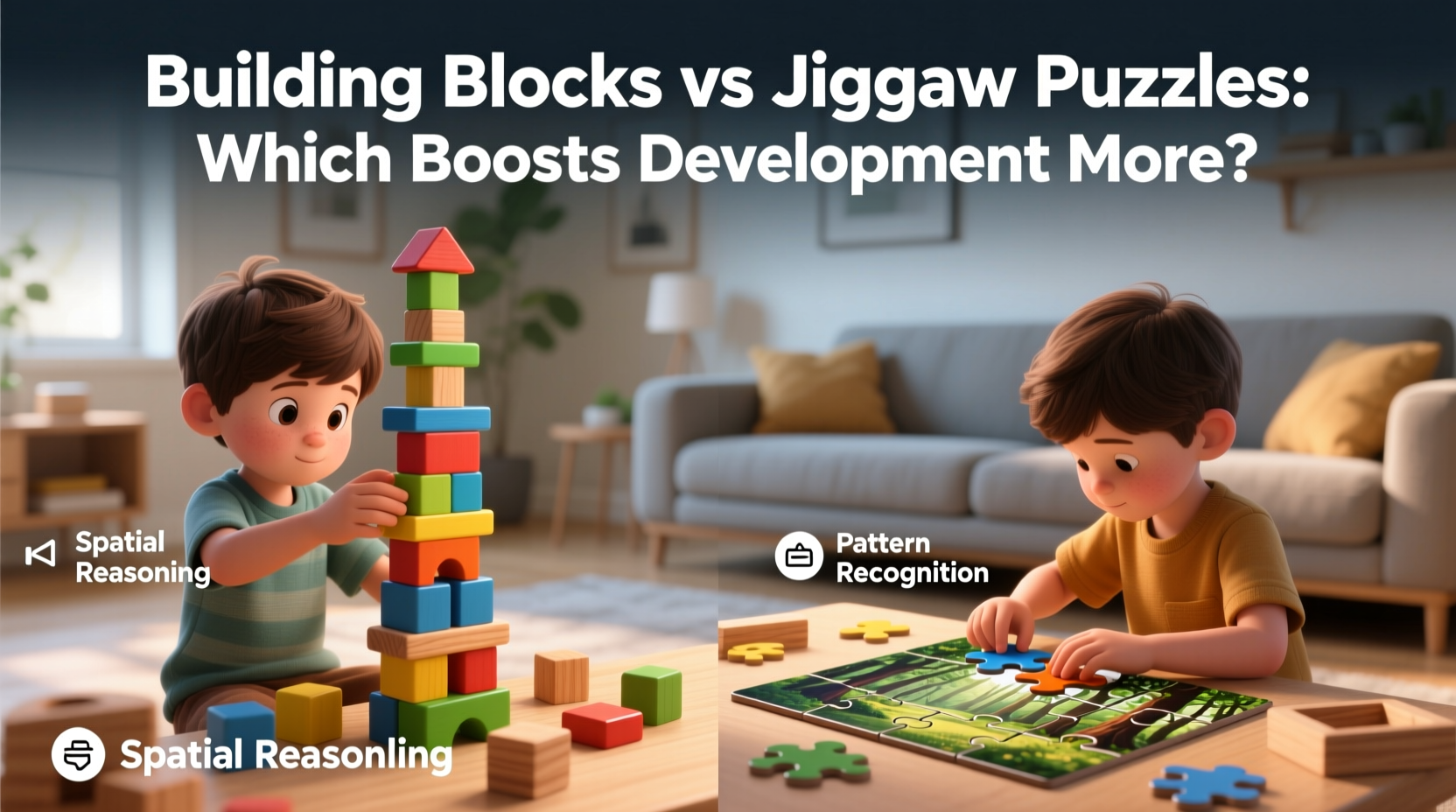
Cognitive growth is a cornerstone of early development, and both building blocks and jigsaw puzzles stimulate the brain in meaningful ways. Jigsaw puzzles require children to analyze shapes, colors, and patterns to find where each piece fits. This process strengthens visual perception, attention to detail, and logical reasoning. Completing a puzzle reinforces goal-oriented thinking—children learn to break down complex tasks into manageable steps, an essential skill for academic success.
Building blocks, on the other hand, promote divergent thinking. Unlike puzzles, which have one correct solution, blocks allow open-ended creation. A child might build a tower one day and a spaceship the next. This flexibility encourages imagination, innovation, and systems thinking. According to Dr. Kathy Hirsh-Pasek, professor of psychology at Temple University and senior fellow at the Brookings Institution:
“Playful learning with materials like blocks activates multiple areas of the brain involved in creativity, problem-solving, and executive function.” — Dr. Kathy Hirsh-Pasek
While puzzles teach linear logic, blocks foster dynamic planning and adaptability—both vital for modern learning environments.
Fine Motor Skills and Hand-Eye Coordination
Physical development is another critical area influenced by play. Jigsaw puzzles demand precision. Picking up small pieces, rotating them, and placing them correctly enhances fine motor control and hand-eye coordination. For younger children, larger knobbed puzzles are designed specifically to support grip strength and finger dexterity.
Building blocks also develop motor skills, but through different actions. Stacking, aligning, balancing, and connecting pieces involve bilateral coordination (using both hands together) and force modulation—learning how much pressure to apply without toppling a structure. These actions mimic real-world engineering challenges and lay groundwork for later tasks like handwriting or using tools.
Social and Emotional Growth Through Play
One often overlooked aspect of toy selection is its impact on emotional intelligence and social behavior. Jigsaw puzzles can be collaborative, especially when completed in groups. Working on a puzzle with siblings or peers teaches turn-taking, patience, and communication. It also provides opportunities to manage frustration—when a piece doesn’t fit, children must regulate emotions and persist.
Building block sets, particularly those used in group settings like classrooms or playdates, naturally encourage cooperative play. Children negotiate roles (“You build the bridge, I’ll make the car”), share resources, and co-create narratives. This kind of socio-dramatic play builds empathy, conflict resolution skills, and leadership qualities.
A mini case study from a preschool in Portland illustrates this well: teachers introduced daily “block time” alongside weekly puzzle sessions. Over three months, they observed that while puzzle time improved focus and individual concentration, block play led to more spontaneous collaboration, verbal negotiation, and sustained imaginative storytelling among students.
Comparative Overview: Strengths and Best Use Cases
The following table summarizes key developmental benefits of each toy type to help guide decision-making based on your child’s age, interests, and current skill level.
| Skill Area | Jigsaw Puzzles | Building Block Sets |
|---|---|---|
| Cognitive Focus | Pattern recognition, sequential logic | Creative problem-solving, spatial planning |
| Motor Development | Fine motor precision, grip control | Bilateral coordination, balance, force control |
| Social Interaction | Turn-taking, shared focus | Collaborative design, role-playing |
| Emotional Regulation | Persistence, managing frustration | Risk-taking, resilience after failure (e.g., tower collapse) |
| Best For Ages | 2–8 (depending on piece count) | 1–10+ (scalable complexity) |
| Learning Style Supported | Structured, convergent thinking | Open-ended, divergent thinking |
How to Choose Based on Your Child’s Needs
There is no universal “better” option—only what suits your child at a given stage. Consider these guidelines when selecting between building blocks and puzzles:
- If your child struggles with attention or gets easily overwhelmed, start with simple puzzles (12–24 pieces) to build confidence and focus.
- If your child loves stories and characters, combine block play with figurines or themed sets (e.g., animals, vehicles) to deepen engagement.
- For children who crave structure, puzzles provide clear goals and measurable completion.
- For those who thrive on invention, blocks offer limitless possibilities and foster intrinsic motivation.
Many experts recommend rotating both types of toys to ensure balanced development. Alternating between focused puzzle time and free-form block building keeps play fresh and targets multiple skill domains.
Step-by-Step Guide: Introducing Blocks and Puzzles at Home
- Assess readiness: Observe your child’s current motor and cognitive skills. Can they pick up small objects? Do they show interest in matching shapes?
- Start simple: Begin with large-piece puzzles (with knobs if needed) and basic stacking blocks.
- Demonstrate briefly: Show how to place a puzzle piece or stack two blocks, then let your child take over.
- Encourage, don’t correct: Praise effort rather than outcome. Say, “I see you’re trying hard to fit that piece,” instead of, “That goes there.”
- Expand gradually: Increase complexity only when your child shows consistent success and interest.
- Integrate into routine: Set aside 15–20 minutes daily for focused play, ideally during calm parts of the day.
Common Questions Parents Ask
Can my child benefit from doing both?
Absolutely. In fact, combining both activities offers the most well-rounded development. Puzzles sharpen analytical thinking, while blocks boost creativity and engineering intuition. Using both helps children become flexible thinkers—capable of following instructions and imagining new solutions.
My child gets frustrated easily with puzzles. Should I stop using them?
Not necessarily. Frustration is part of learning. Instead of removing puzzles, try simplifying them. Use puzzles with fewer pieces, or work on them together. Offer verbal support and model patience. Over time, your child will build tolerance for challenge—a crucial life skill.
Are digital puzzles or apps as effective as physical ones?
Some digital versions can support cognitive skills, but they lack the tactile feedback essential for motor development. Physical manipulation of blocks and puzzle pieces engages more sensory pathways and supports deeper neural connections. Reserve screen-based versions for limited use, especially when traveling.
Action Plan: Building a Balanced Play Environment
- ✔ Include at least one age-appropriate puzzle (start with 6–12 pieces for toddlers)
- ✔ Provide a set of durable building blocks (wooden or interlocking plastic)
- ✔ Rotate toys weekly to maintain interest and prevent overwhelm
- ✔ Store pieces in labeled bins to encourage independence and cleanup habits
- ✔ Join your child in play occasionally to model strategies and strengthen bonding
Final Thoughts
The question isn’t whether building block sets or jigsaw puzzles are better—it’s how to use both to support holistic development. Each has distinct strengths: puzzles cultivate focus, logic, and perseverance; blocks inspire creativity, collaboration, and spatial intelligence. The most effective approach integrates both into a child’s play routine, adapting to their evolving interests and abilities.
Instead of searching for a single “best” toy, focus on creating a rich, responsive play environment where exploration is celebrated. When children feel supported in their efforts—whether fitting the last puzzle piece or rebuilding a fallen castle—they gain not just skills, but confidence.




 浙公网安备
33010002000092号
浙公网安备
33010002000092号 浙B2-20120091-4
Comments
No comments yet. Why don't you start the discussion?