
In today’s digital age, parents face a constant dilemma: should their sons spend more time with building blocks or video games? On one side, traditional toys like LEGO or wooden blocks represent hands-on creativity and tactile learning. On the other, video games offer interactive storytelling, problem-solving challenges, and social connectivity. But amid growing concerns about screen time, many wonder—how harmful is it really? The answer isn’t as black and white as headlines suggest. Understanding the developmental benefits and potential risks of both activities reveals a more nuanced picture.
The Cognitive Value of Building Blocks
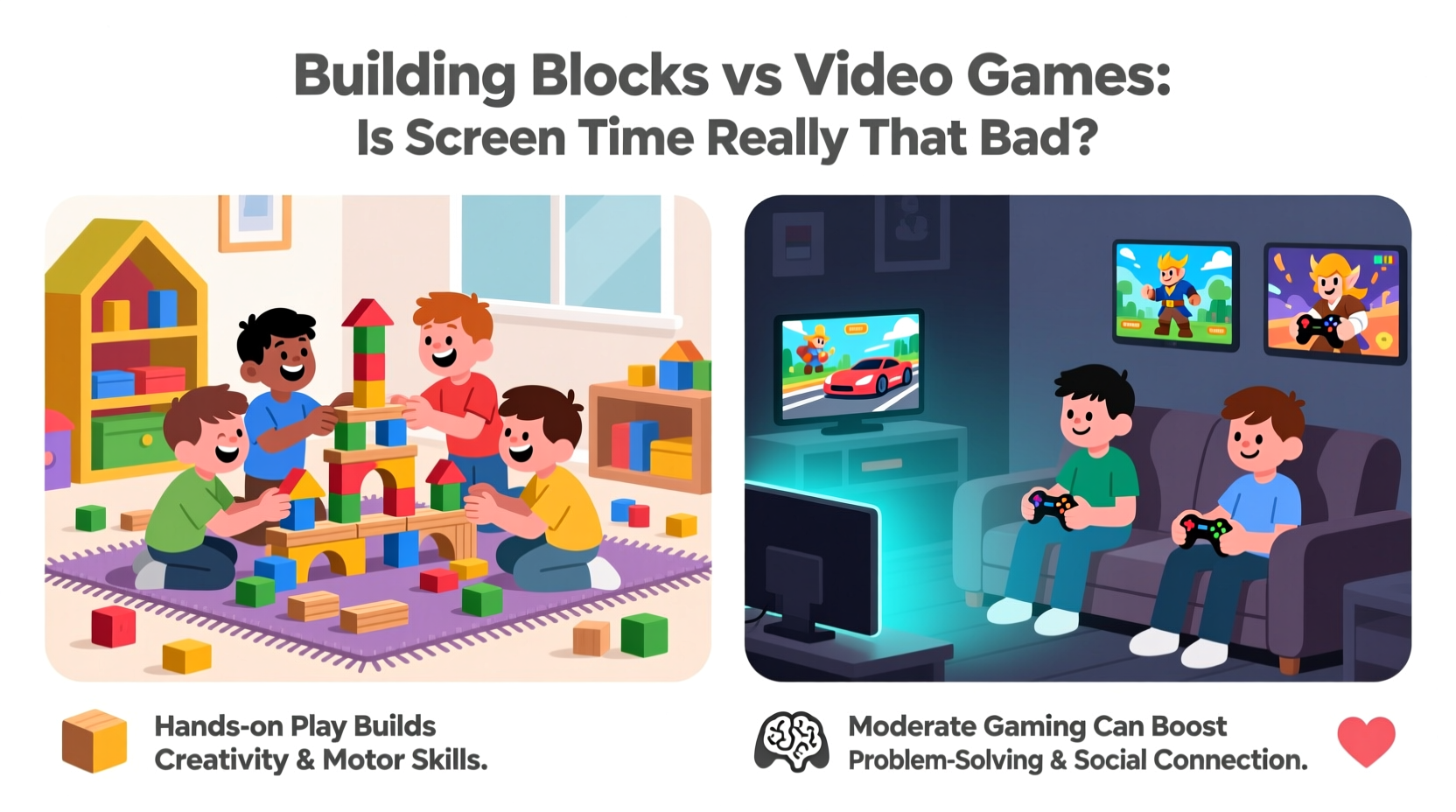
Building blocks have long been celebrated in early childhood education. When children stack, sort, and assemble physical pieces, they engage multiple cognitive domains simultaneously. Spatial reasoning improves as they visualize how parts fit together. Fine motor skills develop through precise hand movements. Language grows when kids narrate their creations or collaborate with peers.
Studies consistently show that block play enhances executive function—the mental skills responsible for planning, focus, and self-control. A 2018 study published in Frontiers in Psychology found that preschoolers who engaged regularly in structured block-building tasks demonstrated stronger working memory and inhibitory control than those who didn’t.
What Video Games Actually Teach Boys
Dismissing video games as mindless entertainment overlooks their complex cognitive demands. Many modern games require strategic planning, resource management, pattern recognition, and rapid decision-making under pressure. Multiplayer titles foster teamwork, communication, and even leadership skills.
Games like Minecraft mirror the creative freedom of building blocks—but in a digital space. In fact, Minecraft Education Edition is used in classrooms worldwide to teach coding, geometry, and collaborative project design. Similarly, puzzle-based games such as Portal enhance logical reasoning and spatial navigation.
“Video games aren’t just about reflexes—they’re dynamic systems that reward persistence, experimentation, and systems thinking.” — Dr. Rachel Kowert, Research Psychologist and Author of *A Parent’s Guide to Video Games*
Comparing Screen Time vs. Hands-On Play: A Balanced View
The debate often centers on “screen time” as if all digital exposure were equal. However, context matters. Passive scrolling through videos differs vastly from actively solving puzzles in an educational game. Likewise, excessive isolation during gameplay raises different concerns than cooperative play with friends online.
Rather than focusing solely on duration, experts emphasize quality, supervision, and balance. The American Academy of Pediatrics recommends consistent limits—no more than one hour per day for children ages 6–12—but also stresses co-engagement: playing together, discussing content, and integrating lessons into real life.
| Aspect | Building Blocks | Video Games |
|---|---|---|
| Sensory Engagement | High (tactile, visual, kinesthetic) | Moderate (visual, auditory) |
| Creativity | Open-ended construction | Limited by software boundaries |
| Social Interaction | In-person collaboration | Online multiplayer options |
| Problem-Solving | Spatial logic, trial-and-error | Strategic planning, quick adaptation |
| Risk of Overuse | Very low | Moderate (if unsupervised) |
A Real-Life Scenario: Two Brothers, Two Approaches
Consider the Johnson family: two sons, aged 8 and 10. Ethan prefers building elaborate cities out of LEGO, spending hours designing roads, buildings, and moving parts. Liam loves playing strategy games like Roblox and Terraria, where he codes simple scripts and builds virtual worlds with friends online.
Their parents initially worried about Liam’s screen use until they observed his projects closely. He was applying math concepts to scale structures, debugging code errors, and scheduling group builds with classmates after school. Instead of restricting him, they set clear boundaries—two hours max on weekends, none during homework—and began joining him occasionally to understand the games better.
Over time, both boys showed strong creative and analytical skills. Their parents realized that engagement mattered more than medium. They now rotate weekly themes: “Maker Week” focuses on physical builds; “Digital Design Week” encourages coding and game-based creation.
How to Create a Healthy Play Balance
Finding harmony between physical and digital play doesn't require eliminating either. Instead, structure can guide healthier habits. Here's a practical step-by-step approach:
- Assess current habits: Track how much time your child spends on screens versus hands-on activities over a week.
- Set consistent limits: Agree on daily or weekly screen allowances based on age and responsibilities.
- Promote hybrid play: Use tech-enhanced building kits (like LEGO Boost) that combine physical assembly with app-based programming.
- Encourage co-play: Join your child in a game or build session to strengthen bonding and monitor content.
- Rotate activity types: Introduce themed weeks or daily switches to prevent overreliance on one form of play.
Essential Checklist for Parents
- ✅ Evaluate the educational value of games—not just entertainment factor
- ✅ Ensure at least one hour of non-screen creative play daily
- ✅ Keep screens out of bedrooms and turn them off one hour before bedtime
- ✅ Discuss online behavior and digital citizenship regularly
- ✅ Prioritize sleep, physical activity, and face-to-face interaction
FAQ: Common Questions About Screen Time and Play
Is any screen time safe for young boys?
Yes—when it’s high-quality, age-appropriate, and supervised. Educational games, interactive e-books, and creative apps can support learning. The key is moderation and engagement. Avoid fast-paced, violent, or overly stimulating content for children under 7.
Can video games improve my son’s social skills?
They can, especially cooperative or team-based games played with known peers. However, passive or competitive-only interactions may not build empathy or communication. Parents should encourage voice chat with friends over solo play and discuss teamwork dynamics afterward.
Are building blocks outdated in a digital world?
No. While digital tools expand possibilities, physical manipulation remains critical for brain development. Tactile feedback strengthens neural pathways linked to fine motor control and spatial intelligence. Combining both forms of play offers the broadest developmental benefit.
Conclusion: It’s Not About Elimination—It’s About Integration
The question isn’t whether building blocks are better than video games, but how both can serve a boy’s growth when used wisely. Physical play grounds imagination in reality; digital play expands access to global ideas and instant feedback. Screen time itself isn’t inherently harmful—it becomes problematic only when it displaces essential experiences like movement, conversation, and unstructured exploration.
Parents don’t need to choose sides. Instead, they can curate a balanced environment where LEGO bricks inspire virtual designs, and game mechanics spark interest in real-world engineering. With mindful guidance, boys can thrive using both tools, developing not just technical skills but emotional resilience, creativity, and adaptability.




 浙公网安备
33010002000092号
浙公网安备
33010002000092号 浙B2-20120091-4
Comments
No comments yet. Why don't you start the discussion?