
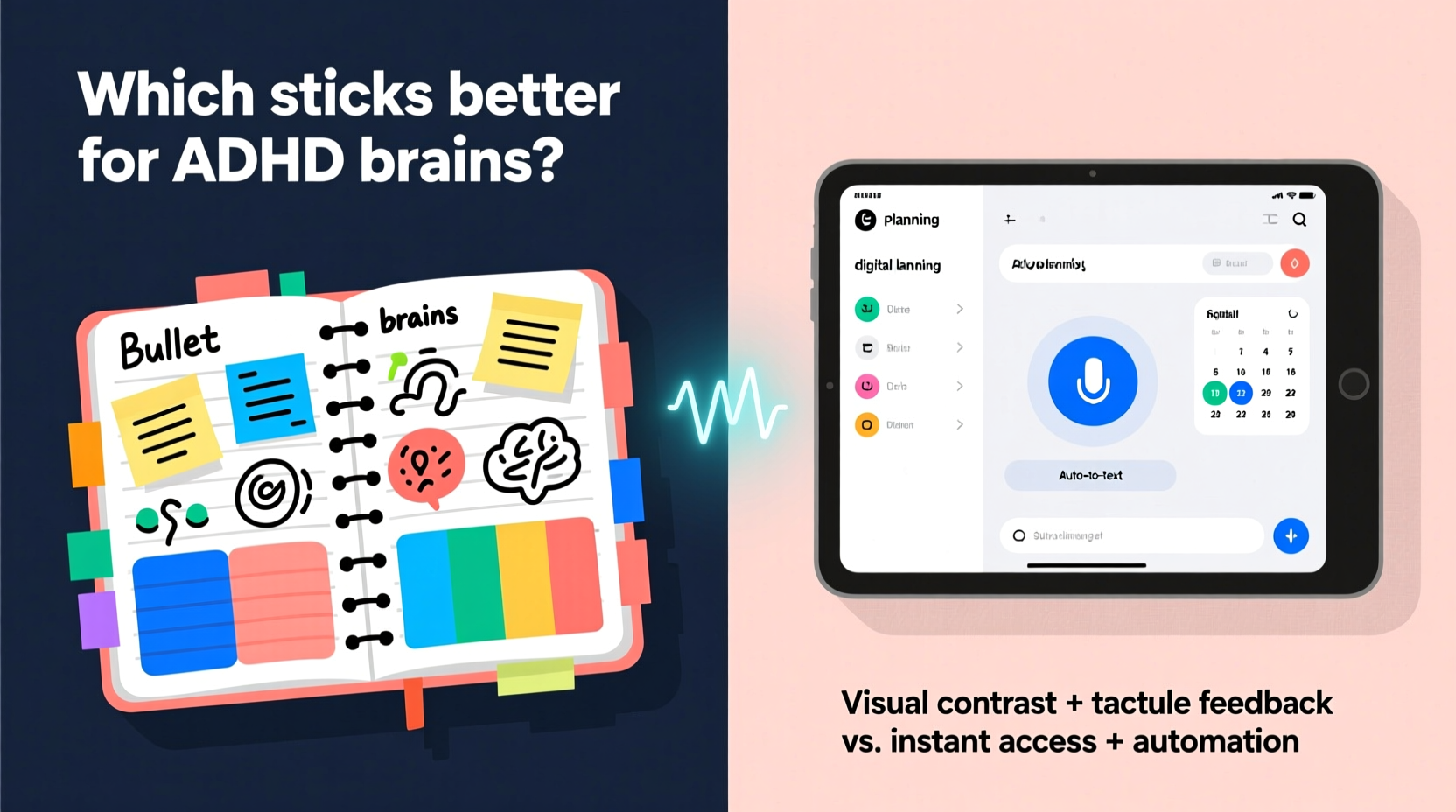
For individuals with ADHD, staying organized isn’t just about productivity—it’s about reducing mental clutter, managing executive dysfunction, and creating systems that actually work with their brain, not against it. Traditional planners often fail because they’re too rigid or impersonal. Enter two popular alternatives: the bullet journal and the digital planner. Both promise flexibility, customization, and structure—but which one truly sticks for ADHD brains?
The answer isn’t universal. It depends on cognitive style, sensory preferences, tech comfort, and how motivation is triggered. Some thrive on tactile feedback and analog creativity; others need push notifications and search functions to stay on track. This article breaks down both tools from an ADHD-informed perspective, comparing functionality, accessibility, and long-term adherence.
Understanding ADHD and Executive Function Challenges
ADHD affects executive function—the brain’s management system responsible for planning, prioritizing, initiating tasks, and sustaining attention. People with ADHD often struggle with:
- Task initiation: Starting projects feels overwhelming, even if the person wants to do them.
- Working memory: Remembering deadlines, appointments, or even what was just decided in a conversation can be difficult.
- Time blindness: Underestimating or misjudging how long tasks take.
- Motivation regulation: Relying on urgency or interest (hyperfocus) rather than routine or responsibility.
- Distractibility: Easily pulled off-task by internal thoughts or external stimuli.
A good planning system must compensate for these challenges—not add more friction. It should be low-effort to maintain, highly visible, and emotionally engaging enough to return to daily. Neither bullet journals nor digital planners are inherently superior; each has strengths that align differently with various ADHD coping strategies.
Bullet Journal: The Analog Advantage
Invented by designer Ryder Carroll, the bullet journal (BuJo) is a customizable analog system combining to-do lists, calendars, habit trackers, and reflection logs—all in one notebook. Its appeal lies in its simplicity and creative freedom.
For many with ADHD, the physical act of writing can enhance retention and engagement. The process of drawing layouts, coloring in trackers, or using colored pens turns planning into a sensory-rich activity that activates different parts of the brain. This kinesthetic element can make the experience feel less like “work” and more like self-expression.
The bullet journal also allows for rapid adaptation. If a weekly spread isn’t working, you can redesign it next week. If you forget to log meals for three days, there’s no app error message—just space to start fresh. This flexibility reduces shame and perfectionism, common barriers for people with ADHD who abandon systems after missing a few entries.
However, the same openness can become a trap. Over-customization—spending hours decorating spreads instead of completing tasks—is a real risk. Known as “BuJo bloat,” this tendency toward aesthetic perfection can derail the core purpose: organization. For some ADHD users, the lack of built-in reminders means tasks simply get written down and forgotten.
“Analog tools give me control over my attention. When I write something down, it feels real. Digital feels temporary.” — Maya T., graphic designer with ADHD
Digital Planners: Structure and Automation
Digital planners—used via tablets, smartphones, or computers—offer features analog systems can’t match: recurring reminders, searchable entries, cloud sync, and integration with calendars and email. Apps like GoodNotes, Notion, or specialized ADHD planners (e.g., Focus Planner) provide templates designed for neurodivergent users.
For those with time blindness or poor working memory, automated alerts are game-changers. A notification popping up 15 minutes before a meeting bypasses the need to remember it exists. Recurring tasks (like “take medication”) reappear automatically, reducing decision fatigue. These nudges help bridge the gap between intention and action—an essential support for ADHD brains.
Digital tools also reduce setup effort. Once a template is created or downloaded, it can be duplicated endlessly. No redrawing lines or fixing mistakes with tape. For someone whose energy fluctuates day to day, this consistency lowers the activation energy needed to open the planner.
But digital systems come with trade-offs. Notifications can become background noise if not managed carefully. Over-reliance on technology means losing access if the device dies or software crashes. And unlike handwriting, typing doesn’t engage motor memory in the same way, which may reduce recall for some users.
Additionally, the infinite scroll and multi-app environment of devices increase distraction risk. Opening a digital planner on a tablet might lead to checking social media instead—a pitfall especially acute for ADHD users prone to context switching.
Comparative Breakdown: Bullet Journal vs Digital Planner
| Feature | Bullet Journal | Digital Planner |
|---|---|---|
| Customization | High—fully hand-drawn, adaptable layouts | High—templates, drag-and-drop, scripting (in advanced apps) |
| Reminders & Alerts | None—relies on user discipline | Yes—push notifications, recurring events |
| Sensory Engagement | High—tactile, visual, kinesthetic | Low to moderate—depends on stylus use |
| Portability | One notebook—light but single point of failure | Device-dependent—can sync across multiple gadgets |
| Error Correction | Harder—crossing out, taping in new pages | Easy—undo, delete, duplicate |
| Searchability | None—manual scanning required | Full text search available |
| Distraction Risk | Low—no internet, no notifications | High—if used on connected devices |
| Setup Time | High—requires drawing each week | Low—templates auto-generate |
Real-World Example: Two ADHD Users, Two Systems
Jamie, 32, freelance writer: Struggled with missed deadlines and chaotic project tracking. Tried a bullet journal for six months but found that without reminders, assignments slipped through. Switched to a digital planner in Notion with linked databases, automated due dates, and color-coded priorities. Now uses daily check-in templates and integrates client calendars. Reports a 70% improvement in on-time delivery.
Lena, 28, art therapist: Felt overwhelmed by screen fatigue and digital overload. Used Google Calendar and task apps but rarely looked at them. Adopted a minimalist bullet journal with only three sections: Today’s Tasks, Weekly Goals, and Gratitude. Draws everything in bright markers and keeps the journal on her nightstand. Says the ritual of evening review helps her wind down and plan mindfully. Has used the same system for over a year.
Their experiences highlight a key insight: sustainability matters more than sophistication. What works isn’t the most advanced tool, but the one you consistently use.
Actionable Tips for Choosing Your System
- Assess your attention triggers: Do you respond better to visual beauty (analog) or timely alerts (digital)?
- Test both for two weeks: Use a cheap notebook for BuJo and download a free digital planner. Track which one you open more often.
- Minimize friction: Keep your journal within arm’s reach or pin the app to your home screen.
- Use hybrid approaches: Some use a bullet journal for long-term goals and mood tracking, while relying on digital tools for appointments and reminders.
- Build in accountability: Share progress with a coach or friend weekly to increase follow-through.
Expert Insight: What Neuroscience Suggests
“The act of handwriting engages the brain’s reticular activating system, which helps prioritize information. For ADHD, this physical encoding can improve intention retention.” — Dr. Alan Chen, Cognitive Neuroscientist specializing in executive function
Research supports that writing by hand enhances memory and comprehension compared to typing. However, digital tools excel in offloading working memory—critical for ADHD where mental RAM is limited. The optimal solution may lie in leveraging both: using handwriting for reflection and goal-setting, and digital tools for scheduling and reminders.
Frequently Asked Questions
Can I combine a bullet journal and digital planner?
Absolutely. Many successful ADHD organizers use a hybrid model. For example, keep a bullet journal for habit tracking and brainstorming, while syncing appointments and deadlines to a digital calendar. The key is ensuring both systems complement rather than duplicate each other.
Why do I keep abandoning my planner after a few days?
This is common with ADHD. Often, the system requires too much upfront effort or doesn’t align with your natural rhythms. Try scaling back: instead of a full weekly spread, start with a simple “Top 3 Tasks” list each morning. Reduce the barrier to entry so consistency becomes possible.
Are printable digital planners better than apps?
Printable PDF planners (used in annotation apps like GoodNotes) offer the best of both worlds: digital convenience with handwriting benefits. They allow you to write with a stylus while gaining searchability and backup. For ADHD users seeking tactile engagement without paper clutter, this format is increasingly popular.
Conclusion: Choose What Sticks, Not What’s Trendy
The question isn’t whether bullet journals or digital planners are objectively better for ADHD—it’s which one you’ll actually use. Sustainability trumps sophistication every time. A beautifully decorated journal abandoned after a week does less good than a basic checklist app opened daily.
Consider your lifestyle, energy patterns, and sensory needs. Test both options honestly. Be willing to iterate, simplify, and even mix formats. The goal isn’t perfection; it’s progress. With ADHD, consistency is rare and valuable. Any system that helps you show up for yourself—even imperfectly—is worth keeping.




 浙公网安备
33010002000092号
浙公网安备
33010002000092号 浙B2-20120091-4
Comments
No comments yet. Why don't you start the discussion?