
In a world where time feels increasingly scarce, many people turn to organizational tools to regain control of their days. Two of the most popular systems—bullet journals and traditional planners—offer distinct approaches to managing tasks, habits, and goals. While both aim to boost productivity, they do so in fundamentally different ways. Choosing between them isn’t about which is objectively better, but which aligns more closely with your personality, workflow, and long-term habits.
This article breaks down the strengths and limitations of each system, compares their impact on daily productivity, and provides actionable insights to help you decide which method will serve you best—or whether a hybrid approach might be ideal.
The Core Philosophy Behind Each System
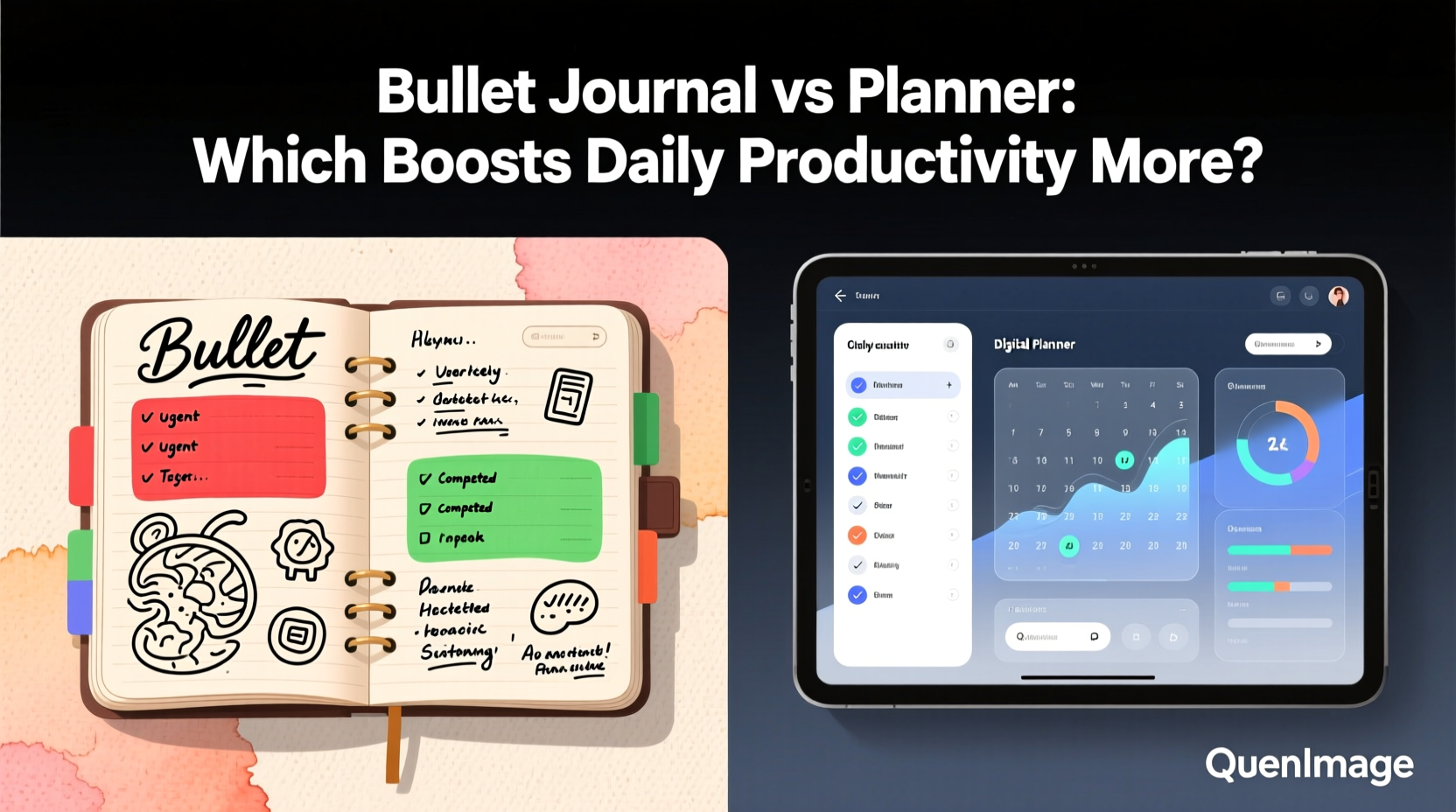
Understanding the foundational principles of bullet journals and planners is essential to evaluating their effectiveness.
Bullet journals, created by designer Ryder Carroll, are built on intentional design and mindfulness. The system uses rapid logging—a method of capturing tasks, events, and notes with minimal formatting—to reduce cognitive load while encouraging reflection. It emphasizes customization, allowing users to create layouts that evolve with their needs, from habit trackers to future logs and goal-setting spreads.
In contrast, planners are typically pre-designed, offering a fixed structure with daily, weekly, and monthly pages. They cater to those who prefer guided organization, often including prompts, time-blocking sections, motivational quotes, or even gratitude spaces. Planners save time on setup but offer less room for personalization.
The key difference lies in flexibility versus convenience. Bullet journals require upfront effort but adapt infinitely; planners demand little setup but may not grow with your changing priorities.
Comparing Productivity Impact: Structure vs. Adaptability
Productivity isn’t just about getting things done—it’s about doing the right things consistently. How each system supports this goal varies significantly.
| Feature | Bullet Journal | Traditional Planner |
|---|---|---|
| Customization | High – fully customizable layouts | Low – fixed format |
| Setup Time | Moderate to high (requires drawing) | Low (ready to use) |
| Mindfulness & Reflection | Strong emphasis on reviews and intentionality | Limited unless user adds reflections |
| Habit Tracking | Flexible and visual (user-designed) | Often included, but rigid in layout |
| Adaptability Over Time | Excellent – evolves with user needs | Poor – same structure year-round |
| Portability & Accessibility | Depends on notebook choice | Generally compact and standardized |
The bullet journal excels when users need a dynamic system that reflects shifting priorities. For example, someone transitioning from academic study to freelance work can redesign their spreads to track client hours, income, and project timelines without buying a new planner. This adaptability reduces friction in maintaining the system over time.
Planners, however, shine in consistency. Because they’re ready to use out of the box, they lower the barrier to entry. A busy professional juggling meetings and deadlines may find comfort in opening a page already divided into hourly blocks, eliminating decision fatigue about how to organize their day.
Real-World Example: Sarah’s Shift from Planner to Bullet Journal
Sarah, a marketing consultant, used a premium weekly planner for two years. At first, it helped her manage client calls and project deadlines. But as her workload diversified—adding content creation, team mentoring, and personal development goals—she found herself scribbling extra lists on sticky notes, taping pages together, and skipping weekly reviews because the planner didn’t accommodate her evolving needs.
After researching alternatives, she adopted a bullet journal. She started with basic future, monthly, and daily logs. Within weeks, she added a habit tracker for exercise and meditation, a project dashboard for ongoing campaigns, and a gratitude log. The ability to audit what was working—and remove what wasn’t—gave her greater clarity.
“I was productive before,” Sarah said, “but I wasn’t intentional. The bullet journal made me think about why I was doing things, not just crossing them off.” Her daily productivity didn’t increase in volume, but its quality improved dramatically. She spent less time reacting and more time planning proactively.
This case illustrates a common pattern: planners support short-term efficiency, while bullet journals foster long-term effectiveness through reflection and iteration.
Expert Insight: What Cognitive Science Says About Organization Tools
Dr. Linda Ramirez, a cognitive psychologist specializing in attention and executive function, explains:
“Systems that engage active recall and metacognition—like reviewing past entries or designing custom trackers—strengthen neural pathways associated with planning and self-regulation. The act of writing and reorganizing information in a bullet journal isn’t just administrative; it’s a form of mental rehearsal.”
She notes that pre-filled planners can lead to passive engagement. Users may treat them like checklists rather than thinking tools. In contrast, the deliberate nature of bullet journaling encourages deeper processing of tasks, increasing the likelihood of follow-through.
However, she cautions against overcomplication: “A beautifully illustrated spread that takes an hour to design defeats the purpose if it delays actual work. Productivity tools should reduce cognitive load, not add to it.”
This insight underscores a critical point: the most effective system is one that balances structure with usability. Aesthetic appeal matters only if it serves function.
Step-by-Step Guide: Choosing and Implementing Your System
Follow this five-step process to determine which system will improve your daily productivity more.
- Assess Your Natural Tendencies
Are you highly structured or more spontaneous? Do you enjoy crafting and creativity, or do you prefer efficiency and simplicity? Honest self-evaluation helps match your personality to the right tool. - Define Your Primary Goals
Is your main objective task completion, time management, habit formation, or goal tracking? Planners work well for time-based scheduling; bullet journals excel at integrating multiple objectives into one cohesive system. - Test Each System for Two Weeks
Use a blank notebook to simulate a simple bullet journal (include task list, event log, and habit tracker). Simultaneously, try a standard planner (paper or digital). Track which one you open more frequently and which leaves you feeling more in control. - Evaluate Maintenance Effort
At the end of each week, ask: Did I dread updating this system? Did I skip days because it felt burdensome? A system that feels like a chore won’t last. - Optimize or Hybridize
If neither option feels perfect, consider combining them. Use a planner for calendar appointments and a bullet journal for goal tracking and brainstorming. Many high-performers use both—one for logistics, the other for strategy.
Common Pitfalls to Avoid
- Overdesigning spreads – Spending more time decorating than acting on tasks undermines productivity.
- Rigid adherence to a system – No tool is sacred. If it’s not serving you, modify or replace it.
- Neglecting review cycles – Weekly and monthly reviews are crucial in bullet journals. Skipping them leads to clutter and lost momentum.
- Using a planner as a storage bin – Planners filled with unprocessed notes and outdated tasks become counterproductive.
- Switching too often – Constantly changing systems prevents habit formation. Give each method at least 30 days before deciding.
Frequently Asked Questions
Can a digital planner replace a bullet journal?
Some digital tools—like Notion, GoodNotes, or OneNote—can replicate bullet journal functionality with added benefits like searchability and backups. However, they may lack the tactile mindfulness of handwriting. Digital versions suit tech-oriented users, but research suggests writing by hand enhances memory and focus.
Do I need artistic skills to use a bullet journal?
No. While Pinterest and Instagram showcase artistic spreads, the core system relies on symbols (• for tasks, ○ for events, – for notes) and clean organization. Functionality trumps aesthetics. Simple lines, boxes, and bullet points are all you need.
Which system is better for students?
It depends on the student. High schoolers with structured schedules may benefit from a planner’s clear layout. College students managing independent projects, research, and extracurriculars often gain more from a bullet journal’s flexibility. Many successful students use a planner for class times and a bullet journal for assignment tracking and exam prep timelines.
Checklist: Is Your System Working?
Use this checklist monthly to evaluate your organizational tool:
- ✅ I open it every day without resistance
- ✅ My tasks are up to date and prioritized
- ✅ I conduct weekly reviews to migrate unfinished items
- ✅ I feel more focused and less overwhelmed
- ✅ I’ve customized it to fit my current life demands
- ✅ It takes less than 10 minutes daily to maintain
If three or more items are unchecked, it’s time to reassess your approach.
Conclusion: Choose Intention, Not Just Efficiency
When comparing bullet journals and planners, the real question isn’t just which improves daily productivity more—but which helps you build a more intentional life. A planner can make you efficient. A bullet journal can make you effective.
Efficiency is completing tasks quickly. Effectiveness is ensuring those tasks align with your values and long-term vision. The bullet journal, with its built-in reflection and customization, nudges users toward the latter. But if a planner keeps you consistent and stress-free, it’s still a win.
The best system is the one you’ll use consistently—not the one that looks best on social media or fits someone else’s routine. Experiment honestly, measure results, and remember: productivity is personal.




 浙公网安备
33010002000092号
浙公网安备
33010002000092号 浙B2-20120091-4
Comments
No comments yet. Why don't you start the discussion?