
For people with racing thoughts, creative impulses, and minds that jump from idea to idea, staying organized can feel like trying to catch smoke. Traditional planners often fail because they impose rigid structures that don’t adapt to chaotic thinking patterns. On the other hand, bullet journals promise freedom—but without guidance, that freedom can become overwhelming. The real question isn’t just about organization; it’s about finding a system that works *with* a messy mind instead of against it.
The debate between bullet journals and pre-made planners isn’t about which is universally better—it’s about compatibility. For messy thinkers, the right choice depends on how their brain processes information, what kind of structure they need (if any), and how much mental energy they’re willing to invest in maintaining a system. Let’s break down both options to see which truly supports clarity without stifling creativity.
Understanding the Messy Thinker’s Mind
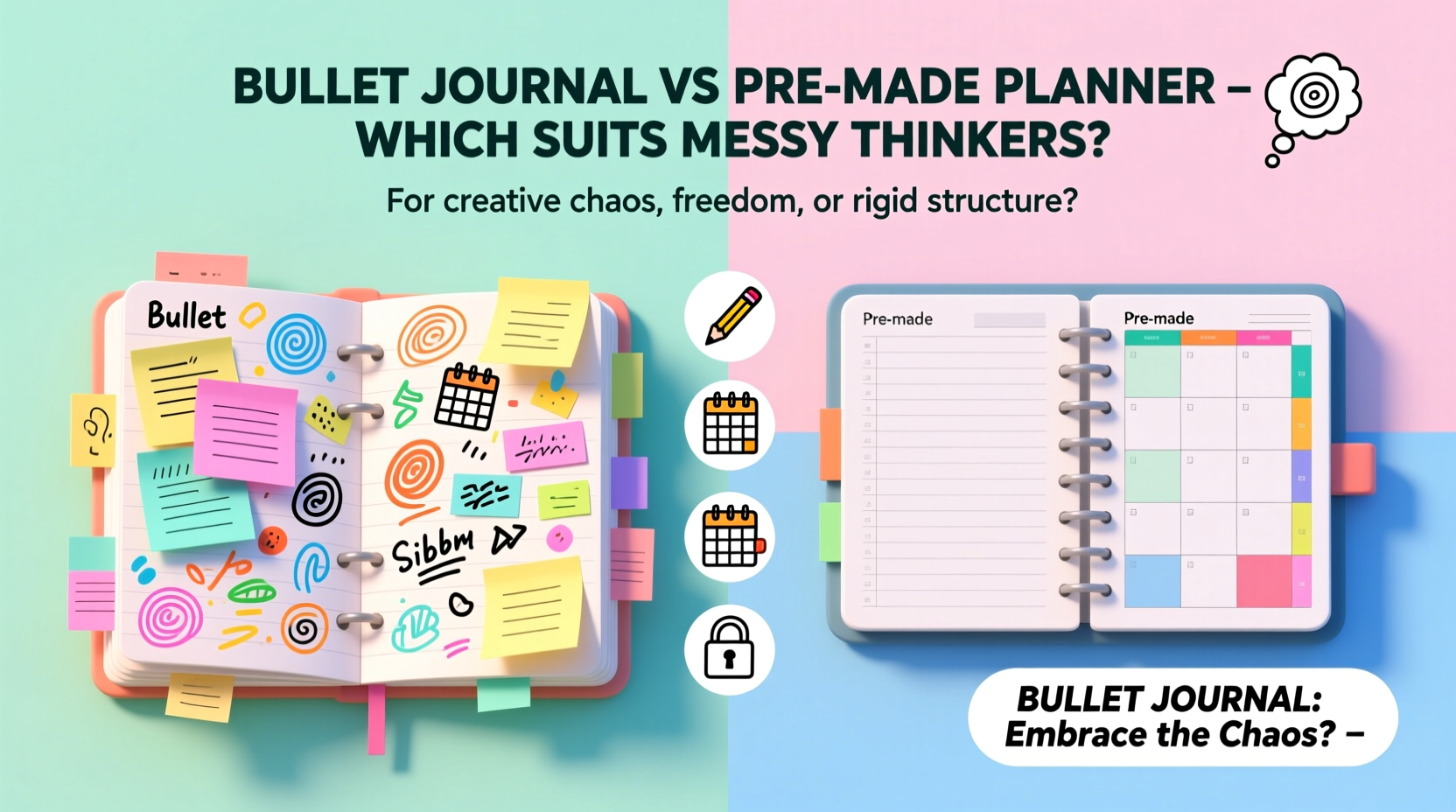
Messy thinkers aren’t disorganized by nature—they’re differently organized. Their brains thrive on nonlinear connections, sudden insights, and bursts of productivity followed by periods of mental stillness. They often have multiple projects running at once, ideas scribbled on napkins, and to-do lists scattered across apps and sticky notes. What they lack isn’t motivation or intelligence—it’s a container that reflects how their mind actually works.
A good planning system for a messy thinker must do three things: capture fleeting thoughts quickly, allow for fluid reorganization, and reduce decision fatigue. Too much rigidity leads to abandonment; too much openness leads to chaos. This is where the bullet journal and pre-made planner diverge—and why one might serve better than the other depending on individual needs.
“Structure isn’t the enemy of creativity—it’s the scaffold that lets it rise.” — Dr. Lena Torres, Cognitive Psychologist
How Bullet Journals Work—And Where They Fall Short
Invented by designer Ryder Carroll, the bullet journal is a customizable analog system built around rapid logging, migration, and indexing. At its core, it’s a blank notebook transformed into a personal organizational tool using symbols, collections, and intentional design. Its strength lies in adaptability: users create layouts as needed, track habits, log moods, manage tasks, and even plan long-term goals—all in one place.
For messy thinkers, this flexibility can be liberating. There’s no pressure to fill predefined boxes. If an idea strikes at 2 a.m., it can go straight into the journal without worrying about format. Collections—custom lists like “Books to Read” or “Side Hustle Ideas”—can evolve over time, mirroring the way a scattered mind connects concepts.
But the same freedom becomes a liability when consistency falters. Because bullet journals require ongoing maintenance—setting up monthly spreads, migrating unfinished tasks, designing new pages—they demand cognitive effort. For someone already battling mental clutter, spending 30 minutes every Sunday setting up a spread can feel like another chore, not a solution.
The Case for Pre-Made Planners: Structure Without Sacrifice
Pre-made planners offer a fixed layout: dated pages, designated sections for goals, priorities, notes, and schedules. They come ready to use, requiring minimal setup. Brands like Passion Planner, Full Focus Planner, or Panda Planner provide guided frameworks that prompt reflection, goal-setting, and daily prioritization.
For messy thinkers, this built-in scaffolding reduces the burden of decision-making. Instead of asking, “What should I track today?” the planner asks, “What are your top three priorities?” That subtle shift—from creation to response—can make all the difference when mental bandwidth is low.
Many modern planners also include space for weekly reviews, gratitude logs, and quarterly goal tracking, encouraging habits that support long-term clarity. Because everything has a place, there’s less risk of losing important ideas in the shuffle. You don’t need artistic skill or planning experience—just the willingness to show up and write.
However, pre-made planners aren’t perfect. Their rigidity can frustrate highly creative individuals who want to experiment with formats. If you hate being told where to write what, a structured planner may feel suffocating. And if you fall behind, blank future pages can become guilt triggers rather than tools.
Comparing Key Features: Bullet Journal vs Pre-Made Planner
| Feature | Bullet Journal | Pre-Made Planner |
|---|---|---|
| Setup Time | High – requires weekly/monthly prep | Low – open and use |
| Customization | Full control over design and function | Limited to provided sections |
| Cognitive Load | Higher – constant decisions required | Lower – prompts guide usage |
| Portability | High – choose any notebook | Medium – size varies by brand |
| Best For | Creative experimenters, visual thinkers | Goal-oriented doers, busy professionals |
Real Example: From Overwhelm to Clarity
Sarah, a freelance writer and illustrator, used to keep seven different notebooks—one for client work, one for story ideas, one for grocery lists, and so on. Her desk was a mosaic of sticky notes, half-finished sketches, and urgent reminders. She tried a bullet journal twice but abandoned it each time after two weeks. “I spent more time drawing cute headers than writing,” she admitted. “It felt like homework disguised as art.”
Then she switched to a pre-made Full Focus Planner. The first week was awkward—she wasn’t used to having only three priority slots per day. But within a month, she noticed something: she was completing tasks instead of just listing them. The planner’s built-in review sections helped her spot patterns (“I always skip Mondays”) and adjust accordingly. Most importantly, she didn’t have to think about how to use it—just show up and respond.
After six months, Sarah reintroduced elements of bullet journaling—specifically, rapid logging for random ideas and a dedicated “Inspiration Bank” collection. But now, she did it selectively, inside her existing planner. “The structure gave me breathing room,” she said. “Now I can be messy *within* order, not instead of it.”
Hybrid Approach: Best of Both Worlds?
What if you don’t have to choose? Many messy thinkers find success with a hybrid model: using a pre-made planner as their primary organizational hub while incorporating bullet journal techniques for flexibility.
This means keeping the daily/weekly framework of a structured planner but adding custom bullet journal-style pages for specific needs—like a project tracker, habit grid, or brain dump section—at the back. Some even use a separate small notebook solely for spontaneous ideas, reviewing and transferring key points to the main planner during weekly reflections.
The hybrid method balances ease of use with personalization. It reduces setup time while preserving space for creativity. It also allows for gradual evolution—start with a fully pre-made planner, then add bullet journal elements as confidence grows.
Step-by-Step: Building Your Hybrid System
- Choose a pre-made planner that aligns with your lifestyle (daily, weekly, or monthly layout).
- Use it as-is for 30 days to build the habit of consistent use without customization pressure.
- Identify gaps during your monthly review—what are you tracking elsewhere? What feels missing?
- Add one bullet journal element (e.g., a habit tracker or mood log) using blank pages or inserts.
- Review every 4–6 weeks—keep what works, remove what doesn’t.
FAQ: Common Questions from Messy Thinkers
Can I use digital tools instead?
Absolutely. Apps like Notion or Obsidian allow for bullet journal-style organization with searchability and backups. However, many messy thinkers benefit from handwriting—it slows down thought processing and improves memory retention. Try both and see what clears your mental fog faster.
I keep abandoning my planner. Why?
Most abandonment happens due to mismatched expectations. If your planner demands more effort than your current energy levels allow, it becomes a source of guilt. Switch to a lower-friction system—even a simple notebook with “Today’s 3 Priorities” at the top of each page—until consistency builds.
Do I need to be artistic to use a bullet journal?
No. While Pinterest shows elaborate spreads with watercolors and calligraphy, the original bullet journal system is minimalist. Symbols (• for tasks, ○ for events, – for notes) and clean lists are all you need. Decorations are optional, not required.
Checklist: Choosing Your Ideal Planning System
- ✅ Assess your current mental bandwidth—do you have energy for weekly setup?
- ✅ Decide whether you prefer guided prompts or total freedom.
- ✅ Consider portability and durability—will you carry it daily?
- ✅ Test one system for 30 days without customization.
- ✅ Evaluate based on actual usage, not aesthetic appeal.
- ✅ Allow room for iteration—your needs will change over time.
Conclusion: Your Mind Deserves the Right Container
There’s no universal answer to whether a bullet journal or pre-made planner is better for messy thinkers. The truth is, the best system is the one you’ll actually use—not the one that looks best in photos or sounds most impressive in theory. For some, the blank canvas of a bullet journal unlocks focus through creation. For others, the gentle guidance of a pre-made planner provides the stability needed to think clearly.
The goal isn’t perfection. It’s progress. It’s capturing that midnight idea without losing sleep. It’s finishing a project because your planner reminded you it mattered. It’s giving your chaotic brilliance a place to land, grow, and make sense.
Start where you are. Use what works. Tweak it often. Your mind doesn’t need fixing—it needs the right container. Find it, fill it, and watch what unfolds.




 浙公网安备
33010002000092号
浙公网安备
33010002000092号 浙B2-20120091-4
Comments
No comments yet. Why don't you start the discussion?